
Quick Summary: AI-powered product identification transforms retail operations by enabling instant recognition of products through computer vision, reducing checkout friction, automating inventory management, and delivering real-time shelf insights. Retailers implementing these systems see improved accuracy in stock tracking, faster customer experiences, and actionable data for better merchandising decisions.
Retail has always been about knowing what’s on your shelves, what’s moving, and what customers want. But manual tracking, human error, and delayed data have kept retailers one step behind.
AI-powered product identification changes that equation. Computer vision systems now recognize products instantly, whether they’re sitting on shelves, passing through checkout, or appearing on a receipt photo.
The tech isn’t futuristic anymore. It’s deployed today, processing hundreds of thousands of SKUs in real time. Retailers implementing AI-based solutions are seeing measurable improvements in conversion rates and inventory accuracy.
What Makes AI Product Identification Different
Traditional barcode systems require line-of-sight scanning. Someone—a cashier, a stock clerk, a field rep—needs to point a scanner at each barcode. That works, but it’s slow. And it breaks down when products are obstructed, poorly positioned, or missing labels.
AI product identification uses computer vision. Cameras capture images, deep learning models analyze them, and the system identifies products based on visual features—shape, color, packaging, text, logos. No barcode needed.
Here’s what that enables:
- Recognition even when products are partially obscured or at odd angles
- Handling of large product catalogs—hundreds of thousands of items
- Zero-shot enrollment, where new products are added from a single catalog image in seconds
- Continuous monitoring of shelf conditions without human intervention
Computer vision doesn’t just identify products. It generates structured data about placement, availability, compliance, and shopper behavior that traditional systems miss entirely.
How the Technology Actually Works
At the core, AI product identification relies on convolutional neural networks trained on massive image datasets. The system learns to distinguish visual features that differentiate one product from another.
Real talk: the training phase is where the heavy lifting happens. Models need thousands of images per product—different angles, lighting conditions, backgrounds—to achieve reliable accuracy.
Once trained, the model converts each product image into a feature vector—a mathematical representation of its visual identity. When a new image comes in, the system extracts its features and searches a vector database for the closest match.
That search happens in milliseconds. The result? Product name, SKU, price, category, and any other metadata attached to that item in the catalog.
The Role of Camera Hardware
Not all cameras are equal. Off-the-shelf cameras work for simple setups—affordable, easy to install, compatible with existing infrastructure. But they lack specialized features needed for complex retail environments.
Specialized cameras handle low light, odd angles, and fast-moving objects better. They’re built for the chaos of real stores where products get shoved around, stacked haphazardly, and partially hidden behind shelf tags.
| Camera Type | Best For | Limitations |
|---|---|---|
| Off-the-Shelf | Simple environments, budget deployments | Lower accuracy in poor lighting or clutter |
| Specialized Retail | High-SKU stores, complex shelf setups | Higher upfront cost, installation complexity |
| Mobile Device | Field teams, audits, receipt scanning | Requires user action, not continuous monitoring |
Mobile apps turn smartphones into product recognition tools. Field sales teams snap a photo, and the system identifies every product in frame, checking planogram compliance or capturing shelf share data in seconds.
Smart Shelves and Automated Inventory
Smart shelves embed cameras directly into retail fixtures. Products sit on shelves as usual, but now those shelves monitor themselves.
The system knows what’s there, how much is there, and when stock drops below threshold levels. Retailers get real-time alerts when products need restocking or when shelf layouts deviate from planograms.
Deep learning models control inventory tracking with accuracy that manual counts can’t match. Stock discrepancies drop. Out-of-stock situations get flagged before customers notice.
And here’s the thing—smart shelves don’t just count. They analyze placement. Are premium products at eye level? Is competitor placement encroaching on your brand’s shelf space? Are promotional end caps set up correctly?
That’s data retailers used to gather with clipboards and spreadsheets. Now it’s automatic, continuous, and structured.
Receipt Scanning and Purchase Intelligence
Receipt scanning turns crumpled paper receipts into structured purchase data. Shoppers upload receipt photos via mobile apps, and AI extracts product names, quantities, prices, retailer information, and transaction timestamps.
Accurate product identification matters here. Regional products, private-label brands, and store-specific SKUs all need recognition. AI-powered receipt scanning handles those edge cases by training on diverse receipt formats and product databases.
For brands and researchers, this unlocks shopper insights at scale. What products do people buy together? How often do they purchase? Where do they shop? Traditional panel data captures a sample; receipt scanning captures actual behavior across broader populations.
The catch: poor-quality photos, faded ink, and crumpled receipts still challenge even the best systems. But accuracy keeps improving as models train on more real-world examples.
Visual Search for Enhanced Shopping Experiences
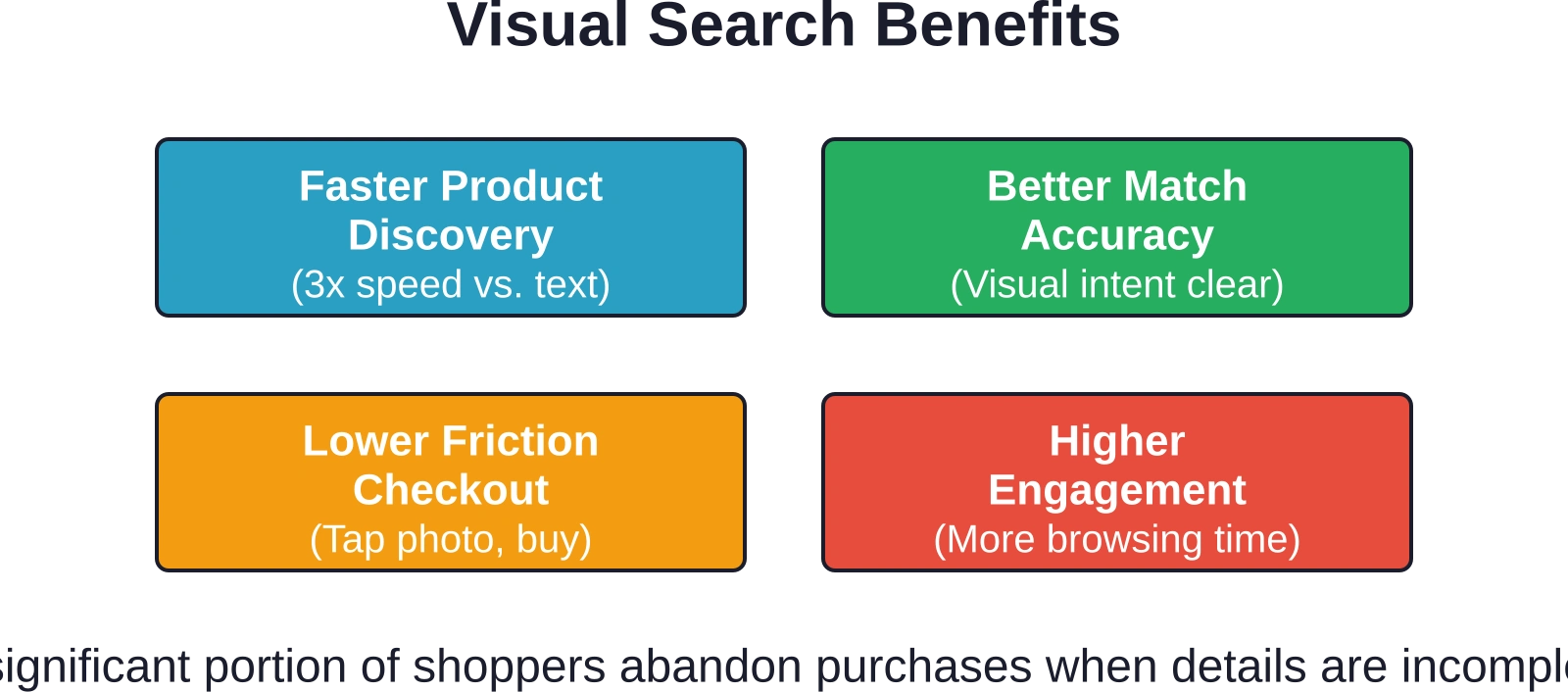
Visual search flips product identification to face customers. Instead of retailers scanning shelves, shoppers scan products.
Someone sees a product they like—on a shelf, in a photo, on a friend’s table—snaps a picture, and the system finds it in the retailer’s catalog. Instant purchase path, no typing, no guessing product names.
This works especially well for fashion, home goods, and complex products where text descriptions fall short. Color, pattern, style—visual features that are hard to describe but obvious in an image—become the search terms.
Retailers integrating visual search into mobile apps report that shoppers engage more deeply. It’s intuitive. And it captures intent that traditional search misses.
But wait. The technology isn’t perfect. Cluttered backgrounds, extreme angles, and low-resolution images still trip up recognition systems. Training data needs constant updates as catalogs expand and packaging changes.
Planogram Compliance and Retail Execution
Retail execution teams live and die by compliance. Did the store set up the promotional display correctly? Are products placed according to the planogram? Is shelf space allocated as agreed?
Field reps used to walk aisles with checklists, manually verifying placement. That’s time-consuming and prone to human error. Image recognition automates the entire process.
A rep snaps one photo of the shelf. The system identifies every product in frame, compares actual placement to the planogram, and flags discrepancies instantly. Same task, fraction of the time.
Brands get real-time visibility into how their products appear in thousands of stores. Retailers ensure merchandising standards are met consistently. Everyone wins.
The Data Quality Challenge
AI models are only as good as their training data. Poor-quality images, inconsistent labeling, and incomplete catalogs degrade recognition accuracy.
Here’s where data annotation comes in. Someone—often a team of annotators—needs to label thousands of product images: bounding boxes around products, category tags, attribute labels. That’s labor-intensive.
Integrating data annotation into inventory management workflows keeps catalogs current as new products launch and packaging updates roll out. Without that integration, models drift out of sync with reality.
Some platforms automate parts of this process using active learning—the model flags uncertain predictions for human review, learns from corrections, and improves over time. But human oversight remains critical.

Identify Retail Products With AI Superior’s Tools
Retail product identification becomes useful when visual data can support real store, shelf, inventory, or product monitoring tasks. AI Superior works with computer vision and helps define what needs to be identified, what image or video data is available, and how the output should connect with existing retail systems. This is useful for companies that want computer vision to support practical retail workflows rather than sit apart as a separate experiment.
AI Superior can support retail product identification with:
- Computer vision use case discovery for retail workflows
- Object detection and image classification models
- Product recognition or visual matching tools
- Image and video analysis for retail environments
- Integration of computer vision features into business software
👉Reach out to AI Superior to discuss product identification tools for your retail data, store workflows, or digital commerce platform.
Real-World Adoption and Results
Retailers aren’t experimenting anymore. They’re deploying at scale.
Smart carts equipped with cameras identify products as shoppers place them in the cart. No checkout line. The system tallies the bill automatically, charges the linked payment method, and shoppers walk out.
AI-based fast billing systems in grocery stores reduce transaction times by handling product recognition and price lookups without manual scanning. Customers experience faster checkouts; stores process more transactions per hour.
Field sales teams can use image recognition apps to improve account visit efficiency. Snap a shelf photo, confirm compliance, and move to the next location—all from a mobile device.
The numbers back it up. Retailers implementing these systems report improved sales conversion rates and better inventory tracking accuracy. Exact figures vary by deployment, but the trend is clear: automation delivers measurable gains.
Emerging Standards and Interoperability
As AI product identification scales, standardization matters. GS1, the organization behind barcode standards, is pushing 2D barcodes (like QR Code and Data Matrix) as the next evolution.
These 2D barcodes pack more information than traditional linear barcodes—product identifiers, batch numbers, expiration dates, even URLs—while maintaining Reed Solomon error correction to ensure reliability.
The goal? By 2027, 100% of POS scanning solutions should be capable of reading GS1-compliant 2D barcodes. That creates a bridge between legacy barcode systems and AI-driven image recognition, giving retailers flexibility during the transition.
But adoption lags. Until scanning infrastructure reaches that 100% threshold, products using 2D barcodes on-pack need to also include traditional barcodes for backward compatibility.
| Technology | Data Capacity | Recognition Method | Deployment Timeline |
|---|---|---|---|
| Linear Barcode | ~20 characters | Laser scanner, camera | Universal today |
| 2D Barcode | ~2,000+ characters | Camera only | 100% by 2027 target |
| AI Image Recognition | Unlimited metadata | Computer vision, deep learning | Growing rapidly, niche today |
Privacy Considerations and Ethical Deployment
Cameras in stores raise privacy concerns. Shoppers worry about surveillance, data collection, and how their images are used.
Retailers deploying AI product identification need transparent policies. Are cameras recording individuals, or just products? Is facial recognition involved? How long is data retained?
Community discussions reflect these tensions. Some shoppers appreciate the convenience of smart carts and faster checkout. Others feel uneasy about constant monitoring.
Best practice: focus cameras on products and shelves, not people. Anonymize any incidental capture of individuals. Publish clear privacy policies and give customers opt-out options where feasible.
The technology itself is neutral. Deployment choices determine whether it’s helpful or intrusive.
Cost and ROI Considerations
Implementing AI product identification isn’t cheap. Hardware costs—cameras, edge computing devices, networking infrastructure—add up quickly for large store networks.
Software licensing, model training, and ongoing maintenance bring recurring expenses. For smaller retailers, upfront costs can be prohibitive.
But ROI shows up in multiple places:
- Labor savings from automated inventory checks and faster checkout
- Reduced shrink through better tracking and compliance monitoring
- Higher sales conversion from improved stock availability and better merchandising
- Data monetization opportunities—aggregated, anonymized insights have value
Payback periods vary depending on deployment scale and use case. High-volume retailers with tight margins see ROI faster. Specialty stores with lower transaction counts need to weigh benefits more carefully.
Integration with Existing Systems
AI product identification doesn’t replace existing retail systems—it augments them. Integrating with POS, inventory management, and ERP platforms is critical.
APIs enable data flow between recognition systems and backend databases. When the AI identifies a product, it needs to pull pricing, stock levels, and promotional rules from existing systems in real time.
Legacy infrastructure complicates integration. Older POS systems weren’t built for camera input or image processing. Middleware layers and edge computing devices bridge the gap, but they add complexity.
Retailers planning deployments should audit their current tech stack first. Understand where data lives, what formats are used, and what APIs exist. That groundwork prevents expensive surprises during rollout.
Future Directions
AI product identification will keep improving. Models are getting better at handling edge cases—damaged packaging, unusual lighting, new product variants.
Multimodal systems that combine visual recognition with RFID, weight sensors, and barcode data will offer redundancy and higher accuracy. If the camera misses something, another sensor catches it.
Generative AI might play a role too—automatically creating training images of new products from catalog photos, reducing manual annotation work.
And as compute gets cheaper and models more efficient, expect more processing to move to edge devices. Real-time recognition without cloud round-trips means faster responses and lower bandwidth costs.
Getting Started: Action Plan for Retailers
Ready to explore AI product identification? Here’s a practical roadmap:
- Pilot small: Start with one category, one store, or one use case. Test the technology, measure results, and learn before scaling.
- Assess infrastructure: Do existing cameras and networks support the workload? What upgrades are needed?
- Choose partners carefully: Vendor capabilities vary widely. Look for proven deployments in similar retail environments.
- Prioritize data quality: Invest in catalog accuracy and training data. Models fail without clean inputs.
- Define success metrics: What does ROI look like for your operation? Faster checkout? Better compliance? Stock accuracy?
- Plan for iteration: First deployments won’t be perfect. Build feedback loops and budget for continuous improvement.
The technology is ready. The question is whether retail operations are ready to adapt workflows, train staff, and commit to the data discipline AI systems require.
Conclusion
AI-powered product identification isn’t replacing human judgment in retail—it’s automating repetitive visual tasks that humans do slowly and inconsistently.
From smart shelves to receipt scanning to visual search, the applications span the entire retail value chain. Retailers gain real-time visibility. Brands get accurate execution data. Shoppers enjoy faster, smoother experiences.
Challenges remain—data quality, integration complexity, privacy concerns, upfront costs. But the trajectory is clear. Computer vision is moving from experimental to essential infrastructure in modern retail.
Retailers waiting for perfect technology will find themselves outpaced by competitors already learning from imperfect deployments. The time to pilot, learn, and iterate is now.
Start small. Measure rigorously. Scale what works. That’s how AI transforms operations—one product, one shelf, one insight at a time.
Frequently Asked Questions
How accurate is AI product identification compared to barcode scanning?
Accuracy varies by implementation and environment. Controlled settings with clean product images and good lighting achieve high recognition rates in controlled settings. Real-world retail environments with poor lighting, obstructed products, and damaged packaging present accuracy challenges. Barcode scanning remains more reliable when labels are intact and accessible, but AI excels when barcodes are obscured, missing, or when bulk recognition is needed.
Can AI product identification work with existing store cameras?
It depends on camera quality and positioning. Many legacy security cameras lack the resolution, angle, or frame rate needed for accurate product recognition. Off-the-shelf cameras can work for simple deployments, but specialized retail cameras optimized for shelf monitoring deliver better results. Edge computing devices often supplement existing cameras to handle image processing locally.
What happens when new products are added to the catalog?
Advanced platforms use zero-shot enrollment, allowing new products to be added from a single catalog image in seconds. The system generates feature vectors from that image and adds them to the recognition database. For best accuracy, capturing multiple angles and lighting conditions during enrollment improves recognition performance when those products appear on shelves.
Does AI product identification raise privacy concerns?
Yes, when cameras are used in customer-facing areas. Best practices focus cameras exclusively on products and shelves, not shoppers. Systems should anonymize any incidental capture of individuals and maintain transparent privacy policies. Retailers should clearly communicate what data is collected, how it’s used, and how long it’s retained. Facial recognition should be avoided unless explicitly required and disclosed.
How long does it take to see ROI from AI product identification?
Payback periods vary depending on deployment scale and use case. High-volume retailers with significant labor costs or shrink issues see faster ROI. Benefits compound over time as systems improve through continued training and as retailers expand use cases beyond initial pilots. Measuring ROI requires tracking multiple metrics—labor savings, inventory accuracy, sales lift, and shrink reduction.
Can small retailers afford AI product identification?
Upfront costs for hardware and software can be prohibitive for small operations. However, mobile app-based solutions offer lower-cost entry points—field teams use smartphones for shelf audits and compliance checks without investing in fixed camera infrastructure. Cloud-based platforms reduce the need for on-premise servers. Starting with narrow use cases like receipt scanning or planogram compliance keeps initial investment manageable.
What’s the difference between AI product identification and visual search?
The core technology is similar—both use computer vision to recognize products from images. The difference is application and user. AI product identification typically refers to retailer-facing systems that automate inventory, compliance, and operational tasks. Visual search is customer-facing, enabling shoppers to find products by uploading photos. One optimizes operations; the other enhances discovery and shopping experience.