
Quick Summary: Chatbot development and consulting services help businesses automate customer interactions, scale support operations, and increase conversions through AI-powered conversational interfaces. Professional chatbot consulting covers strategy, architecture, development, integration, and continuous optimization—transforming customer engagement while reducing operational costs and delivering measurable ROI across industries.
Chatbot technology has moved beyond simple FAQ automation. Modern conversational AI now handles complex workflows, qualifies leads, personalizes interactions, and integrates seamlessly with enterprise systems.
The challenge isn’t whether to deploy chatbots—it’s how to build solutions that actually deliver business value. That’s where professional chatbot development and consulting come in.
This guide explores what chatbot consulting involves, when businesses need it, and how to select development partners that align with strategic goals.
What Chatbot Development and Consulting Actually Means
Chatbot development encompasses the technical work of building conversational interfaces—from architecting dialogue flows to training natural language models and integrating with backend systems.
Consulting adds the strategic layer: analyzing business needs, defining use cases, designing bot personas, mapping user journeys, and establishing success metrics.
Here’s the thing though—many companies jump straight to development without proper consulting. The result? Chatbots that technically function but fail to align with actual customer needs or business objectives.
Core Components of Professional Chatbot Services
Strategic chatbot consulting typically includes several distinct phases before any code gets written:
- Requirements analysis identifies which processes benefit most from automation. Not every customer interaction needs a bot—some require human empathy or complex judgment calls.
- Use case definition specifies exactly what the chatbot should accomplish. Customer support? Lead qualification? Appointment booking? Each use case demands different capabilities and integration points.
- Persona development establishes the bot’s voice, tone, and personality. A banking chatbot needs a different personality than one serving a fashion retailer.
- Conversation design maps dialogue flows, handling not just the happy path but edge cases, misunderstandings, and graceful handoffs to human agents.
Development work follows: building the natural language processing engine, creating integrations, implementing security measures, and establishing monitoring systems.
The Technical Stack Behind Modern Chatbots
Chatbot architecture has evolved significantly. Early rule-based systems relied on keyword matching and decision trees—functional but rigid.
Contemporary chatbot development leverages machine learning models trained on conversational data. Recent research demonstrates impressive results: validation accuracy of 98.03% achieved in research on Seq2Seq chatbot models with LSTM and attention mechanisms.
The technical stack typically includes natural language understanding components, dialogue management systems, integration middleware, and analytics platforms.
Security considerations matter too. Government implementations follow specific frameworks addressing user engagement, data protection, and compliance requirements—standards that enterprise chatbots should also meet.
When Businesses Actually Need Chatbot Consulting
Not every organization requires external consulting. Small businesses with straightforward FAQ automation might succeed with platform-based solutions requiring minimal customization.
But certain scenarios demand professional expertise.
Complex Integration Requirements
Enterprise chatbots rarely operate in isolation. They connect to CRM systems, knowledge bases, order management platforms, authentication services, and analytics tools.
Each integration introduces technical challenges—API compatibility, data synchronization, error handling, and security protocols.
Professional consultants navigate these complexities, designing integration architectures that maintain performance while ensuring data integrity.
Multi-Channel Deployment Strategies
Modern customers interact across channels—website chat widgets, mobile apps, messaging platforms, voice assistants, and social media.
Delivering consistent experiences across channels requires sophisticated orchestration. The same conversational logic must adapt to different interface constraints and user contexts.
Consultants help architect omnichannel solutions where conversation state persists as users switch channels, and responses adapt to each platform’s capabilities.
High-Stakes or Regulated Industries
Healthcare, financial services, and government sectors face strict compliance requirements around data handling, user privacy, and audit trails.
Chatbot implementations in these domains require expertise in regulatory frameworks, security architectures, and documentation practices that prove compliance.
Look, cutting corners here creates legal and reputational risks no organization should accept.
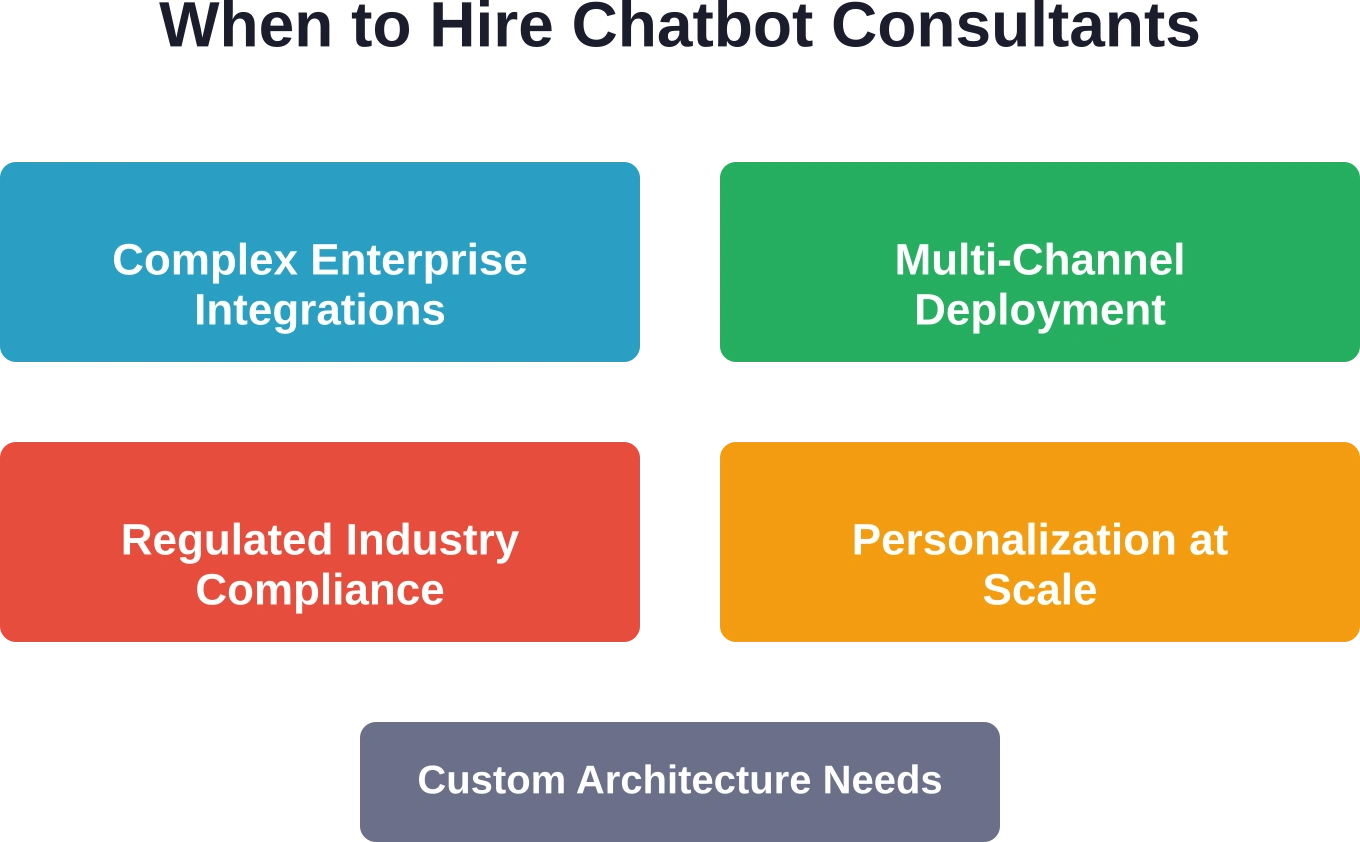
Personalization and Advanced AI Capabilities
Generic chatbot responses feel robotic and frustrating. Users expect personalized interactions that acknowledge their history, preferences, and context.
Research demonstrates performance differences between personalized and generic conversational approaches. Research on personalized conversational AI systems across 10 topic domains demonstrated significant performance improvements of approximately 45% compared to generic implementations.
The study involved studies involving sessions averaging 23 messages per session, with conversations lasting approximately 4.13 minutes and achieving high completion rates.
Building personalization engines requires expertise in user modeling, preference learning, and dynamic content adaptation—capabilities that consulting teams bring to the table.
The Chatbot Development Process: Strategy to Launch
Professional chatbot projects follow structured methodologies that balance business requirements with technical constraints.
Phase 1: Discovery and Requirements Gathering
Discovery workshops bring together stakeholders from business units, IT, customer service, and compliance.
Consultants facilitate discussions that uncover pain points, bottlenecks, and opportunities. Which customer interactions consume the most agent time? Where do users abandon flows? What questions appear most frequently?
The output: a prioritized list of use cases with estimated impact and implementation complexity.
Phase 2: Architecture and Design
Architecture design addresses the technical foundation—platform selection, hosting strategy, integration approach, and data flow.
Conversation design creates the dialogue structure. Professional conversation designers map user intents, craft responses, design error handling, and plan escalation paths.
This phase also establishes the training dataset strategy. Machine learning models require substantial conversational data—either historical customer interactions or synthetic datasets generated for training purposes.
Phase 3: Development and Training
Development teams build the chatbot components: natural language understanding models, dialogue management logic, integration connectors, and user interfaces.
Model training follows specific protocols. The Seq2Seq research example allocates 98% of data for training, 1% for validation, and 1% for testing—proportions that balance model exposure with rigorous evaluation.
Testing accuracy matters. Research on Seq2Seq models demonstrates training accuracy of 99.58%, validation accuracy of 98.03%, and test accuracy of 94.12% across conversational datasets.
Phase 4: Testing and Refinement
Testing extends beyond functional verification. Effective chatbot evaluation includes usability testing with representative users, load testing under realistic traffic patterns, and security assessments.
Evaluation datasets for enterprise implementations may comprise 10,000 queries, with research examples showing distribution of predefined FAQ queries (40%), contextual queries (30%), and out-of-domain queries (30%).
Refinement cycles address gaps discovered during testing—adjusting intent recognition thresholds, expanding training datasets, and improving response quality.
Phase 5: Deployment and Monitoring
Phased rollouts reduce risk. Many organizations start with limited user segments or specific use cases before expanding to full deployment.
Monitoring systems track key performance indicators: conversation completion rates, user satisfaction scores, escalation frequency, response accuracy, and system performance metrics.
Real talk: the launch isn’t the finish line. Continuous optimization based on production data drives long-term success.

Plan and Build Business Chatbots With AI Superior
A useful chatbot starts with a narrow role. It should know what it handles, where its information comes from, and when it should fit into the wider business process. AI Superior can help define the chatbot’s purpose, prepare the right data sources, choose the technical setup, and connect the final solution with websites, platforms, or internal systems. Their work can support customer support chatbots, internal assistants, lead qualification tools, document-based answer systems, knowledge search, or chatbot features inside digital products.
AI Superior’s chatbot projects can include:
- Chatbot use case planning and consulting
- AI chatbot and LLM-based assistant development
- NLP setup for user questions and text workflows
- Connection with documents, knowledge bases, or business data
- Integration into websites, platforms, or internal tools
👉Contact AI Superior to discuss chatbot consulting or development for your business, customers, or internal team.
Key Chatbot Capabilities That Drive Business Results
Successful chatbot implementations deliver specific capabilities aligned with business objectives. Generic “AI-powered chatbots” don’t move metrics—targeted capabilities do.
Automated Customer Support
Customer support remains the most common chatbot use case, and for good reason. Support bots deflect repetitive inquiries, provide instant responses 24/7, and scale to handle traffic spikes without adding headcount.
But effectiveness depends on proper scope definition. Chatbots excel at handling predefined FAQ queries, which typically represent 40% of customer inquiries based on evaluation datasets used in enterprise implementations.
The remaining interactions—contextual queries requiring understanding of user history or out-of-domain questions that fall outside the bot’s training—require different handling strategies.
Lead Qualification and Sales Assistance
Sales-focused chatbots engage website visitors, ask qualifying questions, and route high-intent prospects to human sales representatives.
This capability transforms website engagement. Instead of static contact forms that sit unanswered, conversational interfaces collect information through natural dialogue and schedule follow-up actions automatically.
Integration with CRM systems ensures lead data flows directly into sales pipelines without manual data entry.
Personalized Product Recommendations
E-commerce chatbots guide product discovery through conversational interfaces. Users describe what they’re looking for in natural language rather than navigating category hierarchies or search results.
Recommendation engines analyze user preferences, browsing history, and purchase patterns to suggest relevant products—improving conversion rates and average order values.
Appointment Scheduling and Booking
Healthcare providers, professional services firms, and service businesses use chatbots to automate appointment booking.
Conversational scheduling eliminates phone tag and form-filling friction. Users state their preferences, the bot checks availability, books the slot, and sends calendar invitations—all within a single conversation.
Integration with scheduling systems ensures real-time availability and prevents double-bookings.
Internal Employee Assistance
Enterprise chatbots serve internal audiences too. HR bots answer benefits questions, IT helpdesk bots troubleshoot common technical issues, and onboarding bots guide new employees through setup processes.
Internal chatbots reduce the burden on support teams while giving employees instant access to information and services.
Choosing the Right Chatbot Development Partner
Selecting chatbot consultants requires evaluating both technical capabilities and strategic alignment.
Technical Expertise and Platform Experience
Different chatbot platforms and frameworks offer varying capabilities. Some consultancies specialize in specific platforms; others build custom solutions from scratch.
Evaluate technical depth: Does the team have expertise in natural language processing? Can they architect integrations with enterprise systems? Do they understand the security requirements of your industry?
Ask about model performance metrics. Quality implementations should reference concrete accuracy figures from their work—teams that can’t discuss model evaluation probably haven’t built production systems.
Industry Experience and Domain Knowledge
Chatbot requirements vary significantly across industries. Banking chatbots need different capabilities than healthcare bots or e-commerce assistants.
Look for consulting partners with domain experience. They’ll understand regulatory requirements, common use cases, and industry-specific integration challenges.
Case studies and client testimonials from similar industries provide evidence of relevant expertise.
Design and UX Capabilities
Technical implementation matters, but conversation design makes or breaks user experience.
Strong chatbot partners employ professional conversation designers who craft natural dialogue flows, design error recovery, and create bot personas that align with brand voice.
Request examples of conversation flows from previous projects. Well-designed conversations feel natural and guide users smoothly toward task completion.
Post-Launch Support and Optimization
Chatbot success requires ongoing optimization. Initial deployments rarely achieve optimal performance—refinement based on real usage data drives improvement.
Clarify what post-launch support includes. Will the consulting team monitor performance metrics? How quickly will they respond to issues? What does the optimization process look like?
Some consulting engagements end at launch; others include managed services that handle continuous improvement.
| Evaluation Criteria | Questions to Ask | Red Flags |
|---|---|---|
| Technical Depth | What NLP frameworks do you use? Can you share model accuracy metrics from past projects? | Vague answers about “AI-powered solutions” without technical specifics |
| Industry Experience | Have you built chatbots for our industry? What compliance challenges did you navigate? | Generic case studies with no domain relevance |
| Design Process | How do you approach conversation design? Can we see sample dialogue flows? | Focus solely on technology with no mention of user experience |
| Integration Capability | What systems have you integrated with? How do you handle data synchronization? | Limited integration experience or reliance on basic platform connectors |
| Support Model | What happens after launch? How do you handle ongoing optimization? | No clear post-launch support plan or unreasonably expensive retainers |
Chatbot Development Costs and ROI Considerations
Chatbot project costs vary dramatically based on scope, complexity, and customization requirements.
Understanding Cost Drivers
Several factors influence chatbot development budgets.
Platform choice affects costs significantly. No-code platform subscriptions start at minimal monthly fees for basic functionality. Custom development projects requiring proprietary NLP models and complex integrations fall into much higher ranges.
Custom chatbot development costs vary significantly based on complexity, integration requirements, and industry-specific needs for comprehensive solutions including consulting, development, integration, and initial optimization.
Integration complexity adds costs. Each system integration—CRM, knowledge base, payment processor, authentication service—requires development, testing, and ongoing maintenance.
Conversation sophistication matters too. Simple FAQ bots with limited intents cost far less than contextual assistants that maintain conversation state, understand follow-up questions, and personalize responses.
Compliance and security requirements increase costs in regulated industries. Healthcare, financial services, and government implementations need security assessments, compliance documentation, and additional architectural safeguards.
Calculating ROI
Chatbot ROI comes from multiple sources:
- Support cost reduction represents the most direct savings. Calculate the percentage of inquiries the chatbot handles, multiply by the cost per human-handled interaction, and you’ve got quantifiable savings.
- Conversion rate improvement from lead qualification and sales assistance often exceeds support savings. Even modest conversion increases generate substantial revenue impact.
- Customer satisfaction improvements reduce churn and increase lifetime value. Instant 24/7 responses improve user experience, especially for time-sensitive inquiries.
- Employee productivity gains from internal chatbots free staff for higher-value activities. HR teams spend less time answering repetitive benefits questions; IT support focuses on complex issues rather than password resets.
But wait. ROI calculations must account for ongoing costs—platform subscriptions, hosting, monitoring, maintenance, and continuous optimization.
Common Chatbot Development Challenges and Solutions
Even well-planned chatbot projects encounter obstacles. Anticipating common challenges helps mitigate risks.
Understanding User Intent Accurately
Natural language is ambiguous. Users express the same intent in countless ways, use slang or jargon, make typos, and ask compound questions.
Poor intent recognition frustrates users and tanks satisfaction scores. Solutions include training models on diverse datasets, implementing fallback strategies for low-confidence intents, and providing quick clarification prompts when ambiguity exists.
Continuous improvement based on production data matters. Review conversations where the bot failed to understand user intent, add those variations to training data, and retrain models regularly.
Managing Scope Creep
Chatbot projects often expand beyond initial scope as stakeholders recognize additional opportunities.
Start with narrowly defined use cases and proven ROI before expanding. Trying to solve every problem in the first release creates timeline and budget overruns while diluting the bot’s effectiveness.
Phased rollouts work better: deliver core functionality first, validate performance, then add capabilities based on user feedback and business priorities.
Handling Edge Cases and Errors Gracefully
Users will say unexpected things. They’ll ask questions outside the bot’s domain, provide incomplete information, or change topics mid-conversation.
Effective error handling acknowledges limitations gracefully and provides clear paths forward—whether that’s escalating to human agents, asking clarifying questions, or offering alternative resources.
Never leave users stuck in conversation dead-ends.
Maintaining Conversation Context
Multi-turn conversations require tracking context across messages. When users say “tell me more about that” or “what about the other option,” the bot must understand what “that” and “other option” refer to.
Context management requires session state tracking, entity recognition, and dialogue management systems that maintain conversation history.
Research on hybrid AI frameworks discusses dynamic routing and feedback adaptation approaches for handling complex multi-turn conversations effectively.
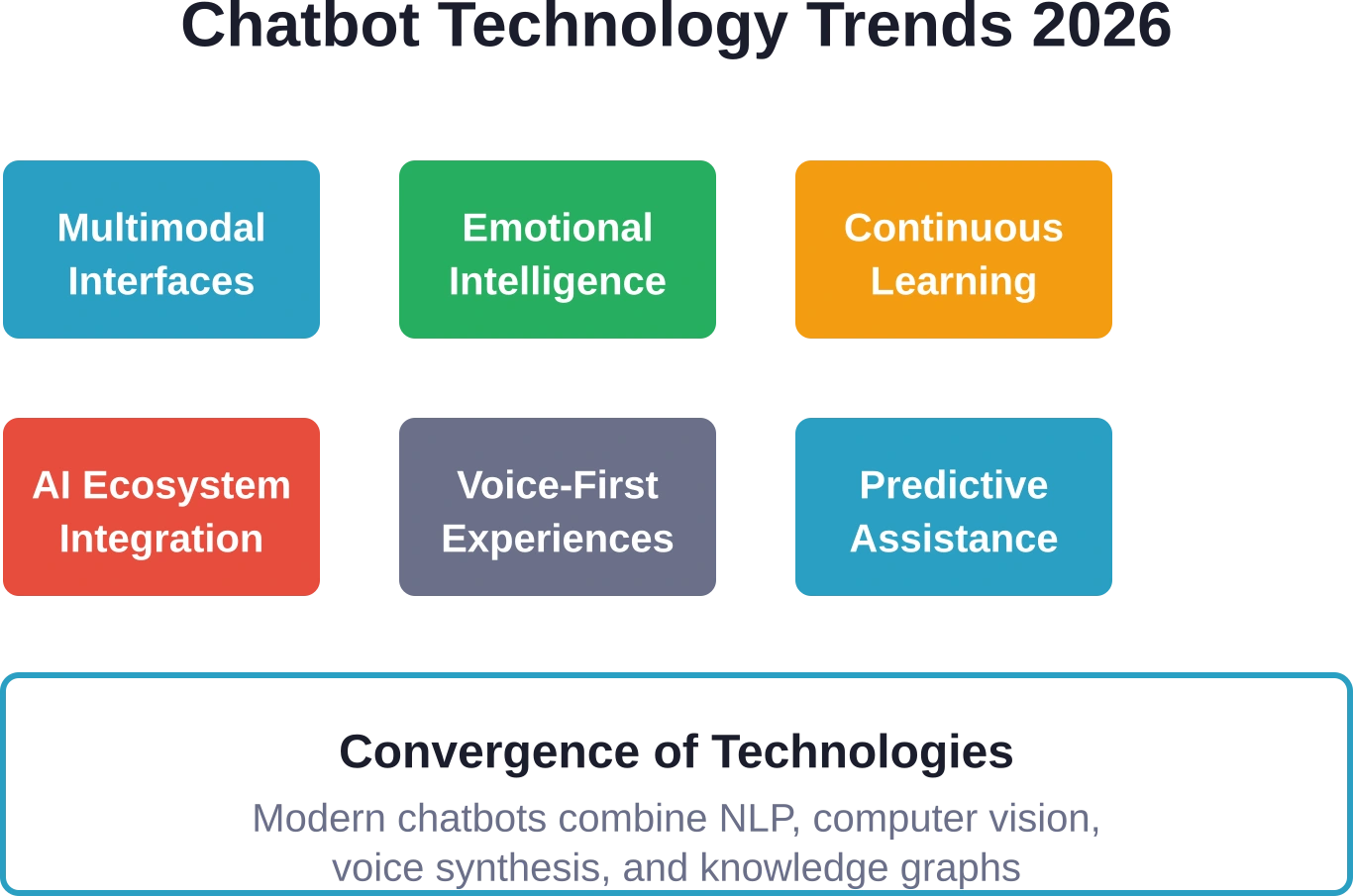
The Future of Chatbot Technology in 2026 and Beyond
Chatbot technology continues evolving rapidly. Several trends shape the landscape moving forward.
Multimodal Conversational Interfaces
Text-only chatbots represent just one interaction modality. Multimodal interfaces combine text, voice, images, and even video within single conversations.
Users might start a conversation via text, switch to voice while driving, then review visual product recommendations on their desktop—all within the same session.
Building multimodal experiences requires coordinating multiple AI models and designing interfaces that adapt seamlessly across modalities.
Emotional Intelligence and Empathy
Next-generation chatbots recognize user emotions through language patterns and adjust responses accordingly.
Frustrated users need different responses than confused or delighted ones. Emotionally intelligent bots detect sentiment, adjust tone, and know when situations require human empathy that AI can’t provide.
Hyper-Personalization Through Continuous Learning
Static chatbots deliver identical experiences to every user. Advanced systems learn from each interaction, building user models that enable increasingly personalized responses.
Research on personalized conversational systems using reinforcement learning has shown performance improvements compared to generic implementations.
This continuous learning approach creates conversational experiences that improve over time rather than stagnating post-launch.
Integration with Broader AI Ecosystems
Chatbots increasingly serve as conversational interfaces to larger AI systems—connecting to knowledge graphs, recommendation engines, predictive analytics platforms, and automation workflows.
This ecosystem approach positions chatbots as orchestration layers that coordinate multiple AI capabilities through natural language interactions.
Industries Transformed by Chatbot Solutions
Chatbot applications span virtually every industry, but certain sectors see particularly dramatic impact.
Healthcare
Healthcare chatbots handle appointment scheduling, symptom checking, medication reminders, and patient education.
Compliance with HIPAA and other healthcare regulations requires careful attention to data security, patient privacy, and documentation practices.
Healthcare bots reduce administrative burden on clinical staff while improving patient access to information and services.
Financial Services
Banks and financial institutions deploy chatbots for account inquiries, transaction history, fraud alerts, and product recommendations.
Security becomes paramount in financial services implementations. Multi-factor authentication, encryption, and audit trails protect sensitive financial data.
Personalized financial guidance chatbots help customers understand spending patterns, set savings goals, and make informed financial decisions.
E-commerce and Retail
Retail chatbots assist product discovery, answer questions about inventory and shipping, process returns, and provide post-purchase support.
Conversational commerce integrates shopping experiences directly into chat interfaces—users browse, compare, and purchase without leaving the conversation.
Personalized recommendations based on browsing history and preferences increase conversion rates and average order values.
Education
Educational institutions use chatbots for admissions inquiries, course information, campus navigation, and student support services.
Learning assistant chatbots help students with homework questions, provide explanations of concepts, and recommend study resources.
Government and Public Services
Government chatbots improve citizen access to information and services—answering questions about programs, helping complete forms, and guiding users through bureaucratic processes.
Research from IEEE examines frameworks for AI chatbot implementation on government websites, addressing development standards, user engagement strategies, and security requirements specific to public sector deployments.
Accessibility requirements matter particularly in government implementations, ensuring chatbots serve users with diverse abilities and technological access.
Measuring Chatbot Success: Metrics That Matter
Effective chatbot programs establish clear success metrics aligned with business objectives.
User Engagement Metrics
Conversation completion rate measures the percentage of conversations where users accomplish their goals without abandoning or escalating.
High-performing chatbots achieve completion rates approaching 100% for well-defined use cases, as demonstrated in research studies evaluating personalized conversational AI systems.
Average conversation length indicates engagement depth. The metric varies by use case—customer support conversations averaging 23 messages indicate substantive assistance, while simple FAQ lookups might involve just 2-3 exchanges.
Session duration provides another engagement signal. Research shows chatbot sessions averaging 4.13 minutes for substantive interactions across diverse topic domains.
Operational Efficiency Metrics
Containment rate measures the percentage of inquiries handled entirely by the chatbot without human escalation.
Response time tracks how quickly the bot generates replies. Modern systems achieve throughput rates of 334.55 messages per minute, ensuring users receive instant responses.
Cost per interaction quantifies the economic value of automation compared to human-handled support.
Quality Metrics
Intent recognition accuracy measures how often the bot correctly understands user requests.
Production chatbot systems should track this continuously. Models achieving 94.12% test accuracy in controlled environments often see lower accuracy in production due to unexpected phrasing and edge cases.
User satisfaction scores gathered through post-conversation surveys provide direct feedback about experience quality.
Business Impact Metrics
Ultimately, chatbots must move business KPIs.
Lead conversion rate improvements demonstrate sales impact. Customer retention and lifetime value increases show longer-term benefits. Support ticket deflection quantifies operational savings.
Tie chatbot metrics directly to business outcomes that executives care about.
| Metric Category | Key Indicators | Target Benchmarks |
|---|---|---|
| Engagement | Completion rate, avg. messages/session, session duration | Completion >85%, 15-30 messages for support, 3-5 min sessions |
| Accuracy | Intent recognition, response relevance, error rate | Intent accuracy >90%, error rate <5% |
| Efficiency | Containment rate, response time, cost per interaction | Containment >70%, response <2 sec, cost <$0.50 |
| Satisfaction | User ratings, NPS, complaint rate | Rating >4.0/5, NPS >40, complaints <2% |
| Business Impact | Conversion lift, ticket deflection, cost savings | Varies by use case and industry |
Frequently Asked Questions
How long does it take to develop a custom chatbot?
Development timelines vary based on complexity. Simple FAQ chatbots built on existing platforms can launch in 4-6 weeks. Custom enterprise solutions with complex integrations, advanced NLP, and extensive training typically require 3-6 months from requirements gathering through deployment. Phased rollouts starting with limited functionality can reduce time to initial launch.
What’s the difference between rule-based and AI-powered chatbots?
Rule-based chatbots follow predefined decision trees, matching user input against keywords and patterns to determine responses. They work well for narrow, predictable use cases but struggle with variation in phrasing. AI-powered chatbots use machine learning models trained on conversational data to understand intent and generate contextually appropriate responses. They handle natural language variation better but require training data and ongoing optimization.
Can chatbots integrate with our existing business systems?
Modern chatbots integrate with most business systems through APIs, webhooks, or middleware platforms. Common integrations include CRM systems, knowledge bases, ticketing platforms, scheduling systems, payment processors, and analytics tools. Integration complexity depends on API availability and data exchange requirements. Professional consulting teams architect integration strategies that maintain security while enabling necessary data flow.
How do we ensure our chatbot complies with privacy regulations?
Privacy compliance requires implementing appropriate data handling, storage, and security measures aligned with applicable regulations like GDPR, CCPA, or HIPAA. Key considerations include obtaining user consent for data collection, encrypting sensitive information, implementing access controls, providing data deletion capabilities, and maintaining audit trails. Consultants with experience in regulated industries help design compliant architectures and documentation practices.
What happens when the chatbot can’t answer a question?
Effective chatbots implement graceful fallback strategies. Options include escalating to human agents, asking clarifying questions to narrow intent, offering related resources the bot can help with, or collecting the question for follow-up. The key is acknowledging limitations honestly and providing clear next steps rather than leaving users stuck. Tracking failed interactions guides training data expansion and capability development.
How much does ongoing chatbot maintenance cost?
Maintenance costs typically include platform subscription fees, hosting infrastructure, monitoring tools, and optimization labor. For platform-based solutions, expect ongoing costs of 15-25% of initial development investment annually. Custom solutions may require dedicated resources for model retraining, integration maintenance, and feature enhancement. Maintenance requirements decrease as the bot matures but never disappear entirely—continuous improvement remains essential for sustained performance.
Can chatbots handle multiple languages?
Multilingual chatbots require training data in each supported language and models capable of detecting language and responding appropriately. Research shows varying performance across languages—studies of conversational QA systems found models like Mistral 7B achieving 62.3% language accuracy when responding in prompted languages. Quality multilingual support requires native speakers involved in training data creation and response validation for each language.
Taking the Next Step in Chatbot Development
Chatbot technology has matured beyond experimental novelty into strategic business infrastructure. Organizations across industries deploy conversational AI to automate operations, improve customer experiences, and drive measurable business outcomes.
The difference between chatbots that deliver ROI and those that disappoint comes down to strategic planning, expert implementation, and continuous optimization.
Professional chatbot consulting brings expertise that bridges business requirements with technical capabilities. Consultants help define use cases with genuine impact, architect solutions that scale, design conversations that users actually want to have, and establish measurement frameworks that prove value.
So where does your organization start?
Begin by identifying specific pain points or opportunities where conversational automation could make a difference. Don’t aim for comprehensive AI transformation—start with defined use cases that deliver measurable value.
Evaluate whether internal resources can handle the project or if external expertise makes sense. Complex integrations, advanced personalization, or regulated industry requirements typically benefit from professional consulting.
When selecting development partners, prioritize domain expertise, technical depth, and post-launch support over cost alone. Cheap implementations that fail to deliver business value waste more money than thoughtful investments in quality solutions.
The chatbot landscape will continue evolving. Models become more capable, platforms add new features, and user expectations rise. Organizations that approach chatbot development strategically—balancing technology capabilities with genuine user needs—position themselves to capitalize on these advances while competitors struggle with underperforming implementations.
Ready to explore how chatbot development and consulting services can transform your customer engagement and operational efficiency? The technology exists. The proven frameworks are established. The ROI case is clear.
The question isn’t whether conversational AI belongs in your strategy. It’s how quickly you can implement solutions that deliver competitive advantage.