Quick Summary: AI optimization in chemical manufacturing uses machine learning, digital twins, and predictive analytics to fine-tune reaction parameters, catch equipment problems before they cause downtime, and cut energy waste. Plants applying it well are reporting yield gains in the 10-15% range alongside measurable drops in energy use and emissions, though the payoff depends heavily on data quality and how deeply AI gets embedded into daily operations. As of 2026, the global AI-in-chemicals market is valued in the low single-digit billions and growing at a compound annual rate well above 25%, according to multiple industry analyses.
Chemical plants run on tight margins and tighter tolerances. A reactor running half a degree too hot, a catalyst degrading a week earlier than expected, a compressor drifting out of spec — any of these can quietly eat into yield long before anyone notices on a shift report. That’s exactly the kind of problem AI is good at catching.
Across the industry, AI-driven process optimization is already showing up in production numbers. Multiple analyses point to yield improvements in the 10-15% range at plants that have deployed AI process control, alongside notable cuts in energy consumption. Sinopec and PetroChina, for instance, have reported energy savings exceeding 8% per optimized unit after rolling out AI-driven process optimization programs across refining and petrochemical operations. None of this is theoretical anymore — it’s operational.
Why Chemical Manufacturing Is a Natural Fit for AI
Chemical processes generate enormous volumes of sensor data — temperature, pressure, flow rate, composition — often at sub-second intervals. Humans can’t process that volume in real time. Machine learning models can, and they can spot correlations between variables that no engineer would think to check manually.
The industry is also under real pressure to cut emissions. Chemicals remain one of the most energy-intensive industrial sectors globally, and regulators aren’t easing up. AI-based process optimization gives plants a way to squeeze more output from existing equipment without necessarily requiring capital-heavy retrofits — a much faster path to both cost savings and compliance.
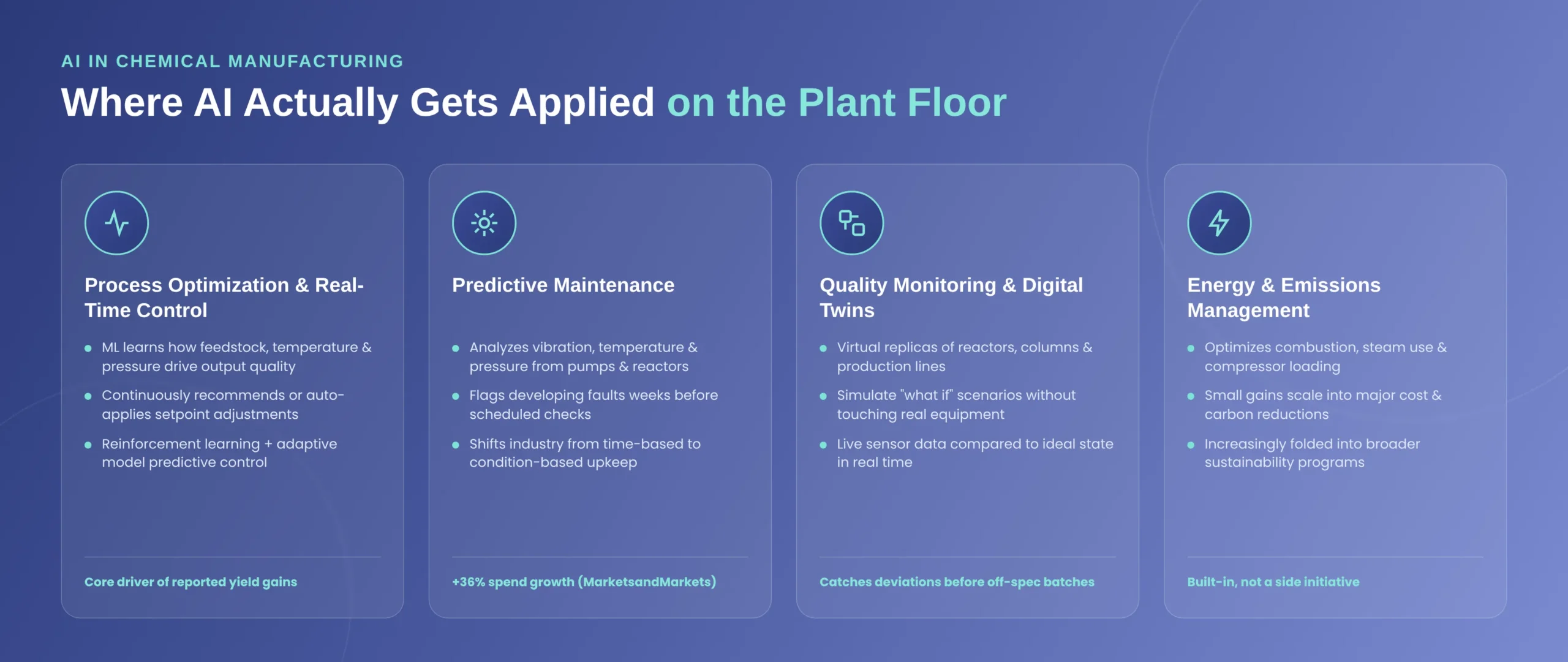
Where AI Actually Gets Applied on the Plant Floor
Process Optimization and Real-Time Control
This is the core use case, and it’s where most of the reported yield gains come from. Machine learning models trained on historical process data learn the relationship between input variables — feedstock composition, temperature, pressure, residence time — and output quality. Instead of operators adjusting setpoints based on experience and static SOPs, the system continuously recommends (or in more mature deployments, automatically applies) small adjustments that keep the process running closer to its optimal operating envelope.
Reinforcement learning and model predictive control are the two dominant techniques here. Model predictive control has been used in chemical plants for decades in a basic form; what’s changed is that AI now lets those models adapt as conditions shift, rather than relying on a fixed model that goes stale.
Predictive Maintenance
Unplanned downtime in a chemical plant is expensive — not just in lost production, but in safety risk and cleanup cost when equipment fails mid-process. Predictive maintenance models analyze vibration, temperature, and pressure signals from pumps, compressors, and reactors to flag developing faults weeks before a traditional maintenance schedule would catch them.
Industry spending on AI-based predictive maintenance in chemicals has risen by roughly 36%, according to MarketsandMarkets research, as manufacturers look to cut downtime and stretch equipment life. That’s a meaningful shift in capital priorities for an industry that has traditionally leaned on time-based, rather than condition-based, maintenance.
Quality Monitoring and Digital Twins
Digital twins — virtual replicas of a reactor, distillation column, or an entire production line — let engineers simulate “what if” scenarios without touching the real equipment. Paired with AI, a digital twin can continuously compare live sensor data against the simulated ideal state and flag deviations before they turn into off-spec batches.
Energy and Emissions Management
Because chemical production is so energy-intensive, even small optimization gains translate into meaningful cost and carbon reductions at scale. AI systems that optimize combustion, steam usage, and compressor loading in real time are increasingly bundled into broader sustainability programs, not treated as a separate initiative.
Apply AI to Chemical Plant Operations With AI Superior
AI Superior works with companies that need AI to support existing manufacturing and operational systems. The focus is on turning plant data into practical tools for monitoring processes, predicting equipment issues, and improving production decisions.
Looking to Optimize Chemical Manufacturing With AI?
AI Superior can help with:
- evaluating plant data and suitable AI use cases
- developing predictive models for equipment and process monitoring
- analyzing sensor, production, and maintenance data
- integrating AI components into existing plant infrastructure
👉 Contact AI Superior to discuss your processes, available data, and implementation approach.
How Big Is the Opportunity, Really?
Market estimates vary by research firm — a sign the space is still young and methodologies differ — but the direction is consistent. Coherent Market Insights values the global AI-in-chemical market at roughly USD 1.93 billion in 2026, projecting growth to around USD 17.6 billion by 2033 at a compound annual growth rate near 37%. Other firms, including Cervicorn Consulting and Persistence Market Research, put 2026 figures anywhere between roughly USD 1.1 billion and USD 3.2 billion, with compound annual growth rates consistently landing in the high-20s to high-30s percent range through the early 2030s. The spread reflects differences in scope — some reports count only software, others fold in hardware and services — but every major forecast agrees this is one of the fastest-growing corners of industrial AI.
Production optimization is consistently cited as the largest application segment, ahead of predictive maintenance and new-material discovery, according to market.us and Grand View Research data.
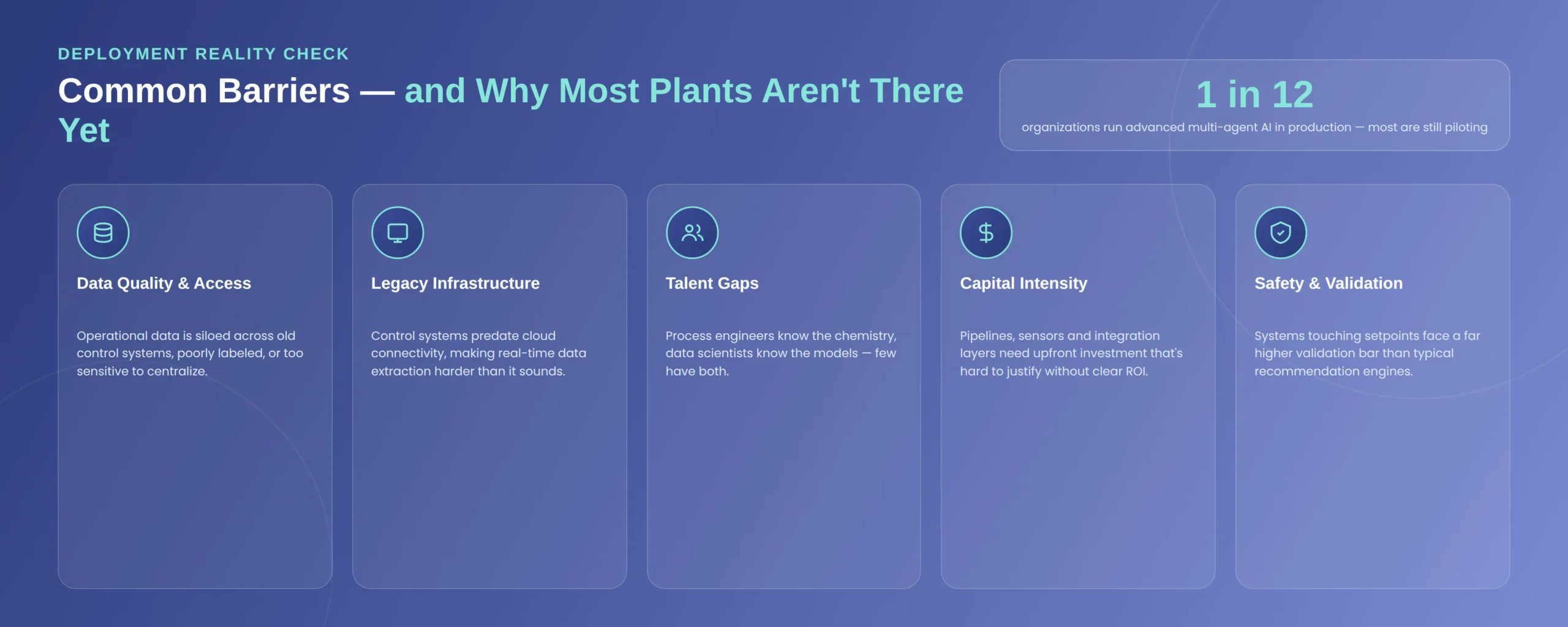
Common Barriers — and Why Most Plants Aren’t There Yet
Here’s the thing though — the market projections are optimistic, but actual deployment maturity lags behind. Industry research cited by market.us found that only 1 out of 12 organizations surveyed had advanced multi-agent AI orchestration running in production environments; most were still at early pilot stages. That gap between ambition and execution is the real story in chemical manufacturing right now.
- Data quality and access: Operational data in chemical plants is often siloed across decades-old control systems, poorly labeled, or considered too commercially sensitive to centralize.
- Legacy infrastructure: Many facilities run control systems installed long before cloud connectivity was a design consideration, making real-time data extraction harder than it sounds.
- Talent gaps: Process engineers understand the chemistry; data scientists understand the models. Few teams have both, and hiring for the overlap is difficult.
- Capital intensity: Building the data pipelines, sensors, and integration layers needed before AI even starts adding value requires upfront investment that’s hard to justify without a clear ROI case.
- Safety and validation: Any system that touches setpoints in a chemical process has to clear a much higher bar for validation than, say, a marketing recommendation engine.
Getting From Pilot to Plant-Wide: A Practical Path
Plants that move past the pilot stage tend to follow a similar sequence rather than trying to automate everything at once.
- Start with a single high-value, well-instrumented process unit — one with clean historical data and a clear cost-of-inefficiency baseline.
- Build the data pipeline first. No model is useful without reliable, timestamped, contextualized sensor data.
- Deploy advisory models before autonomous control. Let operators see recommendations and override them, building trust and catching edge cases the model hasn’t seen.
- Expand horizontally once the model proves stable, moving from one unit to similar units across the plant.
- Layer in predictive maintenance and energy optimization once process control is stable — these tend to depend on the same underlying data infrastructure.
Chemical companies that don’t have in-house data science capacity often work with outside partners to get through the early stages faster. That’s where structured AI consulting engagements tend to add the most value — helping plant teams figure out which process units are actually worth optimizing first, rather than chasing every use case at once. A focused AI use case identification exercise can save months by ruling out low-value pilots before they consume budget.
Beyond Process Control: Other AI Applications Worth Watching
Process optimization gets most of the attention, but a few adjacent applications are gaining ground fast:
| Application | What it does | Typical maturity in 2026 | | --- | --- | --- | | Predictive maintenance | Flags equipment failures before they happen using sensor and historical data | Widely piloted, increasingly standard on critical assets | | Digital twins | Simulates process behavior to test changes without risking live production | Growing adoption among large producers | | Generative AI for materials discovery | Speeds up identification of new compounds and formulations | Early but accelerating, especially in specialty chemicals | | Supply chain and demand forecasting | Improves raw material planning and reduces inventory waste | Moderate adoption, often bundled with ERP upgrades | | Multi-agent orchestration | Coordinates multiple AI systems across a plant autonomously | Still rare — reported in roughly 1 in 12 organizations |
Generative AI in particular is starting to show up in areas that go beyond pure process control — drafting synthesis routes, summarizing lab notebooks, or answering operator questions about standard procedures in natural language. A well-scoped generative AI development project can turn years of accumulated plant documentation into something operators can actually query in seconds, and internal knowledge assistants built on AiSuperiorGPT or similar large language model tools are being tested for exactly this kind of use case in industrial settings.
Sustainability: The Angle Regulators Care About
Emissions reduction has become inseparable from process optimization conversations in chemicals. The European Environment Agency has noted that fuel combustion accounts for the majority of greenhouse gas emissions from the chemical sector, with the remainder tied to industrial processes and product use. AI’s ability to fine-tune combustion, steam generation, and compressor loading in real time directly attacks the larger of those two emissions sources — which is a big part of why sustainability teams and process engineering teams are increasingly working from the same dashboard.
FAQ: AI Optimization in Chemical Manufacturing
How much can AI actually improve yield in a chemical plant?
Reported gains typically fall in the 10-15% range for plants that have implemented mature AI-driven process optimization, based on industry-wide analysis. Actual results vary heavily by process type, data quality, and how deeply the system is integrated into control loops.
Is AI process optimization the same as traditional model predictive control?
Not quite. Traditional model predictive control relies on a fixed mathematical model of the process. AI-based approaches, particularly those using machine learning, can adapt as conditions change over time, which tends to make them more robust to feedstock variability and equipment aging.
What’s the biggest barrier to adopting AI in a chemical plant?
Data. Most chemical facilities run on legacy control systems with fragmented, poorly labeled operational data, and building the pipelines to make that data usable for machine learning is often a bigger project than the AI model itself.
Does AI optimization require replacing existing plant control systems?
Usually not right away. Most deployments start as an advisory layer that sits on top of existing distributed control systems, feeding recommendations to operators before any move toward autonomous control.
How does AI help with predictive maintenance specifically?
It analyzes sensor data, including vibration, temperature, and pressure, against historical failure patterns to identify developing equipment issues before they cause unplanned downtime. This ability to reduce unexpected failures is one of the main reasons investment in AI-powered predictive maintenance has increased significantly in recent years.
Can smaller or mid-sized chemical manufacturers afford AI optimization?
Cost remains a significant barrier, and many market reports identify high upfront investment as a challenge for smaller manufacturers. However, AI-as-a-service platforms are lowering the entry barrier by allowing companies to deploy advanced analytics without first investing in extensive in-house infrastructure.
What role does AI play in reducing emissions at chemical plants?
AI reduces emissions by optimizing combustion, steam consumption, and other energy-intensive processes in real time. These improvements can lower fuel use, decrease carbon emissions, and generate substantial operating cost savings while improving overall process efficiency.
Where This Leaves Chemical Manufacturers
AI optimization in chemical manufacturing isn’t a single tool — it’s a layered set of capabilities that compound as plants build the data foundation to support them. The plants seeing real yield and energy gains today didn’t get there by buying a platform and flipping a switch. They built clean data pipelines, started with advisory models, earned operator trust, and expanded gradually.
For manufacturers still weighing where to start, the smartest first move is usually a scoping exercise rather than a full deployment: pinpoint the process unit with the clearest inefficiency, confirm the data actually exists to model it, and build from there. Teams looking for outside support on that scoping work, or on building the custom models that come after it, can look into AI software development or AI-based process optimization services designed specifically to bridge that gap between plant-floor data and production-ready models.