Quick Summary: AI optimization of ammonia production uses machine learning, real-time sensor data, and predictive control to cut energy use, reduce carbon emissions, extend catalyst life, and stabilize operations in both conventional and green ammonia plants. Companies like Envision Energy, KBR, and Faraday Earth are already deploying AI systems that manage variable renewable power, forecast output, and push green ammonia closer to cost parity with the fossil-fuel-based version. The result is a production process that’s faster to tune, cheaper to run, and better suited to the intermittency of wind and solar.
Ammonia has been made the same basic way since the early 1900s: nitrogen and hydrogen, squeezed together under brutal heat and pressure, with an iron catalyst doing the heavy lifting. The Haber-Bosch process works. It just isn’t efficient by modern standards, and it definitely wasn’t designed with wind farms and solar arrays feeding it power. That’s where artificial intelligence has started to matter — not as a buzzword bolted onto old plants, but as the control layer that makes both conventional and green ammonia production tighter, cheaper, and more predictable.
This shift is happening fast. Industrial players like KBR and Envision Energy, along with startups like Faraday Earth, are already running AI systems on live ammonia infrastructure. Researchers are publishing machine learning models that forecast ammonia output from renewable-powered synthesis loops. None of this is theoretical anymore.
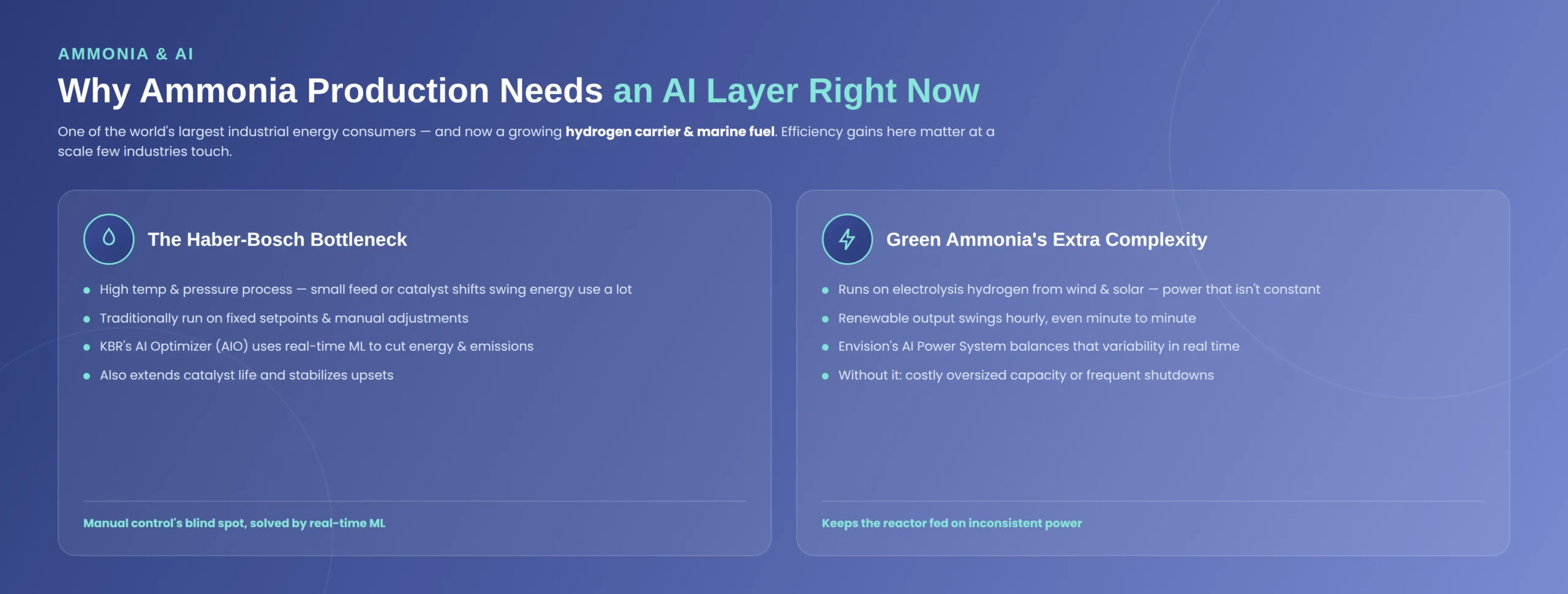
Why Ammonia Production Needs an AI Layer Right Now
Ammonia isn’t just fertilizer feedstock — it’s one of the largest industrial energy consumers on the planet, and increasingly it’s being eyed as a hydrogen carrier and marine fuel. That makes efficiency gains here matter at a scale most industries never touch.
The Haber-Bosch Bottleneck
Conventional ammonia synthesis runs at high temperature and pressure, and small deviations in feed ratios, temperature, or catalyst condition can swing energy consumption significantly. Operators have traditionally managed this with fixed setpoints and manual adjustments — a blunt approach for a process with so many interacting variables. According to reporting on KBR’s AI Optimizer (AIO) platform, the system uses real-time data and machine learning to cut energy use, lower carbon emissions, extend catalyst life, and stabilize operations during upsets — precisely the pain points that manual control struggles with.
Green Ammonia’s Extra Layer of Complexity
Green ammonia — made using hydrogen from renewable-powered electrolysis instead of natural gas — adds a whole new variable: power that isn’t constant. Wind and solar output swing by the hour, sometimes by the minute, and a Haber-Bosch reactor doesn’t like being fed inconsistently. Envision Energy has described its AI Power System as one that intelligently schedules and balances wind and solar variability in real time, aiming to deliver the constant power an ammonia synthesis loop actually needs. Without that kind of intelligent balancing, green ammonia plants either oversize their renewable capacity (expensive) or accept frequent shutdowns (also expensive).
Apply AI to Ammonia Production With AI Superior
AI Superior works with companies that need AI to support existing production systems. For ammonia plants, this can include analyzing process data, monitoring equipment performance, predicting maintenance needs, and improving operating decisions.
Looking to Optimize Ammonia Production With AI?
AI Superior can help with:
- evaluating production data and suitable AI use cases
- developing models for process and equipment monitoring
- analyzing sensor, maintenance, and operational data
- integrating AI components into existing plant systems
👉 Contact AI Superior to discuss your production process, available data, and implementation approach.
Who’s Actually Doing This: Real Deployments and Research
The examples aren’t hypothetical. A handful of companies and research teams are already showing what AI-driven ammonia optimization looks like in practice, each attacking a different piece of the puzzle.
Envision Energy and KBR
Envision Energy’s AI-optimized green ammonia work pairs its AI Power System — which balances intermittent renewable generation — with process-level intelligence to keep synthesis stable. KBR, a long-established engineering firm in the ammonia and fertilizer space, brings its AIO platform to bear on the chemistry side: catalyst life, energy intensity, and emissions reduction inside the reactor itself. Together, these represent the two halves of the AI optimization problem — power-side intelligence and process-side intelligence.
Faraday Earth’s Plasma Route
Not every approach sticks with Haber-Bosch. Faraday Earth, a startup, is using AI-optimized plasma to synthesize ammonia through an entirely different chemical pathway, bypassing the high-pressure thermochemical route altogether. The company has stated its system could reach a levelized cost of around $500 per ton — a figure that, if it holds up at scale, would put plasma-based green ammonia within striking distance of conventional production costs in many markets. That claim still needs to prove out commercially, but it signals how much runway AI-guided novel chemistry might have.
Machine Learning in Hybrid Renewable Systems
On the research side, machine learning has been applied to systems combining biogas, solar, and wind to power low-pressure ammonia synthesis from renewable hydrogen — with models forecasting ammonia volume and helping operators plan around variable inputs. Separately, solar power tower-based tri-generation systems producing electricity, hydrogen, and green ammonia together are being studied as a way to squeeze more value out of a single renewable installation. IEEE Spectrum has also covered how machine learning techniques are being used specifically to improve green ammonia efficiency in low-pressure, renewable-hydrogen-fed synthesis setups.
| Initiative | Core AI Approach | What It Targets | | --- | --- | --- | | KBR AIO | Real-time data + machine learning | Energy use, emissions, catalyst life, operational stability | | Envision Energy AI Power System | Real-time renewable scheduling | Balancing wind/solar variability for steady plant power | | Faraday Earth | AI-optimized plasma control | Alternative synthesis route, targeting ~$500/ton levelized cost | | Academic ML models (biogas-solar-wind hybrids) | Forecasting models | Predicting ammonia volume from variable renewable hydrogen supply |
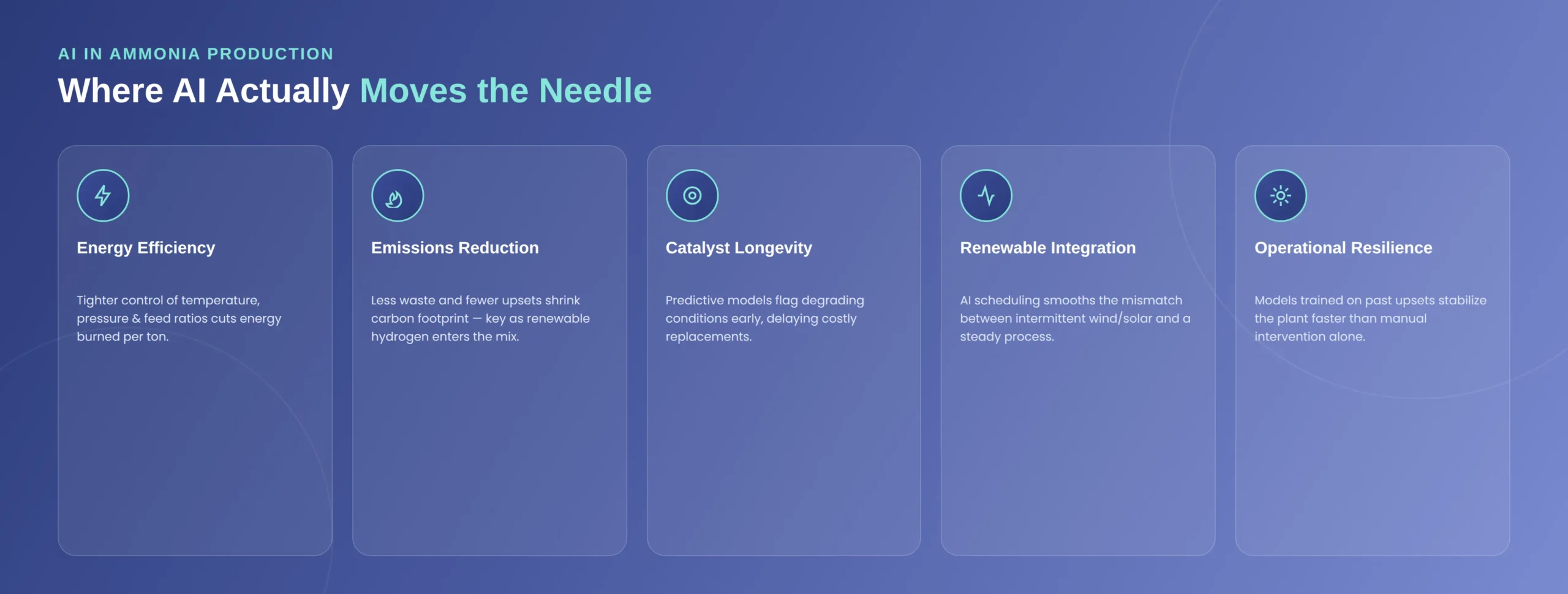
Where AI Actually Moves the Needle
Strip away the branding and most AI ammonia projects are chasing the same handful of outcomes. Here’s what keeps showing up across the industry:
- Energy efficiency: tighter control of temperature, pressure, and feed ratios reduces the energy burned per ton of ammonia produced.
- Emissions reduction: less wasted energy and fewer upset conditions translate directly into a smaller carbon footprint, which matters even more once renewable hydrogen enters the mix.
- Catalyst longevity: predictive models can flag conditions that degrade catalysts early, delaying costly replacements.
- Renewable integration: AI scheduling smooths out the mismatch between intermittent wind/solar and a process that prefers steady input.
- Operational resilience: machine learning models trained on historical upsets can stabilize the plant faster when something goes wrong, instead of relying purely on operator intervention.
 The Challenges AI Still Has to Overcome
None of this is plug-and-play. Ammonia plants are safety-critical, capital-intensive assets, and operators are understandably cautious about handing control decisions to a model, even a well-validated one. A few recurring hurdles show up across the industry:
- Data quality and coverage: models are only as good as the sensor data feeding them, and older plants weren’t built with today’s instrumentation density in mind.
- Trust and validation: operators need to see a model perform reliably across upset conditions before they’ll let it touch setpoints unsupervised.
- Integration with legacy control systems: retrofitting AI into decades-old distributed control systems isn’t trivial.
- Cost justification: as one industry commentator put it regarding end-to-end AI integration, the real test is the final production cost per unit — the efficiency story only matters if it shows up on the balance sheet.
That last point is worth sitting with. Green ammonia, even with AI squeezing out inefficiencies, still has to compete against decades of cost optimization baked into conventional Haber-Bosch plants running on cheap natural gas. AI narrows that gap; it hasn’t closed it everywhere yet.
How This Connects to Broader Industrial AI Adoption
Ammonia optimization is really a specific case of a much bigger trend: heavy industry using AI to squeeze efficiency out of processes that have run on fixed rules for generations. The same principles — pulling in real-time sensor data, building predictive models, and closing the loop with automated or semi-automated control — show up in refineries, steel plants, and power grids too. Organizations exploring this path typically start with a structured assessment of where AI can realistically help before committing capital, which is exactly the kind of work covered under AI use case discovery and identification. From there, building the actual optimization models and integrating them into existing plant systems usually falls under AI-based business process optimization.
Forecasting problems — like predicting ammonia output from variable renewable hydrogen supply — are a natural fit for the kind of custom modeling work done through AI software development, while plants weighing a broader digital transformation often start with a proper AI and data strategy engagement to make sure the underlying data infrastructure can actually support these models before anyone builds anything on top of it.
What This Means for the Fertilizer and Energy Sectors
Ammonia sits at an odd intersection right now — it’s a century-old fertilizer input and, increasingly, a candidate hydrogen carrier and shipping fuel. AI-driven optimization touches both roles. On the fertilizer side, tighter process control means more stable output and lower emissions per ton, which matters as agricultural supply chains face growing pressure to decarbonize. On the energy side, AI-managed renewable integration is what makes green ammonia plausible as a way to store and transport clean energy across long distances, since ammonia is far easier to ship than hydrogen gas.
H2 Tech has framed this plainly: AI is transforming the green hydrogen and ammonia sectors, addressing key challenges and unlocking new efficiencies from the optimization of electrolyzers through to the synthesis loop itself. That’s a fair summary of where the industry actually stands in 2026 — not a finished transformation, but a fast-moving one.
Frequently Asked Questions
What does “AI optimization” mean in ammonia production, specifically?
AI optimization in ammonia production generally refers to using machine learning models trained on real-time plant data to adjust process variables such as temperature, pressure, feed ratios, and renewable power scheduling. These adjustments can be made automatically or with operator oversight to reduce energy consumption, lower emissions, and minimize downtime.
Is AI-optimized ammonia mainly for green ammonia, or does it apply to conventional plants too?
It applies to both. AI platforms such as KBR’s AIO improve efficiency and operational stability in conventional Haber-Bosch ammonia plants, while systems like Envision Energy’s AI Power System are designed to manage the fluctuating renewable energy inputs used in green ammonia production.
Can AI actually make green ammonia cost-competitive with conventional ammonia?
AI helps narrow the cost gap, but it has not eliminated it everywhere. Companies such as Faraday Earth are targeting production costs of around $500 per ton through AI-optimized plasma synthesis, representing meaningful progress toward competitiveness, although commercial-scale validation is still required.
What role does machine learning play in forecasting ammonia output?
Machine learning models forecast ammonia production by analyzing variable inputs such as solar generation, wind availability, and hydrogen supply from renewable sources. These forecasts help operators optimize storage, maintenance scheduling, and product dispatch despite changing energy conditions.
Does AI optimization reduce catalyst replacement costs?
Yes, it can. AI-driven predictive models detect early signs of catalyst degradation, allowing operators to make process adjustments or maintenance interventions before efficiency declines significantly. This extends catalyst lifespan and postpones expensive replacement cycles.
What’s the biggest barrier to adopting AI in ammonia plants?
The main challenges are trust and system integration. Operators require extensive validation before allowing AI models to influence safety-critical operating conditions, and many ammonia plants still rely on legacy control systems that were not designed to integrate with modern AI technologies.
How does AI handle the intermittency of wind and solar power in green ammonia plants?
AI systems continuously balance and schedule renewable energy sources in real time, smoothing fluctuations from wind and solar generation. This provides a more stable power supply for electrolysis and ammonia synthesis, improving production consistency despite variable renewable energy inputs.
Where This Is Headed
Ammonia production is one of those industries where small percentage gains translate into enormous absolute savings, given the sheer scale of global output. That’s exactly why AI is landing here faster than in a lot of other heavy industries — the payoff per efficiency point is simply larger. Expect the next few years to bring tighter integration between renewable scheduling and synthesis control, more startups experimenting with non-traditional synthesis routes like plasma, and a steady stream of published forecasting models refining how well AI can predict output from messy, variable inputs.
For companies evaluating whether their own process operations could benefit from this kind of optimization — ammonia or otherwise — the starting point is usually the same: figure out where the data already exists, where it’s missing, and which process bottlenecks are actually worth solving. That’s the groundwork behind most successful industrial AI projects, and it’s a reasonable first conversation to have before committing to a specific platform or vendor.