Quick Summary: AI is reshaping methanol production by replacing slow first-principles simulations with fast machine learning surrogate models, enabling multi-criteria optimization across production rate, energy use, exergy destruction, and cost simultaneously. Recent research, including a 2025 study by Sultan et al. and a 2025 multi-criteria framework by Manesh et al., shows measurable gains in methanol output and efficiency when ML models guide plant operation. For green methanol specifically, AI also helps manage the volatile electricity costs tied to electrolyzer-based hydrogen production.
Methanol plants are messy, nonlinear systems. Temperature swings, catalyst aging, feedstock variability, and fluctuating electricity prices (for the green route) all interact in ways that traditional process models struggle to capture in real time. That’s exactly the kind of problem machine learning is good at solving.
Over the past couple of years, researchers and plant operators have started pairing classical chemical engineering models with data-driven algorithms to squeeze more methanol, less waste, and lower cost out of the same reactors. This isn’t hype-driven automation talk. It’s a genuine shift in how methanol synthesis gets modeled, monitored, and optimized.
How Methanol Is Actually Produced
Conventional methanol synthesis starts with syngas — a mixture of carbon monoxide, carbon dioxide, and hydrogen — usually derived from natural gas reforming or coal gasification. That syngas passes over a copper/zinc oxide/alumina (Cu/ZnO/Al2O3) catalyst under pressure, where it reacts to form methanol and water. Kinetic models such as the Graaf model have long been the standard for predicting reactor behavior, and they still hold up reasonably well for forecasting reaction rates under typical operating conditions.
The catch is that these mechanistic models are computationally expensive and don’t adapt quickly when a catalyst ages, feedstock composition shifts, or operators push the plant toward a new operating point. That’s the gap AI is stepping into.
Green Methanol Changes the Optimization Problem
Green methanol swaps fossil-derived syngas for carbon dioxide captured from industrial flue gas or directly from the air, combined with hydrogen produced via electrolysis powered by renewable electricity. It’s a cleaner pathway, but it introduces a new layer of complexity: electricity prices swing hour to hour, and the electrolyzer often becomes the bottleneck rather than the methanol reactor itself.
The Electrolyzer Bottleneck
A 2026 study by Majidabad and colleagues focuses on exactly this challenge — optimizing a green methanol plant that includes an electrolyzer under variable electricity pricing. The core question isn’t just “how do we run the reactor efficiently,” but “when should the electrolyzer run at all, and how much hydrogen storage buffers against price spikes.” That’s a scheduling and forecasting problem as much as a chemistry problem, and it’s where AI-driven forecasting and optimization genuinely earns its place.
Where AI Actually Fits Into the Optimization Loop
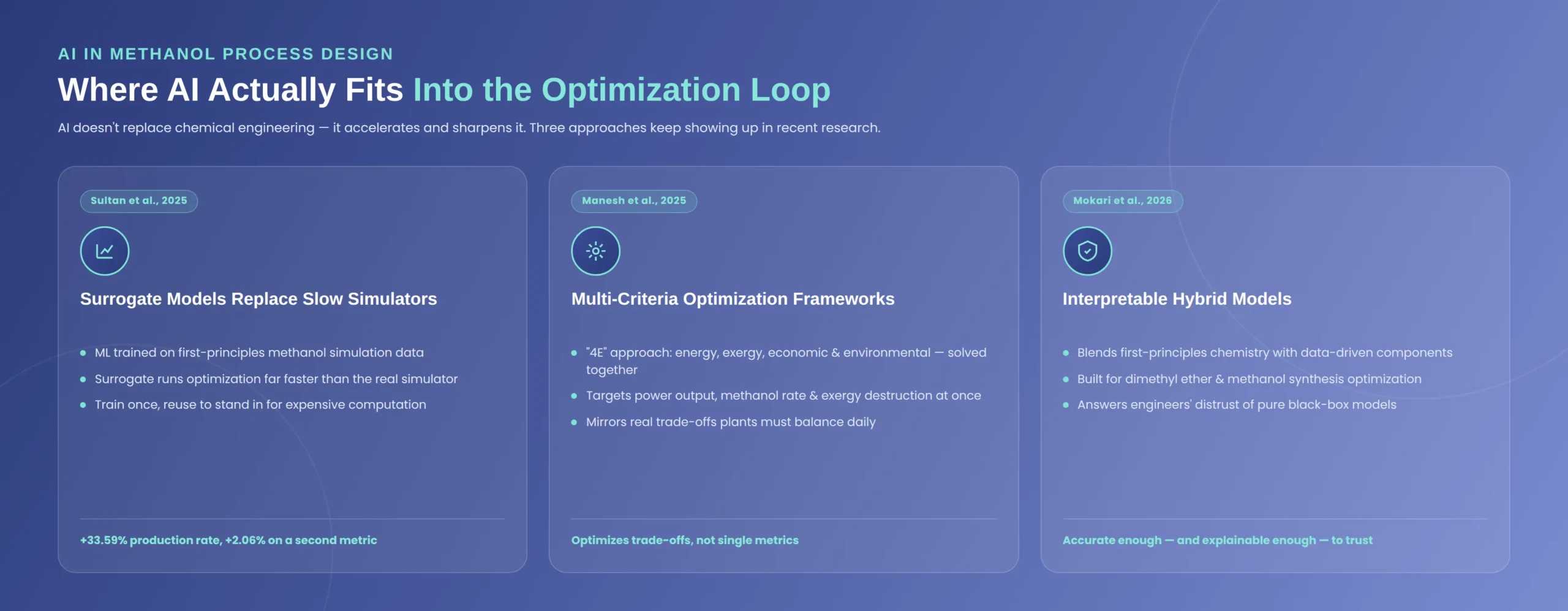
AI doesn’t replace the chemical engineering — it accelerates and sharpens it. Three approaches show up repeatedly in recent research and industry pilots.
Surrogate Models Replace Slow Simulators
A 2025 study by Sultan and colleagues built a machine learning surrogate model trained on data from a first-principles methanol process simulation, then used that surrogate to run optimization far faster than the original simulator would allow. The reported result: roughly a 33.59% increase in production rate alongside a 2.06% gain in another performance metric, according to the study’s abstract. That kind of surrogate-modeling approach is becoming a template — train the ML model once on rigorous simulation or plant data, then let it stand in for expensive computation during the actual optimization search.
Multi-Criteria Optimization Frameworks
Methanol plants rarely optimize for just one thing. A 2025 framework from Manesh and colleagues applied what’s often called a “4E” approach — energy, exergy, economic, and environmental criteria — optimized simultaneously rather than one at a time. Their model targeted net power output, methanol production rate, and exergy destruction together, which reflects how real plants actually have to balance trade-offs: pushing production rate higher can hurt exergy efficiency or spike operating cost if not managed carefully.
Interpretable Hybrid Models
Pure black-box machine learning makes plant engineers nervous, and understandably so — nobody wants to hand safety-critical decisions to a model nobody can explain. A 2026 study by Mokari and colleagues addressed this directly, building an interpretable hybrid framework that blends first-principles chemistry with data-driven components for dimethyl ether and methanol synthesis optimization. The goal is a model that’s both accurate and explainable enough that plant operators trust its recommendations.
Apply AI to Methanol Production With AI Superior
AI Superior develops AI components that can work within existing manufacturing systems. In methanol production, these systems may support process monitoring, equipment failure prediction, data analysis, and more consistent control of operating conditions.
Looking to Optimize Methanol Production With AI?
AI Superior can help with:
- assessing plant data and potential AI applications
- developing predictive models for equipment and processes
- analyzing production, sensor, and maintenance data
- integrating AI tools into existing infrastructure
👉 Contact AI Superior to discuss your plant, data, and technical requirements.
Traditional Simulation vs. ML-Driven Optimization
| Aspect | Traditional First-Principles Simulation | ML Surrogate / AI-Driven Optimization | | --- | --- | --- | | Speed per optimization run | Slow — each scenario re-solves complex equations | Fast once trained; near-instant scenario evaluation | | Adaptability to catalyst aging or feedstock shifts | Requires manual re-calibration | Can retrain or fine-tune on new operating data | | Handling multiple objectives at once | Possible but computationally heavy | Well-suited to multi-criteria (4E) frameworks | | Explainability | High — grounded in known chemistry | Varies; hybrid/interpretable models close this gap | | Data requirements | Low — relies on kinetic and thermodynamic parameters | Needs sufficient historical or simulated data to train |
Feedstock and Catalyst Considerations
AI optimization isn’t limited to the reactor’s operating conditions. It’s also being applied upstream, to feedstock selection and catalyst behavior. Some vendors now market advanced catalyst formulations paired with process controls that aim to maximize conversion efficiency while cutting energy consumption for CO2-to-methanol routes. Separately, work on aged catalysts explores how production can be sustained or boosted even as catalyst activity declines over a plant’s operating life — a problem where predictive models can flag the right moment to adjust temperature or feed ratios rather than waiting for a costly catalyst swap.
Feedstock optimization is a broader use case too. Instead of relying purely on physical testing and static assumptions, AI models can help forecast how a shift in natural gas composition, biomass input, or captured CO2 purity will ripple through downstream production rates — turning what used to be reactive troubleshooting into proactive planning.
Building an AI Optimization Pipeline for a Methanol Plant
None of this works by simply dropping a machine learning model into an existing control room. A workable pipeline usually follows a fairly consistent pattern:
- Identify which specific bottleneck matters most — production rate, energy cost, emissions, or electrolyzer scheduling.
- Assemble historical process data, or generate simulated data if plant records are thin.
- Train and validate a surrogate or hybrid model against known chemistry benchmarks.
- Run multi-objective optimization scenarios before touching live setpoints.
- Deploy with human-in-the-loop review, especially early on.
That first step — figuring out where AI genuinely adds value versus where it’s a distraction — is often the hardest part. Plants considering this route tend to benefit from a structured AI use case identification process before committing engineering time to a model that solves the wrong problem. From there, a clear data strategy determines whether existing plant records are even usable for training, or whether instrumentation gaps need to be closed first.
Once the use case and data foundation are solid, the actual modeling work — building surrogate models, multi-criteria optimizers, or interpretable hybrid systems — typically falls under custom AI software development rather than off-the-shelf tools, since every plant’s chemistry, sensors, and constraints differ. For operators unsure where to start, an initial AI consulting engagement can map out realistic ROI before any code gets written.
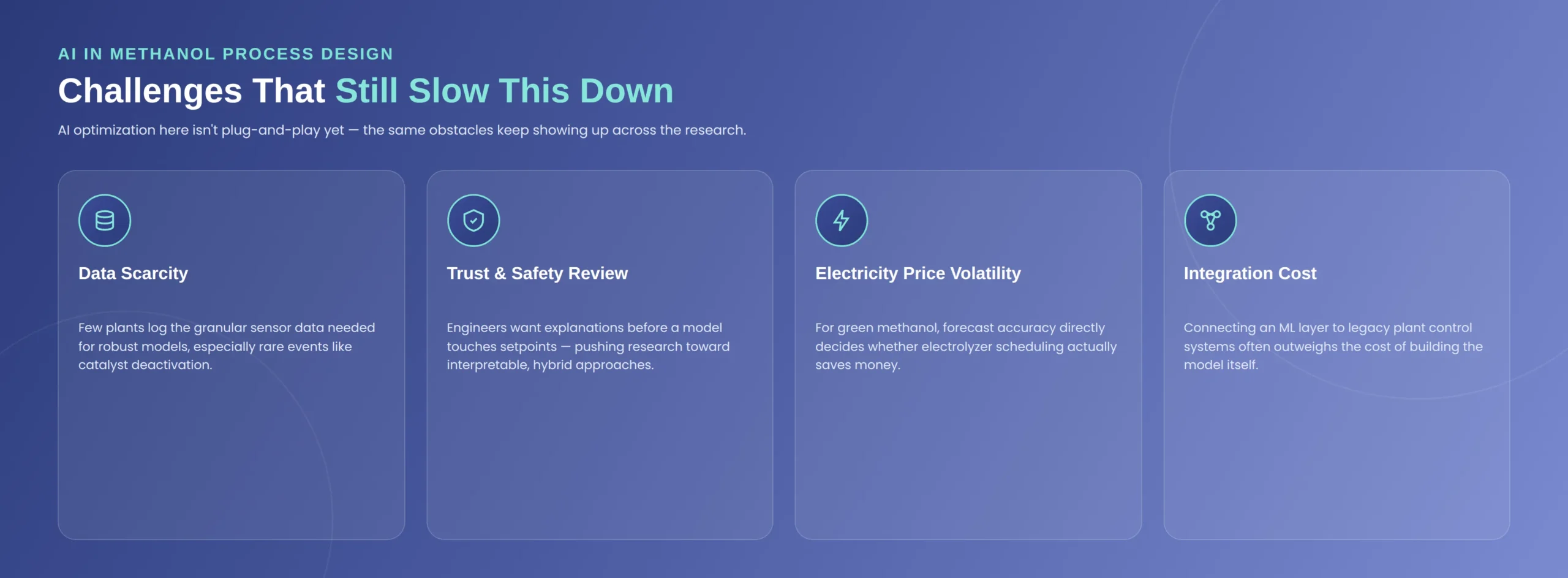
Challenges That Still Slow This Down
AI optimization in methanol production isn’t a plug-and-play story yet. A few recurring obstacles show up across the research:
- Data scarcity: many plants don’t log the granular sensor data needed to train robust models, especially for rare events like catalyst deactivation.
- Trust and safety review: process engineers reasonably want explanations before letting a model influence setpoints, which pushes research toward interpretable and hybrid approaches.
- Electricity price volatility: for green methanol specifically, forecasting accuracy directly affects whether the electrolyzer schedule actually saves money.
- Integration cost: connecting an ML optimization layer to legacy plant control systems is often more work than building the model itself.
 Frequently Asked Questions
What does “AI optimization of methanol production” actually mean?
AI optimization of methanol production refers to using machine learning models, often surrogate models trained on plant or simulation data, to identify operating conditions that improve production rate, energy efficiency, operating costs, or emissions. These models can evaluate optimization scenarios much faster than relying on conventional process simulations alone.
Is AI optimization only relevant to green methanol?
No. AI optimization benefits both conventional natural-gas-based methanol plants and green methanol facilities. In conventional plants, it is commonly used for catalyst performance monitoring and process optimization, while green methanol production also benefits from AI-based forecasting and electrolyzer scheduling to respond to changing renewable electricity availability and prices.
How much improvement can AI realistically deliver?
The level of improvement depends on the plant, the available data, and the optimization objective. Recent published research has demonstrated double-digit percentage improvements in production rate together with more modest gains in efficiency and other performance metrics, although results vary depending on process design and data quality.
What is a “4E” multi-criteria optimization framework?
A 4E optimization framework simultaneously evaluates energy, exergy, economic, and environmental performance instead of optimizing each objective separately. This approach helps operators balance real-world trade-offs, such as increasing production while controlling costs, emissions, and overall process efficiency.
Why does interpretability matter for ML models in methanol plants?
Interpretability is important because process engineers need to understand why an AI model recommends operational changes before applying them to safety-critical or high-value production systems. Hybrid approaches that combine first-principles process models with machine learning are generally easier to validate and explain than purely black-box models.
Does AI optimization replace existing kinetic models like the Graaf model?
Not typically. Most AI optimization methods complement established kinetic models rather than replacing them. Machine learning is commonly used to accelerate optimization calculations or improve predictions in situations where traditional mechanistic models become less accurate, such as catalyst aging or unusual feedstock conditions.
Where should a plant start if it wants to explore AI optimization?
The best starting point is identifying a specific operational bottleneck instead of pursuing AI as a broad objective. Plants typically begin by evaluating available process data, developing a surrogate model for a focused optimization task, and validating its performance before expanding to more advanced multi-objective optimization across the facility.
The Bottom Line
Methanol production has always been a balancing act between chemistry, energy cost, and equipment limits. AI doesn’t remove that balancing act — it gives engineers a faster, sharper way to explore it. Surrogate models cut down simulation time from hours to seconds. Multi-criteria frameworks make trade-offs explicit instead of buried in spreadsheets. And interpretable hybrid models are starting to close the trust gap that’s kept black-box AI out of safety-critical process control.
For plants weighing whether this is worth pursuing, the honest answer is that the technology has moved past the experimental stage — recent peer-reviewed studies from 2025 and 2026 show real, measurable gains. The harder question is organizational: whether the data, the team, and the process are ready to act on what an optimization model recommends. Getting that foundation right, through careful use case scoping and a workable data strategy, matters more than the choice of algorithm itself.