
Quick Summary: Predictive analytics faces significant challenges including data quality issues, algorithmic bias, organizational resistance, and technical complexity. Organizations must address these obstacles through robust data governance, bias mitigation strategies, stakeholder alignment, and selecting appropriate tools to unlock predictive insights successfully. Predictive analytics promises to transform raw data into future-focused insights. Companies can anticipate customer behavior, forecast equipment failures, and make proactive decisions that create competitive advantages. But here’s the thing—implementing predictive analytics isn’t as straightforward as plugging in an algorithm and watching insights flow. The reality involves navigating substantial technical, organizational, and ethical challenges that can derail even well-funded initiatives. Understanding these obstacles is the first step toward building predictive capabilities that actually deliver value. This guide examines the most pressing challenges organizations face when implementing predictive analytics and provides actionable strategies to address them.
What Makes Predictive Analytics Complex?
Predictive analytics blends historical and current data to assess the probability of future events—from customer loan defaults to maintenance problems. Market analysis suggests continued growth in predictive analytics adoption, yet many organizations struggle to capture this potential. The complexity stems from multiple factors. Predictive models require clean, relevant data at scale. They demand specialized technical expertise. And they often challenge existing organizational workflows and decision-making processes. Unlike descriptive analytics that simply reports what happened, predictive analytics attempts to forecast what will happen. This forward-looking nature introduces uncertainty and requires different statistical approaches. The stakes are higher too—predictions guide strategic decisions, resource allocations, and risk assessments. 
Address Predictive Analytics Challenges with AI Superior
AI Superior helps companies work through common issues like data quality, model selection, and system integration. They focus on practical implementation, starting with feasibility analysis and testing a working model before scaling further.
Facing Challenges with Predictive Analytics?
AI Superior can help with:
- assessing data readiness
- selecting the right modeling approach
- building and testing models
- integrating solutions into workflows
👉 Contact AI Superior to discuss your project, data, and implementation approach.
Data Quality: The Foundation That Often Crumbles
Poor data quality consistently ranks as the top challenge in predictive analytics. Models are only as good as the data they’re trained on. Organizations frequently discover their data is incomplete, inconsistent, or outdated. Customer records contain duplicate entries. Transaction logs have missing fields. Historical datasets use different measurement standards than current systems. 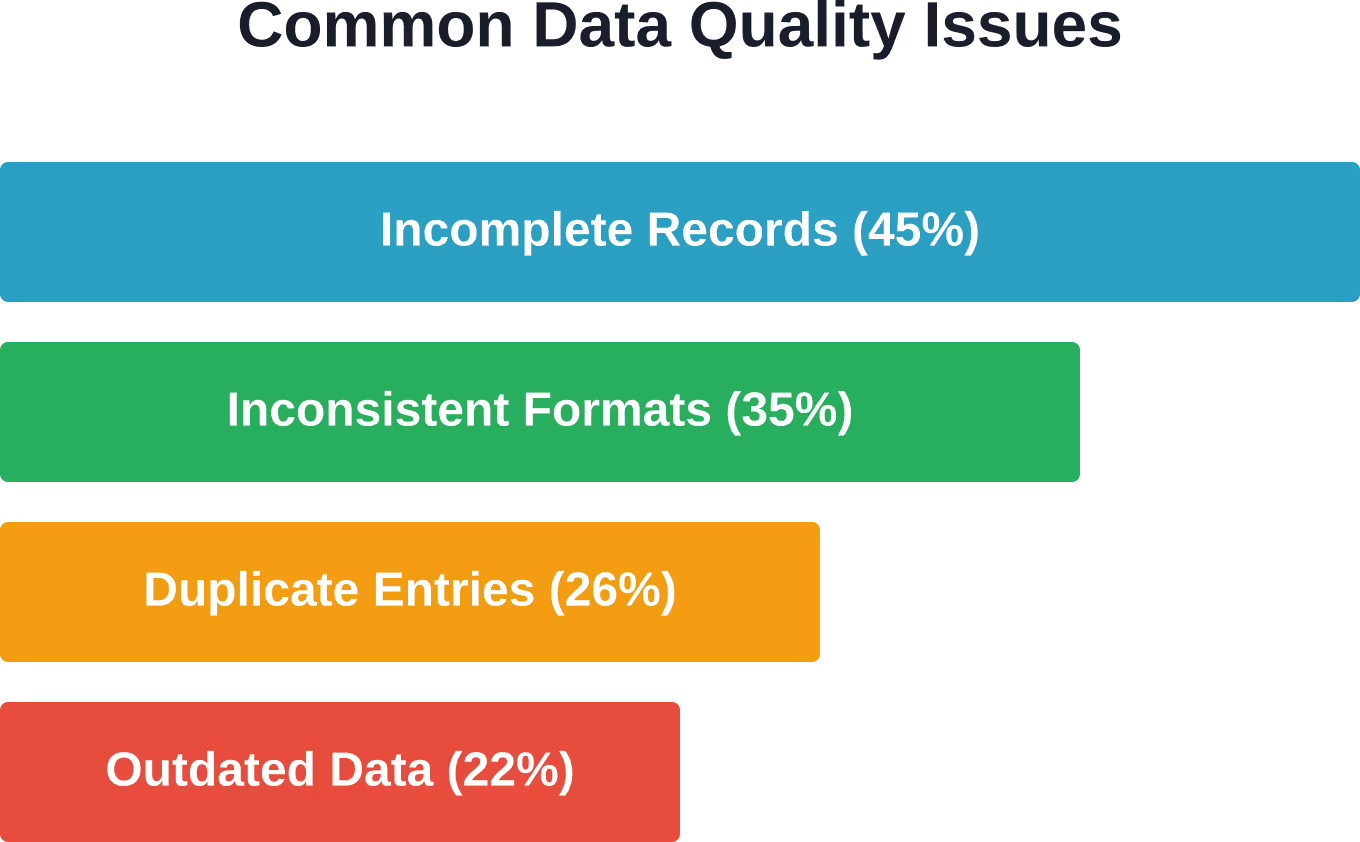 Data preparation typically consumes substantial portions of predictive analytics project timelines. Data scientists spend more time wrangling datasets than building models. Integration adds another layer of complexity. Predictive models typically require data from multiple sources—CRM systems, ERP platforms, external market data, IoT sensors. Each source may use different schemas, update frequencies, and quality standards. The solution requires robust data governance. Establish clear data standards. Implement validation rules at the point of entry. Create data dictionaries that document field definitions and acceptable values. Invest in master data management systems that maintain single sources of truth. Regular data audits help identify quality issues before they poison predictive models. Automated data quality checks can flag anomalies, missing values, and inconsistencies in real-time.
Algorithmic Bias: When Predictions Perpetuate Inequity
Predictive algorithms learn patterns from historical data. When that historical data contains biases, algorithms amplify them. According to the Brookings Institution, Amazon discovered this firsthand when its recruiting algorithm, trained on a 10-year period of hiring data, systematically downgraded résumés containing women’s college names. NIST government research highlights similar concerns in law enforcement. Predictive policing algorithms trained on NYPD records incorporate data from unconstitutional Stop-And-Frisk practices. The program stopped approximately 4.4 million individuals between 2002 and 2013, disproportionately targeting communities of color. Algorithms trained on these records memorialize and perpetuate discriminatory practices. Bias detection tests show promise but aren’t foolproof. One graphical test for bias in meta-analysis demonstrated a 10% false positive rate, meaning it incorrectly flagged unbiased data 10% of the time. Healthcare presents another concerning domain. Predictive models used to allocate care resources or predict patient outcomes can perpetuate existing disparities when trained on data reflecting unequal access to treatment.
| Bias Type | Source | Impact | Mitigation Strategy |
|---|---|---|---|
| Historical Bias | Past discriminatory practices in training data | Reproduces past inequities | Audit datasets, reweight samples, use fairness constraints |
| Measurement Bias | Proxies that correlate with protected attributes | Indirect discrimination | Identify and remove proxy variables, test for disparate impact |
| Representation Bias | Underrepresented groups in training data | Poor predictions for minorities | Oversample minorities, collect more diverse data |
| Aggregation Bias | One-size-fits-all models for diverse populations | Inaccurate predictions for subgroups | Build subgroup-specific models, include interaction terms |
Addressing bias requires deliberate intervention. Start with diverse teams that can identify blind spots. Audit training data for representation gaps and historical inequities. Test model outputs across demographic groups to detect disparate impact. Fairness constraints can be built into algorithms, though they involve tradeoffs. Perfect fairness across all definitions simultaneously is mathematically impossible—organizations must choose which fairness criteria matter most for their context.
The Expertise Gap: Finding and Retaining Talent
Predictive analytics demands specialized skills that combine statistics, programming, domain knowledge, and business acumen. These unicorn profiles are scarce and expensive. Data scientists command premium salaries. Competition for talent is fierce, particularly for professionals who understand both advanced machine learning techniques and specific industry contexts like healthcare, finance, or manufacturing. Smaller organizations face especially steep barriers. They can’t compete on compensation with tech giants. They lack the established data infrastructure and tooling that attract top talent. And they often struggle to provide the challenging problems that keep data scientists engaged. The knowledge transfer problem compounds the talent challenge. When a key data scientist leaves, they take institutional knowledge about model assumptions, data quirks, and implementation decisions with them. Insufficiently documented models become black boxes that remaining staff can’t maintain or improve. Some organizations address the expertise gap through partnerships with universities or consulting firms. Others invest in upskilling existing analysts, providing training in statistical methods and machine learning tools. Embedded AI and automated machine learning platforms lower the expertise barrier somewhat. These tools handle routine model selection and tuning tasks, allowing less specialized staff to build basic predictive models. However, they don’t eliminate the need for expertise—someone still needs to validate model assumptions, interpret results, and handle edge cases.
Organizational Resistance: Culture Eats Analytics for Breakfast
Technical challenges are only half the battle. Organizational resistance often proves more difficult to overcome than any algorithmic problem. Managers who’ve built careers on intuition and experience may resent being told that algorithms outperform their judgment. Employees fear that predictive systems will automate them out of jobs. Departments resist sharing data that represents their turf and influence. 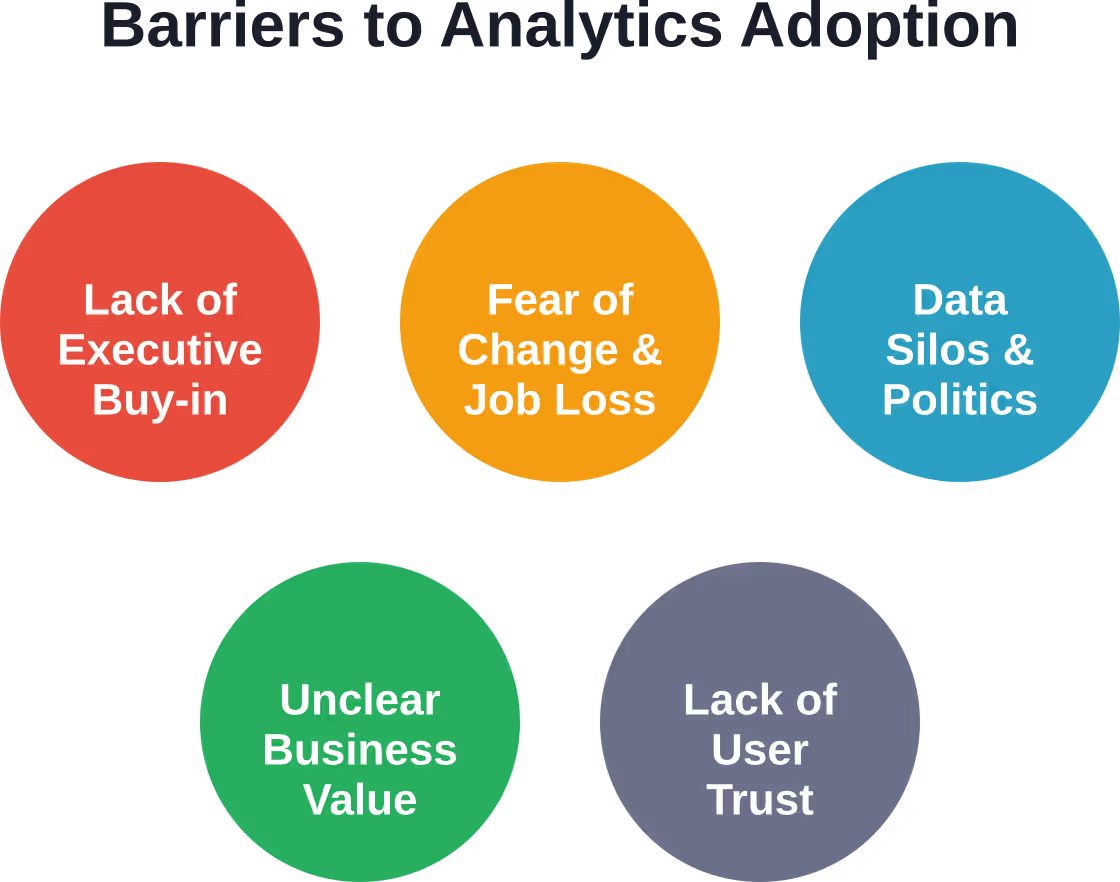 Without executive sponsorship, predictive analytics initiatives languish. They get deprioritized when budgets tighten. They can’t secure the cross-functional cooperation needed for data access and process changes. GSA research on data and analytics approaches emphasizes obtaining leadership and stakeholder commitment as a critical early step. Leaders must champion analytics initiatives, allocate resources, and hold teams accountable for adoption. Communication is essential. Technical teams need to translate model outputs into business language. Rather than discussing precision-recall curves, explain how the model will reduce customer churn by 15% or cut maintenance costs by $2 million annually. Start with quick wins that demonstrate value. Tackle a well-defined problem where predictive analytics can show measurable improvement. Success builds credibility and momentum for more ambitious projects. Change management shouldn’t be an afterthought. Involve end users early in the design process. Provide training on how to interpret and act on predictions. Address job security concerns transparently—position analytics as augmenting human judgment rather than replacing it.
Model Interpretability: The Black Box Problem
Complex machine learning models often operate as black boxes. They generate accurate predictions but provide little insight into how they arrived at those conclusions. This opacity creates problems. Regulatory compliance in industries like healthcare and finance often requires explainable decisions. Clinicians won’t trust a model that recommends treatment without explaining its reasoning. Loan officers need to justify why an application was denied. The tradeoff between accuracy and interpretability presents difficult choices. Simple linear models are easy to understand but may miss complex patterns. Deep neural networks capture intricate relationships but defy human comprehension. According to MIT Sloan research, organizations must carefully choose between generative AI and predictive AI based on their specific needs. For example, predicting a patient’s LDL cholesterol level six months from now or forecasting product sales for the next 24 hours requires transparent predictive models where stakeholders can verify the logic. Interpretable machine learning techniques help bridge the gap. SHAP values and LIME explanations provide post-hoc interpretability by identifying which features most influenced specific predictions. Partial dependence plots show how changing one variable affects outcomes while holding others constant. Some organizations adopt a tiered approach: use complex models for high-stakes predictions but build simpler interpretable models to validate and explain the results to stakeholders.
Selecting the Right Tools and Technologies
The predictive analytics technology landscape is crowded and confusing. Organizations face choice paralysis among dozens of platforms, libraries, and tools. Open-source options like Python’s scikit-learn, TensorFlow, and R provide powerful capabilities at no licensing cost. However, they require significant technical expertise and offer limited support. Commercial platforms from vendors like SAS, IBM, Microsoft, and others bundle analytics capabilities with enterprise features—data management, model deployment, monitoring, and governance. They’re easier to use but come with substantial costs and potential vendor lock-in. Cloud-based services from AWS, Google Cloud, and Azure offer flexible, scalable infrastructure for predictive analytics. They reduce upfront capital expenses but introduce operational complexity and data security considerations.
| Approach | Best For | Key Advantages | Main Drawbacks |
|---|---|---|---|
| Open Source | Organizations with strong technical teams | No licensing costs, maximum flexibility, large community | Requires expertise, limited support, DIY integration |
| Commercial Platforms | Enterprises needing turnkey solutions | Integrated features, vendor support, user-friendly | High costs, vendor lock-in, less customization |
| Cloud Services | Organizations wanting scalability without infrastructure | Pay-as-you-go, infinite scale, latest capabilities | Ongoing costs, data transfer concerns, learning curve |
| Hybrid | Large organizations with diverse needs | Optimize for each use case, reduce risk | Integration complexity, multiple skill sets required |
The right choice depends on organizational context. Consider existing technical capabilities, budget constraints, scalability requirements, and industry-specific compliance needs. Don’t underestimate the importance of the broader data ecosystem. Predictive analytics tools need to integrate with data warehouses, visualization platforms, business applications, and operational systems. Connectivity and interoperability often matter more than algorithm sophistication.
Keeping Models Relevant: The Concept Drift Challenge
Predictive models decay over time. The patterns they learned from historical data become less relevant as business conditions, customer behaviors, and market dynamics shift. This phenomenon, called concept drift, is particularly acute in fast-moving domains. A fraud detection model trained pre-pandemic may miss new scam patterns that emerged during COVID-19. A demand forecasting model built before supply chain disruptions won’t account for new inventory constraints. Real-world changes manifest as declining model performance. Prediction accuracy drops. Precision and recall metrics deteriorate. But organizations often don’t notice until significant business impact occurs. Monitoring is essential. Establish baseline performance metrics when deploying models. Track those metrics continuously in production. Set up alerts that trigger when performance degrades beyond acceptable thresholds. Regular retraining keeps models current. Some organizations retrain monthly, others quarterly—the right frequency depends on how quickly the underlying patterns change. Automated retraining pipelines reduce the operational burden. Feature engineering requires ongoing attention too. As business processes evolve, new data sources become available, or priorities shift, the features that drive predictions may need updating.
Privacy, Security, and Regulatory Compliance
Predictive analytics often requires aggregating sensitive personal information—financial records, health data, behavioral patterns. This creates substantial privacy and security risks. NSF research on AI in healthcare highlights data governance challenges. Predictive models in medical settings must comply with HIPAA regulations that restrict how patient information can be used and shared. Financial services face similar constraints under regulations like GDPR, CCPA, and industry-specific rules. The costs of violations are severe. Data breaches that expose personal information trigger regulatory fines, litigation costs, and reputational damage. Privacy-preserving techniques offer partial solutions. Differential privacy adds mathematical noise to datasets that preserves aggregate patterns while protecting individual records. Federated learning allows models to train on distributed data without centralizing it. Synthetic data generation creates artificial datasets that maintain statistical properties without containing real personal information. However, these techniques involve tradeoffs. Privacy protections typically reduce model accuracy. Implementation requires specialized expertise. And regulatory frameworks haven’t caught up—it’s unclear whether synthetic data fully satisfies compliance requirements. Strong data governance frameworks are non-negotiable. Document data lineage. Implement access controls. Conduct privacy impact assessments. Maintain audit trails. Establish clear policies for data retention and deletion.
Best Practices for Overcoming Predictive Analytics Challenges
Successfully implementing predictive analytics requires a holistic approach that addresses technical, organizational, and governance dimensions simultaneously.
- Start with clear business objectives. Define specific problems predictive analytics will solve and how success will be measured. “Improve customer retention” is too vague. “Reduce churn in the premium customer segment by 10% within six months” provides a concrete target.
- Invest in data infrastructure before investing in algorithms. Establish data quality standards. Build ETL pipelines that reliably move data from source systems to analytics platforms. Create data catalogs that make datasets discoverable.
- Assemble cross-functional teams. Predictive analytics projects need data scientists, domain experts, IT professionals, and business stakeholders working together. Siloed efforts fail.
- Embrace rapid prototyping. Build minimal viable models quickly to test feasibility and generate early feedback. Iterate based on results rather than trying to perfect models before deployment.
- Prioritize model governance. Document model assumptions, training data sources, and performance baselines. Establish review processes before deploying models to production. Create clear ownership and accountability.
- Plan for the full model lifecycle, not just initial development. Who monitors performance? Who retrains models when drift occurs? Who handles edge cases and errors? These operational questions determine long-term success.
- Communicate results effectively. Build dashboards that make predictions actionable. Provide context and confidence intervals, not just point estimates. Train end users on proper interpretation.
Industry-Specific Considerations
Different industries face unique predictive analytics challenges shaped by their regulatory environments, data characteristics, and business models. Healthcare organizations must navigate HIPAA compliance, fragmented health records, and life-or-death consequences of prediction errors. Clinical adoption requires exceptional model interpretability—physicians need to understand and trust recommendations. Financial services face stringent regulatory requirements for model validation and fair lending practices. Models must be auditable and explainable. Real-time fraud detection demands low latency predictions at massive scale. Retail and e-commerce benefit from abundant transaction data but struggle with rapidly changing consumer preferences and seasonal patterns. Inventory optimization requires coordinating predictions across thousands of SKUs. Manufacturing leverages IoT sensor data for predictive maintenance but must handle equipment heterogeneity and the cold-start problem for new machinery without historical failure data. Understanding industry-specific constraints shapes realistic implementation strategies and helps prioritize which challenges to tackle first.
Frequently Asked Questions
What is the biggest challenge in implementing predictive analytics?
Data quality consistently ranks as the top challenge. Predictive models require clean, complete, and relevant data, but most organizations discover their data contains inconsistencies, gaps, and errors. Data preparation typically consumes substantial portions of project timelines, and poor quality data directly undermines model accuracy regardless of algorithm sophistication.
How can organizations address algorithmic bias in predictive models?
Addressing bias requires multiple interventions: audit training data for historical inequities and representation gaps, build diverse teams that can identify blind spots, test model outputs across demographic groups for disparate impact, and incorporate fairness constraints into algorithms. Organizations should also establish ongoing monitoring processes since bias can emerge as conditions change.
Do we need data scientists to implement predictive analytics?
While specialized expertise helps, automated machine learning platforms and embedded AI tools have lowered barriers to entry. Organizations can start with simpler predictive models using these platforms, though complex problems still benefit from data science expertise. Alternatively, partnerships with universities or consulting firms can supplement internal capabilities during initial implementations.
How often should predictive models be retrained?
Retraining frequency depends on how quickly underlying patterns change in the domain. Fast-moving areas like fraud detection or demand forecasting may require monthly or even weekly retraining, while more stable domains can retrain quarterly. The key is establishing performance monitoring that triggers retraining when accuracy degrades beyond acceptable thresholds rather than following arbitrary schedules.
What’s the difference between predictive AI and generative AI?
According to MIT Sloan research, predictive AI forecasts specific outcomes based on input data—like predicting a patient’s cholesterol level six months from now or forecasting product sales for the next 24 hours. Generative AI creates new content like text, images, or code. Organizations should choose based on their specific problem: use predictive AI for forecasting and classification tasks, generative AI for content creation.
How can companies overcome organizational resistance to predictive analytics?
Overcoming resistance requires executive sponsorship, clear communication of business value, and involving end users early in the design process. Start with quick wins on well-defined problems to build credibility. Address job security concerns transparently by positioning analytics as augmenting rather than replacing human judgment. Provide adequate training so stakeholders understand how to interpret and act on predictions.
What are the main privacy concerns with predictive analytics?
Predictive analytics often aggregates sensitive personal information, creating risks of data breaches, unauthorized access, and regulatory violations. Organizations must comply with regulations like GDPR, CCPA, and industry-specific rules such as HIPAA in healthcare. Privacy-preserving techniques like differential privacy and federated learning help, though they involve accuracy tradeoffs and require specialized implementation expertise.
Moving Forward With Predictive Analytics
Predictive analytics challenges are real and substantial. Data quality issues, algorithmic bias, talent shortages, organizational resistance, and technical complexity create formidable obstacles. But these challenges aren’t insurmountable. Organizations that approach implementation methodically—investing in data foundations, addressing bias proactively, securing stakeholder buy-in, and establishing governance frameworks—can build predictive capabilities that deliver genuine competitive advantages. The key is realistic expectations. Predictive analytics isn’t magic. It won’t perfectly forecast the future. And it requires ongoing investment in data infrastructure, talent, and operational processes. Success comes from treating predictive analytics as a strategic capability to be built over time rather than a one-off technology purchase. Start small, learn from failures, iterate based on feedback, and gradually expand to more complex use cases. The organizations that thrive with predictive analytics in 2026 and beyond won’t be those with the most sophisticated algorithms. They’ll be the ones that successfully navigate the full spectrum of technical, organizational, and ethical challenges to embed data-driven decision-making into their culture and operations. Ready to tackle these challenges? Begin by auditing current data quality, identifying a high-value use case for a pilot project, and securing executive sponsorship. The journey requires patience and persistence, but the competitive advantages of predictive insight make it worthwhile.