Quick Summary: Hiring AI developers in 2026 requires understanding specialized skills in machine learning, natural language processing, and AI model deployment. Research examining AI tools and developer productivity found that introducing generative AI tools to software developers increased productivity. The market offers various hiring models—freelance platforms, dedicated development teams, and full-time remote talent—each suited to different project scopes and budgets.
The race for artificial intelligence talent has never been more competitive. A recent survey indicates 9 out of 10 companies are looking to add AI expertise to their staff, with particular focus on ChatGPT and generative AI specialists.
But here’s the challenge: finding qualified AI developers isn’t like hiring traditional software engineers. The skill set is different, the vetting process is more complex, and the market dynamics favor candidates with multiple competing offers.
This guide breaks down everything from understanding what AI developers actually do to choosing between freelance talent and dedicated teams. Real talk: the hiring landscape has shifted dramatically since 2024, and outdated strategies won’t cut it anymore.
What AI Developers Actually Do
Artificial intelligence developers create systems that mimic human intelligence—handling tasks like analyzing data, understanding natural language, recognizing patterns, solving problems, and making decisions. These systems train on data and adapt as they encounter new information.
The role splits into several specializations. Machine learning engineers focus on building and deploying models. Natural language processing experts work on systems that understand and generate human language. Computer vision specialists develop image and video recognition capabilities.
And then there’s the newer category: prompt engineers and generative AI specialists who optimize how systems interact with large language models like GPT-4 and Claude.
Production infrastructure matters as much as model development. AI engineers set up pipelines for data preprocessing, model training, version control, and deployment at scale. They work with frameworks like TensorFlow, PyTorch, and scikit-learn, often deploying on cloud platforms with GPU acceleration.
The Productivity Case for AI Developer Tools
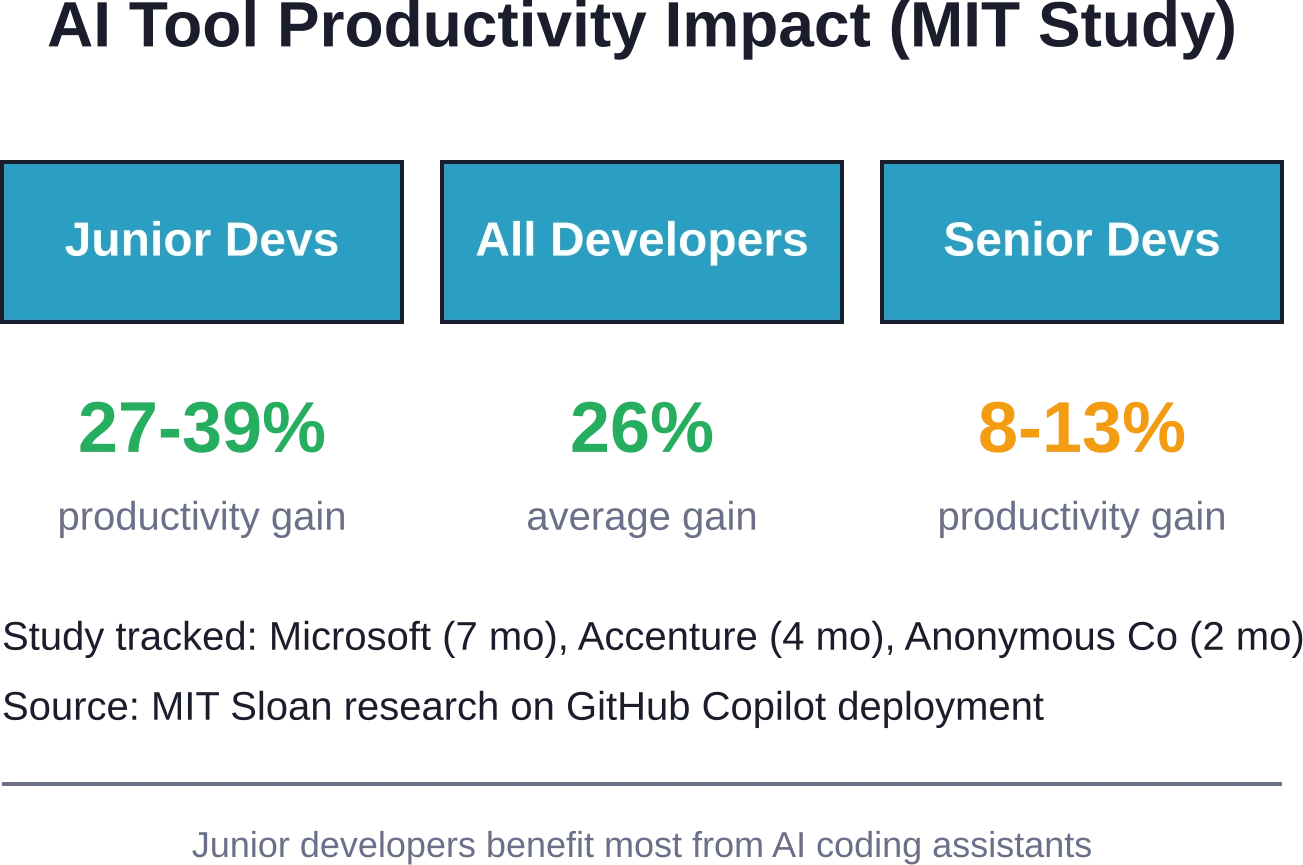
Before diving into hiring, it’s worth understanding how AI tools are changing developer productivity. MIT Sloan research examined three organizations—Microsoft, Accenture, and an anonymous company—that rolled out an AI coding assistant to their development teams in staggered phases. The researchers found that introducing a generative AI tool to software developers increased productivity, with researchers analyzing output metrics across the deployments.
Research found that less-experienced developers showed higher adoption rates and greater productivity gains from AI tools.
Senior developers also benefited from the tools, though with different patterns of adoption.
Here’s why that matters for hiring: AI tools help newer team members ramp up faster. At Microsoft, the split lasted for seven months; at Accenture, it lasted for four months. At the anonymous company, all users were given access to the tool over a period of two months in a staggered fashion, with some teams using the tool up to six weeks before others.
Teams that got access first showed measurable productivity gains within weeks. The implication? Junior AI developers equipped with modern tooling can contribute faster than traditional onboarding timelines would suggest.
Essential Skills for AI Developers
Technical requirements for AI roles differ from general software engineering positions. Python dominates as the primary programming language, with libraries like NumPy, pandas, and scikit-learn forming the foundation.
Machine learning frameworks are non-negotiable. Developers should demonstrate hands-on experience with TensorFlow or PyTorch. Understanding when to use each matters—TensorFlow excels in production deployments, while PyTorch offers more flexibility for research and experimentation.
Core Technical Competencies
Mathematical foundations can’t be skipped. Linear algebra, calculus, probability, and statistics underpin how models learn and make predictions. Developers need to understand gradient descent, backpropagation, loss functions, and optimization algorithms.
Data engineering skills separate competent AI developers from exceptional ones. Model performance depends entirely on data quality. That means expertise in data cleaning, feature engineering, handling missing values, dealing with imbalanced datasets, and creating robust validation strategies.
Cloud platform experience has become essential. AWS, Google Cloud, and Azure all offer specialized AI/ML services. Developers should know how to provision GPU instances, manage storage for large datasets, orchestrate training jobs, and deploy models as scalable APIs.
Specialized Knowledge Areas
Natural language processing requires its own skill stack. Transformers, attention mechanisms, tokenization strategies, embeddings, and fine-tuning techniques for large language models all fall under this umbrella.
Computer vision specialists need different expertise: convolutional neural networks, object detection architectures, image segmentation, transfer learning with pre-trained models, and data augmentation techniques.
Reinforcement learning represents another specialized domain. Understanding Markov decision processes, Q-learning, policy gradients, and reward shaping matters for developers working on game AI, robotics, or optimization problems.
| Skill Category | Core Technologies | Experience Level |
|---|---|---|
| Programming Languages | Python, R, Julia, Scala | Expert in Python required |
| ML Frameworks | TensorFlow, PyTorch, scikit-learn | Proficient in 2+ |
| Cloud Platforms | AWS SageMaker, Google AI Platform, Azure ML | Hands-on deployment experience |
| Data Engineering | SQL, Spark, Airflow, data pipelines | Production-grade skills |
| Mathematics | Linear algebra, calculus, statistics | Strong foundational understanding |
| MLOps | Docker, Kubernetes, CI/CD, monitoring | Intermediate to advanced |
Freelance vs. Full-Time AI Developers
The hiring model depends on project scope, timeline, and budget constraints. Freelance AI developers work well for defined projects with clear deliverables—building a proof of concept, implementing a specific model, or augmenting an existing team during peak periods.
Platforms like Arc, Upwork, and Toptal connect companies with vetted freelance talent. Arc specifically vets AI developers through technical assessments. Dataspace focuses exclusively on data science and AI roles, with decades of experience screening candidates in these specialized fields.
According to Dataspace, their thorough vetting means clients spend 80% less time on the candidate search and vetting process. That matters when engineering leaders don’t have bandwidth to review dozens of resumes and conduct multiple technical screens.
Dedicated Development Teams
Full-time remote AI engineers make sense for ongoing product development, research initiatives, or building proprietary AI capabilities. Platforms like Turing and FullStack specialize in matching companies with senior engineers for longer-term engagements.
FullStack positions itself as Latin America’s largest talent network for AI engineers. They handle contracts, compliance, and payroll, allowing developers to start contributing to the codebase immediately. Their model includes a two-week trial period—if the developer’s performance doesn’t meet expectations within the first 14 days, clients aren’t charged.
Turing focuses on remote AI engineer jobs that require 40-hour weekly commitments with at least four hours of overlap with Pacific Standard Time. That structure works for companies wanting dedicated team members integrated into daily standups and sprint planning.
Now, this is where it gets interesting. Remote talent opens access to global markets where AI expertise might be more available and cost-effective than local hiring.
Cost Considerations
Pricing varies widely based on experience level, specialization, and geographic location. Freelance rates depend on project complexity and contractor seniority. Check platform websites for current pricing—rates fluctuate with market demand.
Full-time salaries for AI engineers in the United States reflect high demand. LinkedIn lists over 29,000 AI developer job openings in the United States. That supply-demand imbalance pushes compensation upward, especially for specialists in generative AI and large language models.
Vetting AI Developer Candidates
Technical screening for AI roles requires domain expertise. Generic coding interviews don’t reveal whether candidates understand model architecture decisions, hyperparameter tuning, or debugging underperforming models.
Portfolio review comes first. Strong AI developers maintain GitHub repositories with documented projects. Look for clean code, proper version control practices, comprehensive README files, and evidence of experimentation.
Kaggle competition participation signals practical experience with real datasets and model optimization under constraints. Top-tier candidates often have profiles showing consistent participation and occasional high rankings.
Technical Assessment Strategies
Take-home projects work better than whiteboard interviews for AI roles. Provide a dataset and a problem statement. Ask candidates to build a model, document their approach, explain architecture decisions, and present results.
Evaluate not just final accuracy but the entire process. Did they perform exploratory data analysis? How did they handle class imbalance? What validation strategy did they choose? Can they articulate why one algorithm outperformed another?
System design discussions reveal production readiness. Ask how they’d deploy a model to serve millions of requests daily. Probe understanding of model versioning, A/B testing, monitoring for data drift, and handling concept drift over time.
Behavioral and Communication Skills
AI projects rarely succeed in isolation. Developers need to communicate technical concepts to non-technical stakeholders, collaborate with data engineers and product managers, and translate business requirements into model objectives.
Ask about past projects where models failed or underperformed. Strong candidates discuss lessons learned, how they debugged issues, and what they’d do differently. Weak candidates either claim they’ve never had failures or blame external factors without reflection.
Understanding business context matters as much as technical chops. The best AI developers ask why a problem needs solving before jumping to solutions. They question whether machine learning is even necessary or if simpler approaches might work.

Get AI Development Support From AI Superior
Hiring AI developers can be difficult when a company is not yet sure what skills, models, data work, or product architecture the project actually needs. AI Superior provides AI consulting, AI/ML development, AI software development, AI components development, generative AI development, computer vision, NLP, and business intelligence solutions. Instead of only looking for individual developers, companies can work with a team that can help define the use case, plan the technical approach, build AI components, and support implementation.
AI Superior can support AI development through:
- AI consulting and use case discovery
- Custom AI and ML software development
- AI components for existing products
- Generative AI, NLP, and computer vision development
- Integration of AI tools into business systems
👉Contact AI Superior to discuss your AI development needs, project scope, or technical requirements before hiring or building an internal team.
Where AI Talent Acquisition Is Heading
Stanford economists discussed AI’s economic impact at the 2026 SIEPR Economic Summit. Erik Brynjolfsson from the Stanford Digital Economy Lab highlighted ongoing research into how AI tools reshape work patterns and skill requirements.
The consensus? AI won’t simply replace developers—it’s changing what skills matter most. Brookings research published April 2, 2026 examined how AI may reshape career pathways, particularly for workers without four-year degrees, finding over 15 million such workers in jobs highly exposed to AI.
Gateway occupations that allow skill-building while providing immediate wage gains become more important. Workers can transition into higher-wage roles by gaining practical AI experience, even without traditional computer science credentials.
That shift creates opportunities for companies willing to invest in training and upskilling. Hiring junior AI developers with strong fundamentals and providing access to modern tools and mentorship can yield productivity gains comparable to hiring expensive senior talent.
The Rise of AI-Native Roles
Prompt engineering emerged as a distinct discipline in the past two years. These specialists optimize how systems interact with large language models, crafting prompts that reliably produce desired outputs and designing evaluation frameworks for generative AI applications.
AI safety and alignment researchers focus on ensuring models behave as intended, identifying and mitigating bias, preventing adversarial attacks, and building interpretability into complex systems.
MLOps engineers bridge the gap between data science and DevOps. They build infrastructure for continuous training, automated model deployment, performance monitoring, and incident response when models degrade in production.
These roles didn’t exist five years ago. The skill requirements continue evolving as the technology advances. Companies need hiring strategies flexible enough to adapt as new specializations emerge.
Building Effective AI Teams
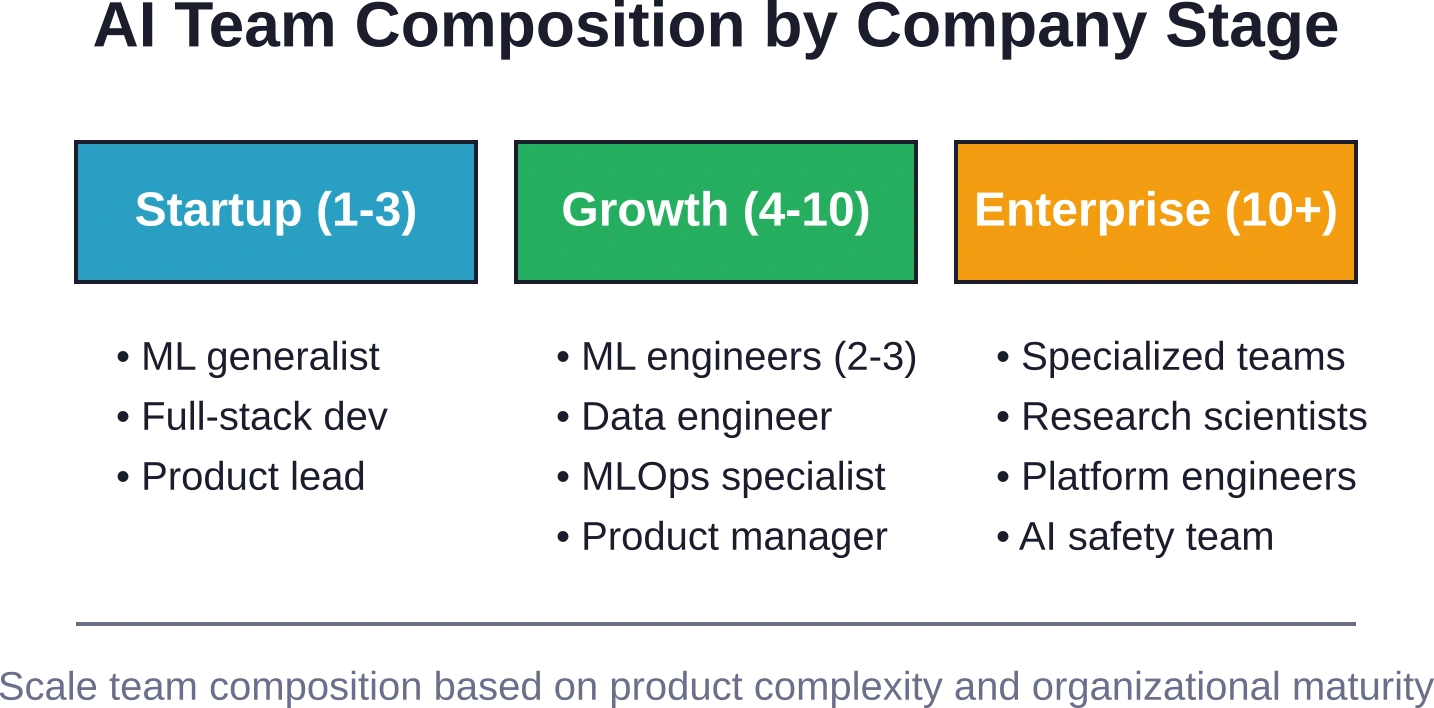
Individual talent matters, but team composition determines project success. Small AI teams need generalists who can handle multiple responsibilities. Larger organizations benefit from specialists who go deep in particular domains.
The minimum viable AI team typically includes a machine learning engineer to build models, a data engineer to handle pipelines and infrastructure, and a product manager who understands both business requirements and technical constraints.
As teams grow, add specialists. A dedicated MLOps engineer ensures models reach production reliably. A research scientist explores cutting-edge techniques and evaluates new approaches. Domain experts provide context-specific knowledge that generic AI skills can’t replace.
Remote Team Management
Remote AI teams present unique coordination challenges. Model training experiments can take hours or days, making synchronous collaboration difficult. Documentation becomes critical when team members work across time zones.
Establish clear experiment tracking protocols. Tools like Weights & Biases, MLflow, or Neptune help teams share results, compare approaches, and reproduce experiments. Without systematic tracking, knowledge gets siloed in individual contributors’ notebooks.
Schedule overlap time for real-time collaboration. Even fully asynchronous teams benefit from a few hours per week when everyone’s online simultaneously for design discussions, code reviews, and debugging sessions.
Create comprehensive onboarding for new AI team members. Document not just code but context—why certain architectural decisions were made, what approaches were tried and abandoned, where the dragons hide in the dataset.
Compliance and Standards Considerations
AI development doesn’t happen in a regulatory vacuum. The IEEE has published multiple standards relevant to artificial intelligence systems, including IEEE 1232-2010 for AI-ESTATE, which standardizes interfaces for intelligent diagnostic reasoners.
More recent standards work includes IEEE P3123 for AI and machine learning terminology and data formats, IEEE P3128 for evaluating AI dialogue system capabilities, and IEEE P3129 for robustness testing and evaluation of AI-based systems.
When hiring AI developers, particularly for regulated industries like healthcare, finance, or legal services, verify their understanding of relevant compliance frameworks. The IEEE published guidance on building trusted AI systems emphasizing four conditions: effectiveness, competence, accountability, and transparency.
Bias and Fairness Testing
AI systems can codify biases present in training data. Developers need skills in identifying potential fairness issues, implementing bias detection techniques, and designing mitigation strategies.
Legal applications of AI face particular scrutiny. Research from the NIST 2011 Text Retrieval (TREC) study reported large discrepancies in participants’ own estimated recall compared with actual recall. For example, one team estimated their recall on a particular task to be 81%, but their actual recall was 56% (a difference of 25%).
That gap between perception and reality matters. AI developers must understand evaluation metrics deeply, not just optimize for accuracy but consider precision, recall, F1 scores, and fairness metrics across demographic groups.
Onboarding and Retaining AI Talent
Hiring is only the beginning. Retention matters more than recruitment, especially given how competitive the AI talent market remains.
Provide access to cutting-edge tools and infrastructure. AI developers want to work with modern frameworks, sufficient compute resources, and clean datasets. Forcing talented engineers to work with outdated tools or inadequate hardware drives them to competitors.
Create time for learning and experimentation. The field evolves rapidly—techniques from two years ago are already outdated. Allow developers dedicated time to explore new approaches, attend conferences, and experiment with emerging methods.
Build clear career progression paths. Not every AI developer wants to move into management. Create technical leadership tracks where senior engineers can advance their careers by deepening expertise rather than managing people.
Knowledge Sharing Culture
Establish regular knowledge-sharing sessions where team members present recent work, discuss papers they’ve read, or demonstrate new techniques. These sessions cross-pollinate ideas and prevent knowledge silos.
Document everything. AI projects generate enormous amounts of tribal knowledge—which hyperparameters work best, why certain preprocessing steps matter, what data quirks to watch for. Capture this in wikis, README files, and code comments.
Encourage publishing and open-source contributions where possible. Many AI developers are motivated by recognition from the broader community. Allowing them to publish research or contribute to open-source projects builds reputation and attracts additional talent.
Common Hiring Mistakes to Avoid
The biggest mistake? Hiring for credentials rather than capabilities. A PhD in machine learning from a prestigious university doesn’t guarantee someone can ship production ML systems. Conversely, self-taught developers with strong portfolios sometimes outperform traditionally credentialed candidates.
Don’t conflate data science with AI engineering. Data scientists focus on analysis, insights, and model prototypes. AI engineers build production systems. The skill sets overlap but aren’t identical. Hiring a data scientist for an engineering role leads to frustration on both sides.
Avoid undefined scope. “We need someone who can do AI” is not a job description. Specify whether the role focuses on NLP, computer vision, recommendation systems, or something else. Clarity attracts better candidates.
Unrealistic Timeline Expectations
AI projects take longer than traditional software development. Data collection and cleaning often consume more time than model building. Proof of concept to production deployment involves significant engineering work.
Setting aggressive deadlines without understanding the work involved creates burnout and high turnover. Experienced AI developers recognize unrealistic timelines and decline offers from companies that don’t understand the development process.
Don’t treat AI as magic. It’s a powerful tool but not a solution for every problem. Sometimes a rules-based system, a SQL query, or a simple heuristic solves the problem better than a neural network. Hire developers who understand when not to use AI.
Evaluating Hiring Platform Options
Multiple platforms specialize in AI developer hiring, each with different strengths. Arc focuses on matching companies with vetted AI developers—both freelance and full-time. Their vetting process screens for technical competence before candidates reach clients.
Upwork offers broader freelance access with less pre-vetting. That means more options but also more screening work on the client side. For companies with strong technical leadership who can evaluate candidates, the larger pool provides flexibility.
Toptal emphasizes elite freelancers and a rigorous acceptance process. Their screening reportedly accepts only the top tier of applicants, which translates to higher rates but potentially faster ramp-up and fewer misfires.
Dataspace specializes exclusively in data science and AI roles. Their focus means recruiters understand the domain deeply. For companies hiring multiple AI specialists, working with a specialized platform reduces time explaining requirements.
LinkedIn remains the largest source of AI developer job postings, with over 29,000 listings currently in the United States. Posting there reaches passive candidates not actively browsing hiring platforms but open to the right opportunity.
| Platform | Best For | Key Advantage |
|---|---|---|
| Arc | Vetted freelance and full-time | Pre-screened technical candidates |
| Upwork | Large freelance pool | Maximum candidate variety |
| Toptal | Premium freelance talent | Elite screening process |
| Dataspace | Specialized AI/ML hiring | Domain-specific expertise |
| FullStack | Latin American talent | Full compliance and payroll handling |
| Turing | Remote full-time engineers | Time-zone overlap requirements |
| Direct recruiting | Largest professional network |
Frequently Asked Questions
What’s the difference between an AI developer and a machine learning engineer?
The terms overlap significantly. Machine learning engineers typically focus on building, training, and deploying ML models. AI developers might have a broader scope including NLP, computer vision, robotics, or other AI subfields. In practice, job titles vary by company—the role description matters more than the title.
How long does it take to hire a qualified AI developer?
The timeline depends on the hiring approach. Using platforms with pre-vetted talent like Arc or FullStack can connect companies with candidates in 48 hours to a week. Traditional recruiting through job postings typically takes 4-8 weeks from posting to offer acceptance, sometimes longer for senior or specialized roles.
Should startups hire AI developers full-time or use freelancers?
Early-stage startups often benefit from freelance or contract developers for initial proof of concept work. This validates the AI approach without long-term commitments. Once product-market fit is established and AI becomes core to the product, transition to full-time hires who build institutional knowledge and proprietary capabilities.
What compensation should companies expect for AI developers?
Compensation varies widely based on experience, location, and specialization. Check current market rates on hiring platforms for up-to-date salary ranges. Remote positions from global talent pools often provide cost advantages compared to major tech hub salaries, while maintaining quality through thorough vetting.
How can non-technical founders evaluate AI developer candidates?
Non-technical founders should leverage technical advisors or use hiring platforms with rigorous vetting processes. Focus interview questions on past projects, asking candidates to explain their work in plain language. Strong AI developers can translate technical concepts for non-technical audiences—that communication skill matters as much as coding ability.
Do AI developers need PhD credentials?
No. PhDs signal deep research experience and theoretical knowledge, valuable for certain roles. But production AI engineering often requires different skills—software engineering fundamentals, systems design, deployment expertise—that aren’t typically part of academic training. Many exceptional AI developers are self-taught or have undergraduate degrees in related fields.
What’s the typical trial period when hiring AI developers?
Many platforms offer trial periods ranging from two weeks to a month. FullStack provides a 14-day trial where clients aren’t charged if the developer’s performance doesn’t meet expectations. This risk-free period allows both sides to evaluate fit before committing to longer-term engagement.
Making Your First AI Developer Hire
Start by defining the problem clearly. What business outcome does the AI project need to achieve? What data is available? What constraints exist around latency, cost, or accuracy?
Write a detailed job description that specifies required skills, preferred experience, and project context. Vague descriptions attract generic applicants. Specific requirements filter for relevant candidates.
Choose a hiring approach based on urgency and budget. Need someone immediately for a defined project? Freelance platforms provide fastest access. Building a long-term capability? Invest time in recruiting full-time team members.
Prepare technical evaluation materials before posting the role. Define the take-home project, create interview questions that probe relevant skills, and establish clear evaluation criteria. Scrambling to create assessments during the hiring process leads to inconsistent candidate evaluation.
Look beyond technical skills for cultural fit and communication abilities. AI projects succeed when developers collaborate effectively with product, design, and business stakeholders. Technical brilliance means little if someone can’t translate their work into business impact.
The AI talent market remains competitive, but opportunities exist for companies that approach hiring strategically. Clear requirements, efficient evaluation processes, and competitive compensation attract strong candidates even in a tight market.
And once great AI developers join the team? Invest in retention through challenging work, modern tools, learning opportunities, and clear career paths. Replacing AI talent costs far more than keeping existing team members engaged and growing.
Ready to build your AI team? Start with one strong hire focused on a specific, well-defined problem. Prove value, learn what works in your organization, then scale the team deliberately based on real needs rather than hype.