
Quick Summary: Image recognition for food uses deep learning and convolutional neural networks to automatically identify dishes, ingredients, and portion sizes from photos. Research shows that 66.7% of food recognition systems now use deep neural networks, achieving test accuracy rates above 97.5%. These systems enable automated dietary tracking, nutritional analysis, and smart restaurant applications by training on large datasets with tens of thousands of labeled food images. The burden of diet-related diseases continues to rise globally, making accurate dietary monitoring more critical than ever. Manual food logging is subject to recall bias and errors, which compromises nutritional tracking for people managing chronic conditions like obesity, hypertension, and diabetes. But here’s where technology steps in. Food image recognition systems have evolved dramatically, shifting from traditional machine learning approaches to sophisticated deep learning models that can identify dishes, detect ingredients, and estimate portion sizes—all from a single photograph. The field of food computing has gained prominence thanks to advancements in computer vision and the widespread use of smartphones. These technologies provide promising potential for real-time information retrieval from food images, enabling efficient digital food journaling, smart restaurants, and automated dietary assessment.
How Food Image Recognition Actually Works
Food recognition systems operate through several distinct phases: image preprocessing, feature extraction, classification, and in many cases, portion estimation. The core technology driving modern systems is the convolutional neural network (CNN), a type of deep learning architecture specifically designed for visual data. Research demonstrates that 66.7% of surveyed food recognition studies now use visual features from deep neural networks. Similarly, all surveyed studies employed CNN variants for ingredient recognition, marking a clear shift away from traditional computer vision methods. The process typically starts with image preprocessing. Training images are down-sampled to a fixed resolution—research indicates that 512 × 512 pixels is commonly used for mobile dietary applications. This standardization ensures consistent input dimensions and reduces computational overhead on mobile devices.
Deep Convolutional Neural Networks in Action
The Deep Convolutional Neural Network (DCNN) architecture has become the standard for complex food recognition tasks. State-of-the-art food recognition systems in 2026, based on multimodal Large Vision Models (LVMs), achieve accuracy rates exceeding 97.5%. Training these models requires substantial computational resources. Research systems typically require substantial computational resources including multiple GPUs to process training datasets efficiently. The training process itself follows a standard machine learning protocol. Images are randomly divided into training and testing groups at a ratio of 3:1. In one documented study on Korean food recognition, images were divided into 69,000 training images and 23,000 test images—a scale necessary to achieve robust performance across diverse food types and presentation styles.
Comparing Recognition Methods and Accuracy
Not all machine learning approaches deliver equal performance for food recognition tasks. Traditional classifiers show significantly lower accuracy compared to deep learning alternatives.
| Classification Method | Accuracy Rate | Key Characteristics |
|---|---|---|
| K-Nearest Neighbor (KNN) | 70% | Simple, distance-based classification |
| Support Vector Machine (SVM) | 57% | Traditional kernel-based approach |
| Linear SVM (11 classes) | 78% | Limited food category range |
| Deep CNN Models | Above 97.5% | Modern deep learning architecture |
The performance gap is substantial. While KNN achieves 70% accuracy and SVM shows lower performance, deep CNNs achieve above 95%, demonstrating why the industry has overwhelmingly shifted toward neural network approaches. The difference between 70% and 97.5% accuracy isn’t merely academic. For dietary tracking applications, that gap represents the difference between catching most meals correctly versus missing nearly one in three—potentially undermining the entire purpose of automated nutrition monitoring. 
Develop Image Recognition With AI Superior
AI Superior develops computer vision tools for image analysis, object detection, segmentation, OCR, and classification. These systems can be built around specific datasets and business needs instead of using a generic setup. For food-related projects, this can support product recognition, food item classification, packaging checks, visual quality review, or image-based sorting workflows.
Need Image Recognition for Food Data?
AI Superior can help with:
- building food image recognition tools
- detecting and classifying items in images
- testing models through PoC or MVP work
- integrating AI into daily workflows
👉 Contact AI Superior to discuss your project.
Food Group Classification and Portion Estimation
Modern systems don’t just identify individual dishes. They classify foods into broader nutritional groups and estimate portion sizes, both critical for accurate dietary assessment. Research on food group classification and portion size estimation using CNN models achieved accuracy rates around 80% for both tasks. The study compared multiple architectures, finding that ResNet-18 achieved only 60% accuracy without preprocessing, while MobileNet-v2 reached 80% with proper image preprocessing techniques. This finding highlights an important truth: preprocessing matters enormously. The same base architecture can show a 20-percentage-point swing in accuracy depending on how input images are prepared. 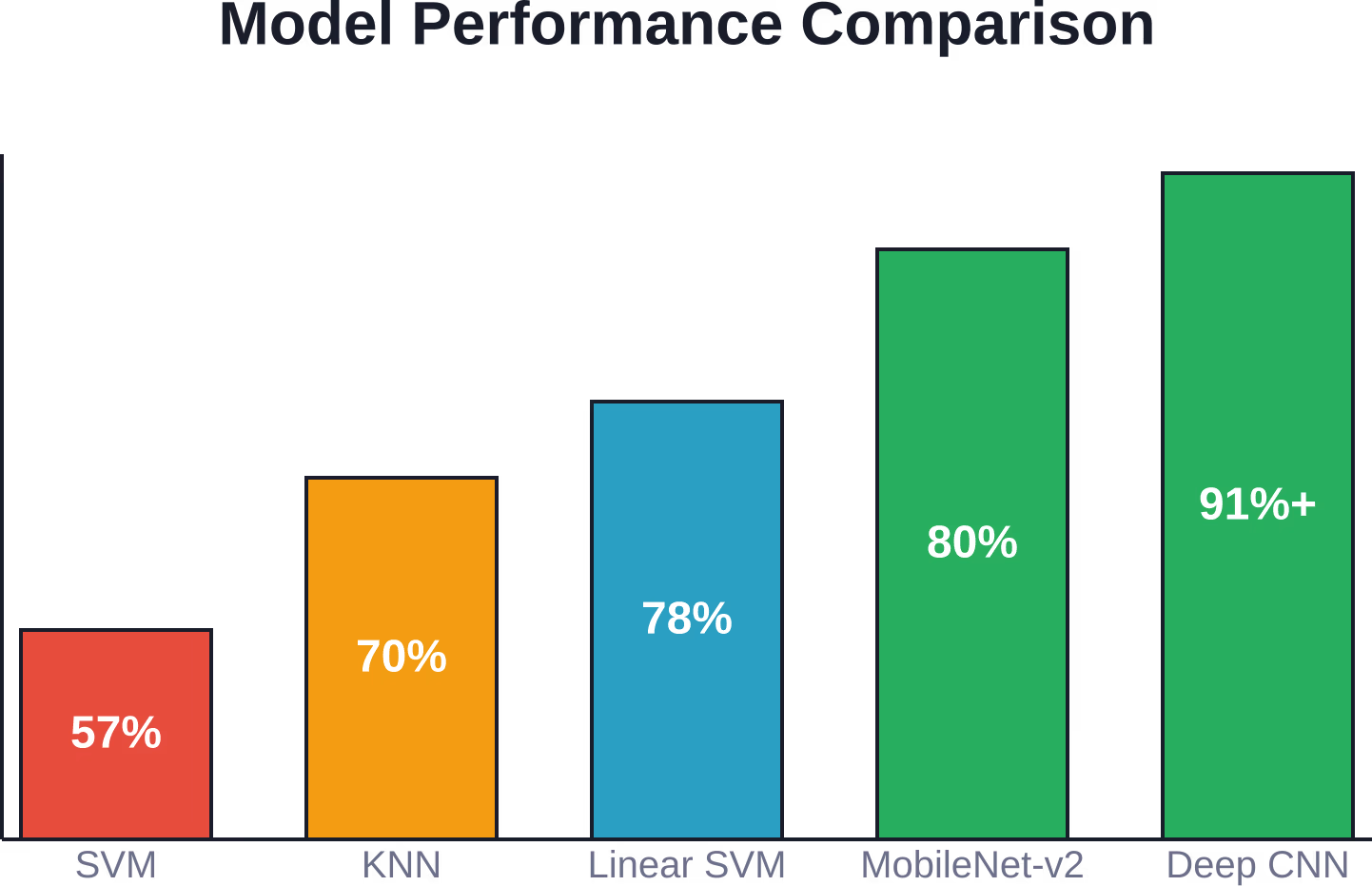
Handling Real-World Complexity
Laboratory performance doesn’t always translate to real-world scenarios. The biggest challenge? Most meals contain multiple food items, not the single-dish images that many early datasets focused on. Several food datasets have been developed covering Western, Mediterranean, and Chinese cuisines, but they often solve the simpler problem of single-item classification. To address this gap, researchers developed large-scale datasets with multiple food items per image. Large-scale food scene datasets containing over 21,000 images across hundreds of food categories have been developed to address multi-item food detection challenges, with object detection models achieving competitive results.
Real-World Applications and Use Cases
Food image recognition technology powers a growing range of practical applications across health, hospitality, and consumer sectors.
Automated Dietary Assessment
Healthcare providers and nutrition researchers use image-based food recognition systems (IBFRS) for dietary assessment. These systems reduce the burden of manual food logging while improving accuracy beyond traditional recall methods. The importance of these solutions lies in their potential to foster healthy dietary patterns and serve as a preventive measure against chronic diseases including obesity. By capturing what people actually eat—rather than what they remember eating—these systems provide more reliable data for intervention and monitoring.
Mobile Health Applications
Smartphone apps integrate food recognition APIs to offer seamless nutrition tracking. Users snap a photo of their meal, and the system returns identified foods along with nutritional information including calories, macronutrients, and micronutrients. Some platforms combine image recognition with natural language processing, allowing users to log meals via photos, voice descriptions, or text entries. This multi-modal approach accommodates different user preferences and scenarios where photography isn’t practical.
Smart Restaurants and Retail
Commercial food service operations deploy recognition technology for inventory management, automated checkout systems, and customer insights. By identifying dishes on plates or in shopping carts, these systems can streamline operations and gather data on consumption patterns.
Dataset Requirements and Model Training
Building effective food recognition models demands large-scale, high-quality datasets. The volume and diversity of training data directly impact model performance and generalization capability. Industry reports suggest that effective training requires tens of thousands of labeled images at minimum. The 3:1 training-to-testing split remains standard practice, ensuring models are evaluated on data they haven’t seen during training.
Image Quality and Preprocessing
Preprocessing techniques significantly influence model accuracy. Common approaches include resizing to fixed dimensions, normalization of pixel values, data augmentation through rotation and flipping, and color space adjustments. The fixed resolution of 512 × 512 pixels balances computational efficiency with sufficient detail for mobile applications. Higher resolutions improve fine-grained recognition but increase processing time and memory requirements—a critical trade-off for smartphone deployment.
Challenges and Limitations
Despite impressive advances, food image recognition faces several persistent challenges that limit real-world performance.
- Visual similarity between dishes poses a major hurdle. Many foods look nearly identical despite different ingredients or preparation methods. Distinguishing between white rice and cauliflower rice, or detecting the difference between full-fat and low-fat cheese in a photograph, remains difficult even for sophisticated models.
- Occlusion and partial visibility complicate recognition in multi-dish scenarios. When foods overlap on a plate or appear partially hidden, detection accuracy drops substantially. This is particularly problematic for complex meals where ingredients intermingle.
- Cultural and regional food diversity demands extensive dataset coverage. Models trained primarily on Western cuisine often fail when presented with Asian, African, or Latin American dishes. Building truly global recognition systems requires representative training data across all culinary traditions.
- Lighting conditions, camera angles, and image quality introduce variability that models must handle robustly. Professional food photography differs dramatically from hastily snapped smartphone photos in dim restaurant lighting.
The Future of Food Recognition Technology
Looking ahead, several trends are shaping the evolution of food image recognition systems. Multi-modal integration combines visual recognition with other data sources. Text descriptions, voice input, location data, and time stamps provide contextual information that improves identification accuracy. When a system knows you’re in Thailand at lunchtime, it can prioritize Thai dishes in its predictions. Real-time portion estimation advances aim to move beyond classification into precise volumetric measurement. Techniques using depth sensors, stereo cameras, and reference objects show promise for calculating actual serving sizes rather than generic portions. Personalized nutrition recommendations will leverage recognition systems to provide tailored dietary guidance. By tracking what someone actually eats over time, applications can identify nutritional gaps, suggest healthier alternatives, and adapt recommendations to individual preferences and health goals. Edge computing deployment brings recognition processing directly onto mobile devices rather than relying on cloud servers. This reduces latency, protects privacy, and enables offline functionality—important for users concerned about data sharing or lacking reliable internet connectivity.
Frequently Asked Questions
How accurate is food image recognition technology in 2026?
Modern deep learning models achieve accuracy rates above 97.5% when classifying food into established categories. Performance varies based on dataset size, food complexity, and image quality. Traditional methods like SVM have been reported to achieve 57% accuracy in some studies, while KNN classifiers achieve approximately 70%, demonstrating the superiority of CNN-based approaches.
What is the difference between food detection and food recognition?
Food detection identifies whether food is present in an image and locates where it appears, often drawing bounding boxes around multiple items. Food recognition goes further by classifying what specific dishes or ingredients are present. Many modern systems perform both tasks—detecting all foods in a scene and then recognizing each individual item.
What datasets are used to train food recognition models?
Training requires large-scale datasets with thousands of labeled images. Research datasets include collections with tens of thousands of training and test images for specific cuisines, such as studies with 69,000 training images and 23,000 test images for Korean food recognition. Comprehensive datasets cover hundreds of food categories with tens of thousands of instances. Images are typically down-sampled to 512 × 512 pixels for mobile applications and divided using a 3:1 training-to-testing ratio.
How do mobile apps implement food recognition technology?
Mobile applications integrate food recognition through APIs that process uploaded images using cloud-based deep learning models. Some apps perform on-device processing using optimized neural networks like MobileNet-v2, which balances accuracy with computational efficiency. Users photograph their meals, the system identifies foods and returns nutritional data including calories, macronutrients, and portion estimates.
What are the main challenges in food image recognition?
Key challenges include distinguishing visually similar dishes, handling occlusion when foods overlap, managing diverse cultural cuisines, and maintaining performance across varying lighting conditions and camera angles. Multi-dish scenes with numerous ingredients remain particularly difficult. Manual food logging is subject to recall bias and errors, motivating automated solutions, but recognition systems still struggle with complex real-world meal presentations.
Which deep learning architectures work best for food recognition?
Convolutional Neural Networks (CNNs) dominate the field, with 66.7% of surveyed studies using deep neural network features. Specific architectures showing strong performance include Deep CNNs achieving above 97.5% accuracy, MobileNet-v2 (80% with preprocessing), and YOLOv12 or RT-DETR v3 for multi-food detection. ResNet-18 achieves 60% without preprocessing but improves significantly with proper image preparation. Architecture selection depends on accuracy requirements, speed constraints, and deployment environment.
Conclusion
Food image recognition has matured from experimental research into practical technology powering dietary assessment, mobile health applications, and commercial food services. Deep learning approaches, particularly convolutional neural networks, have pushed accuracy beyond 97.5% while achieving near-instantaneous recognition times. The shift toward neural networks is decisive—66.7% of current systems rely on deep learning features, completely abandoning traditional classifiers that struggle to exceed 70% accuracy. With training datasets now containing tens of thousands of images and model architectures optimized for both accuracy and mobile deployment, the technology has reached genuine utility. Challenges remain. Multi-dish scenes, cultural food diversity, and precise portion estimation still limit real-world performance. But the trajectory is clear: food recognition technology continues improving through larger datasets, better architectures, and multi-modal integration. For developers building nutrition applications, food service platforms, or dietary research tools, integrating image recognition capabilities has shifted from optional enhancement to essential feature. The technology works, the infrastructure exists, and user expectations now demand it.