Quick Summary: Image recognition for identifying people uses facial recognition algorithms to detect, analyze, and match human faces across photographs and video. Modern systems achieve over 99% accuracy in controlled conditions, with applications ranging from smartphone unlocking to airport security, though significant demographic bias remains a critical challenge that affects darker-skinned individuals disproportionately. Facial recognition technology has become ubiquitous. We unlock phones with a glance, get tagged automatically in photos, and pass through airports without showing documents. But how does image recognition actually identify people, and what does the data tell us about its reliability? The technology relies on machine learning algorithms that map facial features into mathematical representations called embeddings. These algorithms analyze unique characteristics—distance between eyes, nose shape, jawline contours—and convert them into numerical data that can be compared against databases.
How Face Recognition Technology Works
Modern facial recognition operates through several distinct stages. First, the system detects that a face is present in an image. Then it analyzes the facial geometry and creates a template. Finally, it matches that template against stored records. According to NIST FRTE 1:N data, algorithms submitted have grown significantly. In 2018, 209 algorithms were submitted; by 2026, the number of submissions has significantly increased, with over 1,200 total algorithms evaluated from more than 350 unique developers since the evaluation’s inception. The 2022-02-14 FRTE API update introduced multi-face detection capability, allowing algorithms to process multiple faces in a single image. This matters because approximately 3% of border crossing images and 7% of kiosk images contain multiple faces.
Accuracy Rates in Real-World Applications
Top algorithms now achieve impressive accuracy. In airport passenger identification scenarios, the best-performing systems reach 99.5% accuracy when matching against databases with one image per enrolled person. NIST evaluated algorithms for one-to-many matching tasks in flight boarding scenarios. Testing showed high accuracy in identifying travelers with minimal false negatives in simulated passenger processing. But accuracy drops significantly when conditions aren’t ideal. Poor lighting, camera angles, aging, and within-person appearance variability all degrade performance. Research shows human identification accuracy improves from 50% with a single target photograph to approximately 90% when six different images of the same person are available.
| Application Context | Accuracy Rate | Key Variables |
|---|---|---|
| Airport passenger screening | 99.5% | Controlled lighting, single image per record |
| General classification | 90%+ | Optimal conditions, high-quality images |
| Human identification (1 photo) | 50% | Single reference image |
| Human identification (6 photos) | 90% | Multiple reference images |

Build Image Recognition Tools With AI Superior
AI Superior develops custom AI software, including computer vision and image processing solutions. Their team can build systems for image analysis, object detection, image segmentation, OCR, face recognition, and contextual image classification. For identifying people, this can support face recognition, person detection, access-related workflows, or visual search tools built around the data and privacy requirements of the project.
Need Image Recognition Built Around Your Data?
AI Superior can help with:
- building custom computer vision solutions
- detecting and classifying objects in images
- testing ideas through PoC or MVP development
- integrating AI tools into existing systems
👉 Contact AI Superior to discuss your project.
The Demographic Bias Problem
Despite high overall accuracy, facial recognition systems exhibit troubling demographic disparities. NIST assessed 189 algorithms from 99 developers—including major companies like Microsoft and Intel—and found systematic bias. Many algorithms showed 10 to 100 times higher error rates when identifying Black or East Asian faces compared to white faces. For darker-skinned females specifically, error rates were significantly higher than lighter-skinned males. Research from Buolamwini and Gebru found dark-skinned women reported the highest error rate compared to light-skinned men, though specific percentages varied across systems tested. 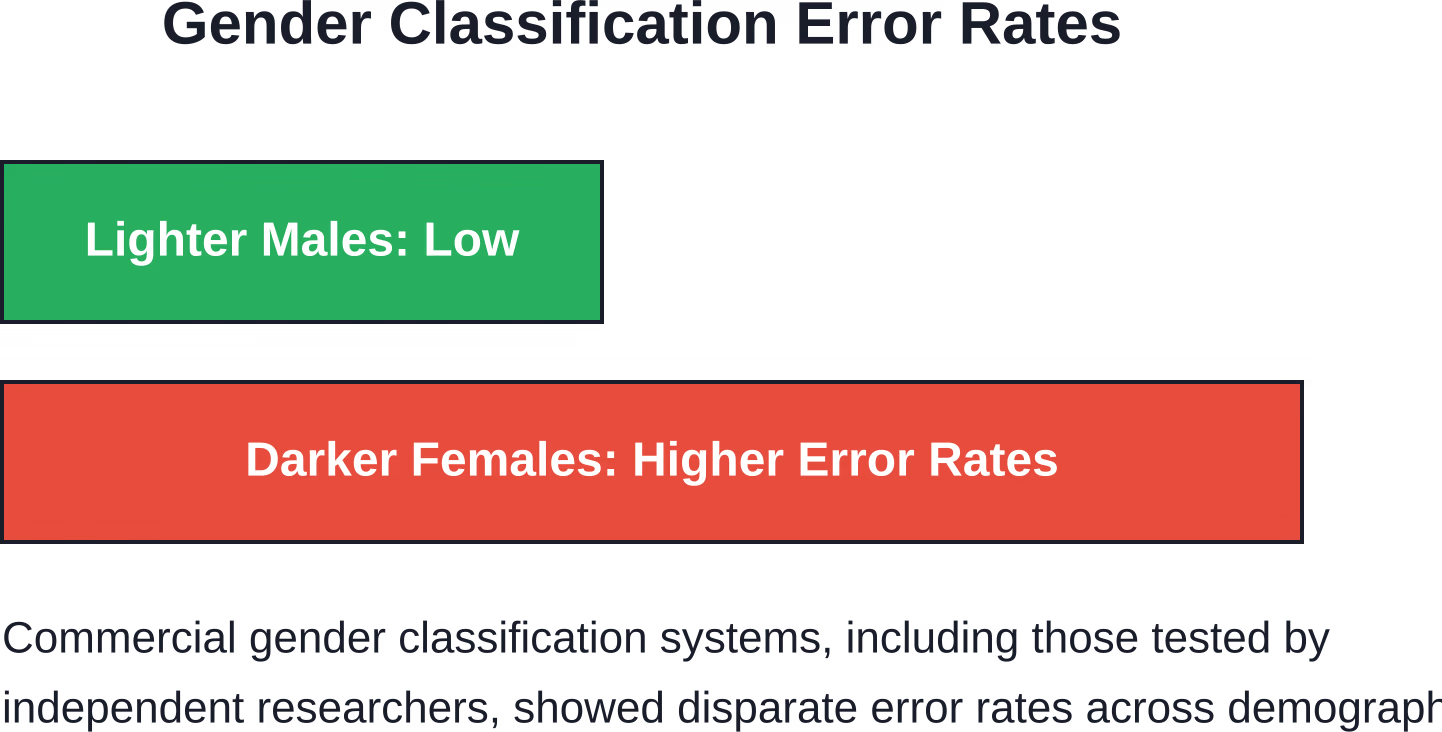 Why does this happen? Training data composition drives algorithmic bias. The popular Labeled Faces in the Wild dataset is 83.5% white. The NIST-constructed IJB-A dataset was specifically created with attention to racial representation. When algorithms train predominantly on one demographic, they perform poorly on underrepresented groups. Sound familiar? It’s the classic garbage-in-garbage-out problem, except here the consequences affect real people seeking employment, housing, or facing law enforcement scrutiny.
Privacy Concerns and Face Search Engines
Face search engines have made facial recognition much easier to access. Today, some tools let a person upload a photo and search for the same face across public parts of the internet.
How Face Search Engines Work
These platforms scan publicly available sources such as social media, websites, image galleries, and other online photo collections. They compare facial features and try to match the uploaded image with appearances of the same person elsewhere online.
Why This Creates Privacy Risks
The privacy concerns are serious. People may appear in photos they never agreed to share publicly. Images can also be reused without permission, and broad face search can make impersonation, stalking, or identity theft easier.
Why On-Device Recognition Is Different
Apple’s approach is different from cloud-based face search systems. In the Photos app, facial recognition runs on the device using private machine learning. That means face data does not need to leave the device, while users can still organize and search their own photo library.
Technical Architecture and Efficiency
Modern face recognition systems achieve remarkable efficiency. Research on identity-trained neural networks shows that performance remains stable even with dramatically reduced dimensionality. Networks maintain identification accuracy with as few as 16 units—just 3% of full 512-unit dimensionality. This efficiency matters for deployment. Lower computational requirements mean faster processing, reduced costs, and the ability to run on mobile devices rather than requiring cloud infrastructure. Real talk: the technology can handle surprisingly large databases. Testing shows no notable accuracy decline until sample sizes exceed 1,000,000 faces in-the-wild, making the technology viable for institutional applications like university campus access or corporate security.
Current Applications and Use Cases
Facial recognition for identifying people now spans numerous domains. Border control agencies use it for immigration processing and passenger verification. Airlines implement it for boarding confirmation and flight rosters. Law enforcement applies the technology for suspect identification, though this use cases raises civil liberties concerns given the documented bias against people of color and the technology’s historical use in activist surveillance. Consumer applications include smartphone unlocking, photo organization, social media auto-tagging, and payment authentication. First responders use biometric authentication for secure access to critical systems during emergencies.
| Sector | Primary Use | Key Consideration |
|---|---|---|
| Border Security | Passenger verification, immigration exit recording | High accuracy in controlled conditions |
| Consumer Tech | Device unlocking, photo tagging | On-device processing protects privacy |
| Law Enforcement | Suspect identification | Bias amplifies existing inequalities |
| Commercial | Reverse image search, identity verification | Consent and privacy concerns |
Frequently Asked Questions
How accurate is facial recognition for identifying people?
Top algorithms achieve 99.5% accuracy in controlled conditions like airport screening with high-quality images and proper lighting. However, accuracy drops significantly with poor image quality, aging, or appearance changes. Demographic factors also affect accuracy, with error rates 10-100 times higher for darker-skinned individuals in many systems.
Can facial recognition identify someone from an old photo?
Yes, but accuracy decreases with image age due to natural aging, changes in appearance, and older photo quality. Systems perform better when the database includes multiple images of the same person from different time periods. Within-person variability in appearance is a significant challenge for identification accuracy.
Is facial recognition biased against certain groups?
Yes. NIST testing of 189 algorithms found systematic demographic bias, with many systems showing 10-100x higher error rates for Black and East Asian faces compared to white faces. Research from Buolamwini and Gebru found dark-skinned women experienced the highest error rates compared to light-skinned men, though specific percentages varied across systems tested. This bias stems from unrepresentative training datasets.
How do face search engines find photos online?
Face search engines analyze uploaded photos to create facial embeddings—mathematical representations of unique facial features. These embeddings are then compared against databases of images scraped from publicly accessible websites, social media, and online galleries to find matches based on facial similarity.
Can you protect your privacy from facial recognition?
Partial protection is possible. Some services allow opt-out requests to exclude your face from search results. Using privacy-focused platforms that process images on-device rather than in the cloud provides better protection. However, once images are publicly posted online, they can be scraped and analyzed by third-party services.
What’s the difference between 1:1 and 1:N facial recognition?
1:1 verification compares one face against one stored template to confirm identity (like unlocking your phone). 1:N identification compares one face against an entire database to find matches (like searching for a suspect across thousands of records). 1:N is computationally harder and more prone to false positives.
How many images are needed for accurate identification?
More images improve accuracy significantly. Human identification accuracy improves from 50% with a single reference photo to approximately 90% with six different images of the same person. Multiple images help systems account for within-person appearance variability from lighting, angles, expressions, and aging.
Looking Ahead
Image recognition for identifying people has matured into a powerful, widely deployed technology. The numbers tell the story—from significant growth since 2017, with 653 total algorithms evaluated from 201 unique developers, to 99.5% accuracy in real-world applications. But technical capability doesn’t equal ethical deployment. Demographic bias remains a critical unsolved problem that perpetuates existing inequalities. Privacy concerns grow as face search capabilities become more accessible. The question isn’t whether the technology works—it clearly does—but whether we can deploy it fairly and responsibly. Organizations implementing facial recognition must audit algorithms for demographic bias, ensure diverse training data, maintain transparency about accuracy limitations, and provide meaningful consent and opt-out mechanisms. Technical progress must be matched by ethical frameworks that protect vulnerable populations from algorithmic discrimination.