
Quick Summary: Machine learning in accounting uses AI algorithms to automate data processing, detect fraud, forecast financial trends, and improve audit accuracy. The technology analyzes patterns in financial data to streamline tasks like reconciliation, expense categorization, and compliance monitoring. Accounting firms and finance teams are increasingly adopting machine learning to reduce manual work, minimize errors, and gain predictive insights that traditional methods can’t provide. Machine learning has moved from tech buzzword to practical tool. And nowhere is that shift more visible than in accounting. Financial professionals now use ML-powered systems to spot anomalies in transaction data, predict cash flow patterns, and automate tasks that once consumed hours of manual work. The technology doesn’t just speed things up—it fundamentally changes what’s possible in financial analysis and reporting. But here’s the thing: understanding how machine learning actually works in accounting contexts matters more than ever. The gap between firms that leverage these tools effectively and those that don’t is widening fast.
What Is Machine Learning in Accounting?
Machine learning is a branch of artificial intelligence that enables computer systems to learn from data patterns without explicit programming for each task. In accounting, this translates to software that gets smarter as it processes more financial information. Traditional accounting software follows rigid rules: if transaction type = X, then categorize as Y. Machine learning systems work differently. They analyze thousands of past transactions, identify patterns, and make increasingly accurate predictions about how new transactions should be classified. The accounting profession has seen this technology evolve from basic automation to sophisticated predictive analytics. According to the International Federation of Accountants (IFAC), accountants must embrace machine learning as the technology moves beyond inflated expectations into practical implementation. Academic research indicates artificial intelligence shows 100% relevance to the accounting profession, with robotic process automation showing 100% relevance to the public accounting profession. This isn’t future speculation—it’s current reality. 
Build Machine Learning Software With AI Superior
AI Superior develops custom AI software, including machine learning models, predictive analytics tools, and AI-based web and mobile applications. Their team supports projects from discovery and data review to MVP development, integration, and result evaluation. For accounting teams, this can support invoice analysis, reporting automation, anomaly detection, forecasting, or internal tools built around financial and operational data.
Need Machine Learning Built Around Your Data?
AI Superior can help with:
- building custom machine learning solutions
- developing predictive analytics tools
- testing ideas through PoC or MVP development
- integrating AI into existing systems
👉 Contact AI Superior to discuss your project.
Key Applications of Machine Learning in Accounting
Real talk: machine learning isn’t replacing accountants wholesale. Instead, it’s handling specific tasks with remarkable efficiency.
Automated Data Entry and Categorization
ML systems can process invoices, receipts, and bank statements by recognizing patterns in document layouts and transaction descriptions. The software learns your company’s categorization preferences and applies them consistently across thousands of entries. This goes beyond simple rules. The system notices that “ABC Corp” gets coded to office supplies 90% of the time, learns the pattern, and flags the rare exceptions for human review.
Fraud Detection and Prevention
Fraud costs small businesses serious money. Research cited in accounting literature found that small businesses with fewer than 100 employees experienced median losses of $200,000 across 2,690 fraud instances. Machine learning excels at identifying unusual patterns that human reviewers might miss. The technology analyzes transaction timing, amounts, approval chains, and vendor relationships to flag anomalies. Recent academic work on deep learning for real-time fraud detection in banking systems has generated research interest. A deep learning framework for detecting fraudulent accounting practices in financial institutions has also been published.
Financial Forecasting and Predictive Analytics
ML models can analyze years of financial history alongside external factors—market conditions, seasonality, economic indicators—to generate more accurate forecasts than traditional linear methods. The technology identifies complex relationships between variables that humans might overlook. For instance, an ML model might discover that a specific combination of customer behavior, inventory levels, and market conditions reliably predicts cash flow challenges three months ahead.
Audit Efficiency and Risk Assessment
Academic research on machine learning in auditing shows significant potential to disrupt the profession. Audits have traditionally focused on sampling transactions; machine learning enables analysis of entire data populations. Research examining the role of artificial intelligence in auditing and fraud detection, with machine learning as a moderating factor within accounting information systems, was published in 2025. This work highlights how ML changes audit scope and methodology. ML-powered audit tools can scan 100% of transactions, identify high-risk areas for detailed review, and flag outliers based on learned patterns of what “normal” looks like for each client.
Benefits Machine Learning Brings to Accounting Teams
The advantages go beyond simple time savings, though those are substantial. Accuracy improvements: ML systems don’t get tired, distracted, or overwhelmed by data volume. They apply learned patterns consistently across millions of records, catching errors that slip through manual review. Speed and scale: Tasks that once took days—reconciling thousands of transactions, categorizing expenses, reviewing vendor files—now complete in minutes. This frees accounting professionals for strategic analysis instead of data processing. Predictive insights: Rather than just recording what happened, ML helps forecast what’s coming. Cash flow projections, budget variance predictions, and early warning systems for financial issues become standard capabilities. Continuous learning: The more data these systems process, the better they get. An ML model that’s been analyzing your company’s transactions for two years understands your business patterns far better than generic software.
Comparison: Traditional vs. Machine Learning Accounting
| Aspect | Traditional Accounting | Machine Learning Accounting |
|---|---|---|
| Data Processing | Manual entry and review | Automated recognition and categorization |
| Fraud Detection | Sample-based audits, rule triggers | Pattern analysis across 100% of transactions |
| Forecasting | Linear models, historical averages | Multi-variable predictive models |
| Error Handling | Post-facto correction | Real-time flagging and prevention |
| Scalability | Proportional to staff size | Handles volume increases without proportional cost |
Challenges and Considerations
Now, this is where it gets real. Machine learning in accounting isn’t plug-and-play simple.
Data Quality Requirements
ML models are only as good as their training data. Garbage in, garbage out still applies. Organizations need clean, consistent, sufficiently large datasets for effective model training. Many accounting systems contain years of inconsistently categorized data, incomplete records, and migration artifacts. Cleaning this data before ML implementation takes significant effort.
Implementation Complexity
Academic research notes that while artificial intelligence shows 100% relevance to the accounting profession, and robotic process automation demonstrates 100% relevance to the public accounting profession, actual adoption varies. Firm size shows 25% relevance as a research factor—suggesting smaller firms face different barriers than large practices. Integration with existing accounting systems, staff training, and change management all require resources and planning.
Skill Gap
Accountants need new competencies. Understanding what ML can and can’t do, interpreting model outputs, and maintaining healthy skepticism about algorithmic recommendations all require education. The technology doesn’t eliminate the need for professional judgment—it amplifies it. Knowing when to trust the model and when to dig deeper becomes a critical skill.
Cost Considerations
Enterprise-grade ML accounting solutions carry significant licensing costs. Development of custom models requires data science expertise. For smaller practices, the return on investment calculation gets complicated. 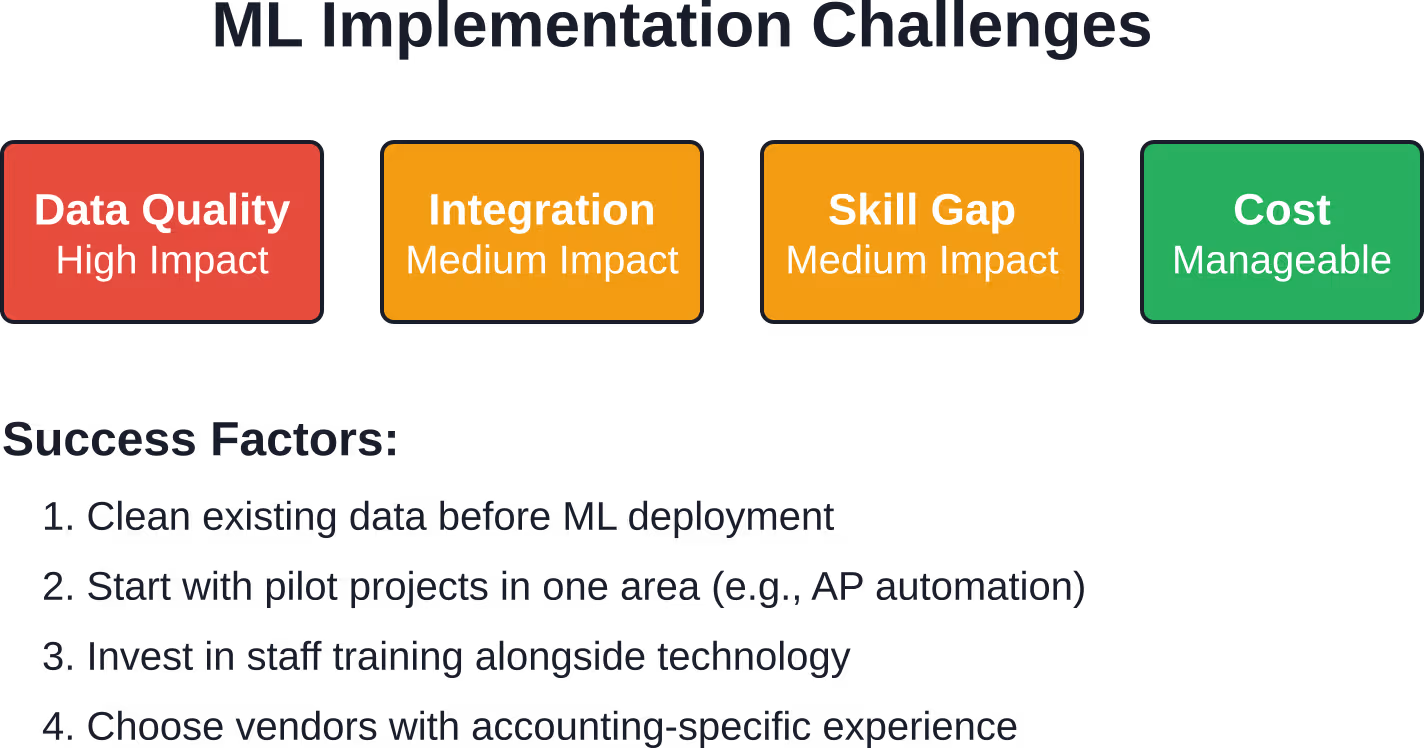
Will Machine Learning Replace Accountants?
The short answer? No—but it will change what accountants do. Machine learning handles repetitive, rules-based tasks exceptionally well. Transaction categorization, data entry, reconciliation, basic variance analysis—these migrate to automated systems. But accounting involves judgment that ML can’t replicate. Understanding business context, advising on financial strategy, interpreting unusual situations, ensuring compliance within ambiguous regulations—these require human expertise. Research from the University of Dallas indicates that machine learning in auditing will shift the profession from transactional focus to interconnected, strategic work. Audits become increasingly analytical as ML handles the mechanical aspects. The future belongs to accountants who combine financial expertise with technology literacy. Professionals who understand how to leverage ML tools, interpret their outputs critically, and apply human judgment to complex situations will thrive.
Getting Started with Machine Learning in Your Accounting Practice
Okay, so what about practical implementation? Start small. Don’t try to revolutionize your entire accounting operation overnight. Pick one pain point—maybe accounts payable processing or expense categorization—and pilot an ML solution there. Evaluate your data infrastructure. ML requires clean, accessible data. If your financial information lives in disconnected systems with inconsistent formats, address that first. Build internal buy-in. Accountants who fear replacement will resist adoption. Frame ML as augmentation, not replacement—technology that handles tedious tasks so professionals can focus on analysis and advisory work. Consider cloud-based solutions. Many ML accounting tools now operate as software-as-a-service, reducing upfront investment and IT complexity. These platforms handle the technical ML aspects while presenting user-friendly interfaces. Invest in education. Staff need to understand what the technology does, how to work with it effectively, and when to question its recommendations.
The Future of Machine Learning in Accounting
The trajectory is clear: ML becomes standard infrastructure, not cutting-edge innovation. Robotic process automation—which insights from the American Institute of CPAs describe as computer-enabled automation with minimal human assistance—continues evolving. The technology moves beyond simple rule-based automation toward cognitive computing capabilities. Natural language processing integration lets accountants query financial data conversationally. Instead of building complex reports, ask: “Which vendors showed unusual payment pattern changes last quarter?” Real-time financial analysis becomes the norm. Rather than closing books monthly, ML-powered systems provide continuous insights into financial position, cash flow, and performance metrics. Industry reports suggest ML adoption in accounting will accelerate as solutions become more affordable and user-friendly. The competitive advantage currently enjoyed by early adopters will become a baseline requirement.
Frequently Asked Questions
What’s the difference between AI and machine learning in accounting?
Artificial intelligence is the broader concept of machines performing tasks that typically require human intelligence. Machine learning is a specific subset of AI where systems learn from data patterns rather than following explicit programming. In accounting, ML refers specifically to algorithms that improve transaction categorization, fraud detection, and forecasting by learning from historical financial data.
How much does machine learning accounting software cost?
Pricing varies significantly based on features, firm size, and implementation complexity. Cloud-based ML tools for small businesses might start around a few hundred dollars monthly, while enterprise solutions for large accounting firms can run into six figures annually. Check vendors’ official websites for current pricing tiers, as costs change frequently and typically scale with transaction volume and user count.
Do I need data science skills to use machine learning accounting tools?
Not necessarily. Modern ML accounting platforms are designed for financial professionals, not data scientists. They handle the technical ML aspects behind user-friendly interfaces. However, understanding basic ML concepts—how models learn, what affects accuracy, when to trust outputs—helps accountants use these tools more effectively. Many vendors offer training programs alongside their software.
Can machine learning work with my existing accounting software?
Integration capability depends on both the ML solution and your current accounting system. Many ML tools offer APIs and pre-built connectors for popular platforms like QuickBooks, Xero, SAP, and Oracle. Some function as add-ons that enhance existing systems, while others operate as standalone platforms. Evaluate integration requirements carefully during vendor selection.
How long does it take to implement machine learning in accounting?
Implementation timelines range from weeks to months depending on scope. A basic cloud-based ML tool for expense categorization might deploy in 2-4 weeks. Comprehensive ML systems integrated across multiple accounting functions could take 6-12 months, especially if data cleaning is required first. Starting with pilot projects in specific areas allows faster initial deployment with measurable results.
Is machine learning accurate enough for financial reporting?
ML systems achieve high accuracy for many accounting tasks—often exceeding human performance on repetitive categorization and pattern recognition. However, they require oversight. Best practice involves ML handling initial processing with accountant review of flagged items and unusual transactions. As models train on more data, accuracy improves. Financial reporting still requires professional judgment and human verification, particularly for complex or non-routine transactions.
What types of accounting firms benefit most from machine learning?
Firms processing high transaction volumes see the clearest ROI—accounts payable/receivable, payroll processing, audit firms analyzing large datasets. However, research suggests firm size affects adoption differently. Large practices have resources for comprehensive implementation, while smaller firms benefit from focused, cloud-based ML tools targeting specific pain points. Mid-sized firms often find the sweet spot where ML investment significantly improves efficiency without overwhelming resources.
Conclusion
Machine learning in accounting has moved beyond experimental technology into practical application. The tools exist, the use cases are proven, and adoption barriers are falling. Financial professionals who embrace ML gain efficiency, accuracy, and analytical capabilities that manual processes can’t match. Those who resist face growing competitive disadvantage as clients expect faster turnaround, deeper insights, and more strategic advisory services. But here’s what matters most: technology amplifies human expertise rather than replacing it. The accountants thriving in 2026 and beyond are those who see ML as a powerful tool for doing better work—not a threat to their profession. Ready to explore machine learning for your accounting practice? Start with a focused pilot project, invest in understanding the technology, and prepare for a future where financial expertise combines with algorithmic power to deliver unprecedented value.