Quick Summary: Machine learning is the core technology enabling autonomous vehicles to perceive their environment, make real-time decisions, and navigate safely without human intervention. Through deep learning algorithms, neural networks, and massive datasets from sensors like cameras and LiDAR, self-driving cars learn to identify objects, predict pedestrian behavior, and optimize driving strategies. Stanford’s Brain4Cars study demonstrated that ML-based maneuver anticipation improved precision from 77.4% to 90.5%, showcasing the technology’s rapid advancement toward safer, more reliable autonomous transportation. Self-driving cars aren’t science fiction anymore. They’re rolling down real streets, processing millions of data points every second, and making split-second decisions that would overwhelm human drivers. But here’s the thing: none of this happens through traditional programming. The software can’t be coded with rules for every possible scenario—there are simply too many variables. Instead, autonomous vehicles rely on machine learning to teach themselves how to drive. According to Facts & Factors, the global autonomous vehicle market was estimated at $23.33 billion in 2020 and is projected to exceed $64 billion by 2026, growing annually at a 22.7% CAGR. That explosive growth reflects both technological breakthroughs and mounting industry confidence in ML-driven systems. This guide breaks down exactly how machine learning transforms sensor data into safe, reliable autonomous driving—from perception and prediction to control systems and real-world testing.
Understanding Machine Learning’s Role in Autonomous Driving
Machine learning fundamentally differs from conventional software development. Traditional programs follow explicit instructions: if a sensor detects an object within X meters, execute action Y. Self-driving cars encounter scenarios that no programmer could anticipate. A pedestrian wearing a costume. A mattress flying off a truck. A police officer manually directing traffic with hand signals. ML algorithms learn patterns from massive datasets rather than following hardcoded rules. The vehicle processes thousands of miles of driving data, identifying correlations between sensor inputs and optimal driving responses. As one principal data scientist noted in discussions about autonomous vehicle development, “90%, or even more than 90% of machine learning is surrounding data, and how you handle data. And then the last small percentage is the algorithms.” That data-centric reality shapes every aspect of autonomous vehicle development.
The Three Pillars of ML-Driven Autonomous Systems
Machine learning in self-driving cars operates across three interconnected domains:
- Perception transforms raw sensor data into semantic understanding. Deep neural networks identify vehicles, pedestrians, lane markings, traffic signals, and road obstacles from camera images and LiDAR point clouds.
- Prediction anticipates how other road users will behave. Will that pedestrian step into the crosswalk? Is the adjacent vehicle about to change lanes? ML models trained on human driving patterns generate probabilistic forecasts of future movement.
- Planning and control determines the vehicle’s actions based on perception and prediction outputs. Reinforcement learning algorithms optimize path selection, speed adjustment, and maneuvering to reach destinations safely and efficiently.
These systems work in parallel, feeding data continuously through processing pipelines that operate in milliseconds. 
Build Autonomous Vehicle ML Systems With AI Superior
Autonomous vehicle systems depend on large-scale sensor data, computer vision, prediction models, and real-time operational workflows. AI Superior can help teams structure machine learning projects for autonomous vehicle research and software development. Their services include AI consulting, machine learning, deep learning, computer vision development, AI software engineering, proof of concept development, and model evaluation. AI Superior can support autonomous vehicle projects with:
- Reviewing sensor, image, and operational datasets
- Developing detection, classification, or prediction systems
- Defining computer vision and ML use cases
- Building proof of concept vehicle models
- Evaluating operational performance and model reliability
- Supporting AI deployment and optimization
- Planning integration into existing software environments
For autonomous vehicles, this may apply to object detection, route prediction, sensor analysis, traffic monitoring, visual perception systems, and vehicle decision-support models. Talk with AI Superior about the development workflow. 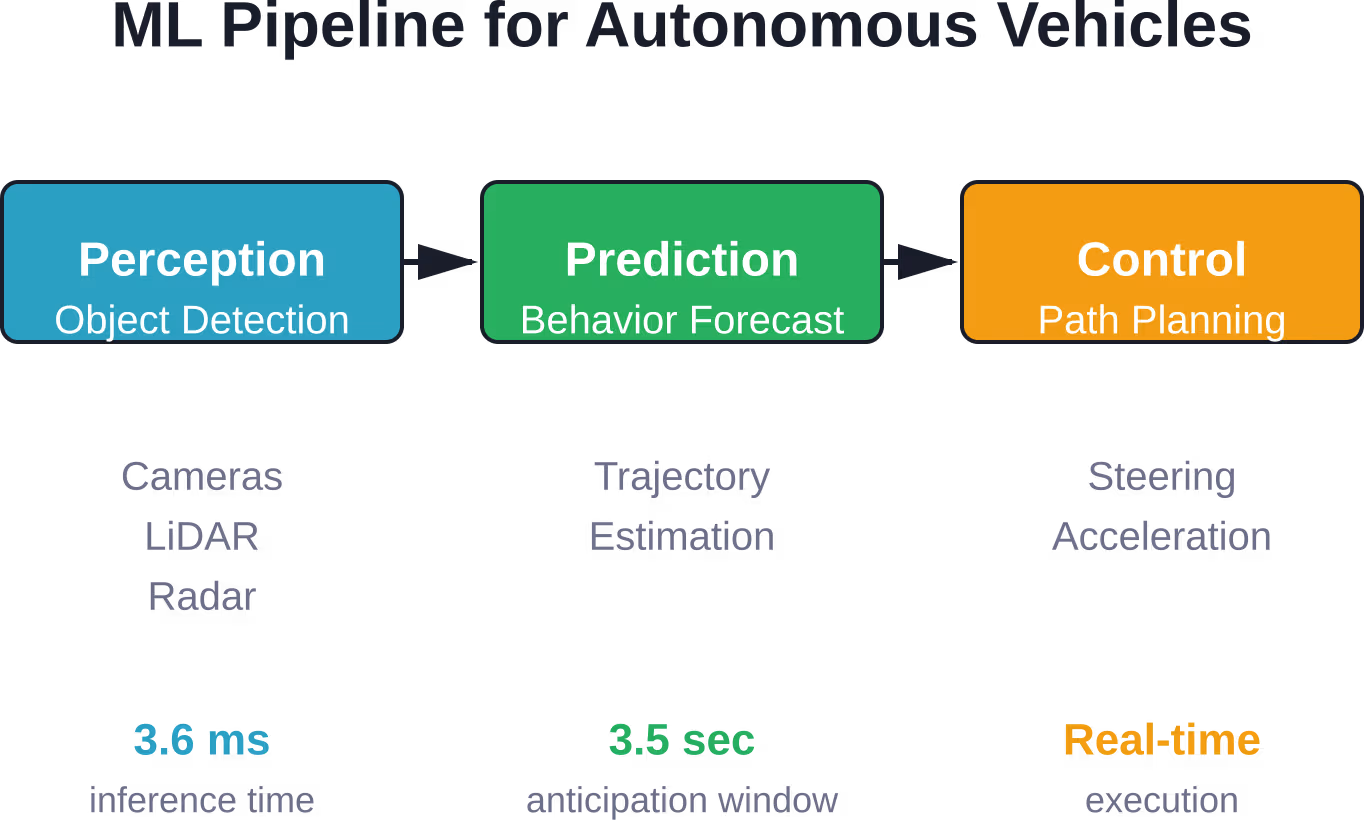
Deep Learning for Perception: Teaching Cars to See
Perception represents the foundational challenge of autonomous driving. Self-driving vehicles must interpret their surroundings with superhuman reliability, operating in all weather conditions and lighting scenarios. Computer vision powered by convolutional neural networks (CNNs) has emerged as the dominant approach.
Object Detection and Classification
Deep learning models process camera feeds to identify and categorize objects in the driving environment. These networks learn hierarchical feature representations—early layers detect edges and textures, while deeper layers recognize complex patterns like vehicle shapes or pedestrian postures. Multiple object detection architectures have proven effective:
- YOLO (You Only Look Once) processes entire images in a single forward pass, achieving real-time performance suitable for onboard computation
- Faster R-CNN uses region proposal networks to focus computational resources on areas likely to contain objects
- EfficientDet balances accuracy and efficiency through compound scaling of network architecture
MIT researchers working on enhanced perception systems note that autonomous vehicles need keener robot perception to accelerate safety improvements. Their algorithm development focuses on protecting both self-driving vehicles and other road users through more reliable object detection. Real talk: the challenge isn’t just detecting objects—it’s maintaining consistent detection across variable conditions. A pedestrian partially obscured by a parked car. Road signs covered in snow. Motorcycles splitting lanes in heavy traffic.
Semantic Segmentation for Scene Understanding
Beyond identifying discrete objects, autonomous vehicles need pixel-level understanding of their environment. Semantic segmentation assigns each pixel in an image to a category: drivable surface, sidewalk, vegetation, sky, building. This granular scene understanding enables precise path planning. The vehicle knows exactly where it can safely drive and which areas represent obstacles or restricted zones. Networks like DeepLab and U-Net excel at this task, using encoder-decoder architectures that capture both high-level semantic information and fine-grained spatial details.
Sensor Fusion and Multi-Modal Learning
No single sensor provides complete environmental awareness. Cameras offer rich visual information but struggle with depth perception. LiDAR generates precise 3D point clouds but provides no color or texture data. Radar penetrates fog and rain but offers lower resolution. Machine learning models fuse data from multiple sensors, combining their complementary strengths. Multi-modal neural networks process inputs from cameras, LiDAR, radar, and GPS simultaneously, learning correlations across sensor types. Stanford’s Brain4Cars research demonstrates this multi-sensor approach: “The context for maneuver anticipation comes from multiple sensors installed on the vehicle.” Their end-to-end system integrates camera feeds, GPS data, and vehicle dynamics to predict driver intentions. That fusion delivers robustness. If one sensor fails or provides unreliable data, the system continues functioning based on other inputs.
Prediction: Anticipating Human Behavior
Detecting objects solves only half the challenge. Autonomous vehicles must predict how those objects will move—especially unpredictable humans. Pedestrians change direction suddenly. Drivers make impulsive lane changes. Cyclists swerve around potholes. ML prediction models learn these behavioral patterns from observational data.
Trajectory Forecasting
Trajectory prediction models estimate future positions of vehicles, pedestrians, and cyclists based on their current motion and historical behavior patterns. These systems typically use recurrent neural networks (RNNs) or transformer architectures that process sequential data. The network observes an object’s movement over several seconds, then generates probabilistic predictions of where that object will be 1-10 seconds in the future. Stanford’s Brain4Cars research demonstrates maneuver anticipation with improved precision from 77.4% to 90.5% and recall from 71.2% to 87.4%, with reported improvements in maneuver anticipation capabilities. These aren’t trivial improvements—they represent the difference between reactive and proactive driving. That 3.5-second anticipation window provides ample time for the autonomous vehicle to adjust its trajectory safely.
Intent Recognition
Understanding what road users intend to do requires more than tracking their current movement. A vehicle slowing down might be parking, preparing to turn, or reacting to unseen hazards ahead. Intent recognition models analyze contextual cues: turn signal activation, brake light patterns, vehicle positioning relative to lane markings, even subtle steering wheel movements visible through windshields. The Brain4Cars research used Structural-RNN approaches to capture these complex spatial-temporal dependencies, achieving an 80% F1-score for maneuver anticipation. Machine learning models that understand human intent enable autonomous vehicles to navigate mixed traffic environments where human-driven vehicles remain prevalent.
Accounting for Human Error
Here’s where things get interesting: autonomous vehicles must anticipate not just typical human behavior but human mistakes. A driver distracted by their phone. A pedestrian stepping off a curb without looking. A cyclist running a red light. Training data must include these anomalous events so ML models learn to recognize and respond to them. Research focused on teaching autonomous vehicles to factor in driver error uses deep neural networks, drone data, and roadside units to enhance perception. The goal is imbuing AVs with a “seventh sense” that mimics experienced human drivers’ ability to recognize risky situations before they escalate. That capability matters enormously for safety. Autonomous vehicles shouldn’t merely react to what happens—they should anticipate what might happen and position themselves to minimize risk.
Machine Learning Algorithms Powering Autonomous Vehicles
Different ML approaches serve distinct functions within autonomous driving systems. The architecture choices reflect trade-offs between accuracy, computational efficiency, and training data requirements.
Convolutional Neural Networks (CNNs)
CNNs dominate visual perception tasks. Their architecture mirrors biological visual processing, with layers of neurons that respond to increasingly abstract features. Early convolutional layers detect simple patterns: edges, corners, color gradients. Deeper layers combine these into complex representations: wheels, windows, faces, traffic sign shapes. Pre-trained models like ResNet, VGG, and Inception serve as starting points. Transfer learning allows developers to fine-tune these networks on driving-specific datasets rather than training from scratch—a crucial shortcut given the computational expense of training deep networks.
Recurrent Neural Networks and Transformers
Sequential decision-making requires models that maintain temporal context. RNNs and their variants (LSTM, GRU) process time-series data while preserving information about previous states. For autonomous vehicles, this temporal awareness enables understanding of motion dynamics. A pedestrian’s trajectory over the past three seconds provides context for predicting their next movement. Transformer architectures, originally developed for natural language processing, have recently gained traction in autonomous driving. Their attention mechanisms allow the model to focus on relevant spatial and temporal features dynamically.
Reinforcement Learning for Control
While supervised learning trains models on labeled examples, reinforcement learning (RL) teaches systems through trial and error in simulated environments. RL agents receive rewards for desirable behaviors (smooth driving, obeying traffic rules, efficient routing) and penalties for undesirable ones (harsh braking, rule violations, collisions). Over millions of simulated miles, the agent learns policies that maximize long-term reward. Deep reinforcement learning combines neural networks with RL, enabling agents to learn directly from high-dimensional sensor inputs without hand-engineered features. But here’s the challenge: pure RL requires extensive simulation time and can produce unpredictable behaviors during training. Most autonomous vehicle companies use RL selectively, combining it with supervised learning and traditional control algorithms.
Ensemble Methods and Model Fusion
Production autonomous vehicles rarely rely on single models. Ensemble approaches combine predictions from multiple neural networks, voting or averaging their outputs to improve reliability. If five independently trained models agree that an object is a pedestrian, confidence increases. If predictions diverge, the system flags uncertainty and may adopt more conservative behaviors. This redundancy provides safety margins critical for life-or-death decisions.
Training Data: The Foundation of ML-Driven Autonomy
Machine learning models are only as good as the data used to train them. Autonomous vehicles require unprecedented volumes of diverse, accurately labeled training data.
Data Collection Strategies
Self-driving car companies operate test fleets that continuously collect sensor data. Every mile driven generates gigabytes of camera footage, LiDAR scans, radar returns, GPS traces, and vehicle telemetry. Stanford’s Brain4Cars research utilized extensive driving data to train their maneuver anticipation models—a substantial corpus, yet dwarfed by the datasets used by industry leaders. The vehicle-generated data market is projected to be worth between $450 billion and $750 billion by 2030, reflecting both the data’s value and the scale of collection operations. The COVID-19 pandemic disrupted data collection efforts. In China, predicted to be the world’s largest AV market, connected car sales declined during the COVID-19 pandemic, temporarily slowing the accumulation of real-world driving data.
Annotation and Labeling Challenges
Raw sensor data requires annotation before it can train supervised learning models. Human labelers must draw bounding boxes around vehicles, mark lane boundaries, classify traffic signs, and label pedestrian poses across millions of video frames. This labeling process is expensive, time-consuming, and error-prone. Labeling just one hour of driving footage might require 800 hours of human labor. Semi-supervised learning and active learning techniques help reduce this burden. Models trained on limited labeled data generate predictions on unlabeled data, and human experts review only uncertain predictions or correct errors—dramatically improving labeling efficiency.
Synthetic Data and Simulation
Simulation environments generate infinite training data without real-world collection costs. Photo-realistic rendering engines create virtual driving scenarios with automatically generated labels. Simulators model rare edge cases difficult to capture in real driving: adverse weather, unusual vehicle types, emergency situations, pedestrians behaving erratically. The gap between simulated and real-world data remains a challenge—models trained purely on synthetic data sometimes fail when confronted with real-world complexities. Transfer learning approaches help bridge this “sim-to-real” gap.
Data Privacy and Security
Autonomous vehicles collect extensive data about their surroundings, including images of people, vehicles, and locations. Privacy regulations like GDPR impose constraints on data collection, storage, and usage. Anonymization techniques blur faces and license plates. Federated learning approaches train models across distributed datasets without centralizing sensitive information. Federated learning approaches enable collaborative model improvement while preserving privacy in autonomous vehicle contexts. Security concerns extend beyond privacy. Adversarial attacks might manipulate sensor inputs to cause misclassification—subtle perturbations that fool neural networks into seeing stop signs as speed limit signs, for instance. Robust training techniques and anomaly detection systems help defend against these threats.
| Training Data Type | Advantages | Limitations | Primary Use Cases |
|---|---|---|---|
| Real-world fleet data | Authentic conditions, natural distribution of scenarios | Expensive to collect and label, limited coverage of rare events | Perception model training, validation datasets |
| Simulated synthetic data | Infinite generation, automatic labeling, controlled scenarios | Sim-to-real gap, may lack real-world complexity | Edge case training, initial model development |
| Augmented data | Increases dataset diversity, addresses class imbalance | Must preserve semantic correctness | Improving model generalization, handling weather variations |
| Crowdsourced data | Diverse geographic and vehicle coverage | Quality control challenges, privacy concerns | Map building, rare event collection |
Real-World Applications and Testing Environments
Machine learning models transition from research labs to public roads through rigorous testing protocols and carefully selected deployment environments.
Controlled Testing Environments
Autonomous pods serving as last-mile shuttles in controlled environments provide valuable testing grounds. These deployments reduce car use and improve accessibility while allowing engineers to refine localization, vehicle-to-everything (V2X) communication, and human-machine interaction without the chaos of urban traffic. Closed test tracks replicate specific scenarios repeatedly: intersections, highway merges, construction zones. Engineers systematically validate that ML models respond correctly across variations in weather, lighting, and traffic density.
Graduated Deployment Strategies
Most autonomous vehicle programs follow graduated deployment: starting with constrained environments and progressively expanding to more complex scenarios. Geofenced operations limit vehicles to thoroughly mapped areas with favorable conditions—flat terrain, good weather, clear lane markings. As systems prove reliable, operational domains expand. SAE International defines automation levels from 0 (no automation) to 5 (full automation). SAE’s “Level 2+” frameworks focus on making automated driving profitable and mainstream through incremental capability improvements rather than pursuing full autonomy immediately.
Shadow Mode and Parallel Autonomy
Shadow mode operation allows autonomous systems to run alongside human drivers without controlling the vehicle. The ML system processes sensor data and generates control decisions, but human inputs actually steer the car. Engineers compare the system’s decisions with the human driver’s actions, identifying discrepancies and edge cases where the ML model would have behaved differently—often incorrectly. This approach safely accumulates data about how ML systems perform in real traffic without risking safety incidents.
Regulatory Frameworks and Safety Validation
Deployment requires regulatory approval. Different jurisdictions impose varying requirements for demonstrating safety before allowing public road testing. In Europe, regulatory frameworks require proof of safe autonomous vehicle behavior rather than simple self-certification. Manufacturers must demonstrate that systems can handle edge cases and unusual scenarios with extremely high reliability. SAE International’s development of ontology and lexicon standards for automated driving systems helps establish common terminology and testing frameworks—critical infrastructure for regulatory validation. The National Transportation Safety Board maintains databases of autonomous vehicle incidents, providing data for understanding failure modes and improving safety protocols.
Current Trends and Future Directions
Machine learning for autonomous vehicles continues evolving rapidly. Several trends are reshaping development priorities and technical approaches.
End-to-End Learning
Traditional autonomous driving architectures break the problem into discrete modules: perception, prediction, planning, control. Each component is developed and tested independently. End-to-end learning approaches replace this pipeline with a single neural network that maps sensor inputs directly to control outputs. Stanford’s Brain4Cars research describes end-to-end multi-modal AI where “generative model maps inputs to control actions.” These systems learn latent representations of driving strategy without explicitly modeling intermediate stages. Proponents argue this approach handles edge cases more gracefully since the entire system optimizes for the ultimate objective: safe driving. Skeptics counter that end-to-end models are black boxes, making debugging difficult and safety validation nearly impossible.
Attention Mechanisms and Explainability
Neural networks traditionally operate as black boxes—inputs go in, decisions come out, but the reasoning process remains opaque. Attention mechanisms provide partial transparency. These components learn to focus on relevant input features, and visualization of attention maps reveals what the model considers important when making decisions. Explainable AI techniques help engineers understand model behavior and identify failure modes. If an object detector misclassifies a bicycle, attention visualizations might reveal the model focused on background clutter rather than the bicycle itself—guiding data augmentation or architecture improvements. Regulatory agencies increasingly demand explainability before approving autonomous systems for public deployment.
Neuromorphic Computing and Edge AI
Processing sensor data with deep neural networks requires substantial computational power. Current autonomous vehicles contain specialized AI accelerators consuming hundreds of watts. Neuromorphic chips mimic biological neural architecture, processing information in event-driven spikes rather than continuous values. These designs promise orders-of-magnitude improvements in energy efficiency—critical for electric vehicle range and cooling requirements. Edge AI approaches push more computation directly into sensors. Smart cameras with integrated neural network accelerators perform object detection locally, transmitting only high-level semantic information rather than raw video streams.
Lifelong Learning and Online Adaptation
Current ML models are trained offline on historical datasets, then deployed with fixed parameters. The vehicle doesn’t learn from new experiences after deployment. Lifelong learning systems continuously update models based on recently encountered data, adapting to new environments and evolving traffic patterns. This capability would help autonomous vehicles operate in diverse geographic regions without requiring separate model training for each location. A vehicle trained primarily in California could adapt to Massachusetts winter driving conditions through online learning. But wait—online learning introduces safety risks. Model updates might degrade performance or introduce unexpected behaviors. Validation frameworks must ensure continuous learning improves rather than compromises safety.
Vehicle-to-Everything (V2X) Communication
Machine learning models currently operate on information gathered only by onboard sensors. V2X communication allows vehicles to share data with each other and with infrastructure. A vehicle that detects black ice around a curve could alert approaching vehicles. Traffic signals could broadcast phase timing to optimize intersection crossing. Emergency vehicles could announce their approach, prompting autonomous vehicles to yield. ML models that incorporate V2X data achieve better prediction and planning by accessing information beyond their immediate sensor horizon.
Challenges and Limitations
Despite remarkable progress, machine learning in autonomous vehicles faces significant technical and practical obstacles.
The Long Tail Problem
ML models excel at scenarios well-represented in training data. They struggle with rare edge cases: a deer crossing the road, a child’s ball rolling into the street, construction equipment partially blocking a lane. Human drivers navigate these situations through common-sense reasoning and physical intuition. Current ML systems lack this contextual understanding. End-to-end models that perceive 3D layout from camera images help address long-tail scenarios by learning more general representations of scene geometry and physics. But complete solutions remain elusive.
Adversarial Vulnerability
Neural networks can be fooled by adversarial examples—inputs carefully crafted to cause misclassification. Adding imperceptible noise to a stop sign image might cause the network to classify it as a yield sign. Physical adversarial attacks pose real threats. Researchers have demonstrated that placing specific stickers on stop signs can fool object detectors. Robust training techniques partially mitigate this vulnerability, but no complete defense exists. Security researchers continue discovering new attack vectors.
Computational and Energy Constraints
Real-time processing of high-resolution sensor streams with deep neural networks demands enormous computational resources. Inference must complete in milliseconds—the Brain4Cars research achieved 3.6 millisecond inference times, but more complex models may require longer. Energy consumption matters critically for electric autonomous vehicles. High power draw from AI accelerators reduces driving range and requires additional cooling systems. Optimization techniques like model quantization, pruning, and knowledge distillation compress networks into smaller, faster versions with minimal accuracy loss. These compressed models enable real-time onboard inference.
Dataset Bias and Fairness
ML models inherit biases present in training data. If datasets contain fewer examples of pedestrians with darker skin tones, object detectors may perform worse at detecting these individuals—an unacceptable safety discrepancy. Geographic bias similarly affects performance. Models trained primarily on US roads might struggle with different driving customs, road signage, and infrastructure in other countries. Diverse, representative datasets help mitigate bias, but collecting truly balanced data across all demographic groups and geographic regions remains challenging.
Regulatory Uncertainty
Regulatory frameworks for autonomous vehicles remain under development. Different jurisdictions impose varying requirements, creating compliance complexity for companies operating internationally. Standards organizations like SAE International are developing ontologies and testing frameworks, but comprehensive regulatory consensus hasn’t yet emerged. This uncertainty complicates long-term product planning and investment decisions.
| Challenge Category | Specific Issues | Current Approaches |
|---|---|---|
| Edge Cases | Rare scenarios underrepresented in training data | Simulation, targeted data collection, end-to-end architectures |
| Adversarial Robustness | Vulnerability to crafted inputs that cause misclassification | Adversarial training, input validation, ensemble defenses |
| Computational Limits | Real-time processing requirements, energy consumption | Model compression, specialized hardware, edge AI |
| Data Bias | Unequal performance across demographic groups and regions | Diverse datasets, fairness-aware training, bias auditing |
| Explainability | Black-box decision-making difficult to validate and debug | Attention mechanisms, saliency maps, modular architectures |
Safety and Ethical Considerations
Machine learning systems that make life-or-death decisions raise profound safety and ethical questions.
Validation and Testing
How many miles of testing demonstrate that an autonomous vehicle is safer than human drivers? Human drivers in the US average one fatality per 100 million miles driven. Proving with statistical confidence that an autonomous system exceeds this safety level requires billions of test miles—impractical for physical testing alone. Scenario-based testing in simulation helps compress validation timelines. SAE International’s work on developing safe software for autonomous vehicles focuses on establishing verification methodologies that combine physical testing, simulation, and formal verification.
The Trolley Problem in Code
Autonomous vehicles will inevitably face situations where some harm is unavoidable. Should the vehicle prioritize passenger safety or minimize total harm across all road users? These ethical dilemmas cannot be resolved through engineering alone. They require societal consensus reflected in regulatory frameworks and liability law. ML models implicitly encode ethical choices through their training data and reward functions. Engineers must consciously design these systems to reflect agreed-upon ethical principles rather than letting ethical decisions emerge accidentally from data patterns.
Liability and Accountability
When an autonomous vehicle causes injury, who bears responsibility? The vehicle owner? The manufacturer? The ML engineer who trained the model? The company that collected training data? Traditional liability frameworks assume human drivers make decisions. Autonomous systems distribute decision-making across software, sensors, and training data in ways that complicate accountability attribution. Insurance models and legal frameworks continue evolving to address these questions.
Job Displacement
Autonomous vehicles threaten millions of driving jobs: truckers, taxi drivers, delivery drivers. The economic and social impacts of this displacement require proactive policy responses. Proponents argue autonomous vehicles will create new jobs in fleet management, remote assistance, vehicle maintenance, and ML development. Critics counter that these new roles won’t employ displaced workers at comparable wages.
Frequently Asked Questions
How do machine learning models in autonomous vehicles learn to drive?
ML models learn from massive datasets of real driving data collected by test fleets. Supervised learning trains neural networks to recognize objects and predict behaviors from millions of labeled examples. Reinforcement learning teaches control policies through trial and error in simulation. The Brain4Cars research utilized 1180 miles of natural driving data, though commercial systems train on millions of miles. Models learn correlations between sensor inputs and correct driving responses, gradually improving accuracy through iterative training.
What’s the difference between machine learning and traditional programming in self-driving cars?
Traditional programming requires engineers to write explicit rules for every scenario: “if an object is within X meters, then brake.” Machine learning instead learns patterns from data, allowing the system to generalize to novel situations not explicitly programmed. ML handles the overwhelming complexity of real-world driving—millions of possible scenarios that can’t be hardcoded. Traditional control algorithms still handle some low-level functions, but ML drives perception, prediction, and high-level decision-making.
How accurate are machine learning perception systems in autonomous vehicles?
Accuracy varies by task and conditions. Stanford’s Brain4Cars achieved 90.5% precision and 87.4% recall in maneuver anticipation, with inference completing in 3.6 milliseconds. Object detection systems typically exceed 95% accuracy for common objects like vehicles and pedestrians in good conditions. Performance degrades in adverse weather, unusual lighting, or with rare object types. Production systems use ensemble methods and multiple sensors to achieve the 99.99%+ reliability required for safety-critical applications.
What types of data do autonomous vehicles collect for machine learning?
Autonomous vehicles collect camera images, LiDAR point clouds, radar returns, GPS traces, IMU measurements, and vehicle telemetry (speed, steering angle, brake pressure). This generates terabytes per vehicle per day. Human labelers annotate this data with bounding boxes around objects, lane markings, traffic sign classifications, and behavioral labels. Industry projections estimate the vehicle-generated data market will reach $450-750 billion by 2030, reflecting the massive scale of data collection operations.
Can machine learning models in self-driving cars improve after deployment?
Most current systems use fixed models that don’t learn after deployment—they’re trained on historical data, validated, then frozen. This ensures predictable behavior and simplifies safety certification. Future systems may incorporate lifelong learning, updating models based on new experiences while maintaining safety. Federated learning approaches enable collaborative improvement across vehicle fleets without centralizing sensitive data. Shadow mode testing allows models to learn from human drivers without controlling the vehicle, then updates roll out after validation.
What are the biggest challenges for machine learning in autonomous vehicles?
The long-tail problem remains critical—ML models struggle with rare edge cases underrepresented in training data. Adversarial vulnerability means carefully crafted inputs can fool neural networks. Computational constraints require balancing model complexity with real-time inference requirements and energy budgets. Dataset bias can cause performance disparities across demographic groups. Regulatory uncertainty complicates deployment. Validation remains difficult—proving statistical safety requires billions of test miles. These technical challenges combine with ethical questions about decision-making in unavoidable accident scenarios.
How do regulatory frameworks address machine learning in autonomous vehicles?
European frameworks require manufacturers to prove safe behavior rather than allowing self-certification, potentially avoiding incidents seen in less regulated markets. SAE International develops standards like automation level definitions and ontologies for automated driving systems. Organizations are establishing testing protocols that combine physical miles, simulation scenarios, and formal verification methods. Regulatory approaches vary by jurisdiction—some require extensive real-world testing, others accept simulation-heavy validation. Standards continue evolving as the technology matures and regulators gain experience with ML-specific challenges like dataset bias and adversarial robustness.
The Road Ahead for ML-Driven Autonomy
Machine learning has transformed autonomous vehicles from theoretical concepts to operating reality. Deep neural networks process sensor data in milliseconds, predicting pedestrian movements 3.5 seconds in advance with over 90% precision. End-to-end systems learn driving strategies from millions of miles of data. Yet significant challenges remain. Edge cases, adversarial vulnerability, computational constraints, and regulatory uncertainty slow progress toward ubiquitous deployment. The next breakthroughs will likely come from better data rather than better algorithms. Diverse, representative datasets that include rare scenarios and edge cases will enable models to generalize more reliably. Simulation environments that capture real-world complexity will accelerate validation timelines. Explainable AI will build trust and enable regulatory approval. Neuromorphic computing will reduce energy consumption. V2X communication will extend perception beyond onboard sensors. Lifelong learning will enable adaptation to new environments. The autonomous vehicle market projects to $64 billion by 2026—reflecting both technological maturity and mounting commercial viability. Machine learning remains the foundational technology enabling this transformation. For organizations developing autonomous systems, prioritizing data quality, diverse testing scenarios, and safety validation frameworks will prove more valuable than chasing algorithmic novelty. The models that win aren’t necessarily the most sophisticated—they’re the most reliable, explainable, and thoroughly validated. Ready to stay current on machine learning advances in autonomous driving? Bookmark this guide and check back for updates as the field evolves.