
Quick Summary: Machine learning is transforming B2B marketing by automating lead scoring, enabling hyper-personalized campaigns at scale, predicting customer behavior with remarkable accuracy, and optimizing content strategies in real time. Organizations leveraging ML-driven insights see measurably stronger customer engagement, higher conversion rates, and dramatically improved marketing ROI compared to traditional approaches. B2B marketing has always been complex. Long sales cycles, multiple decision-makers, and the need for highly targeted messaging make it fundamentally different from consumer marketing. But here’s the thing—machine learning is changing the game entirely. What once required armies of analysts and weeks of manual data crunching now happens in real time. Marketing teams can predict which leads will convert, personalize content for thousands of accounts simultaneously, and optimize campaigns while they’re still running. The professional services sector has been particularly quick to adopt these technologies. According to a survey involving over 1,400 marketing executives, professional services emerged as one of the top industries implementing machine learning and data analytics. That transformation isn’t slowing down. It’s accelerating.
What Machine Learning Actually Means for B2B Marketers
Machine learning algorithms analyze patterns in data—patterns humans would miss or take months to identify. Unlike static rules-based systems, these algorithms improve over time as they process more information. For B2B marketers, this translates into several practical capabilities. First, predictive analytics. Instead of looking backward at what happened last quarter, machine learning models forecast what’s likely to happen next. Which prospects will convert? Which accounts might churn? What content will resonate with specific segments? Second, automation at scale. Tasks that once required manual intervention—lead scoring, content recommendations, campaign optimization—now happen automatically. And they happen faster and more accurately than human teams could manage alone. Third, personalization that actually works. Generic email blasts don’t cut it anymore. Machine learning enables true one-to-one marketing by analyzing individual behavior patterns and preferences, then delivering tailored experiences to each prospect or customer. The difference between traditional marketing technology and machine learning is straightforward: traditional systems follow rules marketers program into them. Machine learning systems discover the rules themselves by analyzing data.
Lead Scoring Gets Smarter
Traditional lead scoring assigns points based on demographic data and basic actions. Downloaded a whitepaper? Five points. Attended a webinar? Ten points. It’s better than nothing. But it’s also crude. Machine learning transforms lead scoring from a simple point system into genuine predictive intelligence. The algorithms analyze hundreds of variables simultaneously—not just what prospects download, but when they download it, how long they spend on each page, which pages they revisit, what time of day they engage, and dozens of other behavioral signals. Then the models compare these patterns against historical data from thousands of past leads. Which patterns preceded conversions? Which patterns signaled prospects who went cold? The result: lead scores that actually reflect conversion probability rather than arbitrary point totals. 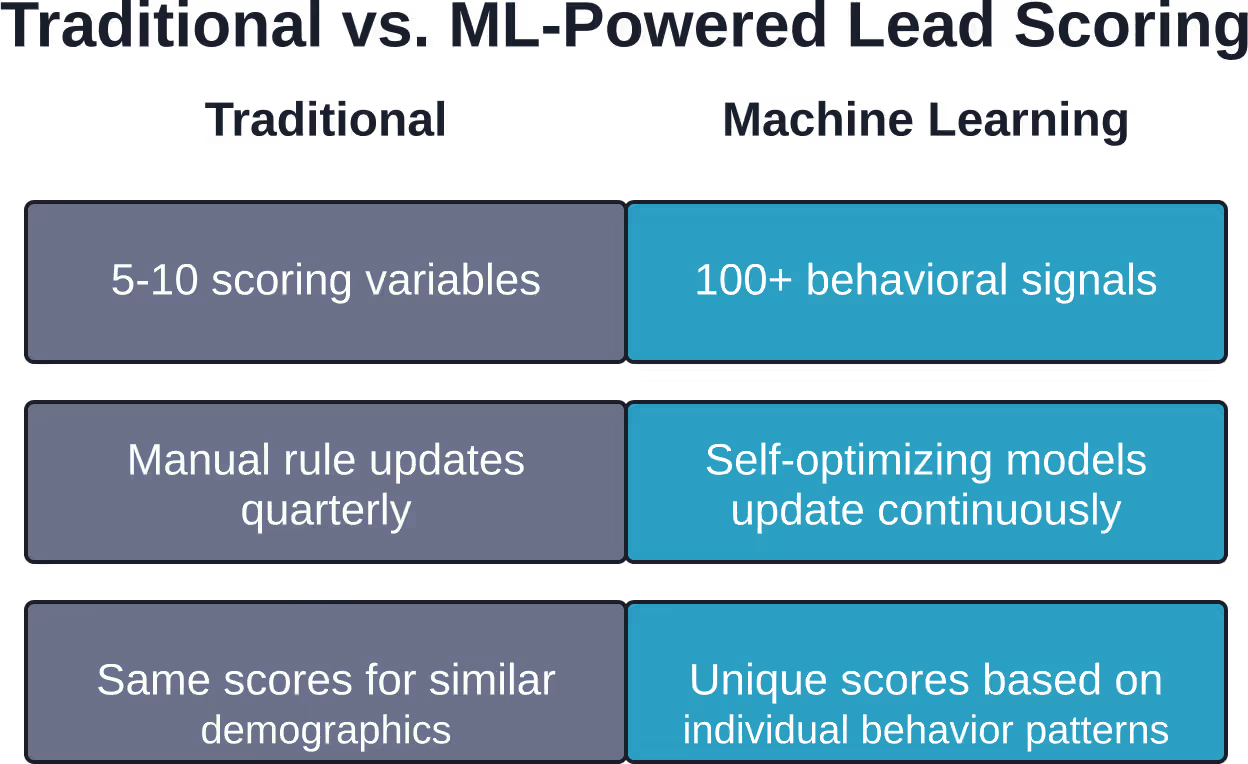 Sales teams notice the difference immediately. Instead of wading through hundreds of mediocre leads, they focus on the prospects most likely to close. Conversion rates climb while time wasted on dead-end conversations drops. The impact extends beyond just identifying hot leads. Machine learning also flags at-risk customers by detecting behavioral changes that precede churn. A customer who suddenly stops engaging with content, reduces login frequency, or changes interaction patterns triggers alerts before the relationship deteriorates beyond repair.
Personalization at Scale Becomes Reality
Personalization sounds great in theory. Everyone knows that tailored messages outperform generic ones. But personalizing content for thousands of accounts manually? That’s impossible. Machine learning solves this by analyzing each prospect’s behavior, industry, company size, role, content consumption patterns, and dozens of other factors—then automatically serving the most relevant content, messaging, and offers to each individual. This goes far beyond inserting a first name in an email subject line. Real personalization means showing different homepage content to different visitors, recommending specific case studies based on industry and pain points, adjusting email cadence based on engagement patterns, and tailoring ad creative to match where each prospect sits in their buying journey. The data backs this up. According to MIT Sloan Management Review data, consumers who participate in top-quartile loyalty programs are 80% more likely to choose the brand over competitors and twice as likely to recommend the brand to others. While that research focused on consumer programs, the principle applies even more powerfully in B2B contexts where purchase decisions involve higher stakes and longer consideration periods.
Dynamic Content Optimization
Machine learning doesn’t just personalize which content gets shown. It also optimizes the content itself. Algorithms test different headlines, images, calls-to-action, and layouts continuously. Not through traditional A/B tests that take weeks to reach statistical significance, but through multivariate testing that evaluates dozens of variations simultaneously and routes traffic to winning combinations in real time. The system learns which content formats work best for different segments. Maybe C-level executives respond better to brief executive summaries while technical buyers prefer detailed specification documents. Machine learning identifies these patterns automatically and adjusts content delivery accordingly.
Predictive Analytics Transforms Campaign Strategy
What if marketers could see the future? Not perfectly, but accurately enough to make better decisions? That’s essentially what predictive analytics delivers. Machine learning models analyze historical campaign data, customer behavior, market trends, and external factors to forecast outcomes before campaigns launch. Which messaging angles will resonate? Which channels will drive the highest ROI? Which budget allocation will maximize conversions? Instead of relying on gut instinct or outdated benchmarks, marketing teams base decisions on data-driven predictions. The algorithms identify patterns invisible to human analysts—subtle correlations between seemingly unrelated variables that significantly impact campaign performance. 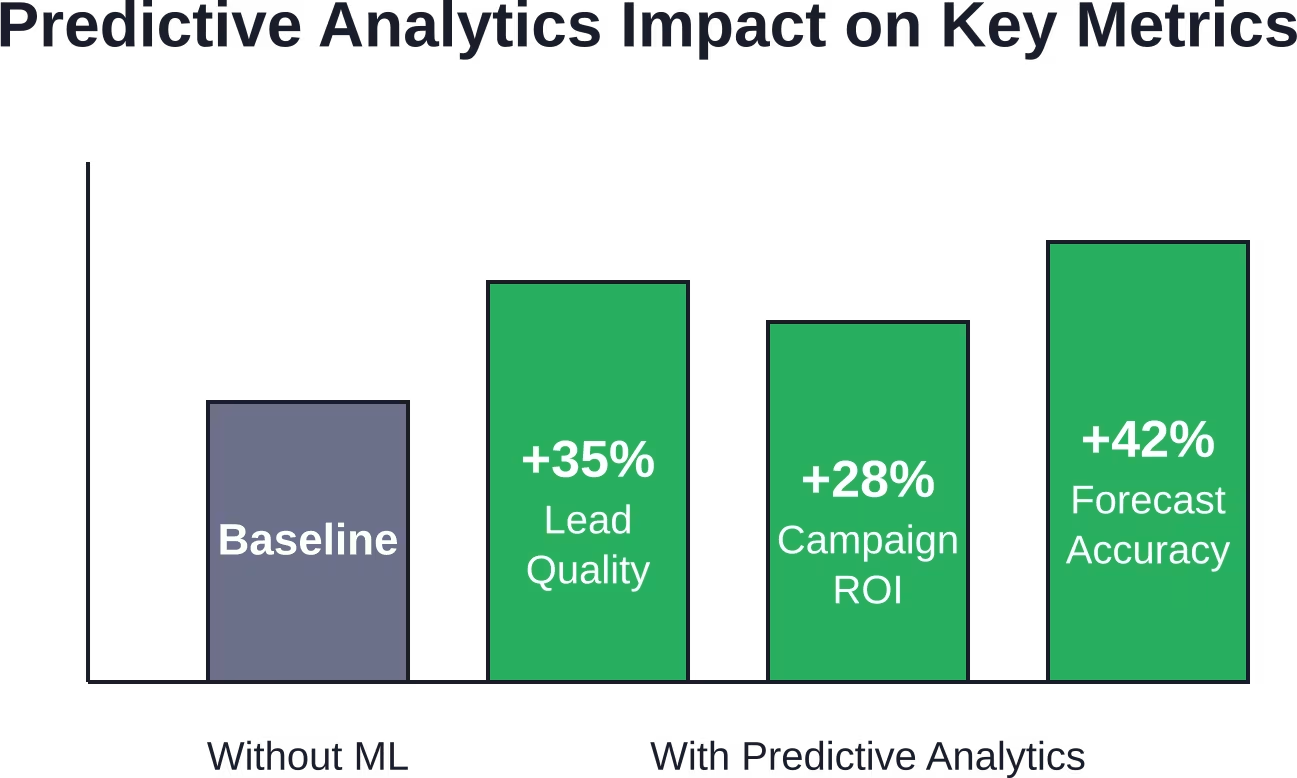 Predictive analytics also improves budget allocation. Machine learning models simulate different spending scenarios and predict the likely return from each. Should the budget shift toward paid search or content marketing? Will increasing spend on LinkedIn ads deliver proportional returns or hit diminishing returns? The algorithms provide data-backed answers.
Customer Lifetime Value Prediction
Not all customers are equally valuable. Some make one small purchase and disappear. Others become long-term partners generating substantial recurring revenue. Machine learning predicts customer lifetime value early in the relationship—often before the first purchase closes. The models identify characteristics and behaviors correlated with high-value customers, allowing marketing and sales teams to prioritize accordingly. This shifts focus from simply maximizing lead volume to maximizing long-term customer value. Marketing strategies optimize for quality over quantity, targeting prospects who match the profile of the organization’s best customers.
Segmentation Gets Precise and Dynamic
Traditional segmentation divides prospects into broad categories: industry, company size, job title. It’s static—once categorized, prospects stay in their assigned segment. Machine learning creates dynamic micro-segments based on behavior, not just demographics. These segments evolve as prospects’ actions and interests change. The algorithms identify clusters of similar prospects automatically, often discovering segments marketers wouldn’t think to create manually. Maybe there’s a segment of mid-market manufacturing companies that engage heavily with video content but ignore whitepapers. Or a cluster of enterprise IT decision-makers who research extensively on mobile devices during evening hours. These insights enable hyper-targeted campaigns that speak directly to each micro-segment’s preferences and pain points. Messaging, content format, channel selection, and timing all adapt to match segment characteristics.
| Segmentation Approach | Number of Segments | Update Frequency | Criteria Used |
|---|---|---|---|
| Traditional | 5-10 broad segments | Quarterly or annually | Demographics, firmographics |
| Machine Learning | 50-500+ micro-segments | Continuous real-time | Behavior, intent signals, engagement patterns, predictive scores |
Dynamic segmentation also means prospects move between segments as their behavior changes. Someone who initially showed casual interest but suddenly ramps up engagement automatically shifts into a higher-priority segment and receives more intensive nurturing.
Content Strategy Informed by Machine Intelligence
Creating content that resonates requires understanding what topics, formats, and angles the audience actually cares about. Traditionally, that meant surveying customers, analyzing past performance, and making educated guesses. Machine learning brings precision to content strategy. Algorithms analyze which content drives engagement, conversions, and customer progression through the sales funnel. They identify topics that correlate with deal velocity and content gaps where prospects drop off. Natural language processing—a branch of machine learning—analyzes customer conversations, support tickets, sales call transcripts, and social media discussions to extract common questions, pain points, and language patterns. Content teams then create materials addressing exactly what prospects and customers are asking about, using the terminology they actually use.
Automated Content Recommendations
Machine learning powers recommendation engines that suggest the next piece of content each prospect should see—similar to how Netflix recommends shows or Amazon suggests products. The algorithms analyze what content similar prospects consumed before converting, then recommend those high-performing assets to current prospects showing similar behavioral patterns. This guides prospects along optimal paths through the buyer’s journey rather than leaving them to navigate randomly. Recommendation engines work across channels: website navigation, email follow-ups, chatbot suggestions, and even sales enablement platforms that recommend which case studies or ROI calculators sales reps should share with specific prospects.
Campaign Optimization Happens in Real Time
Traditional campaign management meant launching a campaign, waiting weeks to gather sufficient data, analyzing results, making adjustments, and repeating the cycle. By the time optimization happened, market conditions often shifted. Machine learning enables real-time optimization. Algorithms continuously monitor campaign performance across all channels and automatically adjust tactics to maximize results. Underperforming ad variations get paused. Budget shifts toward high-performing channels. Bid strategies adapt to changing competition and conversion rates. This creates a feedback loop where campaigns improve continuously while running rather than in discrete optimization cycles. Performance compounds over time as the models accumulate more data and refine their predictions. Real-time optimization extends beyond just digital advertising. Email send times adapt to when each recipient most often opens messages. Website content adjusts based on traffic sources and visitor behavior. Even sales outreach sequences modify timing and messaging based on response patterns.
Chatbots and Conversational Marketing Mature
Early chatbots were frustrating. Rigid scripts, limited understanding, and frequent failures sent prospects scrambling for human assistance. Machine learning-powered conversational AI changed that dramatically. Modern chatbots understand natural language, context, and intent. They handle complex multi-turn conversations, answer nuanced questions, and escalate to humans seamlessly when appropriate. Most importantly, they learn from every interaction—continuously improving their ability to understand questions and provide helpful responses. For B2B marketing, intelligent chatbots serve multiple functions. They qualify leads by asking relevant questions and assessing responses. They route high-value prospects to sales immediately while nurturing others with appropriate content. They answer technical questions, schedule demos, and provide personalized product recommendations. The impact on conversion rates can be substantial. Prospects get immediate responses rather than waiting hours or days for email replies. Questions get answered at the moment interest peaks rather than after it fades.
Attribution Gets More Accurate
Marketing attribution—determining which touchpoints deserve credit for conversions—has always been challenging in B2B contexts where buyer journeys span months and involve dozens of interactions across multiple channels. Simple attribution models like last-touch or first-touch are laughably inadequate. Linear models that give equal credit to every touchpoint aren’t much better. Machine learning creates algorithmic attribution models that analyze thousands of conversion paths to determine which touchpoints actually influence outcomes. The models identify patterns: certain sequences of touchpoints that frequently precede conversions, channels that serve as effective introduction points versus closing channels, and content types that move prospects from one stage to the next. This reveals the true impact of each marketing activity. Maybe that thought leadership content rarely gets credit in last-touch models but plays a crucial role in early-stage awareness for high-value deals. Or perhaps that expensive industry conference generates few immediate conversions but influences deals that close months later. Accurate attribution informs better budget decisions. Marketing teams invest more in activities that actually drive results rather than those that simply happen to touch prospects right before conversion. 
Shape a B2B Marketing ML Project With AI Superior
B2B marketing data can be messy because it often comes from several places — CRM systems, sales pipelines, website activity, account data, and campaign tools. AI Superior can help teams define where machine learning can add value and what data is needed to build something useful. Their services cover AI consulting, machine learning, data science, AI software development, proof of concept development, and model validation. This makes them relevant for B2B teams that want to test ML for account targeting, lead quality, sales support, or marketing analytics. AI Superior can support B2B marketing teams with:
- Mapping business goals into clear ML tasks
- Reviewing CRM, account, lead, and sales data
- Creating proof of concept models
- Developing models for lead scoring or account prioritization
- Evaluating model quality and business relevance
- Planning software integration with existing systems
- Moving validated AI concepts into working tools
For B2B marketing, this can be useful for lead qualification, account-based marketing, pipeline forecasting, customer segmentation, and sales-marketing alignment. Contact AI Superior to discuss the project.
Practical Implementation Considerations
Machine learning delivers impressive capabilities, but successful implementation requires more than just buying tools and flipping switches.
Data Quality and Volume
Machine learning models need substantial high-quality data to function effectively. Garbage in, garbage out applies with full force here. Organizations must ensure their data is clean, consistent, and comprehensive. That means implementing proper tracking across all touchpoints, maintaining unified customer records, and regularly auditing data quality. Duplicate records, missing fields, and inconsistent categorization undermine model accuracy. Volume matters too. Most machine learning applications need at least thousands of data points to identify meaningful patterns. For some use cases—like predictive lead scoring—tens of thousands of historical leads may be necessary to train accurate models. Smaller organizations or those with limited historical data might start with simpler machine learning applications before tackling more complex ones.
Integration with Existing Systems
Machine learning tools don’t work in isolation. They need to connect with CRM platforms, marketing automation systems, analytics tools, ad platforms, and content management systems. Integration complexity varies. Some modern marketing platforms include built-in machine learning capabilities that work seamlessly within their ecosystems. Others require custom API development or third-party integration tools. Planning the technology stack carefully prevents situations where powerful machine learning tools can’t access the data they need or can’t act on their predictions because they’re disconnected from execution systems.
Skills and Training
Marketing teams don’t need to become data scientists, but they do need to understand how machine learning works, what questions to ask, and how to interpret model outputs. This requires training. Marketers should understand concepts like model confidence scores, why predictions come with probability ranges rather than certainties, and what factors influence model recommendations. They also need to recognize model limitations. Machine learning excels at pattern recognition but struggles with unprecedented situations or rapid market shifts. Human judgment remains essential for strategy, creativity, and navigating novel circumstances.
Starting Small and Scaling
Organizations often succeed by starting with one high-impact use case rather than attempting to transform everything simultaneously. Lead scoring is often a good starting point—clearly defined objective, measurable impact, and relatively straightforward implementation. Once that delivers results, expand to predictive analytics, then personalization, then real-time optimization. This approach builds organizational confidence, proves ROI before major investments, and allows teams to develop expertise gradually.
Common Challenges and How to Overcome Them
Machine learning implementation isn’t always smooth. Being aware of common obstacles helps organizations navigate them successfully.
The Cold Start Problem
New machine learning models need data to learn from. But what happens when launching a completely new product or entering a new market where no historical data exists? Solutions include starting with rule-based systems while collecting initial data, using transfer learning to adapt models trained on similar situations, or incorporating external data sources that provide relevant context even without direct historical precedent. The cold start challenge diminishes quickly—even a few months of data often provides enough signal for models to begin delivering value.
Model Drift and Maintenance
Markets change. Customer behavior evolves. Competitive dynamics shift. Models trained on historical data can become less accurate over time as the underlying patterns change. Regular model retraining prevents this drift. Most organizations retrain models quarterly or whenever performance metrics indicate declining accuracy. Automated monitoring systems flag when models need attention.
Explainability and Trust
Some machine learning models—particularly deep neural networks—function as “black boxes.” They make accurate predictions but can’t easily explain why. This creates challenges when marketing or sales teams need to understand and trust model recommendations. If a lead scoring model rates a prospect low, but a sales rep has a good feeling about them, who should they trust? Newer explainable AI techniques help models surface which factors most influenced specific predictions. This builds trust and enables teams to spot potential model biases or errors.
Essential Machine Learning Tools for B2B Marketing
The machine learning marketing technology landscape includes hundreds of solutions. The right tools depend on specific needs, existing infrastructure, and organizational maturity.
| Tool Category | Primary Function | Key Capabilities |
|---|---|---|
| Predictive Analytics Platforms | Forecast outcomes and identify patterns | Lead scoring, churn prediction, lifetime value modeling, campaign forecasting |
| Personalization Engines | Tailor content and experiences | Dynamic website content, email personalization, product recommendations, adaptive campaigns |
| Conversational AI | Automate prospect interactions | Chatbots, virtual assistants, natural language processing, intent recognition |
| Marketing Intelligence | Extract insights from data | Attribution modeling, customer segmentation, performance analytics, opportunity identification |
| Content Optimization | Improve content performance | A/B testing automation, headline optimization, recommendation engines, content gap analysis |
Many comprehensive marketing platforms now incorporate machine learning capabilities across multiple functions rather than requiring separate point solutions for each use case. Evaluating vendor options requires understanding both current needs and how requirements might evolve.
Measuring Machine Learning Marketing Impact
How do organizations know if their machine learning investments deliver results? The answer: establish baseline metrics before implementation, then track improvement across key performance indicators. Relevant metrics vary by use case but typically include:
- Lead quality improvements (conversion rate from lead to opportunity and opportunity to closed deal)
- Sales cycle reduction (time from first touch to closed deal)
- Campaign ROI increases (revenue generated per dollar spent)
- Engagement rate improvements (click-through rates, content consumption, interaction frequency)
- Customer retention enhancements (churn rate reduction, expansion revenue growth)
- Forecast accuracy gains (predicted vs. actual performance variance)
- Operational efficiency (time saved on manual tasks, cost per lead reduction)
Organizations should also track model-specific metrics like prediction accuracy, confidence scores, and coverage (what percentage of decisions the model can inform versus those requiring human judgment). The business case for machine learning strengthens when improvements are quantified clearly. A 20% increase in lead quality or 15% reduction in customer acquisition cost provides concrete justification for continued investment.
Looking Ahead: The Future of Machine Learning in B2B Marketing
Machine learning capabilities will continue advancing rapidly. Several trends are already emerging. First, increased automation. Tasks that currently require human oversight will increasingly run autonomously as models become more reliable and explainable. Entire campaign workflows—from strategy to execution to optimization—may operate with minimal manual intervention. Second, better integration of structured and unstructured data. Machine learning models will analyze not just CRM data and web analytics but also sales call recordings, email conversations, social media interactions, and market news to build a comprehensive understanding of each account. Third, more sophisticated natural language capabilities. AI will generate not just simple content variations but complete marketing materials—whitepapers, case studies, ad copy—tailored to specific audiences and continuously optimized based on performance. Fourth, enhanced privacy-compliant personalization. As data regulations tighten, machine learning techniques that enable personalization without exposing individual data will become crucial. Federated learning and differential privacy are already emerging as solutions. The organizations that stay ahead will be those treating machine learning as a continuous journey rather than a one-time project. The technology keeps improving, new use cases keep emerging, and competitive advantage goes to those who adapt quickly.
Frequently Asked Questions
What’s the difference between AI and machine learning in B2B marketing?
Artificial intelligence is the broad concept of machines performing tasks that typically require human intelligence. Machine learning is a specific subset of AI where systems learn from data without being explicitly programmed for every scenario. In marketing contexts, most “AI” applications actually use machine learning algorithms to analyze patterns and make predictions. The terms often get used interchangeably, though technically machine learning is the methodology that enables most marketing AI applications.
How much data does a B2B company need to implement machine learning effectively?
The data requirement varies by use case. Simple applications like basic lead scoring might work with a few thousand historical leads. More sophisticated applications like predictive customer lifetime value modeling typically need tens of thousands of data points. Generally speaking, organizations should have at least 6-12 months of comprehensive data across their marketing and sales systems before expecting strong results. Smaller datasets can still provide value, but predictions will be less accurate and require more frequent model retraining as new data accumulates.
Can small B2B companies benefit from machine learning, or is it only for enterprises?
Small companies can absolutely benefit, though their approach differs from enterprises. Many modern marketing platforms include built-in machine learning capabilities accessible at reasonable price points—no need for custom data science teams. Smaller organizations should focus on high-impact use cases where even modest improvements deliver meaningful results. Lead scoring, email send-time optimization, and content recommendations all work effectively for companies of any size. The key is starting with realistic expectations about what’s achievable given available data and resources.
How does machine learning handle complex B2B buying committees with multiple decision-makers?
Advanced machine learning models analyze patterns at both the individual and account level. They track interactions from multiple contacts within the same organization, identify key decision-makers based on engagement patterns and role, and assess overall account readiness by synthesizing signals from all stakeholders. Account-based marketing platforms specifically designed for B2B contexts incorporate these multi-contact dynamics into their algorithms. The models learn which combination of roles and engagement levels typically precede successful deals, then apply those patterns to score and prioritize current opportunities.
What happens when machine learning predictions are wrong?
No predictive model achieves perfect accuracy. Responsible implementations acknowledge this by showing confidence scores alongside predictions—a lead scored at 85% conversion probability has a 15% chance of not converting. Marketing teams should treat machine learning as decision support rather than absolute truth. When predictions miss, analyzing why helps improve future model performance. Was it a data quality issue? A market shift the model hadn’t encountered before? A genuinely unpredictable outcome? These insights feed back into model refinement. The goal isn’t perfection—it’s being right more often than traditional methods, which machine learning consistently achieves when properly implemented.
Does implementing machine learning mean replacing marketing and sales teams?
Not at all. Machine learning augments human capabilities rather than replacing them. The technology handles data-intensive tasks—analyzing thousands of leads, optimizing hundreds of campaign variables, personalizing content at scale—that humans can’t do efficiently. This frees marketing and sales professionals to focus on strategy, creativity, relationship-building, and complex problem-solving where human judgment remains superior. The most successful organizations combine machine learning’s analytical power with human expertise in understanding nuance, navigating novel situations, and building authentic connections. Think of it as intelligence amplification, not replacement.
How long does it take to see results from machine learning marketing initiatives?
The timeline varies by application. Some use cases deliver quick wins—email send-time optimization or basic content recommendations might show measurable improvement within weeks. Others require patience—predictive lead scoring needs time to collect enough conversion data to validate model accuracy, typically 3-6 months. More complex implementations like comprehensive attribution modeling or customer lifetime value prediction might take 6-12 months to reach full maturity. Organizations should set appropriate expectations based on their specific use cases and avoid judging success too quickly. Early results often improve significantly as models accumulate more training data and refinements are implemented.
Conclusion
Machine learning fundamentally changes what’s possible in B2B marketing. The ability to predict outcomes, personalize at scale, optimize in real time, and extract insights from massive datasets creates competitive advantages that compound over time. But technology alone doesn’t guarantee success. Organizations need clean data, integrated systems, trained teams, and clear strategies for applying machine learning to their specific challenges and opportunities. The gap between early adopters and laggards will widen rapidly. Companies effectively leveraging machine learning will understand their customers more deeply, convert prospects more efficiently, and allocate resources more intelligently than competitors relying on traditional approaches. The question isn’t whether machine learning will transform B2B marketing—it already has. The question is how quickly each organization will adapt to the new reality and how effectively they’ll harness these capabilities to drive growth. The transformation is happening now. Organizations that start today—even with small pilot projects—position themselves to build capabilities and expertise while competitors are still evaluating options. The time to begin is now.