Quick Summary: Machine learning is revolutionizing the energy sector by enabling predictive maintenance, optimizing grid operations, forecasting renewable energy generation, and reducing overall consumption. From smart grids to solar power systems, ML algorithms process vast datasets to improve efficiency, cut costs, and support sustainability goals. As data centers could account for 20% of global electricity use by 2030–2035, the technology’s role in both powering and optimizing energy infrastructure has never been more critical. Energy systems are getting smarter. Machine learning now predicts when turbines will fail, forecasts solar generation hours ahead, and optimizes electricity flow across entire grids in real time. But here’s the thing—ML isn’t just improving energy infrastructure. It’s also consuming massive amounts of it. The same algorithms that optimize power grids require data centers that could account for 20% of global electricity use by 2030–2035, according to Penn State research. This creates both opportunity and challenge. The energy sector needs ML to hit sustainability targets, yet ML itself strains power infrastructure. Understanding this dynamic matters for anyone working at the intersection of technology and energy.
What Machine Learning Means for Energy Systems
Machine learning is a branch of artificial intelligence that uses data and algorithms to imitate human learning patterns. The system improves accuracy over time based on experience, without explicit programming for every scenario. In energy contexts, that translates to algorithms analyzing millions of sensor readings, weather patterns, consumption histories, and grid conditions. They spot patterns humans can’t see and make predictions that traditional statistical models miss. The U.S. Department of Energy Solar Energy Technologies Office has invested significantly in this space. DOE awarded Arizona State University $750,000 for photovoltaic plant predictive maintenance optimization—a project that uses ML to predict equipment failures before they happen. Additional SETO funding supported projects developing AI-driven solutions for solar system integration and optimization. These aren’t experimental labs. They’re production systems managing real power plants. 
Unlock AI-Driven Solutions for the Energy Sector
Machine learning and AI are transforming the energy sector by driving efficiency and innovation. AI Superior develops custom AI solutions that optimize energy systems and reduce operational costs.
Take Your Energy Business to the Next Level with AI
AI Superior helps improve energy operations with:
- Preventing equipment failures through predictive maintenance
- Accurately forecasting energy demand
- Reducing costs by optimizing processes
👉Contact AI Superior today to unlock AI’s potential for your energy business.
Core Applications Transforming the Energy Sector
Smart Grid Optimization and Management
Smart grids represent the nervous system of modern energy infrastructure. Machine learning algorithms process data from thousands of sensors simultaneously, balancing supply and demand across entire regions. Research on multi-agent energy market simulations demonstrates how ML can coordinate complex interactions between generators, distributors, and consumers. The algorithms adjust in milliseconds—far faster than human operators. Real talk: this stuff works. Testing on a hypothetical 1,300 bus system showed ML-optimized DC optimal power flow achieved an average gap of just 1.4% from theoretical optima. That might sound small, but it accumulates to millions of dollars annually across regional grids.
Demand Forecasting and Load Prediction
Electricity can’t be stored easily at grid scale. That means generation must match consumption almost perfectly, every second of every day. Long Short-Term Memory networks—a type of recurrent neural network—excel at this temporal prediction challenge. They analyze historical consumption patterns, weather forecasts, calendar events, and economic indicators to predict demand hours or days ahead. Load forecasting in smart grids has advanced significantly through deep learning architectures. These models capture complex seasonal patterns, weekly cycles, and sudden demand spikes that simpler methods miss. The accuracy gains translate directly to cost savings. Utilities can schedule generation more efficiently, avoid expensive peak-time purchases, and reduce the spinning reserve capacity they maintain.
Renewable Energy Integration and Forecasting
Solar and wind power are inherently variable. A cloud passes over a solar farm, and output drops 40% in seconds. Wind speeds shift, and turbine generation changes minute by minute. Machine learning models now predict renewable generation with remarkable accuracy by combining satellite imagery, weather station data, historical generation curves, and atmospheric modeling. The DOE Solar Energy Technologies Office hosted a workshop in October–November 2023 focused specifically on solar applications of artificial intelligence and machine learning. Researchers presented methods for predicting solar irradiance, detecting panel degradation, and optimizing array configuration. Sound familiar? That’s because these same prediction challenges appear across all renewable sources. Wind forecasting uses similar ML architectures but ingests different atmospheric data.
Predictive Maintenance for Energy Infrastructure
Turbine failures cost millions. Transformer breakdowns leave thousands without power. Grid equipment operates in harsh conditions—extreme temperatures, constant vibration, electrical stress. Predictive maintenance algorithms monitor sensor data from this equipment continuously. They detect subtle patterns that precede failures: abnormal vibration frequencies, temperature drift, efficiency degradation, unusual acoustic signatures. The Arizona State University project on photovoltaic plant predictive maintenance optimization exemplifies this approach. The system uses ML to schedule maintenance interventions before failures occur, maximizing uptime while minimizing unnecessary inspections. This shifts maintenance from fixed schedules or reactive repairs to condition-based intervention. Equipment gets serviced when data indicates it needs attention, not based on arbitrary time intervals.
Energy Efficiency and Consumption Optimization
According to the International Energy Agency, energy efficiency measures could account for more than 40% of the greenhouse gas emission reductions required to reach Paris Agreement climate targets. Machine learning enables efficiency gains at multiple scales. In buildings, algorithms learn occupancy patterns and adjust HVAC systems dynamically. In industrial facilities, they optimize production schedules to minimize energy intensity. Data centers themselves present both challenges and opportunities. Training large AI models involves thousands of GPUs running continuously for months, leading to high electricity consumption. Data centers are projected to consume up to 9% of total U.S. electricity demand, according to the Department of Energy. But wait. The same ML techniques consuming energy can also optimize data center operations—cooling systems, workload distribution, hardware utilization. Research shows these optimizations can reduce data center energy use by significant percentages.
| Application Area | ML Technique | Primary Benefit | Implementation Complexity |
|---|---|---|---|
| Grid Balancing | Reinforcement Learning | Real-time optimization | High |
| Load Forecasting | LSTM Networks | Demand prediction | Medium |
| Equipment Monitoring | Anomaly Detection | Failure prevention | Medium |
| Solar Forecasting | Ensemble Methods | Generation prediction | Medium |
| Energy Trading | Deep Q-Networks | Price optimization | High |
Blockchain Integration and Peer-to-Peer Energy Trading
Here’s where it gets interesting. Comprehensive research on blockchain and machine learning integration for peer-to-peer energy trading shows how these technologies complement each other. ML algorithms optimize trading strategies and predict price movements. Blockchain provides the decentralized ledger for transparent, secure transactions between prosumers—consumers who also produce energy through rooftop solar or other distributed generation. Research indicates that blockchain and machine learning integration can improve system responsiveness and data exchange efficiency. That matters when thousands of small generators and consumers negotiate electricity trades in real time. This model flips the traditional centralized utility structure. Instead of one-way power flow from large plants to passive consumers, energy flows in multiple directions based on local supply, demand, and pricing.
Implementation Challenges and Barriers
Data Quality and Availability
Machine learning models are only as good as their training data. Energy systems often have incomplete sensor coverage, inconsistent data collection, and legacy infrastructure that wasn’t designed for digital monitoring. Utilities sometimes operate on decades-old SCADA systems with limited integration capabilities. Getting clean, comprehensive datasets for model training requires significant infrastructure investment.
Computational Requirements and Energy Consumption
The irony is real. Training sophisticated ML models for energy optimization requires massive computational resources. By 2030–2035, data centers could account for 20% of global electricity use, putting immense strain on power grids. This creates a feedback loop: as energy systems deploy more ML for optimization, the computational load increases grid demand. Balancing these dynamics requires careful consideration of model complexity versus efficiency gains.
Integration with Legacy Infrastructure
Most energy infrastructure predates modern computing by decades. Integrating ML systems with equipment designed in the 1970s or 1980s presents technical and financial challenges. Retrofitting sensors, installing communication networks, and ensuring cybersecurity across hybrid old-new systems isn’t trivial. Many utilities face budget constraints that limit modernization pace. 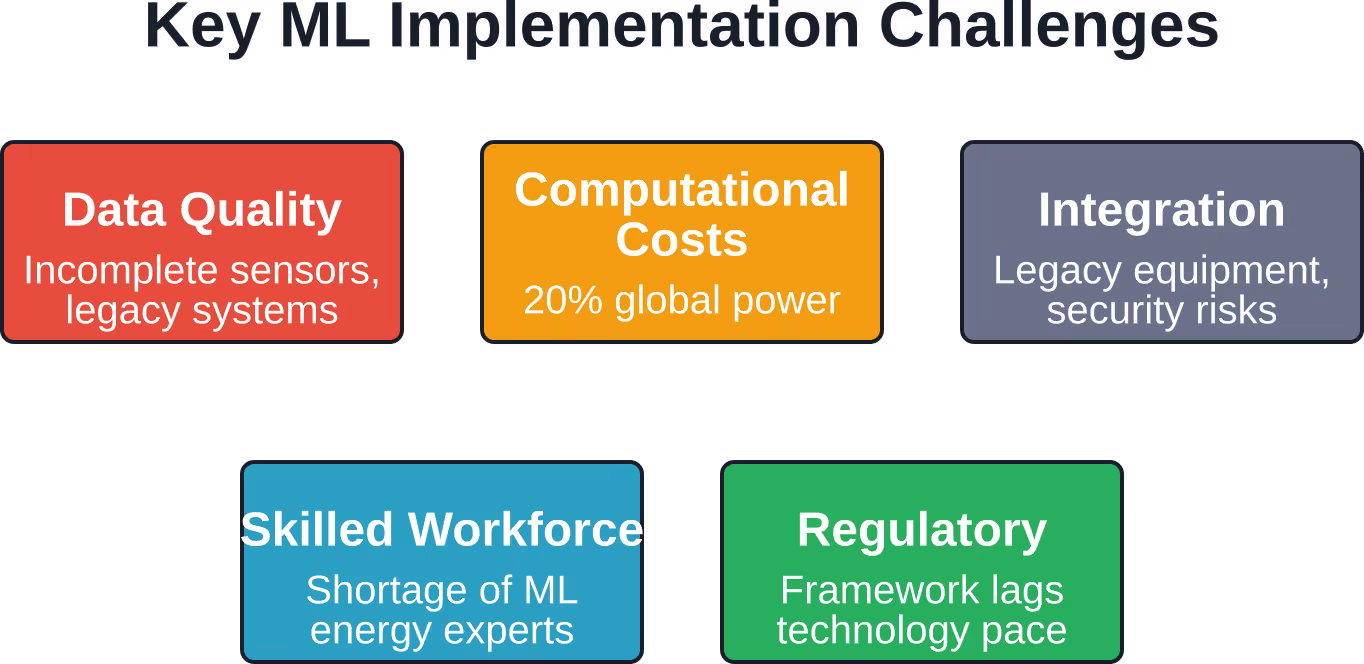
Workforce Skills Gap
Deploying and maintaining ML systems requires expertise in data science, domain knowledge about energy systems, and understanding of operational technology. That’s a rare combination. Energy companies compete with tech firms for ML talent, often at a disadvantage in compensation and perceived innovation culture.
Future Directions and Research Trends
Unsupervised and reinforcement learning will become increasingly significant for the energy sector, though this depends on advancements in data science and big data analytics. Current applications mostly use supervised learning—models trained on labeled historical data. But the energy transition introduces scenarios with limited historical precedent. Unsupervised methods that discover patterns without labeled examples will matter more. Reinforcement learning shows particular promise for real-time grid control. These algorithms learn optimal policies through trial and error in simulated environments, then deploy those strategies in production systems. The DOE Genesis Mission represents a major federal initiative combining supercomputing power, scientific data, and AI capabilities into integrated systems designed to accelerate discovery. As strategic competitors race to dominate AI, this ensures American infrastructure can support and leverage these technologies. Research directions include edge computing for distributed energy resources, federated learning for multi-utility collaboration without data sharing, and hybrid physics-ML models that combine domain knowledge with data-driven optimization.
Frequently Asked Questions
How does machine learning improve energy efficiency?
Machine learning analyzes consumption patterns, weather data, and operational parameters to optimize energy use in real time. Algorithms predict demand accurately, adjust systems dynamically, and identify waste that human operators miss. International Energy Agency data indicates energy efficiency measures enabled by technologies like ML could account for more than 40% of emissions reductions needed for Paris Agreement targets.
What’s the difference between AI and machine learning in energy applications?
Artificial intelligence is the broader concept of machines performing tasks that require human-like intelligence. Machine learning is a specific subset of AI focused on systems that learn from data and improve over time without explicit programming. In energy contexts, ML refers to the statistical and neural network techniques that power predictive maintenance, forecasting, and optimization.
Can machine learning reduce electricity costs for utilities?
Yes, through multiple mechanisms. ML improves demand forecasting, reducing the need for expensive peak-time generation purchases. Predictive maintenance prevents costly equipment failures. Grid optimization algorithms reduce transmission losses. Research on hypothetical 1,300 bus systems showed ML optimization achieved gaps of just 1.4% from theoretical optima—savings that accumulate to millions annually across regional grids.
What are the main challenges in deploying ML for renewable energy?
Data quality remains the primary barrier. Renewable systems need comprehensive sensor coverage and clean historical datasets for model training. Computational costs are significant—training sophisticated models requires substantial resources. Integration with existing grid infrastructure presents technical challenges. The workforce skills gap makes finding personnel with both ML expertise and energy domain knowledge difficult.
How much energy do machine learning systems themselves consume?
Training large AI models involves thousands of GPUs running continuously for months, leading to high electricity consumption. According to Penn State research, data centers could account for 20% of global electricity use by 2030–2035. The Department of Energy projects data centers may consume 9% of total U.S. electricity demand by 2030. This creates a critical challenge: optimizing energy systems with technology that itself demands massive power.
What role does machine learning play in smart grids?
ML algorithms process data from thousands of sensors simultaneously, balancing supply and demand across entire regions in real time. They coordinate complex interactions between generators, distributors, and consumers. Applications include load forecasting, fault detection, voltage regulation, and automated response to grid disturbances. Research on blockchain integration shows ML-optimized smart grids can improve system responsiveness and data exchange efficiency.
Is machine learning ready for widespread adoption in the energy sector?
Adoption varies by application. Demand forecasting and predictive maintenance are mature and widely deployed. Grid-scale reinforcement learning and peer-to-peer energy trading remain more experimental. Legacy infrastructure integration and workforce skills present adoption barriers. But federal investment—such as DOE awards to Arizona State University for solar AI projects, including $750,000 for photovoltaic plant predictive maintenance optimization—signals growing confidence in ML’s production readiness for critical energy infrastructure.
Moving Forward with Machine Learning in Energy
Machine learning isn’t a future technology for the energy sector. It’s deployed right now in production systems managing solar farms, optimizing grids, and predicting equipment failures. The technology delivers measurable results: more accurate forecasts, fewer outages, lower costs, and reduced emissions. But it also introduces new challenges around data infrastructure, computational costs, and workforce development. Organizations entering this space should start with well-defined problems where quality data already exists. Predictive maintenance and load forecasting offer clearer paths to ROI than ambitious grid-scale reinforcement learning projects. As unsupervised and reinforcement learning mature, applications will expand. The integration of blockchain for decentralized energy markets, edge computing for distributed resources, and hybrid physics-ML models will open new possibilities. The energy transition demands these tools. Meeting climate targets while maintaining reliable, affordable electricity requires optimization at scales and speeds beyond human capability. Machine learning provides that capability—if implemented thoughtfully, with attention to its own energy footprint and integration challenges. Ready to explore ML applications for specific energy challenges? Start by auditing available data quality and identifying high-impact use cases where prediction accuracy or optimization directly affects operational costs or reliability.