
Quick Summary: Machine learning in government transforms public sector operations through fraud detection, social program targeting, and operational efficiency. Federal agencies leverage ML for tax compliance, benefit distribution, and risk management, with frameworks from NIST and presidential directives guiding responsible AI deployment. Success depends on ethical implementation, quality data governance, and human oversight. Government agencies are racing to harness machine learning, but not all deployments look alike. While some agencies analyze tax returns to catch fraud, others use ML to identify vulnerable populations who need emergency aid. The stakes? Over $6 trillion in annual federal spending, according to Brookings Institution research. That’s roughly 25.6% of the country’s gross domestic product flowing through systems that increasingly rely on algorithms to make decisions. Here’s the thing though—machine learning isn’t just about efficiency. It’s reshaping how governments deliver services, allocate resources, and interact with citizens. And with President Trump’s AI Action Plan prioritizing American AI dominance, federal agencies face mounting pressure to accelerate innovation while managing risk.
Understanding Machine Learning in the Public Sector
Machine learning enables computers to detect patterns in massive datasets without explicit programming for every scenario. The Department of Energy describes it as combining shape classification, image processing, and statistical analysis to identify phenomena humans might miss. But what does that actually mean for government work? In practice, ML systems analyze historical data to predict future outcomes. Tax agencies identify fraudulent returns. Social service departments target aid to those who need it most. Defense systems detect anomalies in network traffic. The technology processes complexity at scale—something traditional business intelligence tools can’t match. That’s why the federal government established frameworks to guide deployment.
Federal Policy Framework
NIST’s AI Risk Management Framework, developed starting in 2021, provides guidance for cultivating trust while promoting innovation. The framework addresses a fundamental tension: how to move fast without breaking things. Presidential executive orders since January 2025 have emphasized removing barriers to American AI leadership while preventing ideological bias in federal systems. The December 2025 executive order established an AI Litigation Task Force to challenge state laws that might fragment the regulatory landscape. Real talk: the policy environment reflects competing priorities. Innovation versus oversight. Speed versus safety. National security versus transparency. 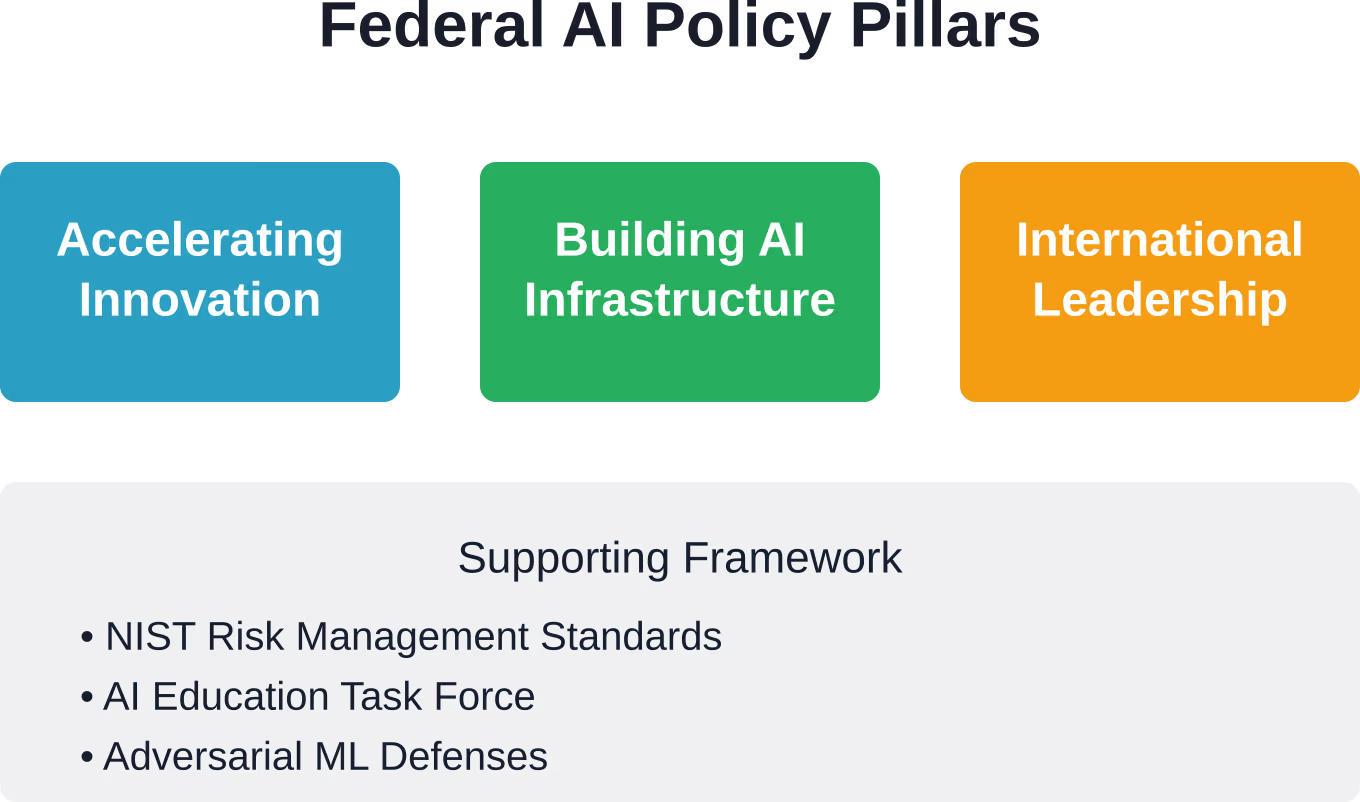
Real-World Government ML Applications
Theory matters less than execution. Here’s where machine learning actually works in government operations.
Tax Compliance and Fraud Detection
The IRS maintains 126 active artificial intelligence use cases as of June 2025, according to the Government Accountability Office. These applications span everything from identifying fraudulent returns to optimizing taxpayer service. But there’s a catch. GAO found that over 25% of IRS AI use cases didn’t include information about expected benefits. That documentation gap makes it tough to measure success or justify continued investment. The IRS received significant funding through the Inflation Reduction Act, though specific allocations have been subject to rescissions. Those budget pressures make ML efficiency gains critical. The IRS established AI governance guidance to direct AI investments, but execution remains uneven.
Social Program Targeting
Yale research by Professor Ahmed Mushfiq Mobarak demonstrates how ML transforms benefit distribution in resource-constrained environments. Working in Bangladesh, researchers used machine learning models applied to mobile phone records to identify the poorest households. The results? Faster targeting at far lower cost than traditional survey methods. ML-enhanced targeting improved benefit distribution efficiency in developing country contexts. Compare that to the U.S. approach during COVID-19 relief. The government looked at previous year’s tax returns—anyone earning less than $75,000 was eligible to receive a relief check. Simple, but potentially missing vulnerable populations without tax filing history. Sound familiar? That’s the trade-off governments face. Speed and simplicity versus precision and equity.
| Application Area | Primary ML Technique | Key Benefit | Main Challenge |
|---|---|---|---|
| Fraud Detection | Anomaly detection, pattern recognition | Identifies suspicious activity at scale | False positive management |
| Benefit Targeting | Classification, predictive modeling | Reaches vulnerable populations | Data availability in developing contexts |
| Risk Management | Statistical analysis, forecasting | Anticipates emerging threats | Model explainability for auditors |
| Service Optimization | Natural language processing, routing | Improves citizen experience | Integration with legacy systems |

Build Machine Learning Systems for Government Operations
Government agencies are increasingly adopting machine learning to improve efficiency, automate workflows, and support data-driven decision-making. AI Superior develops custom AI and machine learning solutions for enterprise and public sector use cases, focusing on practical implementation rather than concept-only consulting.
Looking for a Machine Learning Partner for a Government Project?
AI Superior supports government and public sector initiatives with:
- Custom machine learning model development
- NLP and computer vision solutions
- Integration of AI solutions into existing systems
If you are planning or evaluating a machine learning project in the public sector, (/contact/) to discuss requirements and next steps.
The Ethics Challenge
Government machine learning carries special responsibility. Private sector failures affect customers. Public sector failures affect citizens who can’t opt out. NIST’s adversarial machine learning taxonomy addresses one dimension: security. Attackers might poison training data or exploit model vulnerabilities. Defense agencies worry about adversarial inputs designed to fool classification systems. But ethical concerns extend beyond security.
Bias and Fairness
ML models learn from historical data. When that data reflects past discrimination, models perpetuate bias. A tax compliance model trained on audit patterns might over-scrutinize populations historically targeted for enforcement. The July 2025 executive order on preventing “woke AI” in the federal government adds another layer. It directs agencies to ensure AI outputs remain free from ideological bias and social agendas. Implementation guidance emphasizes reliable outputs for American citizens. Now, this is where it gets interesting. Defining “bias” proves remarkably difficult. Is an ML model biased when it reflects statistical reality, even if that reality stems from structural inequality? Or when it treats all groups identically despite different needs?
Transparency and Explainability
Citizens deserve to understand decisions affecting their lives. But many ML models operate as black boxes—accurate predictions with opaque reasoning. Regulatory frameworks increasingly require explainability. When a government algorithm denies benefits or flags someone for investigation, that person needs recourse. Human oversight becomes essential, not optional. 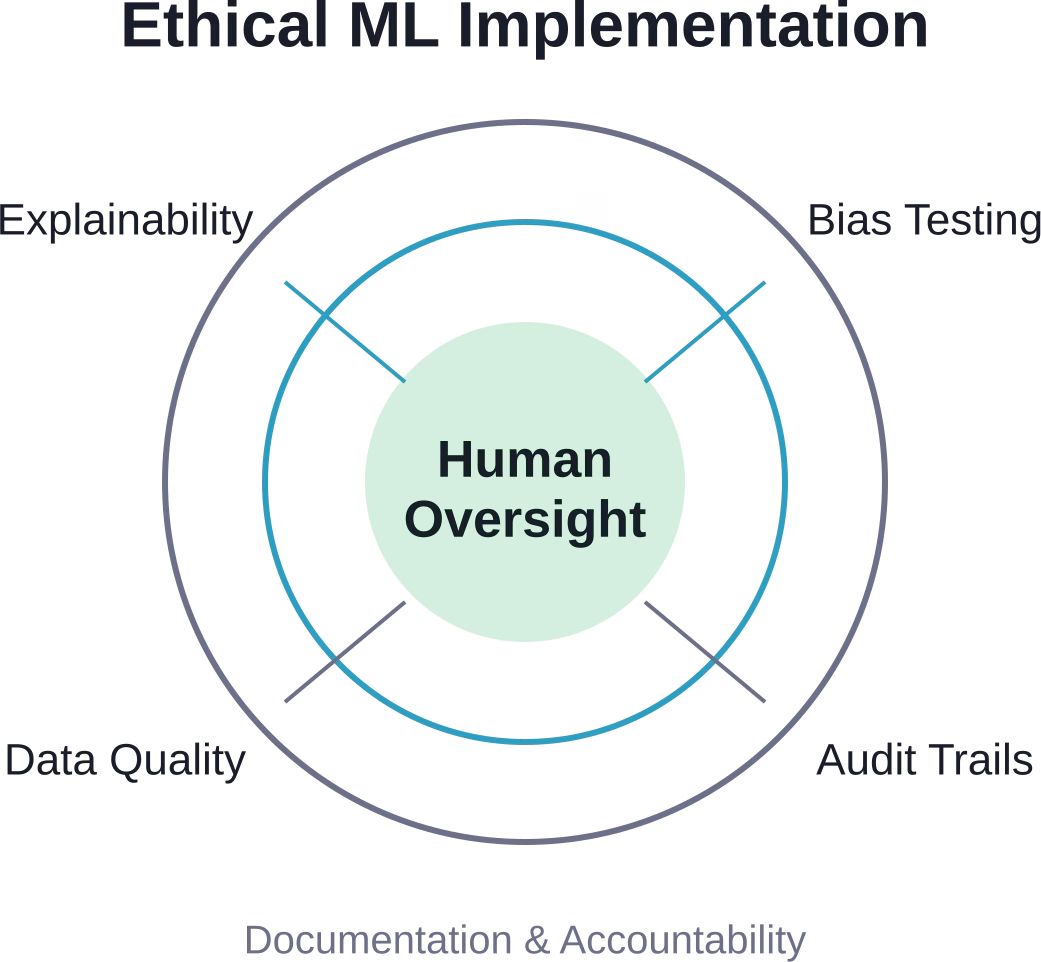
Implementation Challenges
Deploying machine learning in government environments differs from commercial applications. Legacy systems weren’t built for ML integration. Procurement processes move slower than technology evolution. And security requirements add complexity.
Data Infrastructure
Effective machine learning requires quality data—lots of it. Many agencies maintain data in siloed systems with incompatible formats. Privacy regulations restrict how personal information can be used for model training. The Department of Energy notes that ML excels at analyzing complex phenomena like simulations of ice crystals. But government agencies often struggle with basic data governance before reaching that sophistication level.
Workforce Skills
The White House Task Force on Artificial Intelligence Education, established under presidential directive, coordinates federal efforts to promote AI literacy among youth and educators. That’s a long-term investment. Short-term, agencies need data scientists, ML engineers, and ethics specialists. Competition with private sector salaries makes recruitment difficult. Training existing staff takes time.
Vendor Management
Many agencies procure ML solutions from contractors. That introduces risks. How do you audit a proprietary algorithm? Who owns the training data? What happens when a vendor relationship ends? Industry reports suggest government agencies increasingly demand on-premises deployment options and source code access. But those requirements can limit the vendor pool and increase costs.
| Challenge Category | Impact Level | Mitigation Strategy |
|---|---|---|
| Legacy System Integration | High | API development, phased modernization |
| Data Quality and Governance | Critical | Master data management, quality frameworks |
| Workforce Skills Gap | High | Training programs, competitive hiring, partnerships |
| Regulatory Compliance | Medium | NIST framework adoption, legal review processes |
| Budget Constraints | High | Prioritization, shared services, open source tools |
Looking Forward
Machine learning in government will accelerate. The AI Action Plan makes that clear—American dominance in AI is a national priority. Agencies that figure out responsible deployment will deliver better services at lower cost. But success isn’t guaranteed. The GAO report on IRS AI use cases reveals documentation gaps and unclear benefit tracking. Budget pressures could force agencies to cut AI investments before realizing returns. The winning approach? Start small, measure rigorously, scale what works. Agencies should pilot ML applications in low-risk environments, establish clear success metrics, and build institutional knowledge before tackling high-stakes decisions. And ethics can’t be an afterthought. Build fairness testing into development pipelines. Maintain human oversight. Document everything. The special burden of government ML ethics demands it.
Frequently Asked Questions
What is machine learning in government?
Machine learning in government refers to artificial intelligence systems that enable agencies to analyze large datasets, detect patterns, and automate decision-making for public sector applications like fraud detection, benefit distribution, and policy analysis.
Which federal agencies use machine learning?
The IRS maintains 126 active AI use cases for tax compliance and fraud detection. The Department of Energy uses ML for scientific research. Defense and intelligence agencies deploy ML for security applications. Social service agencies increasingly use ML for benefit targeting.
How does NIST’s AI framework guide government ML?
NIST’s AI Risk Management Framework, developed starting in 2021, provides guidance for trustworthy and responsible AI deployment. It helps agencies balance innovation with risk management, addressing security, bias, transparency, and accountability concerns.
What are the ethical concerns with government AI?
Key ethical concerns include algorithmic bias perpetuating historical discrimination, lack of transparency in automated decisions affecting citizens, inadequate human oversight, data privacy violations, and accountability gaps when ML systems make errors.
How much does the federal government invest in AI?
Government-wide AI investment is distributed across defense, intelligence, civilian agencies, and research institutions. The IRS received significant funding through the Inflation Reduction Act, though specific allocations have been subject to budget adjustments and rescissions.
Can machine learning reduce government fraud?
Yes. ML systems analyze transaction patterns to identify anomalies indicating fraudulent activity. Brookings Institution research notes that ML fraud detection operates at scale impossible for manual review, though false positives require human verification.
What skills do government agencies need for ML implementation?
Agencies need data scientists for model development, ML engineers for deployment, data engineers for infrastructure, cybersecurity specialists for adversarial ML defense, ethics experts for bias testing, and program managers who understand both technology and policy.
Conclusion
Machine learning reshapes how the government operates—from tax collection to disaster relief. Federal agencies that master responsible ML deployment will deliver better outcomes for citizens while managing taxpayer resources more effectively. The path forward requires balancing competing imperatives. Innovation and oversight. Efficiency and equity. Speed and security. Agencies succeeding at this balance follow clear frameworks like NIST guidance, maintain rigorous documentation, and keep humans in the loop for consequential decisions. As presidential directives push American AI dominance, government agencies face mounting pressure to accelerate adoption. Those that prioritize ethical implementation and quality data governance will lead. Those that rush deployment without proper safeguards will stumble. The question isn’t whether machine learning belongs in government. It’s already here. The question is whether we’ll deploy it wisely.