
Quick Summary: Machine learning in FMCG is transforming demand forecasting, inventory management, trade promotion, and supply chain efficiency. From Unilever’s predictive logistics to PepsiCo’s 98% forecast accuracy, ML models are cutting waste by up to 10%, reducing forecast errors, and helping companies navigate volatile consumer demand with unprecedented precision. The fast-moving consumer goods industry is valued at more than $10 trillion and reached $15 trillion in 2025. Yet margin pressure, demand volatility, and supply chain complexity make profitability harder than ever. Machine learning isn’t a buzzword in this space anymore. It’s the quiet engine running demand forecasts, optimizing promotions, and keeping shelves stocked without excess inventory sitting in warehouses. Here’s the thing though—ML in FMCG works differently than in tech or finance. The stakes are different, the data is messier, and the business logic is deeply tied to physical goods moving through complex networks. This guide breaks down how machine learning actually gets deployed in FMCG, what results companies are seeing, and where the technology makes the biggest impact.
What Machine Learning Really Means in FMCG Context
Machine learning is a subset of artificial intelligence where algorithms learn patterns from data without being explicitly programmed for every scenario. Instead of hard-coded rules, ML models train on historical data and improve predictions as they process more information. In FMCG, that means feeding years of shipment records, sales data, promotional calendars, weather patterns, and market trends into algorithms that spot patterns humans would miss. But wait. Not all AI is machine learning, and not all analytics in FMCG uses ML. Traditional business intelligence relies on dashboards and retrospective reporting. Statistical forecasting uses methods like exponential smoothing or ARIMA models—these are powerful but lack ML’s adaptive learning capability. Machine learning goes further by continuously refining predictions, handling non-linear relationships, and incorporating diverse data sources simultaneously. According to research from Rochester Institute of Technology, demand forecasting has gained focus with AI advancements precisely because accurate forecasts are no longer a luxury but a necessity for production and marketing decisions. The high volume and demand volatility in fast-moving consumer goods poses unique challenges. Inaccurate forecasts lead to high holding costs on excess inventory, shortages on certain SKUs, and significant impacts on both top and bottom lines. 
Turn Business Data Into AI Software With AI Superior
AI Superior helps companies turn machine learning ideas into working software. Their process covers discovery, dataset assessment, MVP development, scaling, integration, and result evaluation, so the solution is shaped around real data and business needs. For FMCG teams, this can support demand planning, product performance analysis, sales forecasting, customer behavior insights, or image-based workflows when needed.
Need Machine Learning for Real Workflows?
AI Superior can help with:
- building custom AI and ML tools
- creating forecasting and analytics models
- testing ideas with PoC or MVP work
- integrating AI into daily systems
👉 Contact AI Superior to discuss your project.
Why FMCG Needs Machine Learning More Than Most Industries
FMCG operates on razor-thin margins. As little as a 1% drop in sales can translate into millions in lost net profit margin, according to MIT research on case fill rate prediction. Case fill rate—the percentage of ordered products successfully delivered—directly impacts customer loyalty and contract compliance. When CFR drops, sales evaporate and relationships strain. Demand forecasting complexity rises as consumer behavior becomes less predictable. Seasonal patterns overlap with promotional effects, competitive actions, macroeconomic shifts, and even social media trends. Traditional statistical methods struggle when demand patterns become non-linear or when external variables multiply. Machine learning models—particularly ensemble methods, neural networks, and gradient boosting—handle this complexity better. Real talk: the FMCG sector deals with thousands of SKUs, each with unique demand profiles. Manually tuning forecasts at scale is impossible. ML automates pattern recognition across product portfolios. 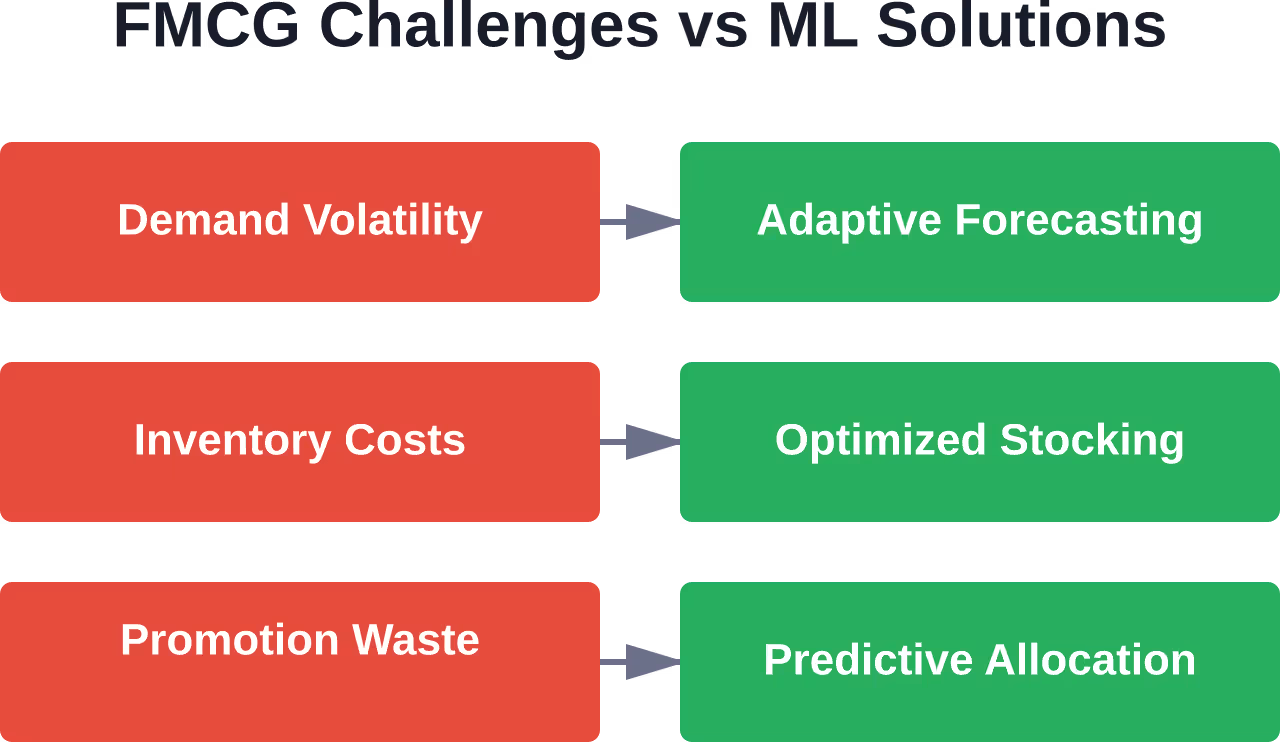
Core Machine Learning Applications in FMCG
Demand Forecasting and Predictive Analytics
Demand forecasting has been studied since the industrial revolution, but machine learning brings a new level of precision. Research from Rochester Institute of Technology (repository.rit.edu) conducted a comparative study evaluating statistical and machine learning forecasting methods for an FMCG company. Research compared various forecasting methods including statistical and machine learning approaches. Each model was evaluated on computational time, robustness, and forecast accuracy. Results varied by SKU and seasonality, but ML methods consistently handled complex demand patterns better than traditional statistical approaches when data volume was sufficient. Industry reports suggest ML can reduce forecasting errors in supply chains by up to 50%. That directly translates into lower stockouts, reduced waste, and better cash flow management. PepsiCo’s internal deployment achieved prediction accuracy near 98% using AI-driven analytics to optimize product mixes and reduce waste across its global supply chain. Not bad for a machine.
Inventory Optimization Through Reinforcement Learning
Inventory decisions in FMCG involve complex trade-offs: holding costs versus stockout risks, warehouse capacity constraints, and promotional timing. Research on data-driven inventory optimization explored reinforcement learning models where agents learn optimal actions through trial and reward feedback. In these models, actions like “reduce prices” could decrease sales price by a percentage while raising sales volume accordingly. The reward value balances multiple factors—maximizing sales while minimizing holding costs and avoiding stockouts. Over thousands of simulated decision cycles, the model learns which inventory levels and pricing actions yield the best overall outcomes. ML predicts demand, helping factories cut waste and save up to 10% of valuable ingredients like vanilla and cocoa, according to analysis of FMCG deployments.
Case Fill Rate Prediction
MIT research on enhancing FMCG resilience through data-driven insights focused specifically on case fill rate prediction. The project followed a robust three-phase methodology addressing the industry’s complex supply chains and unpredictable demand. CFR prediction models incorporate supplier reliability, production capacity, logistics constraints, and demand forecasts. When models accurately predict CFR shortfalls in advance, planners can reallocate resources, adjust production schedules, or communicate proactively with retail partners. This prevents the cascading damage from delivery failures—lost sales, eroded loyalty, and potential contract breaches.
Trade Promotion Effectiveness
FMCG companies spend billions on trade promotions—discounts, displays, and advertising aimed at driving short-term sales lifts. But measuring actual ROI is notoriously difficult. Machine learning models isolate promotional impact by controlling for seasonality, competitive actions, and baseline trends. Gradient boosting and random forest models handle the non-linear interactions between promotion type, timing, price elasticity, and channel. What if scenarios become possible: What if raw material prices rise next quarter? What if a 5% discount is applied to high-margin SKUs? ML-driven scenario planning combines data, AI, and business logic to simulate outcomes and guide decision-making in real time.
Shelf Audit and Image Recognition
Not all image recognition for FMCG is AI-driven. ML-powered shelf audit systems use computer vision to analyze retail shelf images instantly. These models detect out-of-stock situations, measure share of shelf versus competitors, verify planogram compliance, and identify pricing errors. At the retail end, AI-enabled freezers provided live stock updates and helped boost sales in markets like Denmark by ensuring product availability and optimal merchandising.
Real-World Machine Learning Deployment in Leading FMCG Brands
PepsiCo uses AI-driven analytics not just for forecasting but for product innovation. By analyzing consumer preference data, social media sentiment, and purchase patterns, ML models identify emerging flavor trends and package preferences before they hit mainstream awareness. The nearly 98% prediction accuracy in one internal deployment translates directly into reduced waste across manufacturing and distribution networks. Kraft Heinz leverages machine learning to improve supply chain efficiency. Predictive models optimize production scheduling, minimize changeover times, and match output to real-time demand signals from retail partners. Unilever applies ML across its portfolio for everything from raw material sourcing to last-mile delivery. Predictive logistics models route shipments dynamically based on traffic, weather, and delivery time windows. Early AI adopters in FMCG have seen up to a 20% reduction in supply chain costs, according to industry analyses. The impact is significant when operating at the scale of global consumer goods companies.
Machine Learning Model Performance in FMCG Context
Model selection matters. Not all ML algorithms perform equally across different FMCG scenarios. Research on inventory optimization using Random Forest models reported Mean Squared Error of 1341.35 and Mean Absolute Error of 27.35 for forecast predictions. These metrics provide baselines for evaluating whether a model is production-ready. But here’s where it gets tricky. Some models produced predictions off by over 50% in nearly half of forecasts when measured by MAPE (Mean Absolute Percentage Error). For small-volume SKUs, even accurate absolute errors can translate to massive percentage errors. MAPE thresholds of 1.0 or higher indicate large errors relative to actual data magnitude. When building FMCG forecasting systems, segmenting SKUs by volume and applying different model architectures often yields better results than one-size-fits-all approaches. Cross-validation configurations in forecasting applications use rolling-window approaches with defined proportions for training, validation, and testing periods. This approach mimics real-world deployment where models retrain as new sales data arrives.
Statistical Methods vs Machine Learning
The comparative study from Rochester Institute of Technology highlights an important nuance: statistical methods still have a place. For SKUs with stable, linear demand patterns and limited external variables, exponential smoothing or ARIMA can deliver accurate forecasts with lower computational overhead and easier interpretability. Machine learning shines when demand is non-linear, when external variables multiply (weather, promotions, social trends, competitive actions), or when real-time adaptation matters. LSTM neural networks handle sequential dependencies well, making them effective for products with long seasonal cycles or promotional carryover effects. Facebook Prophet balances ease of use with solid performance on daily or weekly data with multiple seasonality patterns.
| Model Type | Best Use Case | Complexity | Interpretability |
|---|---|---|---|
| Exponential Smoothing | Stable demand, minimal variables | Low | High |
| ARIMA | Linear trends, seasonal patterns | Medium | Medium |
| Random Forest | Non-linear, multiple variables | Medium | Medium |
| Facebook Prophet | Multiple seasonality, holidays | Low | High |
| LSTM Neural Networks | Complex sequences, long-term dependencies | High | Low |
| Reinforcement Learning | Dynamic pricing, inventory actions | High | Low |
Implementation Challenges and Practical Considerations
Machine learning in FMCG isn’t plug-and-play. Data quality remains the biggest hurdle. FMCG companies often have fragmented data across ERP systems, point-of-sale terminals, distributor networks, and third-party retailers. Harmonizing this data—reconciling SKU codes, aligning timestamps, handling missing values—consumes the majority of ML project time. Computational power matters less than it used to, thanks to cloud infrastructure. But model interpretability remains critical. Finance and operations teams need to understand why a forecast changed or why the model recommends a specific inventory action. Black-box neural networks face adoption resistance unless paired with explainability layers like SHAP values or LIME that break down feature contributions to predictions. Now, this is where it gets interesting. The FMCG industry values consistency. A model that delivers 85% accuracy reliably beats one that swings between 90% and 70% depending on the week. Robustness testing—evaluating model performance across different time periods, regions, and product categories—is essential before production deployment.
Organizational Readiness
Technology is only half the battle. Organizations need data literacy, cross-functional collaboration between IT and business units, and executive buy-in. Pilots prove value. Start with a single product category or region, demonstrate measurable improvement in forecast accuracy or inventory turns, then scale horizontally. Change management is underrated. Sales teams accustomed to gut-feel forecasting won’t trust ML outputs overnight. Transparency about model limitations and collaborative refinement builds confidence.
Future Directions for Machine Learning in FMCG
The next evolution combines ML with scenario planning. Instead of static forecasts, FMCG companies are building decision intelligence platforms that simulate “what if” scenarios in real time. What if a key ingredient’s price spikes 15%? What if a competitor launches a promotional blitz? What if a viral social media trend suddenly shifts demand toward a specific SKU? These platforms combine ML forecasts with optimization engines and business rules to recommend actions, not just predictions. Edge computing and IoT integration will push ML closer to the point of action. Smart shelves, connected vending machines, and IoT-enabled cold chain monitoring generate real-time data streams that feed directly into adaptive ML models. Personalization at scale becomes feasible when ML models process individual purchase histories, dietary preferences, and location data to tailor promotions and assortment recommendations dynamically. Sustainability applications are emerging. ML optimizes logistics to minimize carbon footprint, predicts product spoilage to reduce food waste, and identifies circular economy opportunities in packaging and returns. 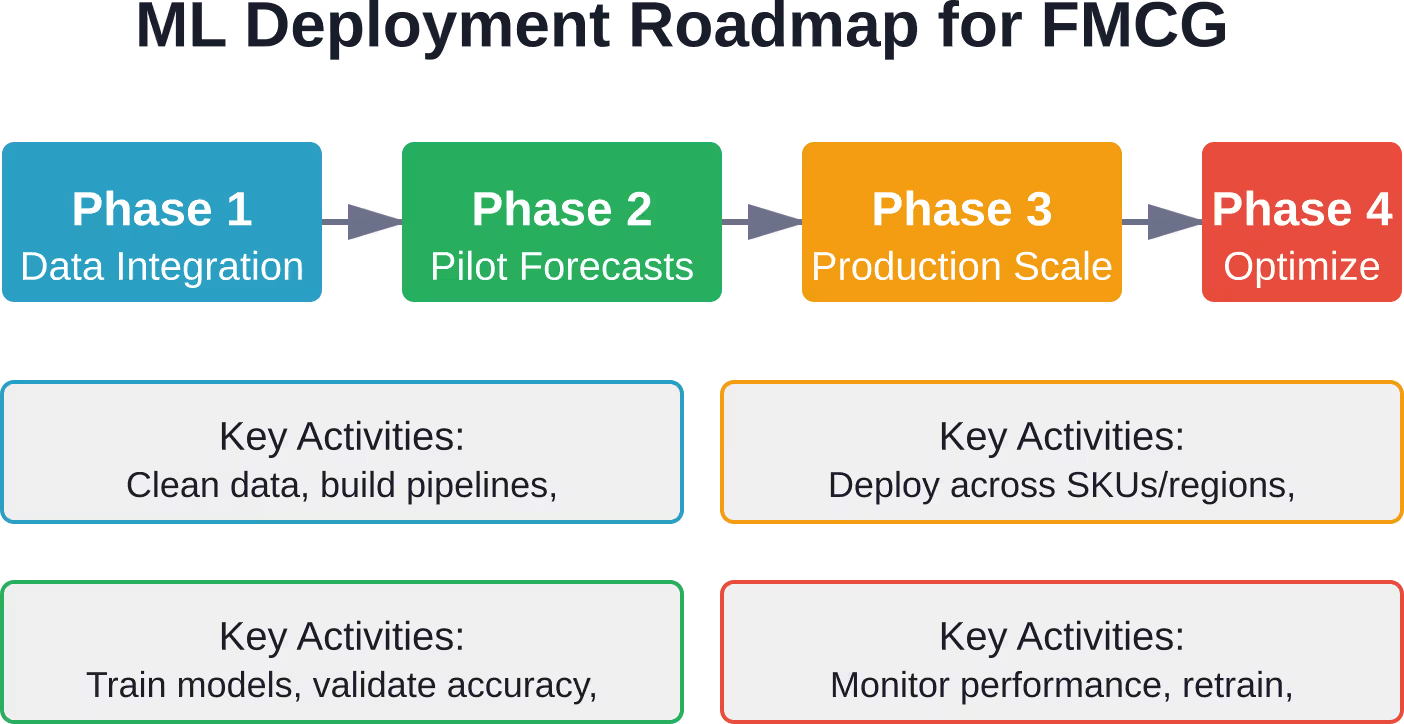
Frequently Asked Questions
How does machine learning differ from traditional forecasting in FMCG?
Traditional forecasting uses statistical methods like exponential smoothing or ARIMA that rely on historical patterns and assume linear relationships. Machine learning handles non-linear patterns, incorporates multiple external variables simultaneously, and adapts continuously as new data arrives. ML excels when demand complexity rises due to promotions, competitive actions, or rapid consumer trend shifts.
What accuracy improvements can FMCG companies expect from machine learning?
Results vary by product category and data quality, but documented cases show forecast accuracy reaching 98% in optimized deployments like PepsiCo’s internal systems. Industry analyses suggest ML can reduce forecasting errors by up to 50% compared to traditional methods. The key is proper model selection, data integration, and continuous retraining as market conditions evolve.
Which FMCG processes benefit most from machine learning?
Demand forecasting, inventory optimization, trade promotion effectiveness, case fill rate prediction, and shelf audit automation show the strongest ROI. These processes involve complex patterns, high-volume decisions, and significant financial impact. Companies like Unilever, PepsiCo, and Kraft Heinz apply ML across supply chain planning, production scheduling, and last-mile logistics.
What data is needed to implement machine learning in FMCG?
Historical sales and shipment data (typically 2-3 years minimum), promotional calendars, pricing history, inventory levels, supplier performance metrics, and external variables like weather, holidays, and economic indicators. Data quality matters more than volume—clean, consistent datasets with aligned timestamps and SKU codes enable faster model development and more reliable predictions.
How do FMCG companies measure machine learning ROI?
Key metrics include forecast accuracy improvement (measured by MAPE, MAE, or MSE), inventory turn rate increases, stockout reduction, waste percentage decrease, and case fill rate improvements. Financial metrics track margin impact—even a 1% sales improvement translates to millions in net profit for large FMCG operations. Pilot projects typically demonstrate measurable impact within 3-6 months.
Can small FMCG companies benefit from machine learning?
Yes, though the approach differs. Cloud-based ML platforms and pre-built forecasting solutions lower the barrier to entry. Smaller companies often start with focused use cases like demand forecasting for top SKUs or promotion optimization for key retail partners. The key is starting with clean data and realistic expectations—even modest accuracy gains drive meaningful cost savings at FMCG margins.
What are the biggest challenges in deploying machine learning for FMCG?
Data fragmentation across systems, lack of data quality and standardization, model interpretability requirements for business stakeholder buy-in, and organizational readiness. Technical challenges are solvable—cultural adoption and change management often determine success. Cross-functional collaboration between IT, supply chain, sales, and finance teams is essential for sustainable ML deployment.
Conclusion
Machine learning in FMCG has moved from experimental to essential. The industry’s complexity—thousands of SKUs, volatile demand, razor-thin margins—makes ML not just valuable but necessary for competitive survival. Results speak clearly. Forecast accuracy reaching 98%. Waste reductions of 10% on high-value ingredients. Sales lifts of 30% from AI-enabled retail systems. Supply chain cost cuts of 20% for early adopters. The technology is proven. Data infrastructure is accessible through cloud platforms. Pre-built models and frameworks lower implementation barriers. What separates winners from laggards isn’t access to algorithms. It’s data discipline, organizational alignment, and the willingness to pilot, measure, and scale methodically. Start with a focused use case. Measure rigorously. Build trust through transparency. Scale what works. The FMCG companies thriving in 2026 aren’t the ones with the biggest ML budgets. They’re the ones that embedded data-driven decision-making into daily operations and gave planners tools that actually work. Ready to move beyond forecasting spreadsheets? The playbook is clear. The results are documented. The only question is when, not whether, to start.