
Quick Summary: Machine learning is revolutionizing the shipping industry through predictive analytics, route optimization, and automated port operations. With the logistics AI market projected to reach over $31 billion by 2028, shipping companies are leveraging ML algorithms to reduce operational costs, minimize delays, and improve cargo handling efficiency. From autonomous vessel navigation to smart container management, ML applications are transforming every aspect of maritime logistics. The shipping industry has entered a new era. What once relied on experience and gut instinct now runs on data-driven intelligence. Machine learning algorithms analyze billions of data points from vessel sensors, weather patterns, port congestion, and cargo manifests. They predict delays before they happen, optimize routes in real-time, and coordinate container movements with precision impossible for human operators alone. The numbers tell the story. According to research from the University of Arkansas Walton College, the logistics AI market is projected to explode, reaching over $31 billion by 2028. The maritime AI market nearly tripled in size between 2023 and 2024, according to a Thetius report cited by the Institute of Marine Engineering, Science and Technology (IMarEST). But here’s the thing—adoption isn’t without challenges. The same IMarEST research found that 37% of marine professionals have witnessed AI failures firsthand. That gap between potential and reality makes understanding the practical applications of ML in shipping essential.
Understanding Machine Learning in Maritime Context
Machine learning represents a subset of artificial intelligence where algorithms improve automatically through experience. Rather than following explicit programming, ML systems identify patterns in data and adjust their behavior accordingly. In maritime applications, this means software that learns from historical shipping data to make increasingly accurate predictions about everything from fuel consumption to equipment failures. The distinction matters. Traditional automation executes predetermined instructions. ML adapts to changing conditions. When a vessel encounters unexpected weather, ML systems recalculate optimal routes based on thousands of similar scenarios encountered previously.
How ML Differs from Traditional Shipping Technology
Older shipping management systems operated on rules-based logic. If-then statements governed decisions. These systems couldn’t adapt to situations their programmers hadn’t anticipated. Machine learning flips that model. Algorithms trained on historical shipping data identify correlations humans might miss. They recognize patterns across weather data, cargo types, seasonal variations, and port characteristics—then apply those insights to current operations. That adaptability proves crucial in an industry where conditions change constantly. Routes, fuel prices, labor availability, and regulatory requirements shift weekly. ML systems adjust recommendations accordingly. 
Develop Predictive AI Software With AI Superior
AI Superior builds AI solutions for prediction, data analysis, NLP, BI, big data analytics, and custom software development. Their predictive analytics work can use current and historical data to support forecasting and better operational decisions. For shipping companies, this can support demand forecasting, route-related insights, equipment failure prediction, shipment risk analysis, or other data-heavy workflows.
Need AI Connected to Your Operations?
AI Superior can help with:
- creating machine learning models
- building predictive analytics systems
- analyzing operational and customer data
- connecting AI tools with existing platforms
👉 Contact AI Superior to discuss your project.
Core Applications Transforming Shipping Operations
The practical applications of machine learning span every phase of maritime logistics. Some deliver immediate operational improvements. Others promise long-term strategic advantages.
Route Optimization and Voyage Planning
Matthias Winkenbach, MIT Center for Transportation and Logistics Director, uses AI to make vehicle routing more efficient and adaptable for unexpected events. These systems process real-time weather data, sea conditions, fuel prices, port congestion, and canal wait times. They calculate optimal routes that minimize transit time, fuel consumption, and risk exposure simultaneously. The complexity exceeds human capability. A single transoceanic voyage involves thousands of variables. ML algorithms evaluate scenarios humans couldn’t process in weeks, delivering recommendations in seconds.
Port Operations and Container Management
Port efficiency represents one of the most promising ML applications. Research published on arXiv revealed that in the terminal where the study was conducted, up to 75% of all container-handling moves were classified as unproductive. Of these wasted movements, approximately 51% were associated with containers requiring pre-clearance service requirements. ML systems address this inefficiency through predictive container placement. Algorithms analyze cargo manifests, destination patterns, and pickup schedules to determine optimal container stacking. The result? Fewer repositioning moves and faster cargo retrieval. Predictive analytics also improve berth allocation. ML models forecast vessel arrival times more accurately than traditional methods, accounting for weather delays, canal traffic, and vessel-specific performance characteristics. Ports can prepare resources in advance and minimize idle berth time.
Predictive Maintenance and Equipment Monitoring
Vessel equipment failures at sea cost shipping companies millions in emergency repairs, missed delivery windows, and cargo delays. ML-powered predictive maintenance changes that equation. Sensors throughout modern vessels collect continuous data on engine performance, vibration patterns, temperature fluctuations, and fuel consumption. Machine learning algorithms analyze these data streams to identify subtle patterns that precede equipment failures. The systems learn what normal operation looks like for each specific vessel and engine configuration. When sensor readings deviate from expected patterns—even slightly—algorithms flag potential issues for inspection. Maintenance teams can address problems during scheduled port calls rather than dealing with catastrophic failures mid-voyage.
The Global Shipping Network Through ML Analysis
Researchers have applied machine learning to understand the global shipping network’s structure and dynamics. Analysis of Lloyd’s shipping data—which covers approximately 100% of the world’s fleet—revealed fascinating network characteristics. The largest connected component of the global shipping network contains 1,154 ports (93% of all ports) linked by 21,776 route connections (99% of all routes). Of these connections, 7,544 are bi-directional, representing 35% of all edges in the network. The network displays a density of 0.01, a diameter of 10 ports, and an average shortest path length of 3.1 connections. The clustering coefficient of 0.6 indicates highly interconnected regional shipping hubs. 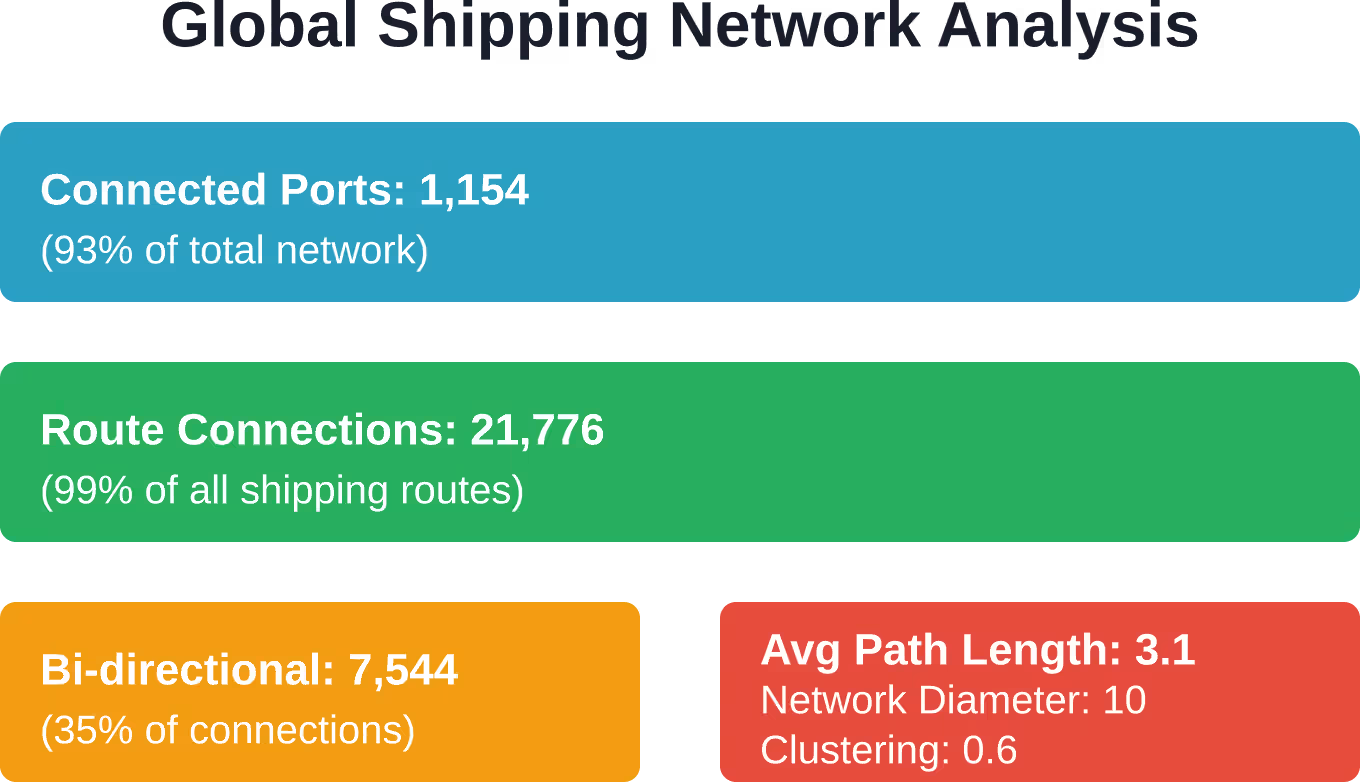
Port Relevance Classification Models
Researchers developed ML models to classify port relevance using 36 features—34 categorical and 2 continuous variables. The models were trained on a 75% split of historical shipping data. Classification thresholds tested included 5%, 10%, and 15% centrality measures to identify critical shipping hubs. These models help logistics companies understand network dynamics and anticipate disruption impacts when major ports experience congestion or closures.
Last-Mile Logistics Enhancement
While ocean shipping captures headlines, last-mile delivery represents a growing ML application area. Traditional vehicle routing becomes exponentially complex as delivery stops increase. ML approaches—particularly transformer models adapted from natural language processing—treat routing as a sequence prediction problem. Just as language models predict the next word in a sentence, routing models predict the next optimal delivery stop given current vehicle location, remaining packages, traffic conditions, and time windows. These systems adapt dynamically to unexpected events. Traffic accidents, closed roads, or customer unavailability trigger instant route recalculation that minimizes impact across the entire delivery fleet.
Challenges and Reality Check
Despite promising applications, ML adoption in shipping faces real obstacles. According to IMarEST research, 37% of marine professionals have witnessed AI failures, highlighting implementation challenges.
Data Quality and Availability
Machine learning requires massive datasets for training. Many shipping companies lack comprehensive historical data in structured, accessible formats. Legacy systems store information in incompatible formats. Manual record-keeping creates gaps and inconsistencies. Poor data quality produces unreliable ML models. Garbage in, garbage out remains true regardless of algorithm sophistication.
Integration with Existing Systems
Shipping operations run on decades-old infrastructure in many cases. Integrating ML capabilities with legacy cargo management systems, billing platforms, and communication protocols requires significant technical effort. The industry hasn’t standardized data formats or communication protocols for ML applications. Each company faces custom integration challenges.
Regulatory and Safety Concerns
Maritime operations involve significant safety considerations. Regulatory bodies require transparency in decision-making processes—something ML’s “black box” nature complicates. When an algorithm recommends a route change, operators need to understand the reasoning. Explainable AI represents an active research area addressing this requirement. Until solutions mature, human oversight remains essential.
| Challenge Area | Impact Level | Primary Mitigation Strategy |
|---|---|---|
| Data Quality | High | Standardized collection protocols and data governance frameworks |
| System Integration | High | API-first architecture and middleware solutions |
| Regulatory Compliance | Medium | Explainable AI models and human-in-the-loop validation |
| Workforce Training | Medium | Continuous education programs and change management |
| Cost Justification | Low | Pilot projects demonstrating clear ROI metrics |
Practical Implementation Strategies
Successful ML adoption in shipping follows predictable patterns. Companies that succeed share common approaches.
Start with Narrow Applications
Attempting to transform entire operations overnight leads to failure. Effective implementations begin with specific, measurable problems: predicting equipment failures for a single vessel class, optimizing container stacking at one terminal, or forecasting arrival times for a particular route. These focused applications deliver quick wins that build organizational confidence and justify expanded investment.
Invest in Data Infrastructure
Before implementing sophisticated ML models, establish robust data collection and storage systems. Install sensors where needed. Standardize data formats. Create centralized repositories. This groundwork proves unglamorous but essential. Without quality data pipelines, ML projects stall.
Maintain Human Expertise
ML augments human decision-making rather than replacing it. Experienced maritime professionals provide context algorithms lack. They identify when recommendations seem off and investigate underlying causes. The most effective implementations combine ML pattern recognition with human judgment and domain expertise.
Measuring ROI and Impact
Quantifying ML value requires tracking specific metrics before and after implementation. For route optimization, measure fuel consumption per nautical mile, average transit time variance, and on-time arrival percentage. Port operations track container moves per hour, berth utilization rates, and dwell time reduction. Predictive maintenance monitors unplanned downtime hours, emergency repair costs, and maintenance schedule adherence. Establish baseline measurements before ML deployment. Track improvements over months rather than weeks—systems need time to accumulate training data and refine predictions.
Future Developments on the Horizon
The trajectory of ML in shipping points toward increasing autonomy and integration. Autonomous vessels represent the most ambitious application. While fully crewed ships will dominate for decades, ML-assisted navigation systems already provide collision avoidance recommendations and optimal heading suggestions. Supply chain visibility platforms will integrate ML predictions across shipping, warehousing, and last-mile delivery. Customers will receive accurate delivery estimates that account for current vessel location, port congestion forecasts, and downstream logistics capacity. Emissions optimization grows more critical as environmental regulations tighten. ML models that minimize fuel consumption while meeting delivery commitments help shipping companies meet sustainability targets without sacrificing operational performance.
Frequently Asked Questions
How accurate are machine learning predictions for shipping delays?
Accuracy depends heavily on data quality and model training. Well-implemented ML systems achieve 85-95% accuracy for short-term delay predictions (24-72 hours ahead) when trained on comprehensive historical data. Longer-term predictions decrease in accuracy due to increasing variable uncertainty. Weather-related delays are generally predicted more accurately than port congestion or equipment failures.
What data do shipping companies need to implement ML systems?
Effective ML implementations require historical voyage data including routes, transit times, weather conditions, fuel consumption, cargo types, and port calls. Equipment sensor data for predictive maintenance includes engine performance metrics, vibration readings, temperature fluctuations, and maintenance logs. Port operations need container manifests, handling times, berth schedules, and cargo characteristics. Generally, 2-3 years of historical data provides sufficient training material.
Can small shipping companies benefit from machine learning?
Absolutely. While large carriers build custom ML systems, smaller operators can leverage cloud-based ML platforms and software-as-a-service solutions that require minimal upfront investment. Starting with focused applications like fuel consumption optimization or maintenance prediction delivers measurable value without massive technology investments. Many vendors offer scalable solutions designed specifically for smaller fleets.
How long does ML implementation take in shipping operations?
Timeline varies by scope. A focused pilot project targeting a specific problem (predictive maintenance for one equipment type, route optimization for a particular service) typically requires 3-6 months from data collection through initial deployment. Organization-wide implementations spanning multiple applications take 12-24 months. Factor in additional time for workforce training, change management, and system refinement based on initial results.
Does machine learning eliminate the need for experienced maritime professionals?
No. ML augments human expertise rather than replacing it. Experienced professionals provide critical context, identify unusual situations algorithms might miss, and make final decisions on ML recommendations. The most effective implementations combine ML pattern recognition with human judgment. As IMarEST research shows, 37% of marine professionals have witnessed AI failures—human oversight remains essential for catching errors and ensuring safety.
What regulations govern AI use in shipping?
Maritime AI regulation remains evolving. The International Maritime Organization (IMO) is developing frameworks for autonomous and AI-assisted vessels. Individual flag states and port authorities impose varying requirements. Most jurisdictions require human oversight of safety-critical systems and mandate that AI recommendations be explainable and auditable. Companies implementing ML should work closely with maritime lawyers and regulatory specialists to ensure compliance.
What’s the difference between AI and ML in shipping contexts?
Artificial Intelligence (AI) represents the broad concept of machines performing tasks that typically require human intelligence. Machine Learning (ML) is a specific subset of AI where algorithms improve through experience rather than explicit programming. In shipping, terms are often used interchangeably, but ML more accurately describes most current applications—systems that learn patterns from historical data to make predictions about routes, maintenance, or cargo handling.
Conclusion: Navigating the ML Transformation
Machine learning is reshaping shipping operations from vessel navigation to cargo delivery. The technology delivers measurable improvements in efficiency, cost reduction, and operational reliability when implemented thoughtfully. The market growth speaks for itself—from nearly tripling between 2023 and 2024 to a projected $31 billion logistics AI market by 2028. But success requires more than adopting trendy technology. Companies that succeed start small, focus on specific problems, invest in data infrastructure, and maintain human expertise alongside algorithmic insights. They measure results rigorously and scale what works. The shipping industry stands at an inflection point. ML capabilities will increasingly separate competitive leaders from laggards. Understanding these technologies, their applications, and their limitations positions maritime professionals and companies to navigate this transformation successfully. The question isn’t whether to adopt machine learning—it’s how to implement it effectively for sustainable competitive advantage.