Quick Summary: Machine learning is revolutionizing media and entertainment through personalized content recommendations, automated production workflows, and predictive audience analytics. From streaming platforms using sophisticated algorithms to deliver tailored viewing experiences to studios optimizing release strategies with data-driven insights, ML is reshaping how content is created, distributed, and consumed across the industry. The entertainment industry has undergone seismic shifts over the past few years. Machine learning sits at the heart of this transformation, quietly powering the streaming services you binge-watch, the music playlists that seem to read your mind, and even the films being greenlit by major studios. But here’s the thing—ML isn’t just making recommendations smarter. It’s fundamentally changing how content gets made, distributed, and consumed. The technology has evolved from simple collaborative filtering to sophisticated neural networks that understand context, emotion, and even cultural nuances. Real talk: the media companies that master machine learning will dominate the next decade. Those that don’t? They’ll be left wondering why their audience disappeared.
Understanding Machine Learning in Entertainment Context
Machine learning in media entertainment refers to algorithms that learn from massive datasets of user behavior, content attributes, and consumption patterns. Unlike traditional programming where developers write explicit rules, these systems identify patterns independently and improve over time. The technology operates primarily through two approaches: supervised and unsupervised learning. Supervised learning relies on labeled training data—think of Netflix knowing which shows you’ve watched and rated. The algorithm learns what features predict your preferences based on this historical information. Unsupervised learning, on the other hand, discovers hidden patterns without predefined labels. It clusters similar content or identifies viewing behaviors that human analysts might miss entirely. Research from arXiv on MovieLens 1M dataset shows the average user generated approximately 165 ratings, while specifically in the experiments of the cited paper on popularity bias, the density and average may vary based on the sub-sample used. 
Revolutionize Your Media and Entertainment Projects with AI
Machine learning is shaping the future of media and entertainment, from content creation to audience engagement. AI Superior offers tailored AI and ML solutions that help media companies tackle complex data challenges and streamline creative processes.
Leverage AI to Transform Your Entertainment Experience
AI Superior brings machine learning to the entertainment industry with:
- Advanced audience segmentation and content personalization
- Automated media analysis and metadata creation
- Insights-driven decision-making for content strategy and performance
👉Get in touch with AI Superior today to explore how their AI solutions can elevate your media and entertainment projects.
Personalized Content Recommendations
Streaming platforms have turned personalization into an art form. The algorithms analyze what you watch, when you pause, which thumbnails you click, and even what you abandon after five minutes. But the sophistication goes deeper. Modern recommendation engines consider calibration—ensuring suggestions match your actual consumption patterns. Research shows that if a user historically consumes 80% rock and 20% pop music, a calibrated recommendation list should reflect a similar distribution rather than overwhelming them with just popular tracks. 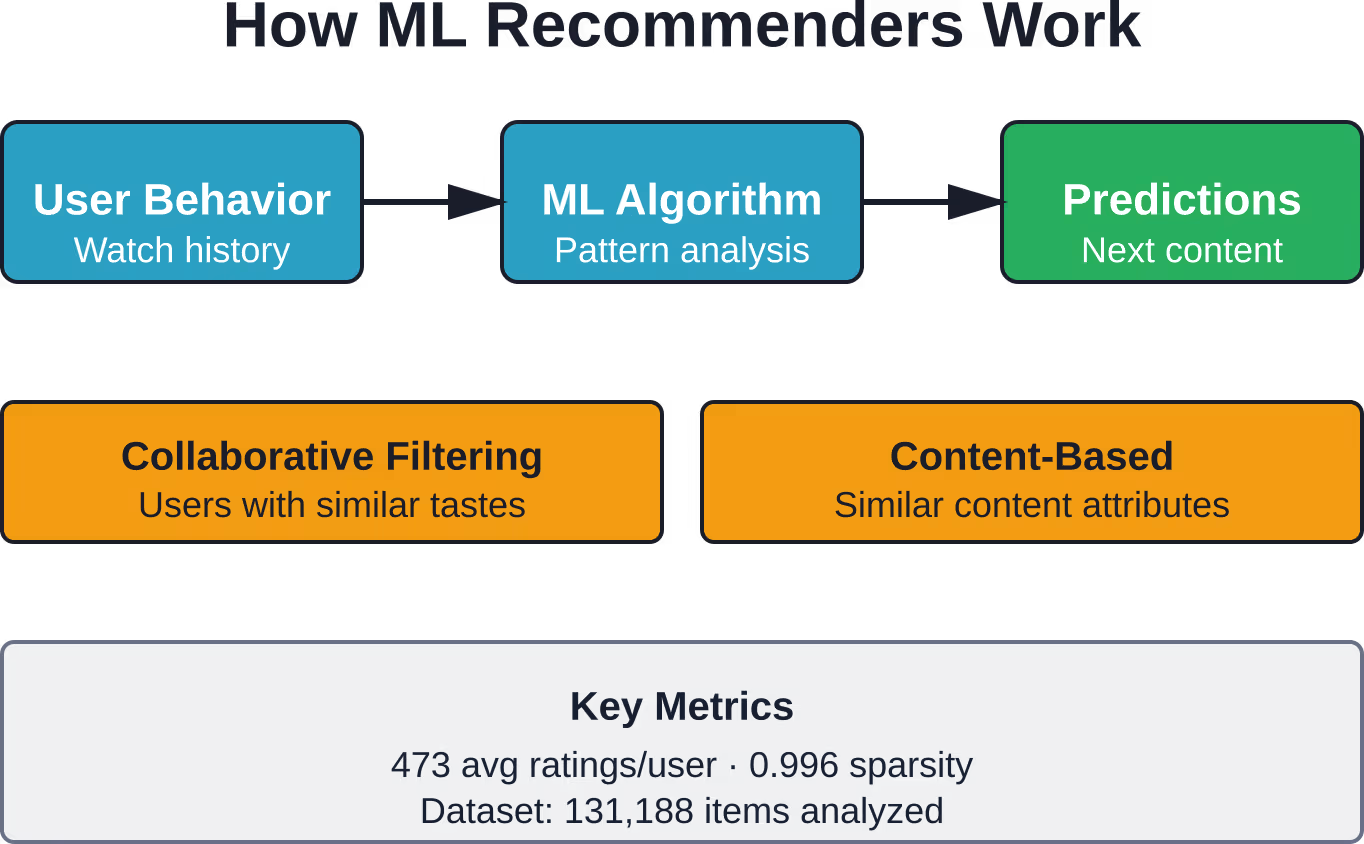 The challenge? Balancing personalization with discovery. Algorithms can trap users in filter bubbles, serving only familiar content types. Advanced systems now incorporate exploration strategies, deliberately introducing diverse options to broaden viewing horizons while maintaining relevance. Recent research from arXiv on optimizing recommendations using fine-tuned large language models shows the next frontier: systems that understand natural language descriptions of preferences and can explain why they’re recommending specific content.
Content Creation and Production
Machine learning has moved beyond recommendations into the creative process itself. The technology assists—and sometimes drives—actual content production across multiple dimensions. In partnership with Ross Goodwin, Benjamin AI crafted the science fiction movie “Zone Out” in just 48 hours. While it won’t win Academy Awards, this experiment demonstrates ML’s potential in scriptwriting, scene planning, and narrative structure. More practically, ML automates time-consuming production tasks:
- Automated video editing that identifies key moments, removes dead space, and creates highlight reels
- Color grading that matches cinematographer styles across entire films
- Audio mixing that balances dialogue, music, and effects based on learned preferences
- Visual effects rendering that reduces manual artist hours by identifying patterns
Sound familiar? That’s because many production tools you use daily already incorporate these capabilities, often without explicit marketing of the ML components.
Predictive Analytics for Distribution Strategy
Studios and streaming platforms now leverage machine learning to make smarter distribution decisions. The days of gut-feel release strategies are fading fast. Industry reports suggest that Disney’s data-driven distribution experiments proved hugely successful. The company tested shortened theatrical windows, experimenting with TVOD models before SVOD releases on Disney Plus. Machine learning models analyzed subscriber behavior, churn risk, and revenue optimization across distribution channels. Predictive analytics answer critical business questions:
| Decision Area | ML Application | Business Impact |
|---|---|---|
| Release Timing | Demand forecasting models | Optimized launch windows |
| Marketing Budget | ROI prediction algorithms | Efficient spend allocation |
| Content Acquisition | Performance projections | Smart licensing decisions |
| Churn Prevention | Subscriber behavior analysis | Retention improvements |
The algorithms process viewing patterns, social media sentiment, competitive releases, and historical performance data. They identify which genres perform best in specific markets, predict breakout hits, and flag content likely to underperform before significant marketing investment occurs.
Addressing Bias and Fairness
Now, here’s where it gets complicated. Machine learning systems can amplify existing biases, creating real problems in content recommendations and discovery. Research from arXiv specifically investigates popularity bias amplification in entertainment domain recommender systems. The study examined how algorithms disproportionately favor already-popular content, creating feedback loops where mainstream items get exponentially more exposure while niche content languishes in obscurity. 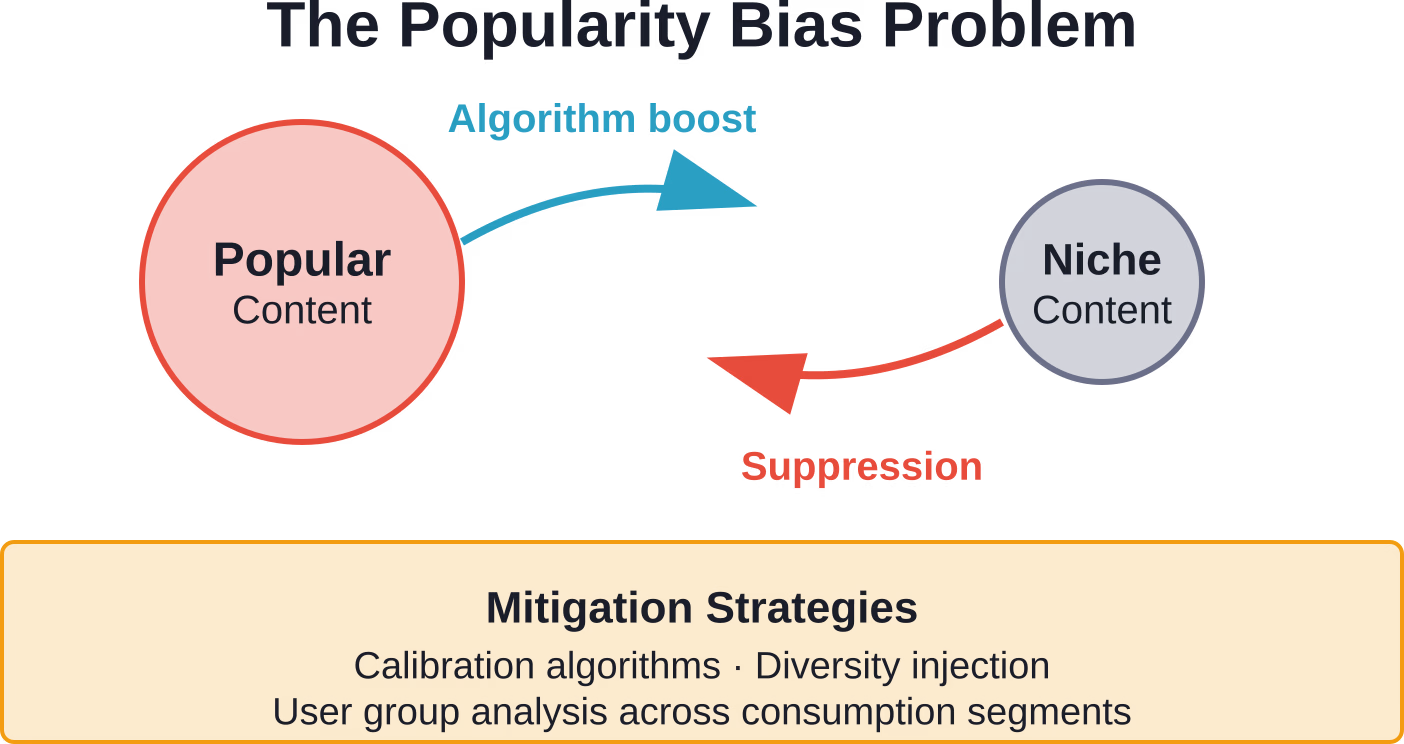 Researchers tackle this by splitting users into groups to analyze consumption patterns across different popularity segments. This granular approach reveals how different audience segments experience algorithmic bias differently. The solution involves calibration techniques that deliberately balance recommendations, ensuring diverse content types receive fair exposure regardless of existing popularity metrics.
Multi-Agent Systems and Video Recommendations
The latest frontier involves multi-agent recommender systems—multiple AI models working collaboratively to deliver superior results. Research from Google on multi-agent video recommenders explores how different specialized algorithms can combine strengths while compensating for individual weaknesses. These systems deploy:
- Specialized agents for different content types (movies vs. shorts vs. live streams)
- Context-aware models that adjust based on time, device, and viewing environment
- Collaborative agents that share insights across recommendation scenarios
- Quality-focused models that prioritize user satisfaction over pure engagement metrics
But wait—there’s a challenge. Coordinating multiple agents requires sophisticated orchestration. The systems must decide which agent’s recommendation to prioritize in real-time, balancing computational costs against recommendation quality.
The Future of ML in Media Entertainment
Looking ahead, several trends will reshape the landscape. Large language models are being fine-tuned specifically for entertainment recommendations, allowing users to describe preferences conversationally rather than through implicit behavior tracking alone. Immersive technologies—augmented and virtual reality—demand entirely new recommendation paradigms. Traditional metrics like watch time become meaningless when users actively navigate 360-degree environments. Research from NIST explores privacy implications and technical standards for these emerging platforms. The technology will also enable hyper-localization, creating content variations optimized for cultural contexts, language preferences, and regional sensibilities at scales impossible through manual production. Audio processing advances through ensemble learning techniques show promise for adaptive soundtracks, accessibility features, and emotion-responsive audio that adjusts based on detected user states.
Frequently Asked Questions
How accurate are machine learning recommendations in entertainment?
Modern ML systems achieve impressive accuracy, with many platforms reporting significant engagement increases from personalized recommendations compared to non-personalized content. However, accuracy depends on data quality and quantity—new users with limited history receive less precise recommendations until the system learns their preferences.
Can machine learning replace human creativity in content production?
Not yet, and likely not entirely. ML excels at pattern recognition and optimization but struggles with true creative innovation. The technology works best augmenting human creators—automating technical tasks while leaving artistic decisions to people. The “Zone Out” AI film demonstrates both potential and current limitations.
What data do entertainment ML systems collect?
Systems typically track viewing history, search queries, pause/rewind behavior, completion rates, ratings, time of day, device types, and sometimes cross-platform activity. The specific data varies by platform and jurisdiction, with privacy regulations like GDPR imposing restrictions on collection and usage.
How do platforms prevent recommendation filter bubbles?
Advanced systems incorporate diversity algorithms that deliberately introduce varied content types. They use exploration strategies that balance familiar recommendations with discovery opportunities, calibration techniques that match genre distributions to user profiles, and explicit diversity constraints in ranking algorithms.
What’s the difference between collaborative and content-based filtering?
Collaborative filtering recommends content based on similar users’ preferences—if users with similar histories to you liked something, you’ll probably like it too. Content-based filtering analyzes item attributes directly, recommending content with similar characteristics to what you’ve enjoyed. Most modern systems combine both approaches.
How does popularity bias affect content discovery?
Popularity bias causes algorithms to disproportionately recommend already-popular content, creating feedback loops where mainstream items dominate while niche content remains hidden. Research shows this affects different user segments unequally, with calibration techniques and deliberate diversity injection helping mitigate the problem.
Will machine learning change theatrical release strategies?
It already has. Studios now use predictive analytics to optimize release windows, distribution channels, and marketing budgets. Data-driven experiments with shortened theatrical windows and hybrid TVOD/SVOD strategies demonstrate how ML influences distribution decisions that were once purely instinct-based.
Conclusion
Machine learning has evolved from a competitive advantage to an industry necessity in media and entertainment. The technology powers everything from the recommendations you see to the production workflows creating content to the strategic decisions determining release strategies. The companies winning this transformation don’t just deploy ML—they integrate it thoughtfully, addressing bias concerns, maintaining creative authenticity, and keeping human judgment central to artistic decisions. They recognize algorithms as powerful tools that amplify human capabilities rather than replacements for human creativity. As the technology advances through fine-tuned language models, multi-agent systems, and immersive platform support, the gap between ML-native companies and traditional media organizations will only widen. The question isn’t whether to adopt machine learning—it’s how quickly and how effectively your organization can leverage these capabilities while maintaining the creative excellence audiences demand. The entertainment landscape of 2026 runs on machine learning. The winners will be those who master the balance between algorithmic efficiency and human artistry.