
Quick Summary: Machine learning is transforming the travel industry through personalized recommendations, predictive pricing, fraud detection, and operational optimization. Airlines, hotels, and travel platforms use ML algorithms to enhance customer satisfaction, reduce costs, and streamline operations. With the AI travel market projected to grow from $888 million in 2025 to nearly $10 billion by 2033, adopting machine learning has become essential for staying competitive. The travel industry generates massive amounts of data every single day. Flight bookings, hotel searches, customer reviews, pricing fluctuations, weather patterns—all of it creates a digital footprint that’s ripe for analysis. And that’s exactly where machine learning comes in. Airlines lose $33 billion annually due to flight delays, according to 2019 FAA estimates. Hotels struggle with no-shows and cancellations. Travel agencies face fierce competition and razor-thin margins. Machine learning isn’t just solving these problems—it’s rewriting the entire playbook for how travel companies operate.
What Machine Learning Actually Means for Travel
Machine learning refers to algorithms that learn from data without being explicitly programmed. Instead of writing rules like “if a customer books a beach hotel, recommends sunscreen,” ML models analyze millions of transactions to discover patterns humans would never spot. The difference? Traditional software follows fixed rules. Machine learning adapts. In travel, this means systems that get smarter with every booking, every search, every customer interaction. The more data flows through these algorithms, the better they perform at predicting what travelers want, what they’ll pay, and when they’ll cancel. 
Empower Your Travel Business with Machine Learning Solutions
Machine learning is reshaping travel by improving personalization, operational efficiency, and data-driven decision making. AI Superior helps companies across industries implement custom AI and ML solutions to address complex data challenges and support business goals.
Use AI to Upgrade Your Travel Services
AI Superior applies machine learning to business problems, which include:
- Personalized recommendations and customer insights
- Predictive analytics for demand patterns and trends
- Automation of data processing and workflow tasks
👉Contact AI Superior today to explore how their AI solutions can support your travel projects.
Enhancing Customer Satisfaction Through Predictive Analytics
Research using the Airline Passenger Satisfaction dataset—comprising over 100,000 observations with 22 predictors of customer satisfaction—demonstrates how effectively ML models predict traveler happiness. Support Vector Machines, Random Forest, and Gradient Boosting algorithms all achieved test accuracies of 0.95 when predicting whether passengers would be satisfied with their flight experience. These models used 5-fold cross-validation for hyperparameter tuning and an 80-20 training-test split. But accuracy numbers don’t tell the whole story. Airlines use these predictions to identify at-risk customers before they leave negative reviews. If the model flags a passenger as likely dissatisfied based on factors like delayed baggage, short connection times, or seat assignment issues, customer service can proactively reach out with solutions. 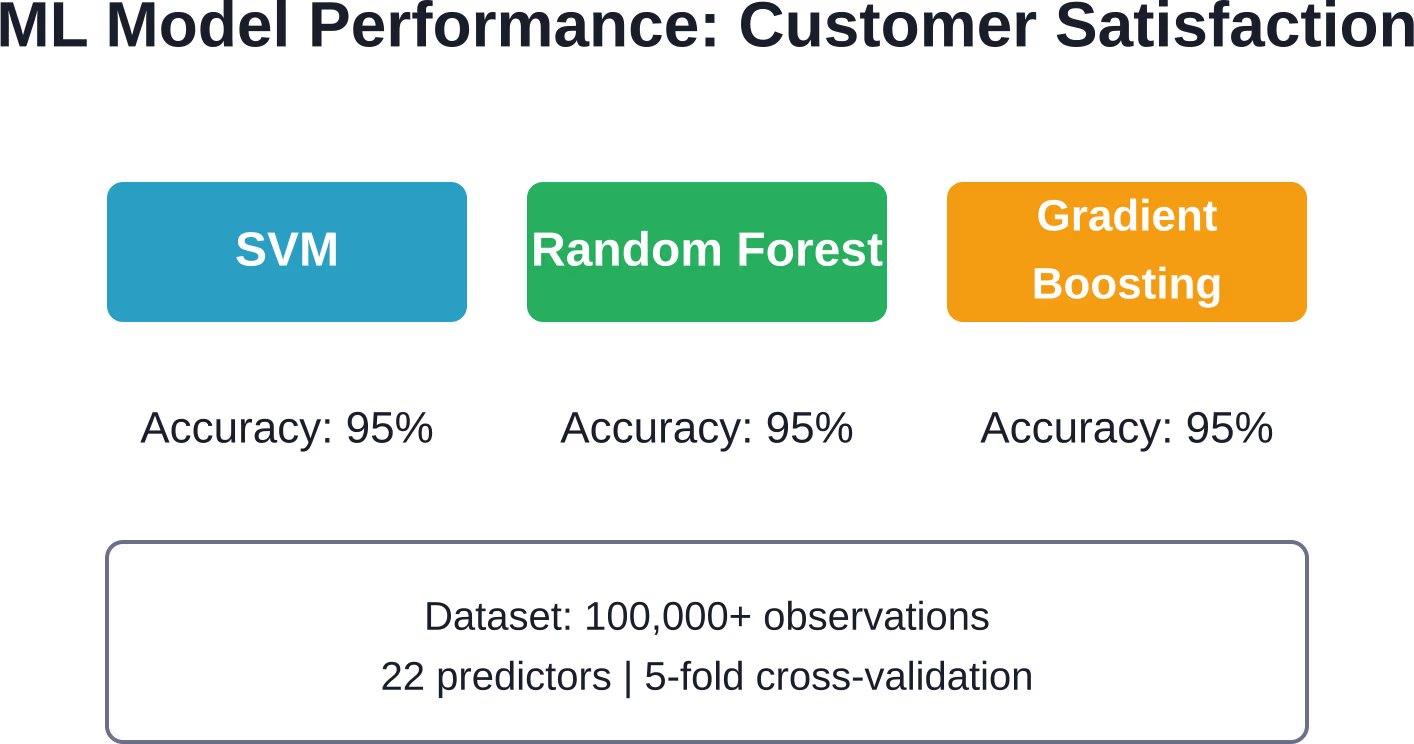 The real-world impact? Hotels using multilingual AI assistants—powered by machine learning for natural language understanding—see guest satisfaction scores that are 27% higher among international travelers, based on Marriott’s AI implementation data.
Predicting and Preventing Flight Delays
Flight delays cost the aviation industry $33 billion annually. Weather, maintenance issues, air traffic control constraints, crew scheduling—dozens of variables interact in complex ways that humans struggle to predict. Machine learning excels at exactly this kind of multivariable prediction. Research examining flight delay trends using regression ML methods found Decision Trees achieved high accuracy in predicting delays. Random Forest models hit 92.40% accuracy, while Gradient Boosted Trees reached 93.34%. These aren’t theoretical benchmarks. Airlines actively deploy similar models to:
- Reassign aircraft before delays cascade through the network
- Alert passengers early so they can rebook connections
- Optimize crew scheduling to minimize disruption costs
- Adjust gate assignments dynamically based on predicted arrival times
The models analyze departure time, airline, airport, historical performance, weather forecasts, and maintenance records to generate predictions hours—sometimes days—in advance.
Personalized Recommendations That Actually Work
Here’s the thing though—not all “personalization” is created equal. Basic recommendation engines use collaborative filtering: “People who booked this hotel also booked…” Machine learning takes it several steps further by analyzing behavioral patterns, preference signals, seasonal trends, pricing sensitivity, and contextual factors. According to research by Oliver Wyman, more than one-third of leisure travelers use generative AI to get destination ideas, plan trips, and book reservations. Even more telling: 84% report being satisfied or very satisfied with the quality of generative AI’s recommendations. Machine learning powers these experiences by:
- Clustering travelers into micro-segments based on behavior, not demographics
- Predicting which amenities matter most to each segment
- Timing recommendations to match booking windows and price sensitivity
- Learning from implicit signals—what people browse but don’t book
The result? Recommendations that feel intuitive rather than intrusive.
Dynamic Pricing and Revenue Optimization
Airlines pioneered dynamic pricing decades ago, but machine learning has elevated it to an art form. Modern revenue management systems analyze competitor pricing, search volume, historical booking curves, seasonality, events, and even social media sentiment to adjust prices in real-time. Hotels, car rentals, and vacation packages all follow similar strategies. The optimization challenge is brutally complex. Prices are too high and seats stay empty. Prices are too low and revenue evaporates. ML models find the sweet spot by continuously testing and learning.
| Traditional Pricing | Machine Learning Pricing |
|---|---|
| Fixed rules based on booking window | Dynamic rules that adapt to market conditions |
| Manual competitor analysis | Automated real-time competitor tracking |
| Seasonal adjustments only | Event-driven, weather-aware, sentiment-informed |
| Limited segmentation (business vs. leisure) | Micro-segmentation with individual willingness-to-pay |
Some systems optimize not just for maximum revenue, but for customer lifetime value—accepting lower margins on first bookings to build loyalty.
Fraud Detection and Security
Data breaches in the hospitality industry represent a significant financial risk. Machine learning fights back with anomaly detection models that flag suspicious transactions in milliseconds. These systems analyze:
- Booking patterns that deviate from normal behavior
- Payment method mismatches with geographic locations
- Velocity checks—too many bookings too quickly
- Device fingerprinting and IP reputation
Research on detecting fraudulent travel agencies using ML found Support Vector Machine (SVM) algorithms achieved 92.3% accuracy analyzing both text descriptions (via TF-IDF) and metadata patterns. The balance is tricky. Flag too many transactions and legitimate customers get frustrated. Flag too few and fraudsters slip through. Machine learning continuously adjusts thresholds based on false positive rates and cost-benefit analysis.
Optimizing Travel Itineraries
Planning multi-city trips involves solving an optimization problem with countless variables: cost, time, preferences, sustainability, weather, events, seasonal pricing, and more. Genetic algorithms—a type of machine learning inspired by natural selection—excel at these combinatorial challenges. Research on travel itinerary optimization using genetic algorithms found the approach provides optimal solutions in 100 generations, with quality improving 5% per iteration. 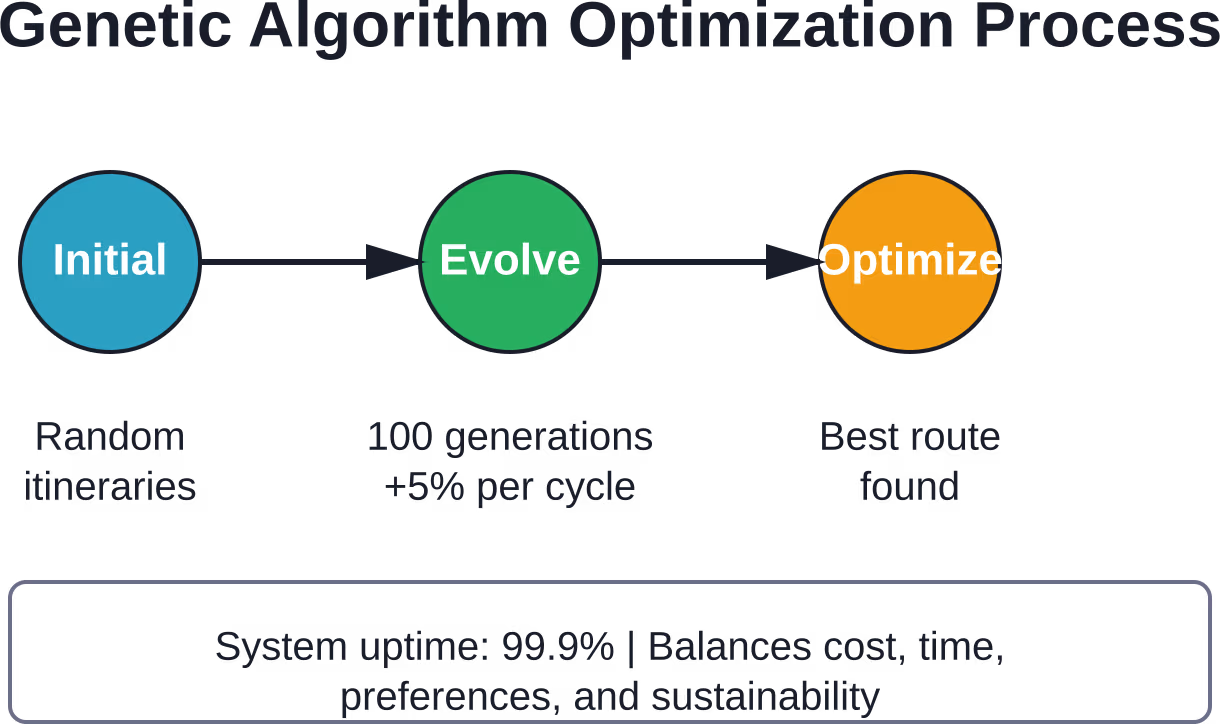 The system achieved 99.9% availability, making it reliable enough for production travel platforms. Travelers input preferences—budget cap, must-see destinations, preferred travel pace—and the algorithm generates optimized routes that balance all constraints.
Chatbots and Virtual Assistants
According to a survey of 150 hotel operators by Oracle, 78% believe in mass adoption of voice assistants to control room devices, lights, and air conditioning. But chatbots do more than control thermostats. Modern conversational AI handles booking changes, answers FAQ, provides local recommendations, and escalates complex issues to humans. The machine learning component learns from every conversation, getting better at understanding intent, context, and sentiment. Natural language processing models parse questions like “I need a hotel near the Eiffel Tower under $200 with breakfast” and extract structured data: location (Paris, near Eiffel Tower), price constraint (under $200), amenity requirement (breakfast included). The real value isn’t replacing humans—it’s handling the repetitive 80% of queries so staff can focus on the complex 20% that require judgment and empathy.
Sustainability and Environmental Impact
Travel contributes significantly to carbon emissions, and travelers increasingly factor sustainability into booking decisions. Machine learning helps in several ways:
- Predicting aircraft fuel consumption based on route, weather, and load to optimize flight planning
- Identifying hotels with verified sustainability practices through text analysis of certifications and reviews
- Calculating carbon footprints for different travel options and surfacing lower-emission alternatives
- Optimizing ground transportation routes to reduce fuel consumption
Some platforms now offer “eco-friendly” filters powered by ML models that score accommodations and transportation on environmental criteria.
Implementation Challenges
Real talk: deploying machine learning in travel isn’t plug-and-play. Data quality remains the biggest hurdle. ML models need clean, structured, representative data. Legacy systems in travel often store information in incompatible formats across siloed databases. Integration costs can be substantial. Privacy regulations add another layer of complexity. GDPR, CCPA, and similar laws restrict how companies collect, store, and use customer data—the very fuel ML models need. Then there’s the interpretability problem. When a model denies a booking or flags a transaction as fraudulent, can the company explain why? Regulatory compliance and customer service both demand transparency that black-box models struggle to provide.
| Challenge | ML Solution Approach |
|---|---|
| Data quality and integration | Data pipelines, automated cleaning, schema standardization |
| Privacy compliance | Federated learning, differential privacy, data minimization |
| Model interpretability | SHAP values, LIME, attention mechanisms, decision trees |
| Bias and fairness | Fairness metrics, bias audits, diverse training data |
The Future: Where Travel ML is Heading
The AI market in tourism is projected to grow from $888 million in 2025 to nearly $10 billion by 2033—a staggering 35% compound annual growth rate. What’s driving that growth? Multimodal AI that combines text, images, and video will power visual search—upload a photo of a beach and find similar destinations. Computer vision will analyze hotel room photos to verify cleanliness and amenities match listings. Reinforcement learning will optimize pricing strategies by testing different approaches and learning from outcomes in real-time, going beyond supervised learning’s historical pattern matching. Edge computing will move ML inference to mobile devices, enabling instant translation, augmented reality city guides, and offline recommendations without cloud latency. And integration with blockchain could verify credentials, loyalty points, and booking confirmations through ML-powered smart contracts.
Frequently Asked Questions
How accurate are machine learning models for predicting flight delays?
Research shows machine learning models achieve high accuracy for flight delay prediction at major airports, with Random Forest and Gradient Boosted Trees reaching 92-93% accuracy. Accuracy varies by airport, airline, and time horizon—short-term predictions (1-2 hours) perform better than long-term forecasts.
Do travel companies need large datasets to use machine learning?
It depends on the application. Pre-trained models for tasks like sentiment analysis or chatbots require minimal company-specific data. Custom models for pricing or personalization typically need thousands of transactions for reliable performance. Transfer learning and synthetic data generation can reduce data requirements significantly.
How do machine learning travel recommendations differ from traditional search results?
Traditional search ranks results by explicit filters (price, location, stars). Machine learning analyzes behavior patterns, implicit preferences, seasonal trends, and contextual signals to predict what travelers want before they explicitly search for it. More than one-third of leisure travelers now use AI for trip planning, with 84% satisfaction rates.
What privacy concerns arise from ML-powered travel platforms?
ML models require extensive personal data—browsing history, location, purchase patterns, preferences. Concerns include unauthorized data sharing, profiling for price discrimination, and security breaches. Data breaches represent a significant financial risk for the hospitality industry. Compliance with GDPR, CCPA, and similar regulations is mandatory.
Can small travel agencies compete with ML-powered platforms?
Absolutely. Cloud-based ML services (AWS, Google Cloud, Azure) offer pay-as-you-go access to sophisticated algorithms without requiring data science teams. Pre-built solutions for chatbots, fraud detection, and recommendation engines lower entry barriers. Small agencies can focus on niche markets where personalized service complements ML automation.
How do genetic algorithms optimize travel itineraries?
Genetic algorithms start with random itinerary “populations,” then iteratively combine and mutate the best performers. Research shows systems find optimal solutions in 100 generations with 5% quality improvement per cycle, balancing cost, time, preferences, and sustainability while maintaining 99.9% uptime.
Will machine learning replace human travel agents?
Unlikely. ML excels at repetitive tasks, pattern recognition, and data processing. Complex trip planning, handling unexpected disruptions, and providing empathetic customer service still require human judgment. The most effective approach combines ML efficiency with human expertise—automation handles routine queries while agents focus on high-value interactions.
Moving Forward with Machine Learning
Machine learning has moved from experimental to essential in the travel industry. Airlines predict delays with high accuracy. Hotels boost satisfaction scores 27% with multilingual AI. Fraud detection saves millions in breach costs. The technology isn’t perfect. Implementation challenges around data quality, privacy, and interpretability remain real. But the competitive advantages are equally real—and growing. For travel companies still on the sidelines, the question isn’t whether to adopt machine learning. It’s whether they can afford not to. Start small. Pick one high-impact use case—personalized recommendations, dynamic pricing, chatbot support. Test, measure, iterate. Build data infrastructure that supports future ML applications. Because in an industry where margins are thin and customer expectations climb constantly, machine learning isn’t just an upgrade. It’s survival.