Quick Summary: Machine learning is revolutionizing music through intelligent systems that generate compositions, classify genres, recommend personalized playlists, and analyze audio signals. Applications span from AI-powered music creation tools and emotion recognition to automated transcription and adaptive marketing strategies. While offering transformative capabilities, the technology raises important ethical questions about authorship, copyright, and transparency in AI-generated content. The intersection of machine learning and music represents one of the most fascinating applications of artificial intelligence. From Spotify’s eerily accurate recommendations to AI systems composing original symphonies, machine learning algorithms are fundamentally changing how music is created, distributed, and experienced. But this isn’t just about robots making beats. Machine learning in music tackles genuinely hard problems—extracting meaning from audio signals, understanding emotional context, predicting listener preferences, and even generating coherent musical structures that resonate with human audiences. The technology has matured rapidly. What started as simple pattern recognition in the early 2000s has evolved into sophisticated deep learning systems capable of multimodal analysis, combining audio, lyrics, video, and social data to understand music holistically.
The Core Applications of Machine Learning in Music
Machine learning touches virtually every aspect of the modern music ecosystem. Here’s where technology makes the biggest impact.
Music Generation and Composition
AI systems now generate music that ranges from background tracks to compositions that challenge the boundaries between human and machine creativity. Deep learning models trained on vast datasets learn the patterns, structures, and progressions that define musical genres. According to research, common approaches include recurrent neural networks (RNNs), long short-term memory networks (LSTMs), variational autoencoders (VAEs), and generative adversarial networks (GANs). These systems learn from substantial training data. The Maestro dataset, for instance, contains 200 hours of recorded piano performances from the International Piano-e-Competition. The NSynth dataset includes 305,979 musical notes from different instruments. The Lakh dataset encompasses 174,154 files of multi-track MIDI recordings. Google’s MusicLM, described in technical documentation published in 2023, represents a text-to-music generator that converts textual descriptions into audio compositions. While not publicly released, it demonstrates the capability of transformer-based architectures to understand musical intent from language. The EMSYNC system, described in research submitted February 5, 2026, generates music tailored to video content by analyzing emotional cues and synchronization requirements. This addresses a practical challenge: finding suitable soundtracks for the rapidly growing volume of video content. Real talk: generated music isn’t replacing human composers wholesale. But it’s carving out niches in stock music, adaptive game soundtracks, and personalized content creation where scale matters more than artistic vision.
Music Classification and Genre Recognition
Teaching machines to categorize music by genre sounds straightforward until you realize how subjective and fluid genre boundaries actually are. One of the earliest landmark studies came from Tzanetakis and Cook in 2002. They used Gaussian Mixture Models (GMM) and K-Nearest Neighbor (KNN) classifiers to achieve an overall accuracy of 61% for 10 genres. Modern approaches leverage deep learning to extract features automatically rather than hand-engineering them. Convolutional neural networks (CNNs) process spectrograms—visual representations of audio—much like image classification tasks. Classification extends beyond genre. Machine learning systems now identify:
- Musical instruments in complex audio mixes
- Emotional content and mood
- Key signatures and tempo
- Cultural and regional styles
- Song structure (verse, chorus, bridge)
The applications are practical. Streaming platforms use classification to organize massive catalogs. Radio stations use it to ensure smooth transitions. Music educators use it to build structured curricula.
Music Recommendation Systems
Recommendation engines represent perhaps the most visible application of machine learning in music. Spotify, Apple Music, YouTube Music, and similar platforms rely heavily on these algorithms to keep listeners engaged. These systems typically combine multiple approaches:
- Collaborative filtering identifies patterns across user behavior. If users who like Artist A also tend to like Artist B, the system recommends Artist B to new listeners of Artist A.
- Content-based filtering analyzes the audio itself—tempo, key, instrumentation, vocal characteristics—to find similar tracks regardless of listening patterns.
- Hybrid systems merge both approaches with additional signals: social tags, playlist co-occurrence, lyrics analysis, and even visual elements like album artwork.
The sophistication has increased dramatically. Early systems relied on metadata and explicit genre tags. Modern systems employ deep learning models that understand nuanced audio features and contextual listening patterns—workout playlists differ from dinner party playlists even when featuring the same genres.
Music Transcription and Analysis
Automatic music transcription—converting audio recordings into written notation—represents one of the hardest problems in Music Information Retrieval (MIR). Humans do this naturally but computers struggle with overlapping frequencies, complex harmonies, and the sheer variability of real-world recordings. Machine learning, particularly deep learning architectures, has made substantial progress. The MAPS dataset, containing 65 hours of piano audio recordings, serves as a benchmark for transcription systems. Models must identify not just which notes are played but their precise timing, duration, and velocity. Polyphonic transcription—handling multiple simultaneous notes—remains challenging. But specialized systems now achieve impressive accuracy for specific instruments, particularly piano and guitar. Analysis extends beyond transcription. Machine learning systems extract:
- Chord progressions
- Beat and downbeat timing
- Melody and bass lines
- Harmonic structure
- Performance expression and dynamics
These capabilities enable searchable music databases, educational tools for musicians, and preservation of recordings in structured formats.
Multimodal Music Information Retrieval
Music doesn’t exist in isolation. Listeners encounter it alongside lyrics, videos, album art, reviews, social media discussions, and live performances. Multimodal MIR systems process these diverse data sources simultaneously. Research published in March 2026 emphasizes how integrating multiple modalities improves understanding beyond what any single source provides. A system analyzing a music video might combine:
- Audio signal processing to understand musical content
- Computer vision to interpret visual elements and performance
- Natural language processing for lyrics and comments
- Social network analysis for popularity and influence
This mirrors how humans experience music. Nobody listens to audio in complete isolation—context matters. The same song hits differently in a concert video versus a lyric video versus a meme. Multimodal approaches power features like:
- Video-to-music generation for content creators
- Emotionally-aware recommendation based on lyrics and audio
- Cross-modal search (find songs by describing the music video)
- Cultural and demographic analysis through multiple signals

Transform Your Music Projects with Machine Learning
Machine learning is reshaping industries, offering innovative solutions for creation, recommendation, and audience engagement. AI Superior helps companies integrate custom AI and ML solutions to enhance their business processes.
Explore What AI Can Do for Your Music Workflows
AI Superior brings machine learning to creative projects through:
- AI‑driven tools for sound analysis and content generation
- Personalization and recommendation systems
- Automated workflows for mixing and audio optimization
👉Contact AI Superior today to discuss how their AI expertise can boost your music projects.
Machine Learning Techniques Powering Music Applications
Understanding the specific algorithms and architectures helps demystify what’s actually happening under the hood.
Deep Neural Networks and Architectures
Different neural network architectures excel at different music tasks:
- Recurrent Neural Networks (RNNs) process sequential data, making them natural for music where note order matters. They maintain internal memory of previous inputs, allowing them to learn temporal dependencies.
- Long Short-Term Memory (LSTM) networks extend RNNs with gating mechanisms that better capture long-term dependencies. Music has structure at multiple timescales—beat, measure, phrase, section—and LSTMs handle this hierarchical temporality better than vanilla RNNs.
- Convolutional Neural Networks (CNNs) excel at pattern recognition in spatial data. For music, they process spectrograms or other time-frequency representations, identifying local patterns like note combinations or timbral characteristics.
- Transformers use attention mechanisms to weigh the importance of different parts of the input. Originally developed for natural language, they’ve proven remarkably effective for music, allowing models to capture dependencies across long sequences without the vanishing gradient problems that plague RNNs.
- Generative Adversarial Networks (GANs) pit two networks against each other: a generator creates music and a discriminator tries to distinguish real from generated. This adversarial training pushes generators toward more realistic output.
- Variational Autoencoders (VAEs) learn compressed representations of music in a latent space. This enables interpolation between styles and controlled generation by manipulating latent variables.
Traditional Machine Learning Approaches
Deep learning dominates current research, but traditional machine learning methods remain relevant for specific tasks, particularly when labeled data is limited or interpretability matters:
- Support Vector Machines (SVMs) find optimal boundaries between classes in high-dimensional feature spaces. They performed well in early genre classification studies and still serve as baseline comparisons.
- Decision Trees and Random Forests create interpretable rule-based models. Music educators and researchers sometimes prefer these because they can understand why the model made a particular classification.
- K-Nearest Neighbors (KNN) classifies based on proximity to known examples in feature space. Simple but effective for recommendation when computational resources are limited.
- Hidden Markov Models (HMMs) model sequences with hidden states, useful for tasks like beat tracking and chord recognition where underlying musical states generate observable audio features.
Ethical Dimensions and Challenges
The rapid advancement of machine learning in music raises thorny ethical questions that the industry is still grappling with.
AI-Generated Music Detection and Transparency
As AI-generated music quality improves, distinguishing it from human-created work becomes harder—and more important. Research published on June 25, 2025 explores the “AI Music Arms Race” between generation and detection. According to a 2024 study commissioned by musicians’ rights organizations GEMA and SACEM, 89% of their members surveyed demanded that AI music be clearly identified. Additionally, 71% of German and French music creators worry AI could make careers unsustainable according to the same 2024 study. Detection systems achieve impressive accuracy in controlled settings. Research demonstrates varying detection rates depending on methodology and model types. But this is an adversarial game—as detection improves, generation techniques adapt to evade detection. The implications span multiple domains:
- Copyright enforcement when AI imitates existing artists
- Content identification for streaming royalties
- Music recommendation systems segregating or labeling AI content
- Consumer rights to know what they’re purchasing
Here’s the thing though—there’s no consensus on whether AI-generated music should be labeled, or how prominently, or at what threshold of AI involvement (fully generated? AI-assisted? AI-mastered?).
Bias and Representation
Machine learning models reflect the biases present in their training data. In music, this manifests in multiple ways. Western popular music dominates training datasets. Models trained predominantly on Western music struggle with the microtonal scales of Arabic music, the rhythmic complexity of African traditions, or the melodic structures of Indian ragas. Research on Arabic music classification and generation using deep learning (arXiv:2410.19719, submitted October 25, 2024) highlights these challenges. Models must be specifically adapted to handle the unique characteristics of non-Western musical systems. Genre classification systems often reify Western genre boundaries that don’t map cleanly to music from other cultures. This has practical consequences when classification drives recommendation—listeners may never discover music outside the Western-centric taxonomy. Gender and demographic biases also appear. If training data overrepresents male artists or certain age groups, the resulting models may perform worse on underrepresented groups or perpetuate industry inequalities through biased recommendations.
Authorship and Copyright
Who owns music created by an AI system? The person who trained the model? The person who prompted it? The creators of the training data? The developers of the algorithm? Current copyright law wasn’t designed for AI-generated content. Different jurisdictions are taking different approaches, creating legal uncertainty for both creators and users. When an AI model trains on copyrighted music, does that constitute fair use for research and learning, or infringement? When the output resembles training examples, is that derivative work or independent creation? These aren’t just theoretical questions. Multiple lawsuits are working through courts as of 2026, with potentially industry-reshaping outcomes.
Adversarial Attacks and System Robustness
Research published on July 7, 2021 demonstrates that small adversarial perturbations of audio can drastically change machine learning system outputs. These perturbations are often imperceptible to humans but fool the model completely—an instrument classifier might confidently misidentify a guitar as a piano after tiny modifications to the waveform. While initially an academic curiosity, adversarial attacks have practical security implications. Could malicious actors manipulate audio to evade content identification systems, inject inappropriate content into recommendation engines, or sabotage copyright enforcement? Building robust systems that resist adversarial manipulation remains an active research challenge.
Machine Learning for Music Marketing and Trends Analysis
The commercial side of music relies heavily on machine learning to understand markets, predict hits, and target audiences.
Predictive Analytics for Hit Songs
Can algorithms predict which songs will become hits? Companies certainly try. Machine learning models analyze audio features, social media buzz, early streaming metrics, and historical patterns to forecast commercial success. Some services claim to identify potential hits before they break, offering labels and investors an edge. The accuracy remains debatable. Music success depends on complex social dynamics, marketing spend, cultural moments, and sheer luck. Models might identify songs with hit potential, but whether that potential is realized depends on factors beyond the audio itself.
Audience Segmentation and Targeting
Marketing platforms use machine learning to segment listeners into micro-audiences based on listening behavior, demographic data, and engagement patterns. This enables targeted advertising campaigns that would be impossible manually. An artist releasing a new album can identify listeners who enjoy similar artists, have shown interest in the genre, and actively discover new music. Spotify for Artists, Apple Music for Artists, and similar platforms surface these insights, democratizing access to analytics that were previously available only to major labels with dedicated data science teams.
Trend Identification and Forecasting
Machine learning systems identify emerging trends by analyzing patterns across streaming data, social media, playlist placements, and cultural signals. Which subgenre is gaining momentum? Which region is driving growth in a particular style? Which production techniques are becoming popular among successful tracks? These insights inform A&R decisions, marketing strategies, and even production choices. Producers and artists can identify what’s resonating before trends become saturated. The dark side? When everyone optimizes for the algorithm, does music become homogeneous? If machine learning identifies a successful formula, market incentives push toward convergence on that formula until the next disruption.
Educational Applications and Tools
Machine learning is transforming music education, making sophisticated analysis and feedback accessible to learners.
Intelligent Tutoring Systems
AI-powered practice tools provide real-time feedback on performance. Systems can listen to a student play and identify timing errors, pitch inaccuracies, or dynamic issues, offering specific guidance for improvement. These tools don’t replace human teachers but extend their reach. Students get more practice time with feedback, and teachers can focus on higher-level musical concepts rather than basic error correction.
Adaptive Learning Platforms
Machine learning personalizes music education by adapting to individual learning pace and style. Platforms track progress, identify struggling areas, and adjust difficulty dynamically. Research on intelligent audio analysis for music education demonstrates how automated systems can assess student performance and provide customized learning paths.
Accessibility Enhancements
Machine learning enables music education for people with hearing loss. The Cadenza Challenges, described in IEEE research, use machine learning competitions to improve music processing for listeners with hearing impairments. Systems can enhance certain frequency ranges, adjust dynamics, or provide alternative representations (visual or haptic) that make music more accessible to deaf and hard-of-hearing individuals.
Current Limitations and Research Frontiers
Despite impressive progress, machine learning in music faces significant limitations.
Data Quality and Availability
High-quality labeled datasets remain scarce for many music tasks. Annotation requires musical expertise and is time-consuming and expensive. Datasets also suffer from biases, limited diversity, and legal restrictions. Researchers often can’t share datasets containing copyrighted music, fragmenting the research community.
Evaluation Challenges
How do you objectively evaluate generated music? Traditional metrics like accuracy don’t capture musical quality, creativity, or emotional impact. Subjective human evaluation is expensive and inconsistent. Automated metrics approximate human judgment but miss nuanced qualities that make music compelling. This evaluation problem slows progress because researchers can’t efficiently compare approaches or measure improvements.
Computational Requirements
State-of-the-art models require substantial computational resources. Training large transformers on music datasets demands GPUs and time that many researchers and small organizations can’t afford. This creates barriers to entry and concentrates advanced research at well-funded institutions and companies.
Interpretability and Explainability
Deep learning models are often black boxes. Understanding why a system classified a song a certain way or generated a particular melody is difficult. For research and education, interpretability matters. Musicians and musicologists want to understand the learned patterns, not just use them. Recent work in explainable AI attempts to open these black boxes, but music applications remain under-explored compared to computer vision or natural language processing.
The Road Ahead: Future Trends
Where is machine learning in music headed? Several trends are emerging.
Real-Time Interactive Systems
Future systems will respond to musicians in real-time, enabling collaborative improvisation between humans and AI. Datasets supporting improvisation research are being developed to support real-time interactive systems. Research explores AI systems that listen, adapt, and contribute musically during live performance. The technical challenges are substantial—low latency, musical coherence, stylistic consistency—but progress is accelerating.
Personalized Music Generation
Rather than generic stock music, AI systems will generate music tailored to individual preferences, contexts, and needs. Music that adapts to your workout intensity, your stress level, or your specific work task. This hyper-personalization raises interesting questions about the nature of musical art—is it still meaningful if algorithmically optimized for your brain’s response patterns?
Cross-Modal and Multimodal Integration
Systems will increasingly integrate music with other media—video, games, virtual reality, augmented reality. Music that responds to visual content, user actions, or environmental context. The video-based music generation research (arXiv:2602.07063, submitted February 5, 2026) exemplifies this direction, with systems like EMSYNC automatically generating soundtracks synchronized to video emotion and pacing.
Enhanced Human Creativity Tools
Rather than replacing musicians, the most successful applications will augment human creativity. Tools that suggest chord progressions, generate variations on melodies, or provide instant orchestrations of sketched ideas. These “AI co-pilots” for music creation lower barriers to entry while leaving creative control with human artists.
Ethical Frameworks and Governance
Industry and research communities are developing ethical guidelines, best practices, and potentially regulations for AI in music. Expect ongoing debates about labeling requirements, training data rights, output ownership, and fair compensation for human creators whose work trains AI systems. 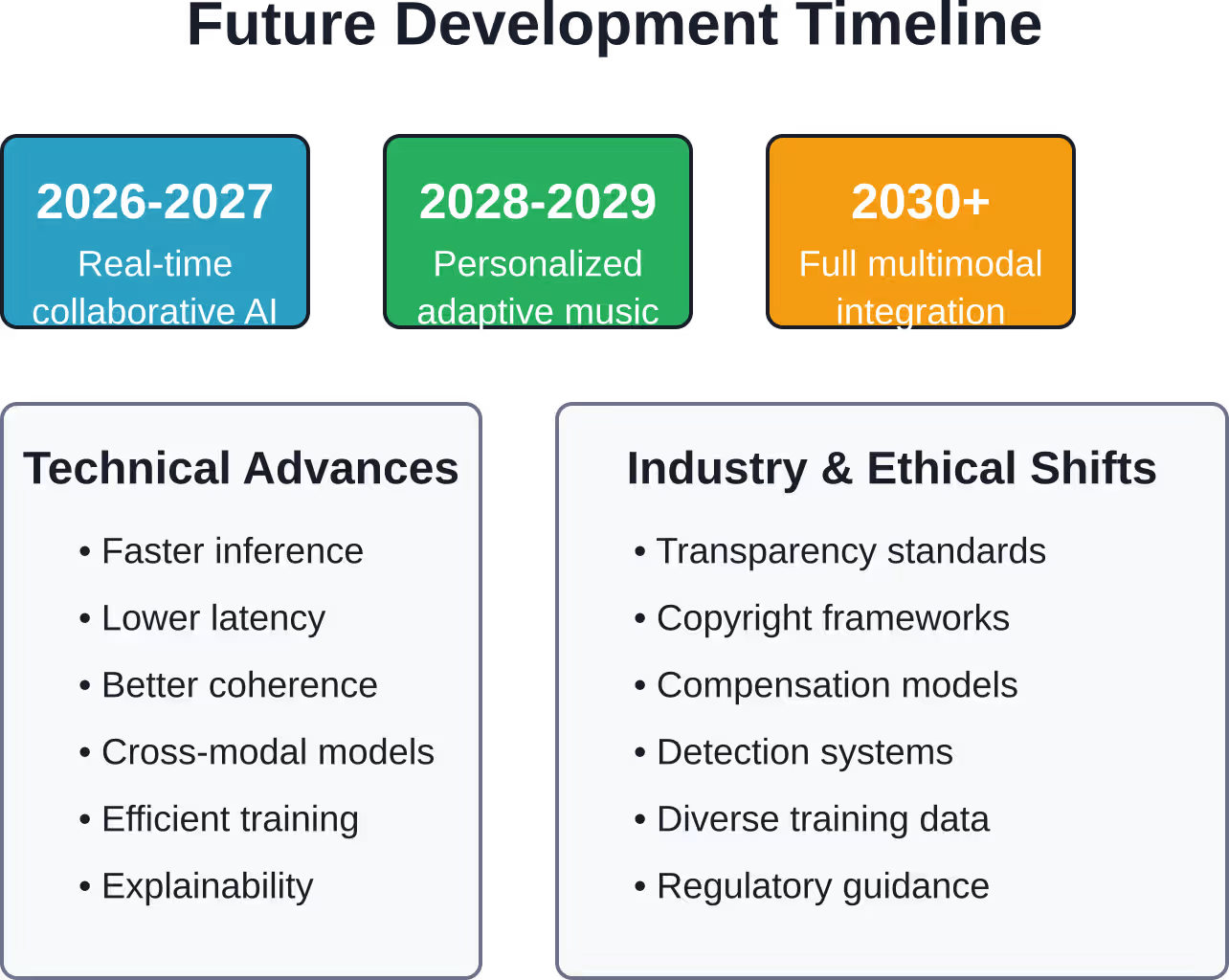
Practical Considerations for Implementation
For developers, musicians, and organizations looking to leverage machine learning in music applications, several practical factors deserve attention.
Choosing the Right Approach
The best machine learning approach depends on the specific task, available data, and constraints.
| Use Case | Recommended Approach | Key Considerations |
|---|---|---|
| Genre classification | CNN on spectrograms | Requires labeled training data; consider transfer learning |
| Music generation | LSTM or Transformer | Large datasets needed; computational cost high |
| Recommendation | Hybrid collaborative + content-based | Cold start problem for new content |
| Transcription | RNN or Transformer | Instrument-specific models perform better |
| Style transfer | VAE or GAN | Quality vs. controllability tradeoffs |
Data Preparation and Feature Engineering
Raw audio requires preprocessing before feeding into models. Common transformations include:
- Converting to spectrograms or mel-spectrograms
- Extracting MFCC (Mel-frequency cepstral coefficients)
- Computing chroma features for harmony analysis
- Beat and tempo extraction
- Loudness normalization
Deep learning reduces manual feature engineering, but thoughtful preprocessing still improves performance and training efficiency.
Model Training and Evaluation
Training music models requires careful attention to evaluation methodology. Random train-test splits can leak information when songs have multiple segments in the dataset. Better practice involves artist-based or album-based splits—ensure no artist appears in both training and test sets, avoiding the model simply memorizing artist characteristics. Cross-validation strategies should respect musical structure. Time-based splits matter for tasks involving trends or popularity prediction.
Deployment and Performance
Real-world deployment introduces constraints often ignored in research settings. Latency matters for interactive applications—a recommendation that takes 30 seconds to compute won’t work. Model compression techniques (quantization, pruning, distillation) can reduce model size and inference time with acceptable accuracy tradeoffs. Edge deployment for mobile or embedded applications requires extremely efficient models, potentially ruling out large transformers in favor of smaller architectures.
Key Datasets for Music Machine Learning
Access to quality datasets is essential for training and evaluating music machine learning systems. Here are the most commonly used datasets in research:
| Dataset | Size | Content | Primary Uses |
|---|---|---|---|
| Maestro | 200 hours | Piano performances from competitions | Generation, transcription |
| NSynth | 305,979 notes | Individual notes from instruments | Synthesis, timbre analysis |
| Lakh MIDI | 174,154 files | Multi-track piano MIDI | Generation, structure analysis |
| MusicNet | 330 recordings | Classical music with annotations | Transcription, analysis |
| MetaMIDI | 436,631 files | MIDI with metadata patterns | Large-scale generation |
| Groove MIDI | 444 hours | Drum performances from 43 kits | Rhythm generation, beat tracking |
| MAPS | 65 hours | Piano audio with aligned MIDI | Transcription evaluation |
| Nottingham | 1,000 tunes | British and American folk | Symbolic generation |
| J.S. Bach Chorales | 100 pieces | Four-part harmony chorales | Harmony, generation |
Many datasets face copyright restrictions, limiting distribution. Researchers increasingly release features or metadata rather than audio, or work with royalty-free and public domain content.
Frequently Asked Questions
Can machine learning accurately identify music genres?
Yes, machine learning achieves high accuracy on genre classification—early studies from 2002 reported 85% accuracy, and modern deep learning systems exceed 90% on well-defined genres. However, genre boundaries are inherently fuzzy and culturally contingent, so perfect classification is conceptually impossible. Systems perform best on distinct genres and struggle with hybrid or emerging styles.
How does AI-generated music differ from human composition?
AI-generated music excels at pattern recognition and statistical mimicry of training data but lacks intentionality, emotional experience, and cultural context that inform human composition. Current systems generate locally coherent music but struggle with long-term structure and meaningful narrative arc. Detection systems can identify AI-generated music with over 99% accuracy in controlled settings, though this remains an evolving adversarial competition.
What are the main ethical concerns with machine learning in music?
Key ethical issues include transparency and labeling of AI-generated content (89% of musicians in a 2024 survey demanded clear identification), copyright and ownership questions for AI output, bias in training data that underrepresents non-Western music, economic impacts on professional musicians, and potential homogenization when creators optimize for algorithmic recommendation rather than artistic vision.
Which machine learning models work best for music generation?
LSTM and Transformer architectures dominate current music generation research due to their ability to model long-term dependencies in sequential data. Variational autoencoders (VAEs) enable controlled generation through latent space manipulation, while generative adversarial networks (GANs) can produce high-quality audio through adversarial training. The best choice depends on whether you need symbolic (MIDI) or audio generation, controllability requirements, and available computational resources.
How do music recommendation systems work?
Modern recommendation systems combine collaborative filtering (finding patterns in user behavior), content-based filtering (analyzing audio features like tempo, key, and timbre), and contextual signals (playlist co-occurrence, social tags, listening time). Hybrid approaches that integrate multiple data sources outperform single-method systems. Deep learning models increasingly learn these features end-to-end rather than relying on hand-crafted descriptors.
What datasets are available for training music machine learning models?
Major datasets include Maestro (200 hours of piano), NSynth (305,979 instrument notes), Lakh MIDI (174,154 recordings), MetaMIDI (436,631 files), MusicNet (330 classical recordings), Groove MIDI (444 hours of drums), and MAPS (65 hours of piano with aligned MIDI). Copyright restrictions limit dataset sharing, particularly for commercial music, leading researchers to use classical, royalty-free, or synthesized content.
Can machine learning help musicians with hearing loss?
Yes, machine learning enables several accessibility applications. Systems can enhance specific frequency ranges, adjust dynamics for better audibility with hearing aids, and provide alternative representations like visual or haptic feedback. The Cadenza Challenges specifically focus on improving music processing for listeners with hearing impairments through machine learning competitions, developing techniques that preserve musical quality while accommodating individual hearing profiles.
Conclusion: Harmonizing Technology and Artistry
Machine learning has transformed from an academic curiosity to a fundamental technology reshaping every aspect of the music industry. From how songs are created and classified to how they’re discovered and marketed, intelligent algorithms now play central roles. The technology offers genuine benefits: democratized creation tools, personalized listening experiences, enhanced accessibility, and new creative possibilities. But it also raises legitimate concerns about transparency, fairness, economic impacts, and the fundamental nature of musical creativity. The most promising path forward doesn’t pit humans against machines but explores how they can complement each other. Machine learning as a tool for augmenting human creativity rather than replacing it. Systems that make music creation more accessible while preserving artistic control. Algorithms that help listeners discover music while respecting diversity and avoiding filter bubbles. For developers, musicians, researchers, and industry stakeholders, understanding both the capabilities and limitations of machine learning in music is essential for making informed decisions. The technology will continue evolving rapidly—staying current requires ongoing learning and critical evaluation of new approaches. Whether you’re building the next music AI startup, conducting academic research, or simply curious about how algorithms shape your listening experience, the field of machine learning in music offers endless fascinating challenges at the intersection of technology and art. To explore machine learning in music projects: Start by experimenting with existing datasets and open-source models, join the Music Information Retrieval community, and contribute to the ongoing conversation about building music technology that serves both artists and listeners ethically and effectively.