Quick Summary: Machine learning in sports uses advanced algorithms and data analytics to transform athlete training, injury prevention, tactical decision-making, and performance optimization. AI-powered systems achieve approximately 85% accuracy in pre-competition injury risk forecasting and improve training outcomes by 25% over traditional methods. Sports organizations now leverage computer vision, predictive modeling, and real-time data processing to gain competitive advantages across all athletic disciplines. Sports analytics has shifted from gut feelings and basic statistics to sophisticated machine learning systems that process millions of data points in real time. What coaches once decided through experience alone now gets validated—or challenged—by algorithms that spot patterns invisible to the human eye. The integration of AI into athletics isn’t just about numbers on a spreadsheet. It’s reshaping how teams scout talent, how trainers prevent injuries, and how players optimize every aspect of their performance. From tennis courts to football pitches, machine learning models are becoming as essential as the equipment athletes use. But here’s the thing: not all machine learning applications deliver equal value. Some offer genuine competitive advantages, while others generate impressive dashboards that don’t translate to wins. Understanding which techniques actually work—and which are overhyped—makes the difference between transformation and distraction.
How Machine Learning Transforms Sports Analytics
Traditional sports analysis relied on summary statistics: batting averages, shooting percentages, yards gained. Machine learning treats sports differently—as sequences of events, each containing rich contextual information that reveals deeper patterns. Computer vision systems now track player movements with high spatial precision, capturing biomechanical data that was impossible to measure consistently just five years ago. These systems don’t just record what happened; they understand spatial relationships, player positioning, and tactical formations in ways that create actionable insights. The real power shows up in prediction. Analysis from academic research on university football players demonstrated that machine learning models using body composition and biomechanical data achieved an area under the receiver operating characteristic curve (AUC) of 0.74 for injury risk prediction. That’s good discrimination between injured and non-injured athletes—valuable intelligence that can shape training decisions. 
Enhance Sports Analytics with Machine Learning
Machine learning is changing how teams and organizations analyze performance, strategy, and engagement. AI Superior helps companies build custom AI and ML solutions to solve complex data challenges and improve analytical workflows.
Unlock the Full Potential of AI in Your Sports Analytics
AI Superior supports machine learning with:
- Performance analytics and tracking models
- Predictive systems for strategy and injury risk
- Engagement and personalized content solutions
👉Contact AI Superior today to explore how their AI expertise can strengthen your sports analytics. 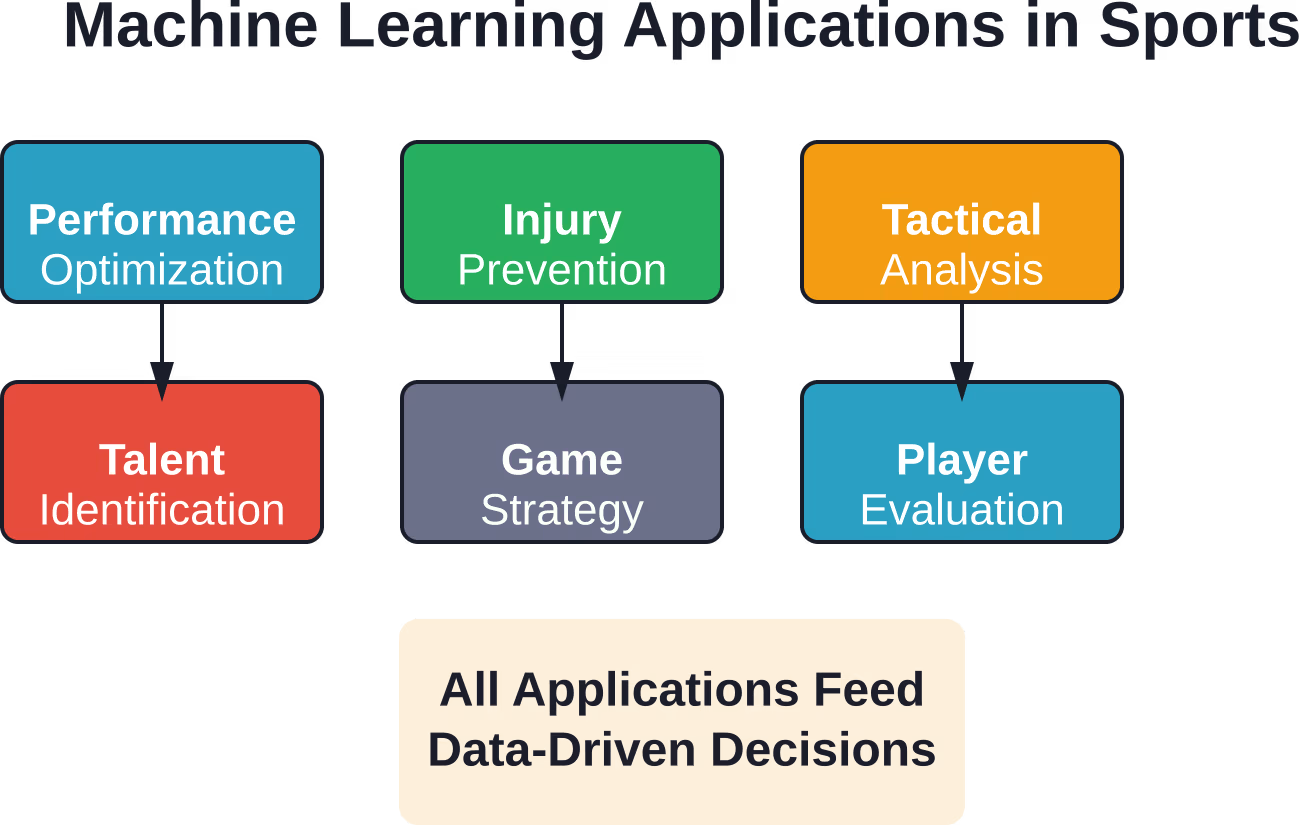
Injury Prevention Through Predictive Analytics
Injuries don’t just happen. They emerge from accumulated stress, biomechanical inefficiencies, and lifestyle factors that create vulnerability. Machine learning models now detect these warning signs before athletes break down. Research on sports biomechanical analysis shows that temporal modeling can detect biomechanical changes before injury emergence. That’s a valuable advance warning that can shape training decisions. The accuracy is remarkable. AI-powered systems achieve approximately 85% accuracy in pre-competition injury risk forecasting. When combined with body-region prediction models, the technology gets even more specific—research on NCAA Division I athletes found 50.0% top-1 accuracy for predicting body region injury, improving to 62.5% for top-2 predictions and 77.1% for top-3 predictions. What makes these models work? They integrate multiple data dimensions: body composition from DXA scans, biomechanical variables from motion analysis systems, balance test results, and crucially—lifestyle factors like sleep duration and stress levels. Recent research on university football players found that psychological stress (importance: 0.10), sleep duration (0.09), and balance ability (0.08) were identified as key injury risk factors, with lifestyle factors outweighing traditional physical fitness indicators.
Implementation Challenges
Predictive models sound impressive in research papers. Real-world deployment faces obstacles. Data standardization remains messy. Different tracking systems use incompatible formats, making it difficult to combine datasets or transfer models between organizations. Field validation often shows performance degradation compared to laboratory results, particularly when environmental conditions vary. Model explainability matters more in sports than in many other domains. Coaches and athletes won’t trust black-box recommendations, even if they’re statistically sound. SHAP-based interpretability analysis helps by identifying which factors drive predictions—stress level, sleep duration, balance ability—in ways that make intuitive sense to practitioners.
Performance Optimization and Training Personalization
Generic training programs treat all athletes like identical machines. Machine learning enables true individualization by modeling how each athlete responds to specific stimuli. Analysis of AI applications in sports biomechanics found that individualized training prescriptions demonstrated 25% improvement over baseline approaches. That’s not a marginal gain—it’s the difference between incremental progress and breakthrough performance. The technique works through continuous feedback loops. Sensors capture training loads, biomechanical responses, and recovery markers. Algorithms learn each athlete’s dose-response curves: how much training stress produces adaptation versus exhaustion, which exercises generate the most improvement for the least injury risk, when recovery needs to be prioritized. Computer vision adds another layer. Modern systems achieve technique analysis agreement with international judges at 94% agreement. Athletes get immediate, objective feedback on movement quality without waiting for coach review or video analysis sessions. 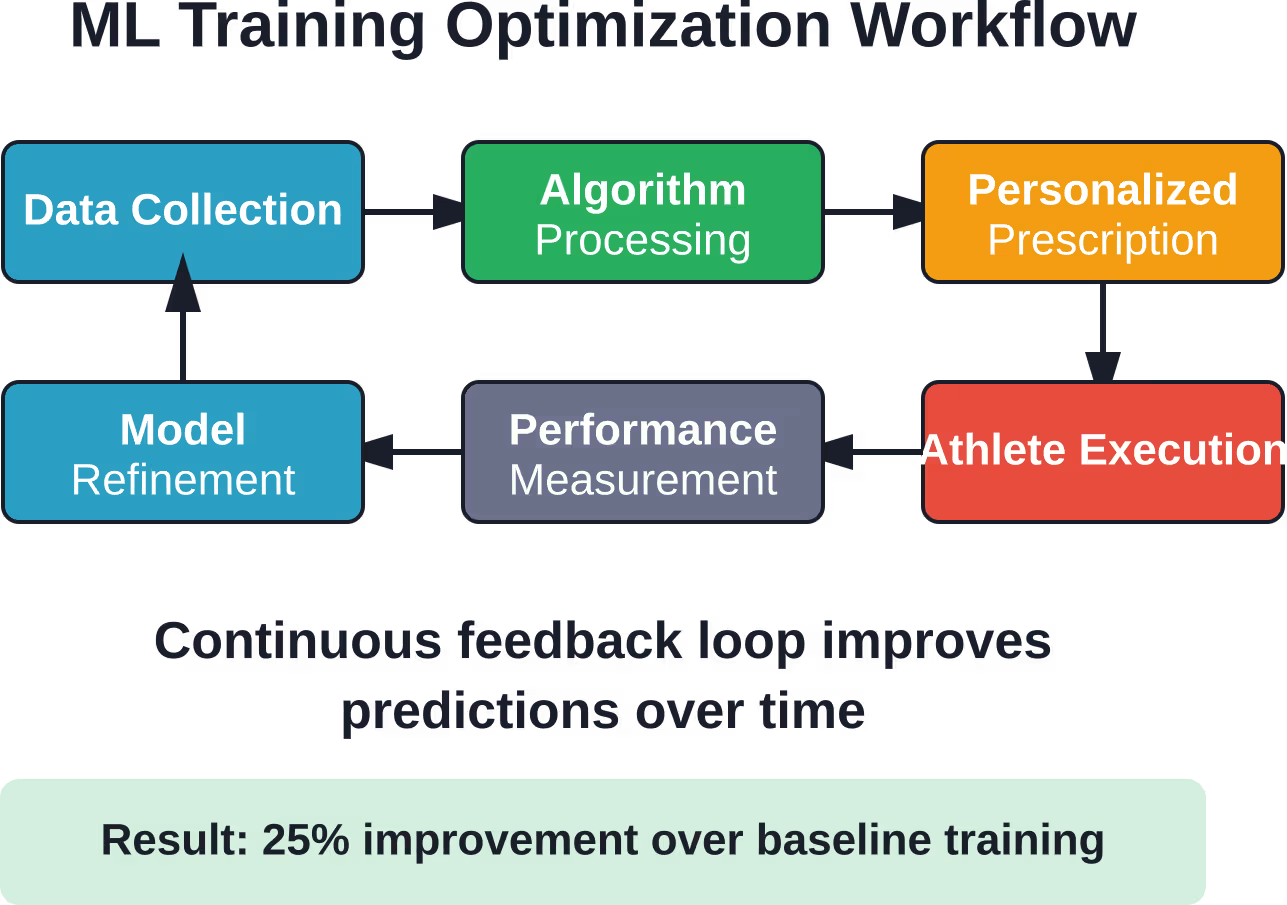
Learning Management Systems Amplify Impact
Technology alone doesn’t change behavior. Integration with learning management systems bridges the gap between insight and action. Research indicates that learning management systems can significantly improve coach understanding and athlete adherence compared to traditional reporting methods. The difference comes from making complex analytics accessible: visualizations that make sense at a glance, contextual explanations of why recommendations matter, and tracking systems that create accountability.
Tactical Analysis and Game Strategy
Sports unfold as sequences of decisions under uncertainty. Machine learning models this complexity better than traditional methods. Instead of treating games as collections of independent events, modern approaches capture temporal dependencies and spatial contexts. Which defensive formation most effectively counters a specific offensive set? When should a pitcher be pulled before performance degrades? How do different lineup combinations affect team dynamics? These questions have always existed. What’s changed is the ability to answer them with statistical rigor. Models now process tracking data to recognize patterns like on-ball screens in basketball or passing lanes in football automatically—eliminating thousands of hours of manual video tagging. The applications extend to real-time decision support. During games, systems can project likely outcomes of strategic choices, weighing probabilities of success against risk profiles. Whether that’s fourth-down decisions in American football or substitution timing in soccer, data-driven recommendations now complement—and sometimes challenge—coaching intuition.
Sport-Specific Applications
Different sports present unique analytical challenges. Tennis involves individual athletes in structured point-by-point competition. Cricket adds team dynamics and multiple specialized roles. Volleyball requires modeling rally dynamics and rotational effects. IEEE research has documented machine learning applications across this spectrum: predicting tennis player scores based on shot selection patterns, evaluating cricket player performance using multiple algorithm approaches, and forecasting volleyball match outcomes from team statistics.
| Sport | Primary ML Applications | Key Challenges |
|---|---|---|
| Tennis | Point outcome prediction, shot selection optimization, opponent modeling | Individual variability, psychological factors, surface differences |
| Cricket | Player evaluation, match outcome forecasting, team composition optimization | Multiple playing formats, weather impacts, pitch conditions |
| Volleyball | Rally outcome prediction, rotation effectiveness, serve reception analysis | Quick transitions, limited tracking data, team synchronization |
| Football/Soccer | Pass completion modeling, space creation analysis, injury prevention | Continuous play, positional fluidity, tactical complexity |
| Basketball | Shot quality metrics, defensive scheme recognition, lineup optimization | High event frequency, player interaction effects, pace variation |
The common thread? Every sport benefits from treating performance as a prediction problem rather than just historical description. Machine learning excels at finding the patterns that separate likely outcomes from unlikely ones.
Data Collection and Technical Infrastructure
Machine learning models are only as good as the data they consume. Modern sports organizations invest heavily in tracking infrastructure. Wearable sensors capture physiological data: heart rate variability, accelerations, decelerations, metabolic power output. Optical tracking systems record player positions at 25-30 frames per second. Force plates measure ground reaction forces during jumping and cutting movements. DXA scans quantify body composition changes over training cycles. The volume is staggering. A single football match might generate 10 million data points from tracking systems alone. Multiply that across a season, add training session data, and integrate physiological monitoring—the technical challenge becomes data engineering as much as analytics. That’s where modern machine learning frameworks prove essential. Tools handle the pipeline from raw sensor streams to cleaned, feature-engineered datasets ready for modeling. Automation replaces manual processing that would otherwise consume entire analyst teams.
Python and R Dominate Implementation
Open-source programming languages have become the standard for sports analytics. Python offers scikit-learn for classical machine learning, TensorFlow and PyTorch for deep learning, and specialized libraries like passingmap for football analysis. R provides complementary strengths: statistical rigor, visualization capabilities through ggplot2, and packages specifically designed for sports data workflows. Many organizations use both, choosing the right tool for each analytical task. 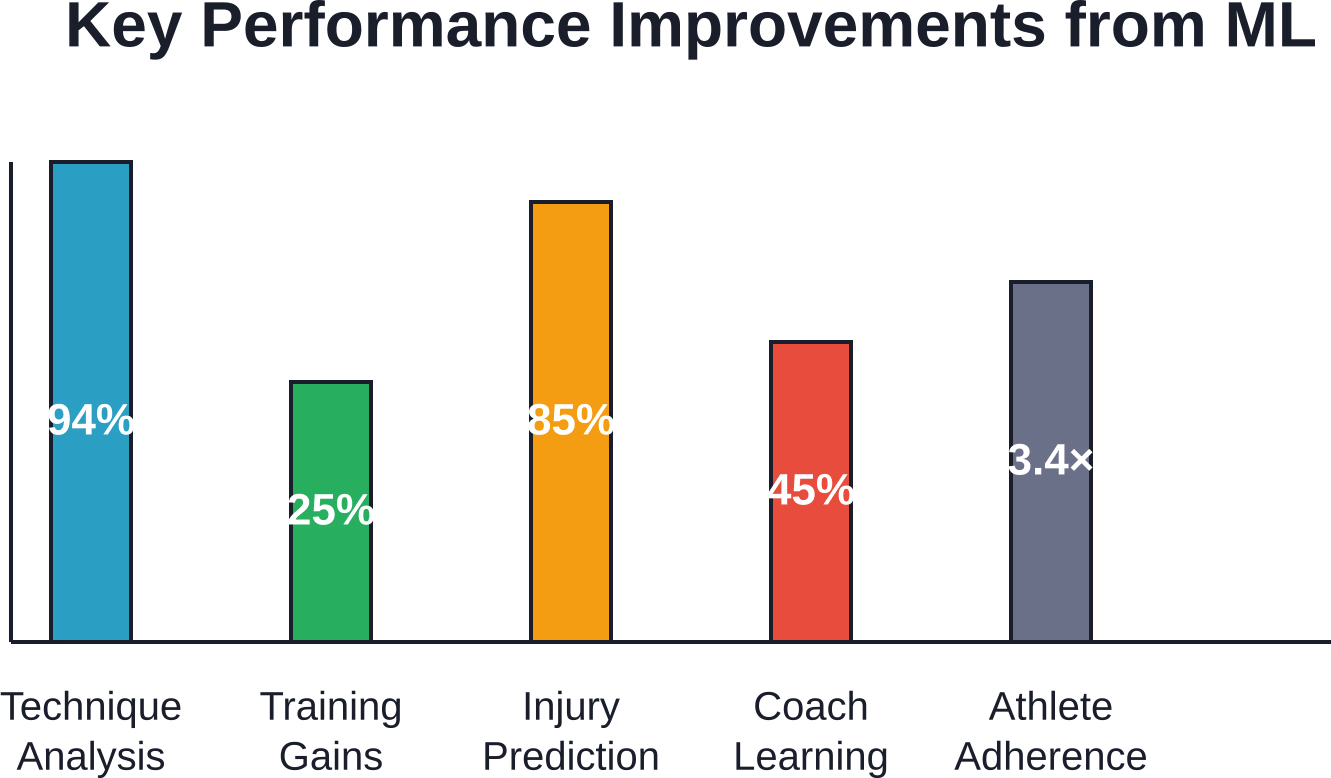
Ethical Considerations and Future Directions
As machine learning capabilities expand, ethical questions intensify. Who owns athlete data? How should privacy be protected when tracking systems capture intimate details of movement, physiology, and performance? Data ownership remains contested. Athletes generate the data through their performance, but organizations typically control collection systems and storage infrastructure. Contracts increasingly address these issues, but standards lag behind technological capabilities. Equitable access presents another challenge. Elite professional teams can afford sophisticated tracking infrastructure and dedicated data science teams. University programs operate with tighter budgets. Youth sports rarely have access to advanced analytics at all. The risk? Machine learning could widen performance gaps instead of leveling them. Athletes with access to personalized training optimization and injury prevention systems will develop advantages over those relying on traditional methods. Sports organizations and technology providers need to consider how sophisticated biomechanical analysis can extend across all competitive levels.
Integration Into Coaching Workflows
Technology adoption fails when systems don’t fit existing workflows. Coaches don’t have time to learn complex data science tools or interpret statistical outputs during training sessions. Successful implementations prioritize usability: dashboards that surface the three most important insights instead of overwhelming users with information, alerts that trigger only when action is needed, and visualizations that make complex patterns immediately graspable. That’s the real barrier. Not algorithm performance or tracking accuracy, but whether busy practitioners will actually use the tools being built. Machine learning in sports ultimately succeeds or fails based on human adoption, not technical sophistication.
Practical Implementation Considerations
Organizations considering machine learning investment should start with clear objectives. Which specific problems need solving? Is the goal injury reduction, performance improvement, tactical optimization, or talent identification? Data infrastructure comes before fancy algorithms. Reliable collection systems, proper storage, and basic quality control matter more initially than sophisticated modeling. Many organizations jump to machine learning before establishing data fundamentals—that sequence fails consistently. Start narrow rather than broad. Pick one well-defined problem with clear success metrics and sufficient training data. Build competency there before expanding to additional applications. The teams seeing the most success treat machine learning adoption as a multi-year journey, not a one-time project.
| Implementation Stage | Key Activities | Success Indicators |
|---|---|---|
| Foundation | Data collection standardization, infrastructure setup, team training | Reliable data pipelines, consistent quality metrics |
| Proof of Concept | Single focused application, baseline model development, validation testing | Model outperforms existing methods, stakeholder buy-in achieved |
| Integration | Workflow incorporation, user interface development, feedback loops | Regular usage by coaches/staff, decisions informed by outputs |
| Scaling | Multiple applications, automated pipelines, continuous improvement | Measurable performance gains, competitive advantage realized |
Frequently Asked Questions
How accurate are machine learning injury predictions in sports?
Current research demonstrates that machine learning models achieve approximately 85% accuracy in pre-competition injury risk forecasting when using comprehensive data including biomechanical measurements, body composition, and lifestyle factors. NCAA athlete studies showed injury risk discrimination with an AUC of 0.74, indicating good separation between injured and non-injured athletes. Body-region specific predictions reach 50% accuracy for the most likely injury location, improving to 77.1% when considering the top three predicted regions.
What types of data do sports machine learning systems need?
Effective sports machine learning requires multiple data sources: tracking data from GPS or optical systems capturing player positions and movements, biomechanical data from motion capture or wearable sensors measuring joint angles and forces, physiological monitoring including heart rate and metabolic markers, body composition measurements from DXA scans, and contextual factors like sleep quality, stress levels, and training loads. The most accurate models integrate data across these dimensions rather than relying on single sources.
Can machine learning models work for youth and amateur sports?
While most published research focuses on elite athletes, machine learning principles apply at all competitive levels. The challenge is data availability—youth programs rarely have access to sophisticated tracking infrastructure. But simpler implementations using smartphone video analysis, basic wearables, and standardized fitness testing can still provide valuable insights. The algorithmic approaches remain the same; the data collection methods need to match available resources.
How long does it take to implement machine learning in a sports organization?
Timeline depends on starting infrastructure and scope. Organizations with existing data collection systems can develop proof-of-concept models in 3-6 months. Full integration into coaching workflows typically requires 12-18 months. Building comprehensive systems covering multiple applications spans 2-3 years. The most successful implementations treat this as gradual capability building rather than a single project with a defined end date.
What machine learning algorithms work best for sports analytics?
No single algorithm dominates. Random forests and gradient boosting methods handle the mixed data types common in sports well. Support Vector Machine achieved strong performance (95.6% accuracy, 95.7% F1-score, 99.2% ROC-AUC) in injury risk prediction. Neural networks excel at pattern recognition in tracking data. The best approach depends on the specific problem, available data volume, and interpretability requirements. Many practitioners compare multiple algorithms and ensemble the best performers.
Do machine learning systems replace coaches and trainers?
No. Machine learning augments human expertise rather than replacing it. Systems identify patterns in massive datasets that humans can’t process manually and provide probabilistic recommendations based on statistical evidence. But coaches integrate these insights with contextual knowledge, interpersonal understanding, and real-time observations that algorithms miss. The most effective implementations treat machine learning as decision support, not decision replacement.
How much does sports machine learning technology cost?
Costs vary dramatically. Enterprise tracking systems for professional teams can exceed $100,000 annually. Mid-tier wearable solutions for college programs range from $10,000-$50,000. Open-source software tools are free, but require data science expertise. Cloud computing for model training adds ongoing expenses based on usage. Organizations should budget for both technology acquisition and the personnel needed to implement and maintain systems—staffing often exceeds hardware costs.
Conclusion
Machine learning represents an irreversible paradigm shift in sports analytics. The evidence is clear: properly implemented systems achieve approximately 85% accuracy in pre-competition injury risk forecasting, improve training outcomes by 25%, and provide technique analysis matching expert judges at 94% agreement. But technology alone doesn’t create competitive advantage. Success requires data infrastructure, technical expertise, workflow integration, and organizational commitment to data-driven decision making. The teams pulling ahead aren’t necessarily those with the most sophisticated algorithms—they’re the ones that successfully combine machine learning capabilities with coaching wisdom. The trajectory points toward continued AI integration across all sports and competitive levels. Computer vision will become more accessible, models will grow more interpretable, and real-time applications will expand. The organizations that build capability now establish advantages that compound over time. Ready to explore machine learning for your sports program? Start by auditing current data collection practices, identifying the single highest-impact application area, and building the foundational infrastructure before jumping to advanced modeling. The competitive advantage goes to those who execute thoughtfully, not just quickly.