
Quick Summary: Machine learning is transforming private equity by improving deal sourcing, exit timing predictions, portfolio value creation, and fund administration. Despite significant enterprise investment—estimated at $30–40 billion in GenAI—according to research cited by Preqin, 95% of organizations report zero ROI on generative AI investments. Leading PE firms are now taking structured approaches: securing executive buy-in, assessing AI impact during due diligence, and focusing on workforce automation and data readiness to unlock meaningful value. Private equity firms manage trillions of dollars, yet many critical decisions—when to exit an investment, which companies to back, how to create portfolio value—have historically relied more on instinct than data. That’s changing fast. Machine learning promises to revolutionize how PE firms operate. But here’s the thing: despite enterprises pouring $30–40 billion into generative AI, according to research cited by Preqin, 95% of organizations report zero ROI on generative AI investments. The disconnect between hype and results is massive. So what separates winners from the rest? The answer lies in structured implementation, realistic expectations, and focusing on specific high-value use cases rather than chasing every shiny AI tool.
How Machine Learning Changes Deal Sourcing
Finding the right investment opportunities in a crowded market has always been challenging. In 2025, global private equity fundraising reached approximately $735.3 billion, following a recovery from the 2023–2024 cyclical downturn. That’s a staggering amount of capital hunting for promising businesses. Machine learning algorithms can now scan thousands of potential targets, analyzing financial data, market positioning, growth trajectories, and competitive dynamics at speeds no human team can match. The technology identifies patterns across successful investments and flags companies that fit proven profiles. But the real intelligence still comes from humans. The best approach combines data analytics—the machine element—with direct relationships and industry insights—the human element. Fund managers who maintain relationships with portfolio companies and industry contacts get early insights into upcoming opportunities that algorithms alone would miss. 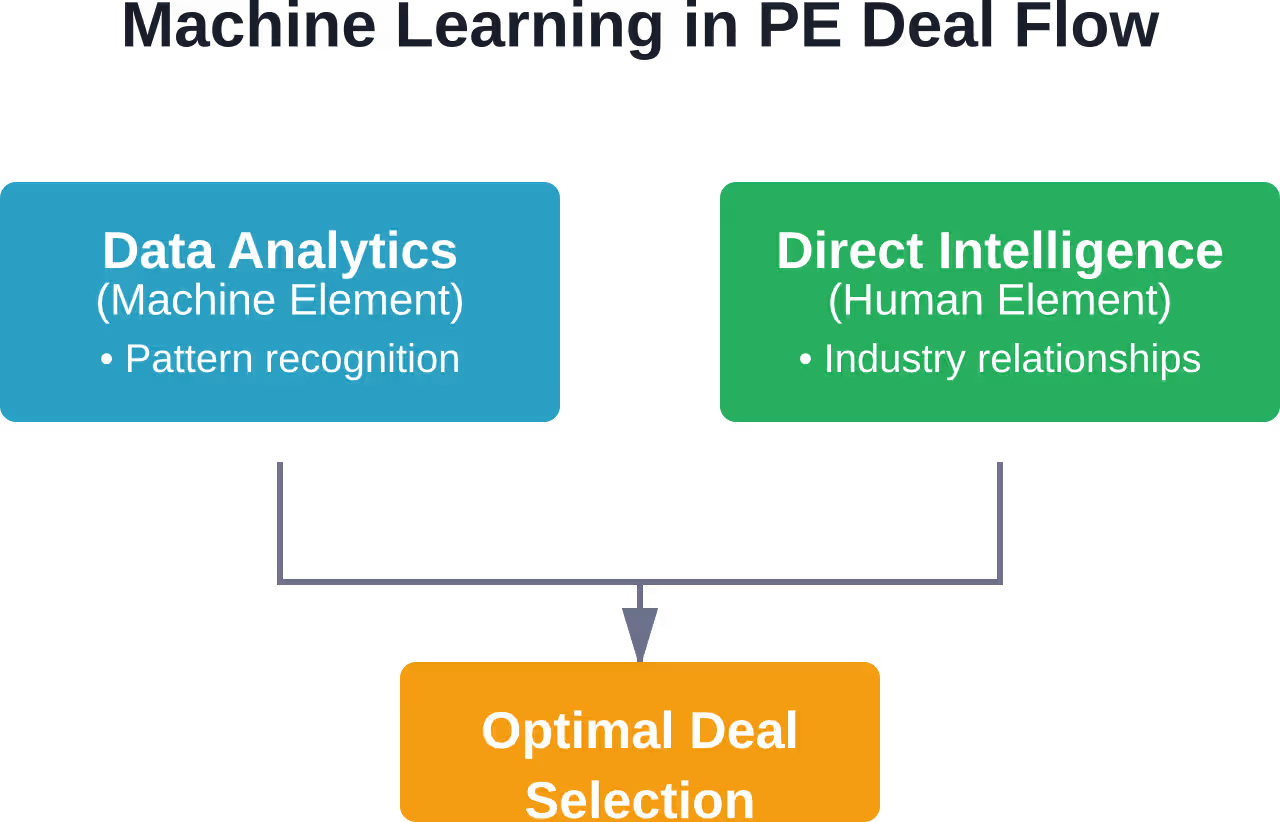

Develop Predictive AI Tools With AI Superior
AI Superior builds AI and machine learning solutions for prediction, data analysis, BI, NLP, big data analytics, and custom software development. Their predictive analytics work can use current and historical data to support forecasting and better decision-making. For private equity teams, this can support deal screening, portfolio analysis, due diligence workflows, market research, or internal data tools.
Need AI Connected to Investment Workflows?
AI Superior can help with:
- creating machine learning models
- building predictive analytics systems
- analyzing financial and business data
- connecting AI tools with existing platforms
👉 Contact AI Superior to discuss your project.
Predicting Exit Timing: The New Competitive Edge
Predicting when to exit an investment has historically been more art than science. For investors, this uncertainty is critical—when will the money come back, and how much will it be worth? Unlike public stocks that trade instantly, private equity investments lock up capital for years. Fund managers must wait for the right market conditions, buyer interest, and company readiness to converge. Machine learning models now analyze key market signals to forecast optimal exit windows. IPO activity serves as a leading indicator: analysis shows that when IPO volumes double—as they did from Q4 2023 to Q4 2024—distribution pace typically increases by about 4 percentage points the following year. Other signals matter too. Interest rates, sector-specific M&A activity, credit availability, and even sentiment analysis from financial news all feed into predictive models. The technology doesn’t eliminate uncertainty, but it dramatically improves the odds of timing exits well.
Creating Value in Portfolio Companies
Machine learning isn’t just about picking winners and timing exits. The real opportunity lies in creating value within portfolio companies. Leading PE firms now assess AI opportunities before even acquiring a target. Due diligence includes evaluating workforce automation potential, data readiness, and competitive positioning around AI capabilities. This isn’t generic tech speculation—it’s specific analysis of which processes can be automated, which customer experiences can be enhanced, and which competitive advantages AI might unlock. The approach varies by sector. In manufacturing, machine learning optimizes supply chains and predicts equipment failures. In retail, algorithms personalize marketing and forecast demand. In financial services, models detect fraud and automate underwriting. But here’s what doesn’t work: dumping AI tools into portfolio companies without executive buy-in or implementation expertise. Firms that succeed bring in operating partners who understand both the business context and technical requirements. Rather than over-investing in hard-to-retain data scientists, many rely on consultants or full-stack engineers who can ship working solutions quickly.
AI’s Role in Fund Administration
Fund administration—historically a manual, time-consuming process—is undergoing rapid transformation. Artificial intelligence has shifted from experimental to foundational in this space. According to Preqin’s authoritative research, AI now helps with data extraction, enhances analytics, and supports compliance and cybersecurity. These aren’t standalone features anymore; they’re becoming core infrastructure. The private equity industry faced new SEC regulations in recent years that dramatically increased reporting requirements. Private funds turned to AI in response, using machine learning to automate investment reporting, flag compliance issues, and manage the sheer volume of required documentation.
| Fund Administration Task | Traditional Approach | Machine Learning Approach |
|---|---|---|
| Data extraction from documents | Manual review and entry | Automated extraction with validation |
| Compliance monitoring | Periodic manual audits | Continuous automated screening |
| Investment reporting | Quarterly manual compilation | Real-time dashboards and alerts |
| Cybersecurity threat detection | Rule-based alerts | Pattern recognition and anomaly detection |
The efficiency gains are significant. Tasks that once took days now complete in hours. But the technology also introduces new risks—cybersecurity attacks have become more sophisticated, with bad actors leveraging AI themselves. Leading firms are investing in password-less zero trust architectures and advanced monitoring systems.
Why Most AI Investments Fail (And What Works Instead)
Real talk: the gap between AI hype and results is embarrassing. Despite massive investment, most firms aren’t seeing returns. The problem isn’t the technology—it’s the approach. Firms fail when they chase automation for its own sake, deploy tools without clear use cases, or expect instant transformation without changing workflows. What works? Differentiation over pure automation. According to Preqin research on private market CTOs, senior technology leaders now prioritize competitive edge over simple cost savings. The question isn’t “Can AI automate this task?” but “Can AI help us do something our competitors can’t?” Software providers also play a role. PE firms increasingly expect their technology vendors to deliver AI-powered competitive advantages, not just better versions of existing tools. The focus has shifted from “Can this save us time?” to “Can this help us win deals, improve returns, or spot opportunities others miss?”
Implementation: A Practical Roadmap
So how should PE firms actually implement machine learning? Here’s what the evidence suggests works:
- Start with due diligence enhancement. Before acquiring companies, assess how AI might affect entire industries and evaluate the target’s potential for AI-driven gains. This includes workforce automation opportunities, data quality, and whether competitors are ahead or behind on AI adoption.
- Secure executive buy-in early. Machine learning initiatives fail without C-suite support. Executives need to understand not just the potential returns but also the timeline, resource requirements, and organizational changes needed.
- Bring in the right talent. Operating partners who understand both business strategy and technical implementation are more valuable than pure data scientists. Consider consultants or full-stack engineers who can deliver working solutions rather than building large in-house teams.
- Focus on data readiness. Algorithms are only as good as the data they consume. Many firms discover their data is fragmented, inconsistent, or simply insufficient for machine learning. Address this before deploying models.
- Start narrow, then expand. Pick one high-value use case—exit timing prediction, specific portfolio company automation, or compliance reporting—and prove value there before expanding. The Economist ran a series of articles outlining that AI is expected to add $16 trillion to the global economy by 2030, but capturing that value requires discipline, not spreading resources across every possible application.
FAQ
What is machine learning in private equity?
Machine learning in private equity refers to the use of algorithms and statistical models to improve investment decisions, automate processes, and create value across the investment lifecycle. Applications include deal sourcing, due diligence, exit timing predictions, portfolio company optimization, and fund administration.
How accurate are AI predictions for exit timing?
Machine learning models can identify correlations between market signals and successful exits. For example, when IPO volumes double, distribution pace typically increases by about 4 percentage points the following year. However, predictions aren’t perfect—models reduce uncertainty rather than eliminate it.
Why do most AI investments in PE fail to deliver returns?
According to research cited by Preqin, 95% of organizations report zero ROI on generative AI investments despite $30–40 billion in spending. Common failure modes include lack of executive buy-in, unclear use cases, poor data quality, insufficient implementation talent, and unrealistic expectations about automation.
How do PE firms assess AI opportunities during due diligence?
Leading firms evaluate workforce automation potential, data readiness, and competitive positioning around AI capabilities. The assessment includes identifying which processes can be automated, analyzing data quality and availability, and determining whether AI could create defensible competitive advantages.
What’s the difference between AI for fund administration versus portfolio value creation?
AI in fund administration focuses on internal operations—data extraction, compliance monitoring, reporting, and cybersecurity. AI for portfolio value creation targets the actual businesses being invested in, automating operations, enhancing customer experiences, and creating competitive advantages within those companies.
Should PE firms build in-house data science teams?
Not necessarily. Many successful firms rely on operating partners with technical expertise, consultants, or full-stack engineers rather than large in-house data science teams. Data scientists are expensive and hard to retain, and many PE-specific applications don’t require cutting-edge research—they need solid execution of proven techniques.
How is AI changing regulatory compliance in private equity?
New SEC regulations dramatically increased reporting requirements for private funds. Machine learning helps automate investment reporting, flag compliance issues, and manage documentation volume. According to Preqin, AI has shifted from experimental to foundational in fund administration, particularly for compliance and cybersecurity.
Conclusion
Machine learning is reshaping private equity, but not in the way most headlines suggest. The technology won’t replace human judgment in complex investment decisions. What it will do—what it’s already doing at leading firms—is enhance capabilities across the investment lifecycle. Deal sourcing becomes more systematic. Exit timing predictions improve. Portfolio companies operate more efficiently. Fund administration requires fewer manual hours. And firms that implement machine learning thoughtfully gain genuine competitive advantages. But success requires realism. The 95% failure rate on AI investments isn’t because the technology doesn’t work—it’s because most implementations lack clear strategy, adequate data, or proper execution. Firms that start with specific high-value use cases, secure executive buy-in, and focus on differentiation rather than pure automation are the ones seeing results. The question for PE firms in 2026 isn’t whether to adopt machine learning. It’s how to do so in ways that actually create value rather than just checking a technology box.