
Quick Summary: Machine learning has transformed capital markets through algorithmic trading, risk management, and predictive analytics. From high-frequency execution to fraud detection, ML models process vast market data to identify patterns humans cannot detect. While challenges like data quality, model interpretability, and regulatory compliance persist, advanced techniques including deep learning and ensemble methods now achieve prediction accuracies exceeding 88%, fundamentally reshaping how financial institutions operate. Capital markets have always been data-driven. But the sheer volume of information flowing through exchanges today—tick data, order books, news sentiment, economic indicators—has overwhelmed traditional analytical methods. Machine learning changed that equation. Financial institutions now deploy ML models that process millions of data points per second, identifying trading opportunities, managing risk exposures, and detecting anomalies that signal fraud or market manipulation. The technology has moved far beyond experimental pilots. According to the 2026 Global InvestOps Report, 70% of buy-side firms are successfully employing AI to support their front office, while 57% of firms cite vendor stability as the top priority when selecting AI solutions. Here’s the thing though—implementing ML in capital markets is fundamentally different from other industries. Market data exhibits unique challenges: non-stationarity, regime changes, adversarial dynamics, and regulatory constraints that don’t exist elsewhere. This article examines how machine learning actually works in capital markets today, which use cases deliver measurable results, what accuracy levels are achievable, and what challenges developers still face when building production systems.
How Machine Learning Transformed Capital Markets Operations
The financial industry has experimented with quantitative models for decades. What changed? Three supply-side factors converged. First, advances in deep learning techniques—particularly Long Short-Term Memory (LSTM) networks and attention mechanisms—enabled models to capture temporal dependencies in sequential financial data. Second, access to unstructured data sources expanded dramatically: social media sentiment, satellite imagery, alternative data providers. Third, computational power increased through cloud infrastructure and specialized hardware like GPUs. Demand-side pressures accelerated adoption. Cost reduction opportunities became critical as trading margins compressed. Staying competitive required processing information faster than rivals. The Bank for International Settlements noted in their June 2025 financial stability report that AI expansion in finance is driven by these dual forces: technological capability meeting business necessity. But machine learning introduced complexity that traditional quant models avoided. Neural networks operate as black boxes. Regulatory scrutiny intensified, particularly around financial stability implications. The BIS highlighted in January 2026 remarks that AI in financial markets now attracts close regulatory attention from a systemic risk perspective.
The Scale Challenge
Financial institutions operate at extraordinary scale. Adding more features, more models, more exchanges, more products, more asset classes—all simultaneously. This isn’t a theoretical scaling problem. Trading firms continuously expand geographic colocations while increasing data dimensionality. The computational demands are substantial. Even relatively simple algorithms carry significant time costs. Research comparing ML algorithms for stock price prediction found that SVM RBF models achieved the best accuracy while requiring substantially longer processing time than other models. Random Forest achieved competitive accuracy with moderate computation requirements. Decision Trees were fastest but delivered lower accuracy. Speed versus accuracy. That tradeoff defines much of ML implementation in capital markets. 
Build Machine Learning Software With AI Superior
AI Superior develops custom AI software, including machine learning models, predictive analytics tools, and AI-based web and mobile applications. Their team supports projects from discovery and data review to MVP development, integration, and result evaluation. For capital markets teams, this can support risk modeling, market signal analysis, forecasting, reporting automation, or decision-support tools built around financial data.
Need Machine Learning Built Around Your Data?
AI Superior can help with:
- building custom machine learning solutions
- developing predictive analytics tools
- testing ideas through PoC or MVP development
- integrating AI into existing systems
👉 Contact AI Superior to discuss your project.
Core Machine Learning Use Cases in Capital Markets
ML applications in capital markets cluster around several high-value domains. Not all use cases deliver equal returns, and some remain more mature than others.
Algorithmic Trading and Execution
This is where ML found its earliest and strongest foothold. High-frequency trading firms use models to predict short-term price movements and optimize order execution. Transaction cost analysis relies heavily on machine learning. When institutions execute large orders, breaking them into smaller pieces across time minimizes market impact. ML models predict optimal execution schedules based on historical patterns, current liquidity conditions, and volatility forecasts. The performance gains are measurable. Industry data suggests that ML-driven execution strategies reduce transaction costs by meaningful margins compared to traditional algorithms.
Price Prediction and Forecasting
Stock price prediction remains one of the most researched ML applications. The challenge is notoriously difficult because financial markets incorporate information efficiently—if a pattern were easily exploitable, arbitrage would eliminate it. Despite this, modern ML techniques demonstrate significant predictive power. Research on LSTM networks versus traditional ARIMA models found that LSTM overcomes ARIMA-based models by a substantial margin. Research demonstrates that LSTM architectures achieve significantly lower error rates compared to traditional ARIMA approaches on stock forecasting tasks. Advanced architectures push performance further. Advanced deep learning architectures including attention-based models and LSTM variants achieve high accuracy on stock prediction tasks. These aren’t generic claims—they represent specific experimental results from academic research on quantitative trading frameworks. The methodology matters enormously. Studies typically use a 70% training and 30% testing data split. Feature engineering and correlation analysis prove critical—researchers eliminate features with correlation above 95% to avoid multicollinearity issues.
Risk Management and Portfolio Optimization
Financial institutions face complex risk exposures across counterparties, market factors, credit events, and operational failures. ML models enhance traditional Value-at-Risk (VaR) calculations and stress testing. Autoencoder architectures have emerged for interest rate modeling. These unsupervised learning models compress high-dimensional yield curve data into latent representations, then reconstruct rate scenarios for risk calculations. The approach addresses challenges in calibrating models when market regimes shift. Portfolio optimization uses ML to identify non-linear relationships between assets that correlation matrices miss. Reinforcement learning agents learn trading strategies through simulated market interactions, optimizing risk-adjusted returns rather than following predetermined rules.
Fraud Detection and Compliance
Anomaly detection represents a natural ML application. Models trained on normal trading patterns flag unusual activities that may indicate market manipulation, insider trading, or operational errors. Clustering algorithms like K-Means can be applied to identify behavioral patterns in market participants segment market participants by behavior patterns. Deviations from cluster norms trigger compliance reviews. Sentiment analysis of trading communications helps identify potential misconduct. Natural language processing models scan emails, chat logs, and voice transcripts for suspicious language patterns.
Alternative Data Analysis
The proliferation of non-traditional data sources created opportunities traditional quants couldn’t exploit. Satellite imagery of retail parking lots, credit card transaction data, social media sentiment—these require ML to extract actionable signals. Research on news sentiment embeddings for stock forecasting demonstrated that headline data embeddings greatly benefit stock price prediction by at least 40% compared to training without such data. That may sound modest, but in capital markets, small edges compound significantly. Transfer learning techniques enable knowledge sharing across related assets. Research using Dynamic Time Warping for transfer learning showed that models trained on one stock’s patterns could improve predictions for related securities, particularly within sector groups.
Machine Learning Model Architectures for Finance
Not all ML approaches suit financial applications equally. The temporal, sequential nature of market data favors specific architectures.
Recurrent Neural Networks and LSTMs
Long Short-Term Memory networks became the dominant architecture for financial time series. Their ability to maintain long-term dependencies while avoiding vanishing gradient problems makes them ideal for capturing market dynamics across multiple time scales. A typical LSTM architecture for stock prediction might use 64 memory units in the first layer with 20% dropout to prevent overfitting, followed by a second layer with 32 units. The dropout rate and layer configuration directly impact performance—these aren’t arbitrary choices but carefully tuned hyperparameters. Bidirectional LSTMs process sequences in both forward and backward directions, capturing future context that unidirectional models miss. Research showed Bidirectional LSTM architectures improve performance over unidirectional approaches by processing sequences in both directions.
Ensemble Methods
Combining multiple models often outperforms any single algorithm. Ensemble approaches include voting (each model contributes equally), stacking (a meta-model learns to weight base models), and blending (weighted combinations). Research frameworks integrating AdaBoost, Decision Trees, LightGBM, Random Forest, and XGBoost with fusion models demonstrated that ensemble approaches generate substantial returns in trading simulations. The diversification of model types reduces the risk that a single algorithm’s weakness dominates outcomes.
Transformer Architectures
Attention mechanisms revolutionized natural language processing and increasingly appear in financial ML. Transformers process entire sequences simultaneously rather than sequentially, enabling parallel computation and capturing long-range dependencies. The attention mechanism learns which past time steps most influence current predictions, effectively creating adaptive feature weighting. This proves valuable in markets where the relevance of historical information varies by regime. 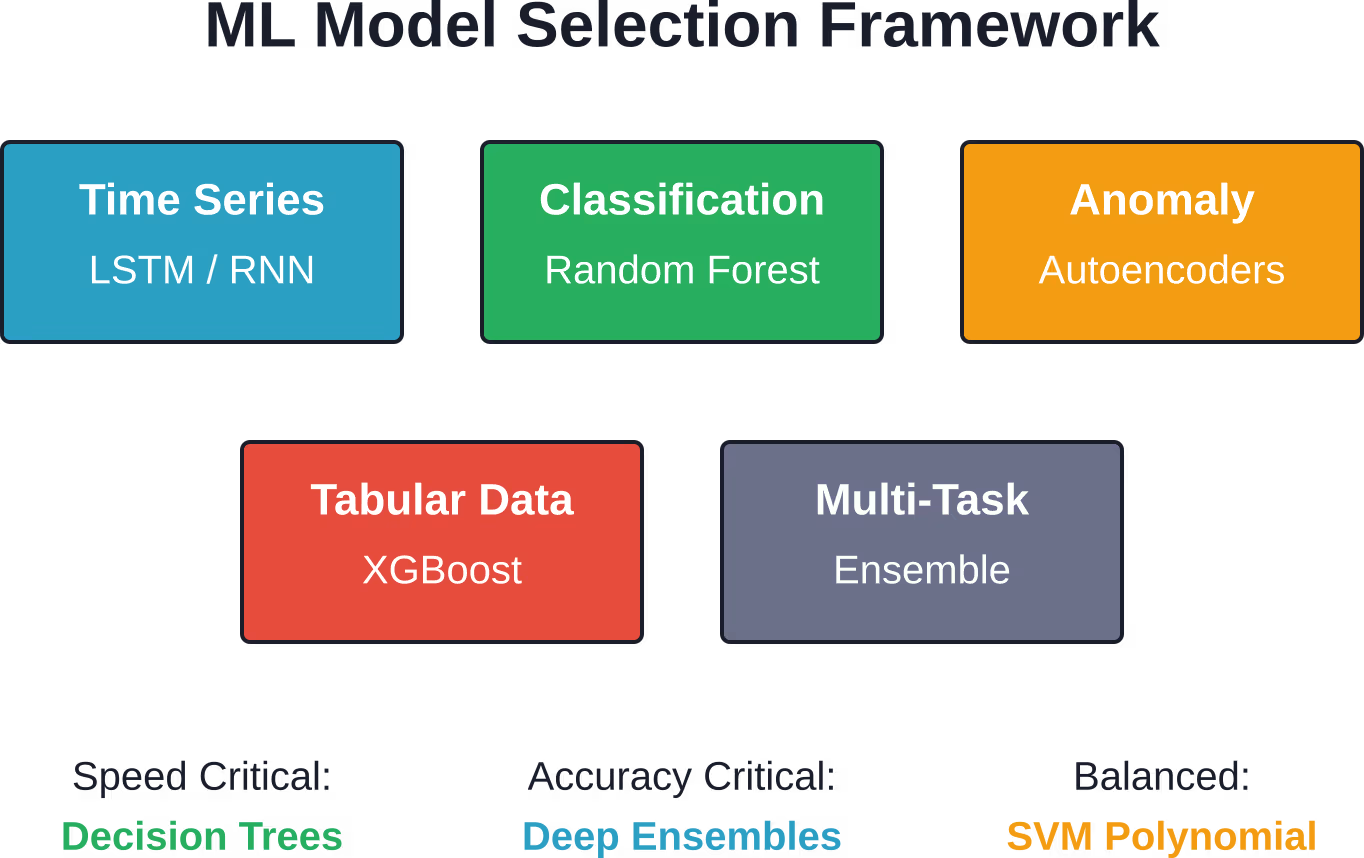
Critical Challenges in Financial Machine Learning
Implementing ML in capital markets is harder than most domains. The challenges fall into technical, regulatory, and operational categories.
Data Quality and Availability
Financial data contains gaps, errors, and inconsistencies. Corporate actions like stock splits require adjustments. Survivorship bias distorts historical datasets when failed companies disappear from records. Alternative data introduces additional quality concerns. Web scraping produces noisy signals. Satellite imagery requires expert interpretation. Social media sentiment reflects bot activity alongside genuine opinions. Preprocessing consumes enormous resources. Cleaning datasets, handling missing values, normalizing scales, and engineering features often takes longer than model training itself.
Non-Stationarity and Regime Changes
Markets don’t stay constant. Relationships between variables shift as economic conditions, regulations, and market structures evolve. A model trained on pre-2020 data might fail post-pandemic because correlations fundamentally changed. Regime detection becomes essential. Models must identify when their training distribution no longer matches current conditions. Some approaches use online learning to continuously update parameters. Others maintain multiple models specialized for different regimes and switch between them.
Model Interpretability and Explainability
Regulators and risk managers demand explanations. “The neural network said so” doesn’t satisfy compliance requirements or inspire confidence when models recommend large positions. Techniques like SHAP (SHapley Additive exPlanations) and LIME (Local Interpretable Model-agnostic Explanations) help decompose predictions into feature contributions. But these methods add computational overhead and don’t fully resolve the black box problem. Some institutions accept lower accuracy from interpretable models like linear regressions or decision trees rather than opaque neural networks. The accuracy-interpretability tradeoff mirrors the accuracy-speed tradeoff.
Overfitting and Generalization
Financial datasets contain enormous noise relative to signal. Models easily memorize training data patterns that don’t generalize. Regularization techniques help: L1 and L2 penalties, dropout layers, early stopping. Cross-validation becomes critical but challenging with time series data where traditional k-fold approaches violate temporal ordering. Walk-forward testing provides more realistic performance estimates. The model trains on historical data up to time T, predicts period T+1, then retrains including T+1 before predicting T+2. This mimics actual deployment but requires careful implementation.
Regulatory Compliance and Model Risk
The Bank for International Settlements emphasized in their June 2025 financial stability report that AI expansion attracts regulatory scrutiny. Model risk management frameworks now mandate documentation, validation, and ongoing monitoring. Backtesting requirements force institutions to demonstrate that models perform as expected across various scenarios. Stress testing must show how models behave during market crises, not just normal conditions. The growing use of AI by financial institutions raises systemic risk concerns. If many institutions rely on similar ML models and data sources, correlated failures could amplify market stress.
Real-World Implementation Considerations
Academic research demonstrates what’s possible. Production deployment reveals what’s practical.
Infrastructure Requirements
Real-time trading models need microsecond latencies. Cloud infrastructure introduces network delays unacceptable for high-frequency strategies. Many firms deploy models on bare metal servers colocated at exchanges. Data pipelines must handle streaming market data, execute feature calculations, run inference, and generate orders—all within strict time budgets. Infrastructure-as-code approaches help manage the complexity of latency-critical bare metal systems.
Monitoring and Maintenance
Models degrade over time as market conditions evolve. Continuous monitoring tracks key metrics: prediction accuracy, feature distributions, error rates, execution quality. Alerting systems notify teams when model performance falls outside expected ranges. But distinguishing genuine degradation from temporary market anomalies requires judgment. Retraining schedules balance freshness against stability. Daily retraining might capture recent patterns but introduces noise. Monthly retraining might miss regime shifts. The optimal frequency depends on the specific application and market.
Model Governance
Large institutions run hundreds of ML models simultaneously. Governance frameworks track model inventories, ownership, validation status, and risk classifications. Change management processes ensure that model updates undergo testing before production deployment. Version control systems track model iterations and enable rollback if new versions underperform.
| Implementation Phase | Key Activities | Typical Timeline |
|---|---|---|
| Research & Prototyping | Hypothesis formation, data exploration, baseline models | 2-4 months |
| Development | Feature engineering, architecture selection, hyperparameter tuning | 3-6 months |
| Validation | Backtesting, stress testing, out-of-sample evaluation | 1-3 months |
| Production Deployment | Infrastructure setup, monitoring systems, gradual rollout | 2-4 months |
| Ongoing Monitoring | Performance tracking, retraining, maintenance | Continuous |
Advanced Techniques Pushing the Frontier
Research continues advancing financial ML capabilities. Several emerging approaches show particular promise.
Transfer Learning Across Assets
Training separate models for each security wastes information about shared market dynamics. Transfer learning enables knowledge sharing across related assets. Research demonstrated that Dynamic Time Warping combined with transfer learning improved prediction robustness. Models trained on liquid stocks could bootstrap predictions for less-liquid securities where training data is sparse. Sector-based transfer learning assumes stocks within an industry respond similarly to market factors. Technology stocks might share patterns distinct from utilities or financials.
Multi-Target Prediction
Most price prediction models forecast a single target—typically next-day closing price. But traders care about multiple signals: price direction, volatility, volume, and various technical indicators. Research on flexible target prediction developed frameworks forecasting three distinct momentum indicators simultaneously: Closing Price Difference, Moving Average Difference, and Exponential Moving Average Difference. Multi-target approaches leverage relationships between objectives, potentially improving accuracy on all targets.
Insider Trading Signal Integration
Corporate insiders possess privileged information about business prospects. Their trading activity provides signals about future stock performance. Research analyzing insider trading data using a dataset examining transactions across multiple time periods found that several ML algorithms successfully forecast stock prices using this alternative data. The dataset was cleaned by dropping gift transactions since only buys and sales influence prices. Ethical and regulatory considerations surround this application. The research uses publicly disclosed insider transactions, not illicit information, but the line requires careful navigation.
Reinforcement Learning for Trading Strategies
Rather than predicting prices, reinforcement learning directly optimizes trading actions. Agents learn through trial and error in simulated markets, receiving rewards based on profit-and-loss outcomes. The approach naturally incorporates transaction costs, slippage, and position limits—factors that price prediction models ignore. But training requires enormous computational resources and carefully designed reward functions.
The Financial Stability Dimension
As ML penetration increases, systemic implications emerge. The Bank for International Settlements addressed financial stability implications in remarks at the Asian Financial Forum in January 2026. Several risks require attention. First, concentration risk—if many institutions use similar models and data vendors, correlated errors could trigger synchronized liquidations during stress. Second, procyclicality—ML models trained on historical data may amplify market trends. In bull markets, models predict continued gains and encourage buying. In crashes, predictions turn pessimistic, accelerating selling. Third, opacity—regulators struggle to understand complex models, complicating supervision. Systemically important institutions running opaque AI systems create blind spots in financial stability monitoring. Fourth, cybersecurity vulnerabilities—ML systems can be attacked through adversarial examples. Deliberately crafted input data might fool models into making exploitable predictions. These concerns don’t argue against ML adoption but emphasize the need for governance, diversity of approaches, and regulatory frameworks that evolve alongside the technology.
Measuring Success: What Good Looks Like
How do institutions know if their ML initiatives are working? Different applications require different metrics. Trading models are judged by risk-adjusted returns—Sharpe ratios, maximum drawdown, profit factors. A model achieving 95% prediction accuracy is worthless if it doesn’t translate to profitable trades after transaction costs. Risk models are evaluated by coverage—do 95% of actual outcomes fall within predicted 95% confidence intervals? Backtesting validates that loss predictions match realized losses across various time horizons. Fraud detection systems balance false positive and false negative rates. Flagging every transaction as suspicious achieves perfect recall but destroys precision. The optimal threshold depends on investigation costs and fraud damage. Execution algorithms measure implementation shortfall—the difference between decision price and actual execution price. Reducing this by even a few basis points generates substantial savings at institutional scale. Real talk: many ML projects fail to deliver value. Models that shine in research prove fragile in production. Infrastructure investments exceed returns. Regulatory approval takes longer than anticipated. Successful implementations share common traits: clear business objectives, cross-functional teams combining quants and engineers, realistic timelines, and executive sponsorship that sustains investment through initial setbacks.
The Competitive Landscape in 2026
Machine learning has become table stakes in capital markets. Not using ML doesn’t mean stability—it means losing ground to competitors who do. But the advantage from ML adoption alone is eroding. As techniques diffuse across the industry, differentiation shifts to data access, talent quality, and execution excellence. Everyone runs LSTM models now. The winners find proprietary data sources or engineer features competitors miss. Vendor solutions proliferate. Cloud providers offer financial ML platforms. Data providers bundle analytics with their feeds. These commoditize basic capabilities while raising questions about model homogeneity. The cutting edge moved to hybrid approaches. Combining ML predictions with traditional quantitative models, overlaying risk constraints, and incorporating human judgment. Pure ML rarely outperforms thoughtful integration with existing systems.
Practical Steps for Organizations Getting Started
For institutions beginning ML adoption, several principles guide successful implementation.
- Start narrow. Don’t attempt to transform all operations simultaneously. Pick one high-value use case with clear success metrics and manageable scope. Transaction cost optimization for a single asset class beats building a universal market prediction engine.
- Invest in data infrastructure first. ML models are only as good as the data they train on. Establishing clean, well-documented data pipelines pays dividends across all subsequent projects.
- Build cross-functional teams. Quants understand models but not production systems. Engineers build robust software but lack domain knowledge. Traders know markets but not ML. Success requires collaboration.
- Plan for iteration. Initial models will disappoint. Budgets and timelines should assume multiple development cycles before production deployment.
- Establish governance early. Waiting until dozens of models exist makes retroactive documentation painful. Creating frameworks when the first model goes live scales more naturally.
| Success Factor | Why It Matters | Common Pitfall |
|---|---|---|
| Clear Business Objective | Prevents aimless experimentation, aligns stakeholders | “Doing ML” without defining success |
| Data Infrastructure | Clean data essential for model quality | Expecting ML to fix bad data |
| Cross-Functional Teams | Bridges quant expertise with engineering rigor | Siloed development disconnected from operations |
| Realistic Timelines | Production deployment takes longer than research | Underestimating validation and infrastructure work |
| Executive Sponsorship | Sustains investment through inevitable setbacks | Treating ML as IT project without business ownership |
Looking Forward: What’s Next
Several trends will shape financial ML over the coming years. Large language models are entering capital markets beyond chatbots. Analyzing earnings call transcripts, regulatory filings, and research reports at scale. Extracting signals from unstructured text that traditional NLP missed. Federated learning addresses data privacy constraints. Financial institutions can collaboratively train models without sharing proprietary data. This enables learning from broader datasets while maintaining competitive information protection. Quantum computing remains speculative but potentially transformative. Portfolio optimization and option pricing involve combinatorial problems that quantum algorithms might solve exponentially faster. Commercial viability remains years away, but research accelerates. Graph neural networks model relationships between entities—companies, securities, counterparties. These network effects influence risk propagation and market dynamics in ways traditional features don’t capture. Regulatory technology continues evolving. Supervisory authorities develop their own ML capabilities to monitor markets and evaluate institution models. The cat-and-mouse dynamic between sophisticated trading algorithms and regulatory oversight intensifies.
Frequently Asked Questions
What accuracy can machine learning achieve in stock price prediction?
Research results vary by methodology and target, but modern approaches achieve 88% accuracy with SVM RBF algorithms, 83% with Random Forest, and 81% with SVM Polynomial models. More advanced deep learning architectures like attention-based models reach 95.1467% accuracy on specific tasks. However, prediction accuracy doesn’t directly translate to trading profitability since transaction costs, slippage, and market impact significantly affect returns. Real-world trading performance typically falls below research backtests.
How long does it take to implement a machine learning model in capital markets?
Production deployment typically requires 8-17 months from initial research to full implementation. Research and prototyping take 2-4 months, development 3-6 months, validation 1-3 months, and production deployment 2-4 months. This assumes the organization already has adequate data infrastructure and cross-functional teams in place. First-time implementations often take longer as institutions build foundational capabilities. Ongoing monitoring and maintenance then continue indefinitely.
What are the biggest challenges in financial machine learning?
Data quality represents the most critical challenge, followed closely by model interpretability and handling regime changes. Financial data contains gaps, errors, and survivorship bias that require extensive preprocessing. Regulatory requirements demand model explainability that deep learning architectures struggle to provide. Markets exhibit non-stationarity where relationships change over time, causing models to degrade unpredictably. Infrastructure complexity for low-latency trading and regulatory compliance add operational difficulties beyond the technical challenges.
Do machine learning models work better than traditional quantitative methods?
ML models significantly outperform traditional methods on many tasks. Research shows LSTM networks exceed ARIMA models by 84% to 87% on time series forecasting, achieving MAPE of 2.72% versus 20.66%. However, ML introduces complexity, requires more data, and lacks interpretability. For some applications—particularly those requiring regulatory transparency or involving small datasets—traditional statistical models remain preferable. The best implementations often combine ML with traditional approaches rather than replacing one with the other.
What regulatory concerns surround AI in capital markets?
The Bank for International Settlements highlighted financial stability implications of AI in their June 2025 report. Primary concerns include systemic risk from correlated model failures if many institutions use similar approaches, procyclicality that amplifies market trends, opacity that complicates supervision, and concentration risk with shared data vendors. Regulators require model documentation, validation, stress testing, and ongoing monitoring. The growing use of AI attracts closer regulatory scrutiny as authorities assess whether current frameworks adequately address risks.
Which machine learning algorithms are fastest for real-time trading?
Decision Trees offer the fastest computation at just 1 minute in comparative studies, though they achieve only 68% accuracy. SVM Linear models require 8 minutes and reach 77% accuracy. Random Forest takes 18 minutes for 83% accuracy. The most accurate approach, SVM RBF, needs 28 minutes and delivers 88% accuracy. For latency-critical high-frequency trading, simpler algorithms or pre-computed features become necessary since model inference must complete in microseconds rather than minutes.
Can machine learning predict market crashes?
ML models can detect anomalies and regime changes that sometimes precede crashes, but reliably predicting market crashes remains extremely difficult. Markets crash precisely because unexpected events trigger correlated selling. If crashes were predictable from historical data patterns, market participants would anticipate them, changing behavior and preventing the crash. ML models trained on normal market conditions often fail during extreme stress when correlations break down and unprecedented dynamics emerge. Some approaches use reinforcement learning or specialized crisis detection models, but none provide reliable crash prediction.
Conclusion
Machine learning has fundamentally changed how capital markets operate. From algorithmic trading achieving microsecond execution to risk models processing billions of scenarios, ML now underpins critical financial infrastructure. The results speak clearly. Prediction accuracies exceeding 88%, transaction cost reductions, enhanced fraud detection, and risk management improvements all demonstrate measurable value. Advanced architectures like LSTMs and attention mechanisms continue pushing performance boundaries. But challenges persist. Data quality remains the foundation—no algorithm compensates for bad inputs. Model interpretability tensions with regulatory requirements. Infrastructure complexity demands specialized expertise. Financial stability implications require industry-wide consideration. Success comes not from ML adoption alone but from thoughtful integration with existing systems, clear business objectives, cross-functional collaboration, and realistic expectations. The technology is proven. The differentiation now lies in execution quality, proprietary data access, and organizational capability. For institutions beginning this journey, start focused. Pick one high-value use case, invest in data foundations, build cross-functional teams, and plan for iteration. The competitive landscape won’t wait. Machine learning has moved from experimental to essential in capital markets.