
Quick Summary: Predictive analytics in demand forecasting leverages machine learning algorithms and historical data to predict future customer demand with unprecedented accuracy. Advanced models can reduce forecast errors by 20–50% compared to traditional methods, enabling businesses to optimize inventory, reduce costs, and respond dynamically to market changes. The U.S. economy is projected to add 5.2 million jobs from 2024 to 2034, highlighting how accurate workforce and demand planning have become critical competitive advantages. Getting demand forecasting right has never been more complicated. Market volatility swings wildly. Consumer preferences shift overnight. Supply chains stretch across continents, each link vulnerable to disruption. Traditional forecasting methods—spreadsheets, gut instinct, last year’s numbers plus 10%—simply can’t keep pace. That’s where predictive analytics enters the picture. By combining historical data with advanced algorithms, businesses can anticipate demand patterns with remarkable precision. Research suggests that machine learning algorithms, particularly deep learning and reinforcement learning models, can reduce forecast errors by 20–50% compared to conventional techniques. But here’s the thing: implementing predictive analytics isn’t just about buying software and flipping a switch. It requires understanding how these systems work, what data they need, and how to integrate human expertise with algorithmic recommendations. This guide breaks down exactly how predictive analytics transforms demand forecasting, the proven benefits, and practical steps to get started.
What Makes Predictive Analytics Different
Traditional demand forecasting relies heavily on historical sales data and simple statistical models. Analysts look at past performance, apply seasonal adjustments, and project forward. It works reasonably well in stable environments. The problem? Markets aren’t stable anymore. Predictive analytics operates differently. Instead of assuming the future will mirror the past, these systems identify complex patterns across multiple data sources. They ingest historical sales, economic indicators, weather patterns, social media sentiment, competitor pricing, promotional calendars, and dozens of other variables simultaneously. Machine learning algorithms then detect relationships that human analysts might miss. A retail chain might discover that rainy weekends in specific zip codes correlate with online grocery orders for comfort foods. Or that manufacturing demand for electrical components spikes three months before consumer electronics launches. According to Bureau of Labor Statistics employment projections, electrical equipment and component manufacturing is among sectors expected to see job growth through 2034. Predictive analytics adapts continuously. As new data arrives, models retrain themselves, adjusting to emerging trends without manual intervention. Traditional forecasting requires analysts to notice changes and update formulas manually—a process that can take weeks or months. 
Apply Predictive Analytics in Demand Forecasting with AI Superior
AI Superior builds predictive models using historical and real-time data to support demand planning and forecasting. The focus is on integrating models into existing systems so predictions can be used in daily decision-making.
Looking to Use Predictive Analytics in Demand Forecasting?
AI Superior can help with:
- evaluating historical and operational data
- building predictive models
- integrating models into existing systems
- refining forecasts based on results
👉 Contact AI Superior to discuss your project, data, and implementation approach.
Core Technologies Powering Predictive Demand Forecasting
Several technologies work together to enable predictive analytics:
Machine Learning Algorithms
These form the analytical engine. Supervised learning models learn from labeled historical data, identifying which factors most reliably predict demand. Unsupervised learning discovers hidden patterns and segments customer behavior without predefined categories. Deep learning models excel at handling unstructured data—product reviews, images, voice-of-customer feedback—that traditional systems ignore. Reinforcement learning optimizes decisions over time, learning which inventory strategies yield the best outcomes.
Real-Time Data Integration
Predictive systems continuously pull data from point-of-sale systems, warehouse management platforms, enterprise resource planning software, and external sources. This real-time feed allows models to detect demand shifts as they happen, not weeks later when monthly reports arrive. According to MIT Sloan Management Review research, pairing human expertise with AI agents produces superior forecasting results compared to either approach alone. Humans provide contextual judgment about one-off events—product recalls, regulatory changes, competitive disruptions—while algorithms handle pattern recognition at scale.
Statistical Modeling Frameworks
Time series analysis, regression models, and Bayesian methods provide the mathematical foundation. These techniques quantify uncertainty, generating not just point forecasts but probability distributions. Planners can see the most likely demand level alongside best-case and worst-case scenarios.
Measurable Benefits for Businesses
The value of predictive analytics shows up directly in operational metrics:
Reduced Forecast Errors
This is the primary advantage. When forecasts miss the mark, businesses either stock out (losing sales and frustrating customers) or overstock (tying up capital in excess inventory that eventually gets discounted or written off). Machine learning models achieve 20–50% lower forecast errors compared to conventional techniques. For a retailer with $500 million in annual revenue, even a 25% improvement in forecast accuracy can unlock millions in working capital and prevent stockouts during peak demand.
Inventory Optimization
Predictive analytics enables businesses to right-size inventory levels continuously. Instead of maintaining large safety stock buffers to compensate for forecast uncertainty, companies can carry precisely what they’ll need. Industry reports suggest firms implementing AI-based predictive models achieve up to a 10–15% reduction in operational costs. Much of this comes from lower inventory carrying costs, reduced warehousing expenses, and fewer emergency expedited shipments.
Improved Customer Service
Product availability drives customer satisfaction. When the item customers want is in stock, in the right location, at the right time, conversion rates climb and loyalty strengthens. Predictive analytics ensures high-demand products stay available while slow movers don’t consume valuable shelf space or warehouse positions. The Bureau of Labor Statistics projects employment changes in transportation and warehousing through 2034, reflecting how optimized logistics and demand planning continue expanding as competitive differentiators.
Agile Response to Market Changes
Markets shift. Competitors launch products. Economic conditions evolve. Predictive systems detect these changes quickly, allowing businesses to adjust production schedules, reorder points, and promotional strategies before competitors react. Real talk: the businesses that thrive in volatile markets aren’t necessarily the ones with the best products. They’re the ones that can pivot fastest when demand patterns change.
How Predictive Demand Forecasting Works Step-by-Step
Implementing predictive analytics follows a structured process:
Step 1: Data Collection and Preparation
Gather historical sales data going back at least two years, preferably three to five. Include product details, customer segments, geographic regions, pricing, promotional activities, and seasonal indicators. External data enriches predictions significantly. Economic indicators, weather forecasts, industry trends, competitor intelligence, and social media sentiment all provide valuable signals. Businesses can effectively anticipate changes in demand by using predictive analytics to identify trends and seasonal variations in consumer behavior. Clean the data rigorously. Remove duplicates, handle missing values, standardize formats, and correct obvious errors. Poor data quality guarantees poor forecasts, regardless of algorithmic sophistication.
Step 2: Feature Engineering
Transform raw data into features that algorithms can learn from. Create lag variables (sales from one week ago, one month ago, one year ago), rolling averages, growth rates, and interaction terms. Domain expertise matters enormously here. Retail analysts know that back-to-school shopping starts in mid-July in some regions but early August in others. Manufacturing planners understand lead time variability by supplier. This contextual knowledge shapes which features get engineered.
Step 3: Model Selection and Training
Choose appropriate algorithms based on data characteristics and business requirements. Time series models work well for products with clear seasonal patterns. Gradient boosting machines handle complex non-linear relationships. Neural networks excel when vast amounts of data are available. Split historical data into training and validation sets. Train models on the training set, then evaluate performance on the validation set to prevent overfitting. The best model isn’t always the most complex—simpler models that generalize well often outperform elaborate architectures in production.
Step 4: Validation and Tuning
Test forecast accuracy using metrics like mean absolute percentage error, root mean squared error, and forecast bias. Compare predictive analytics performance against baseline methods to quantify improvement. Tune hyperparameters systematically. Adjust learning rates, regularization strength, tree depth, and other settings to optimize performance. This process requires patience and computational resources but pays dividends in forecast quality.
Step 5: Deployment and Monitoring
Integrate forecasting models into operational systems. Automate data feeds so models receive fresh information continuously. Build dashboards that present forecasts clearly to planners, buyers, and operations teams. Monitor performance obsessively. Track actual demand against forecasts weekly or daily. When accuracy degrades, investigate immediately. Market conditions may have shifted, requiring model retraining or feature adjustments.
Real-World Applications Across Industries
Predictive demand forecasting delivers value across diverse sectors:
Retail and E-Commerce
Fashion retailers face notoriously unpredictable demand. Trends emerge rapidly, and inventory ordered months in advance can become obsolete overnight. Predictive analytics helps retailers anticipate trending colors, styles, and sizes before competitors. Grocery chains use predictive models to optimize fresh produce orders, minimizing spoilage while ensuring availability. Perishable goods represent both high margin opportunity and significant waste risk—analytics swing this equation favorably.
Manufacturing and Industrial Supply
Manufacturers coordinate complex supply chains with long lead times. Ordering raw materials six months before production requires accurate demand visibility. Predictive analytics reduces the bullwhip effect, where small demand fluctuations amplify as they move upstream through the supply chain. According to Bureau of Labor Statistics employment projections, electrical equipment and component manufacturing is among sectors expected to see job growth through 2034, driven partly by demand for components in renewable energy and electric vehicles. Manufacturers serving these growth markets rely on predictive analytics to scale capacity appropriately.
Healthcare and Pharmaceuticals
Hospital systems forecast demand for medications, equipment, and staffing. Predictive models incorporate seasonal illness patterns, local demographic trends, and public health data to ensure critical supplies remain available without excessive inventory costs. Pharmaceutical manufacturers balance regulatory constraints, patent lifecycles, and market demand. Analytics help optimize production scheduling and distribution to maintain drug availability while managing expiration risks.
Energy and Utilities
Electricity demand varies by hour, day, season, and weather. Utilities use predictive analytics to forecast load, enabling efficient generation scheduling and grid management. Renewable energy sources—solar and wind—introduce additional variability that sophisticated forecasting helps manage. Wind turbine service technicians represent one of the fastest-growing occupations according to Bureau of Labor Statistics employment projections through 2034. This explosive growth reflects the renewable energy transition, where accurate demand forecasting for capacity, components, and maintenance drives planning.
Challenges and How to Overcome Them
Implementing predictive analytics isn’t without obstacles:
Data Quality and Availability
Many organizations discover their historical data is incomplete, inconsistent, or stored in incompatible systems. Addressing this requires investment in data infrastructure, governance policies, and sometimes painful data archaeology projects to reconstruct historical records. Start small. Pilot predictive analytics with a product category or region where data quality is strongest. Demonstrate value, then expand systematically while improving data practices elsewhere.
Organizational Resistance
Experienced planners may distrust algorithmic forecasts, especially when predictions contradict their intuition. Building confidence requires transparency about how models work, involving planners in model development, and validating forecasts against actual outcomes over time. According to MIT Sloan Management Review research, the most effective approach pairs people and AI. Human judgment handles exceptional circumstances and provides business context, while algorithms excel at pattern recognition and processing massive datasets.
Technical Complexity
Building and maintaining predictive models requires specialized skills—data science, machine learning engineering, and domain expertise. Smaller organizations may lack in-house capabilities. Cloud-based analytics platforms democratize access. Many vendors offer pre-built forecasting models that require configuration rather than development from scratch. These solutions lower technical barriers significantly, though they still require thoughtful implementation and ongoing management.
Model Degradation
Forecasting accuracy declines as market conditions evolve beyond the patterns models learned during training. The COVID-19 pandemic illustrated this dramatically—historical patterns became irrelevant overnight. Combat model degradation through continuous retraining, ensemble methods that combine multiple models, and alert systems that flag when forecast accuracy drops below acceptable thresholds. Maintain fallback processes for when automated forecasts become unreliable.
| Challenge | Impact | Solution Approach |
|---|---|---|
| Poor data quality | Inaccurate forecasts, wasted resources | Invest in data governance; start with clean data subsets |
| Organizational resistance | Low adoption, underutilized systems | Involve stakeholders early; demonstrate value with pilots |
| Skill gaps | Implementation delays, maintenance issues | Use cloud platforms; partner with vendors; train staff |
| Model degradation | Declining accuracy over time | Automate retraining; monitor performance; use ensembles |
| Integration complexity | Disconnected systems, manual workarounds | API-first architecture; phased integration strategy |
Best Practices for Implementation Success
Organizations that successfully deploy predictive demand forecasting share common practices:
Start with Clear Business Objectives
Define what success looks like before selecting technologies. Is the goal reducing stockouts? Lowering inventory carrying costs? Improving production scheduling? Different objectives may require different modeling approaches and data inputs. Quantify current baseline performance. Measure existing forecast accuracy, inventory turnover, stockout rates, and operational costs. This establishes benchmarks against which to evaluate predictive analytics impact.
Prioritize Data Infrastructure
Predictive analytics depends entirely on data availability and quality. Invest in systems that capture granular transaction data, integrate external data sources, and provide clean feeds to analytical platforms. Establish data governance standards. Define who owns each data element, how it gets validated, and processes for handling corrections. Poor data discipline undermines even the most sophisticated algorithms.
Build Cross-Functional Teams
Effective implementation requires collaboration between IT, operations, finance, and analytics. IT provides infrastructure and integration expertise. Operations understands business processes and constraints. Finance evaluates ROI and manages budgets. Analytics develops and maintains models. Appoint a clear project owner with authority to make decisions and resolve conflicts. Predictive analytics initiatives often stall when responsibilities remain ambiguous across departments.
Embrace Iterative Development
Don’t wait for perfect data or perfect models. Launch with minimum viable solutions that deliver measurable value, then refine iteratively based on feedback and results. Run parallel testing initially. Generate forecasts using both traditional methods and predictive analytics, compare results, and analyze differences. This builds confidence and identifies where each approach excels.
Maintain Human Oversight
Algorithms should augment human judgment, not replace it. Planners bring irreplaceable context about business strategy, competitive dynamics, and one-off events that models can’t anticipate. Design workflows where analysts review forecasts, adjust for known factors models might miss, and provide feedback that improves future predictions. This human-in-the-loop approach consistently outperforms fully automated or fully manual processes.
The Future of Predictive Demand Forecasting
Several trends are reshaping how businesses approach demand forecasting:
Multimodal Data Integration
Next-generation systems integrate text, images, and time series data simultaneously. Recent research explores using satellite imagery to forecast retail demand by monitoring parking lot traffic, or analyzing social media images to detect emerging fashion trends before they appear in sales data. Natural language processing enables models to incorporate product reviews, customer service transcripts, and news articles. These unstructured data sources capture sentiment shifts and emerging issues that numerical data misses.
Real-Time Adaptive Forecasting
Traditional forecasting operates on monthly or weekly cycles. Emerging systems update forecasts continuously as new data arrives, enabling near-instantaneous response to demand shifts. Edge computing and IoT sensors provide granular real-time data—shelf sensors detecting out-of-stocks, smart devices reporting usage patterns, vehicles transmitting location and status. This data density enables forecasting at unprecedented temporal and spatial resolution.
Causal Inference and Explainability
Early machine learning models functioned as black boxes, offering predictions without explanations. Businesses increasingly demand transparent models that explain why demand is forecasted to rise or fall. Causal inference techniques distinguish correlation from causation, helping businesses understand which factors actually drive demand versus those that merely correlate with it. This understanding enables better decision-making beyond just accepting algorithmic recommendations.
Autonomous Supply Chains
Looking ahead, predictive analytics integrates with automated decision systems that adjust ordering, production, and distribution without human intervention. When forecasts change, systems automatically modify purchase orders, production schedules, and logistics plans within predefined parameters. Total employment is projected to increase to 175.2 million and grow 3.1 percent by 2034 according to Bureau of Labor Statistics projections. Industries investing in predictive analytics and automation will capture disproportionate shares of this growth, while sectors clinging to manual processes face employment declines. Mining, quarrying, and oil and gas extraction is projected to decline 1.6 percent, and retail trade is projected to decline 1.2 percent, both partly driven by productivity gains through technology adoption. 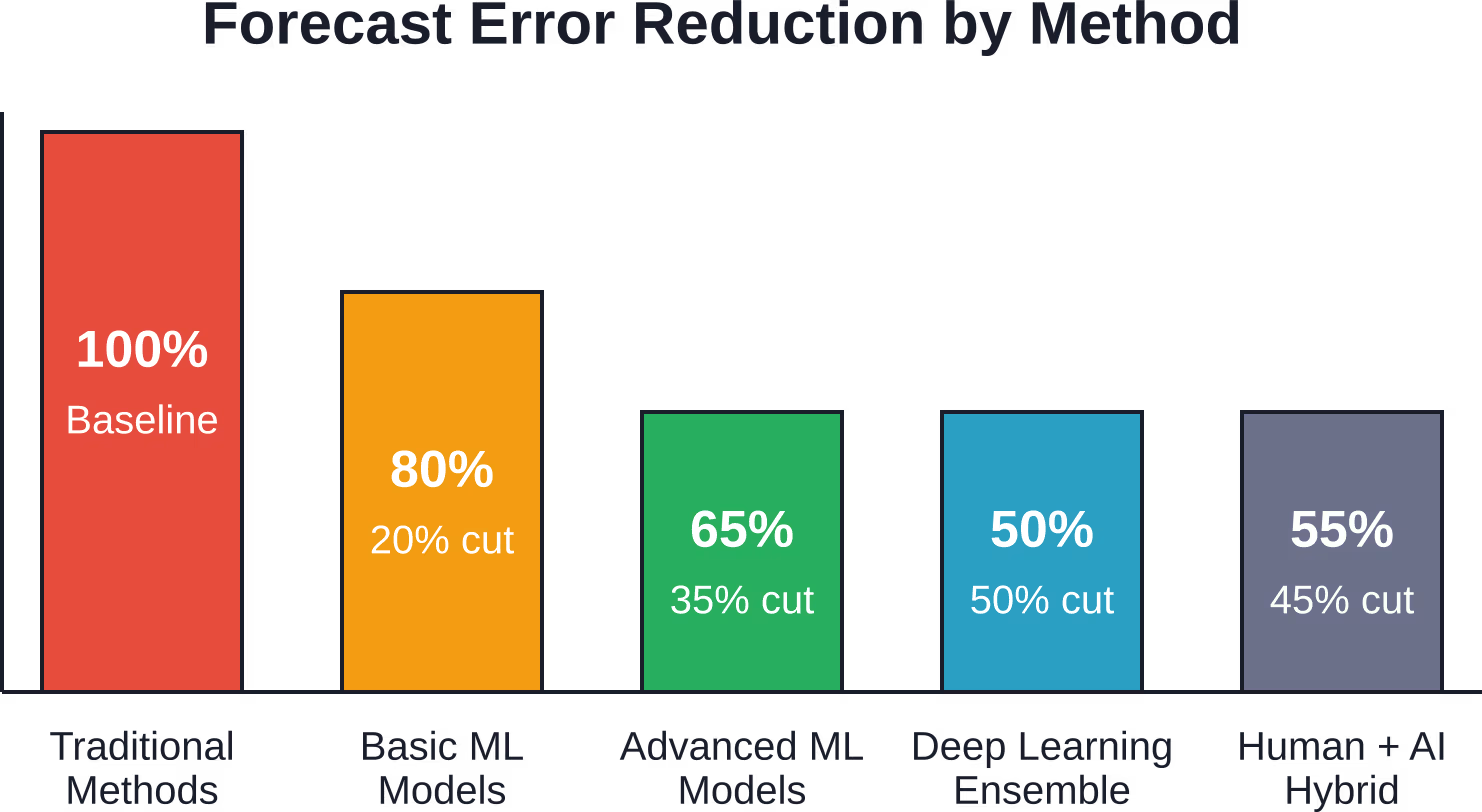
Getting Started: A Practical Roadmap
For organizations ready to implement predictive demand forecasting:
Months 1-2: Assessment and Planning
Evaluate current forecasting processes and data infrastructure. Identify pain points, quantify current accuracy, and document business requirements. Assess internal capabilities and determine whether to build, buy, or partner for analytics expertise.
Months 3-4: Data Preparation and Pilot Scoping
Select a pilot scope—a specific product category, geographic region, or business unit where success can be demonstrated without enterprise-wide complexity. Gather and clean historical data, establish data pipelines, and define success metrics.
Months 5-7: Model Development and Testing
Build and train initial models using historical data. Validate forecast accuracy against holdout periods. Compare predictive analytics performance to existing methods. Iterate on features, algorithms, and data inputs based on results.
Months 8-9: Pilot Deployment
Integrate forecasts into operational planning processes. Run parallel with existing methods initially. Train users, gather feedback, and refine based on practical experience.
Months 10-12: Evaluation and Scaling
Measure pilot results against success criteria. Document lessons learned and refine implementation approach. Develop roadmap for scaling to additional products, regions, or business units based on pilot outcomes. The U.S. economy is projected to add 5.2 million jobs from 2024 to 2034. Organizations that master predictive demand forecasting position themselves to capture these growth opportunities while competitors struggle with outdated planning methods.
Frequently Asked Questions
How accurate is predictive analytics for demand forecasting?
Research indicates that machine learning algorithms, particularly deep learning and reinforcement learning models, can reduce forecast errors by 20–50% compared to conventional techniques. Actual accuracy depends heavily on data quality, product characteristics, and market stability. Products with consistent seasonal patterns and long sales histories forecast more accurately than new products or those in rapidly changing markets.
What data is needed for predictive demand forecasting?
At minimum, businesses need 2-5 years of historical sales data at the SKU level, including quantities, prices, and dates. Enhanced accuracy comes from incorporating promotional calendars, economic indicators, weather data, competitor intelligence, web analytics, social media sentiment, and supply chain disruption data. The more relevant data sources included, the better models can detect complex demand patterns.
Can small businesses benefit from predictive analytics?
Absolutely. Cloud-based analytics platforms have democratized access to sophisticated forecasting capabilities. Small retailers, manufacturers, and distributors can now use tools that were previously accessible only to large enterprises with dedicated data science teams. Starting with focused applications—forecasting top-selling products or peak demand periods—delivers value without overwhelming resources.
How does predictive analytics handle unexpected events?
This remains a limitation. Models trained on historical patterns struggle with genuinely unprecedented events like pandemics, natural disasters, or sudden regulatory changes. Best practices include maintaining human oversight to adjust forecasts when circumstances fall outside historical experience, using ensemble models that blend multiple approaches, and building alert systems that flag when recent data diverges significantly from patterns models expect.
What’s the difference between demand forecasting and demand planning?
Demand forecasting predicts what customers will buy. Demand planning uses those forecasts to make operational decisions—how much to produce, where to position inventory, when to run promotions, which suppliers to engage. Forecasting is analytical; planning is strategic. Predictive analytics enhances forecasting, which then informs better planning decisions.
How long does it take to implement predictive demand forecasting?
Pilot implementations typically require 6-12 months from initial planning through deployment and evaluation. Enterprise-wide rollouts can take 18-36 months depending on organizational complexity, data infrastructure maturity, and scope. Organizations with clean data and strong analytics capabilities can move faster. Those requiring significant data cleanup or cultural change need longer timelines.
What ROI can businesses expect from predictive demand forecasting?
Industry reports suggest firms implementing AI-based predictive models achieve up to a 10–15% reduction in operational costs. Benefits include lower inventory carrying costs, reduced stockouts and lost sales, fewer expedited shipments, and better capacity utilization. Specific ROI varies by industry, product characteristics, and baseline forecast accuracy. Most organizations see payback within 12-24 months when implementation follows best practices.
Conclusion
Predictive analytics has fundamentally changed what’s possible in demand forecasting. Traditional methods that worked adequately in stable markets simply can’t keep pace with today’s volatility. Consumer preferences shift rapidly. Supply chains span continents and multiple tiers of suppliers. Competitors emerge from unexpected directions. Economic conditions swing unpredictably. In this environment, businesses that forecast accurately gain decisive competitive advantages. They stock the right products in the right quantities at the right locations. They avoid both costly stockouts and excess inventory that ties up working capital. They respond faster when demand patterns shift. The technology has matured significantly. Machine learning algorithms deliver 20–50% better accuracy than conventional approaches. Cloud platforms make sophisticated analytics accessible to organizations of all sizes. Integration with operational systems enables forecasts to drive automated actions across procurement, production, and distribution. But technology alone isn’t sufficient. Success requires clean data, cross-functional collaboration, iterative refinement, and—critically—pairing algorithmic power with human judgment. The most effective implementations combine machine learning’s pattern recognition capabilities with human expertise about business context, competitive dynamics, and exceptional circumstances. The U.S. economy is projected to add 5.2 million jobs from 2024 to 2034, according to Bureau of Labor Statistics projections, with 3.1 percent total employment growth. Companies that master predictive demand forecasting will capture disproportionate shares of this growth, while those relying on outdated planning methods will struggle to compete. Ready to transform how your organization forecasts demand? Start with a focused pilot, demonstrate measurable value, and scale systematically. The competitive advantages gained from superior demand visibility compound over time—making now the right moment to begin.