Quick Summary: Predictive analytics is transforming the energy sector by leveraging machine learning and AI to forecast demand, optimize grid operations, and reduce costs. Recent research shows efficiency improvements of 14-24% in electric power systems, with forecasting accuracy increasing by 65% through automated models. Energy providers use these tools to predict renewable output, prevent equipment failures, and cut operational expenses by up to 15%. The energy sector faces a fundamental challenge: matching supply with demand in real time while managing increasingly complex renewable resources and aging infrastructure. Traditional forecasting methods—relying on historical averages and conservative assumptions—leave billions on the table every year. But predictive analytics is changing that equation entirely. By integrating machine learning algorithms with IoT sensors, smart meters, and grid data, energy companies now forecast load patterns, renewable generation, and equipment failures with unprecedented accuracy. The results? Measurable improvements across reliability, cost, and environmental impact.
What Makes Predictive Analytics Essential for Energy Operations
Energy systems generate massive volumes of data every second—consumption patterns, weather feeds, equipment sensors, market prices, and grid status updates. That data holds the blueprint for optimization, yet most organizations struggle to extract actionable insights fast enough to matter. Predictive analytics bridges that gap. Rather than reacting to problems after they occur, energy providers anticipate them hours or days in advance. Here’s the thing though—accuracy matters more than speed alone. And the forecasting precision? A recent MIT study tracking drilling bits demand in the energy-exploration sector showed that automated causal and time-series models dropped global mean absolute percentage error rates by 65%. That leap in accuracy translates directly to reduced waste and optimized inventory management. 
Apply Predictive Analytics with AI Superior
AI Superior builds predictive models on operational and sensor data to support forecasting, maintenance planning, and system performance. They focus on integrating models into existing infrastructure, starting with data assessment and a working prototype before scaling.
Looking to Use Predictive Analytics in Energy?
AI Superior can help with:
- evaluating operational and sensor data
- building predictive models
- integrating models into existing systems
- refining outputs based on results
👉 Contact AI Superior to discuss your project, data, and implementation approach.
Key Applications Driving Results Across the Energy Value Chain
Demand Forecasting and Load Balancing
Predicting electricity demand accurately prevents both overproduction (wasting fuel and capital) and shortfalls (triggering expensive peaker plants or grid instability). Machine learning models analyze historical consumption data, weather patterns, economic indicators, and event schedules to forecast load at hourly, daily, and seasonal intervals. For utilities managing renewable portfolios, accurate demand forecasting is critical. Wind and solar generation fluctuate with weather conditions, making this capability the linchpin of grid stability.
Renewable Energy Output Prediction
Solar and wind resources depend on environmental variables that change by the hour. Predictive models ingest satellite imagery, atmospheric data, and historical generation patterns to forecast renewable output with increasing precision. Best studies show that augmenting solar and wind energy with AI increased predictive capability by 95%, alongside an overall energy efficiency increase of 7%. These improvements allow grid operators to schedule conventional generation more effectively and reduce reliance on spinning reserves. The U.S. Department of Energy’s Solar Energy Technologies Office awarded $750,000 to Arizona State University (Tempe, AZ) for a project titled ‘Photovoltaic Plant Predictive Maintenance Optimization under Uncertainties Using Probabilistic Information Fusion’. This initiative aims to develop solutions that improve the reliability and affordability of solar technologies on the grid. 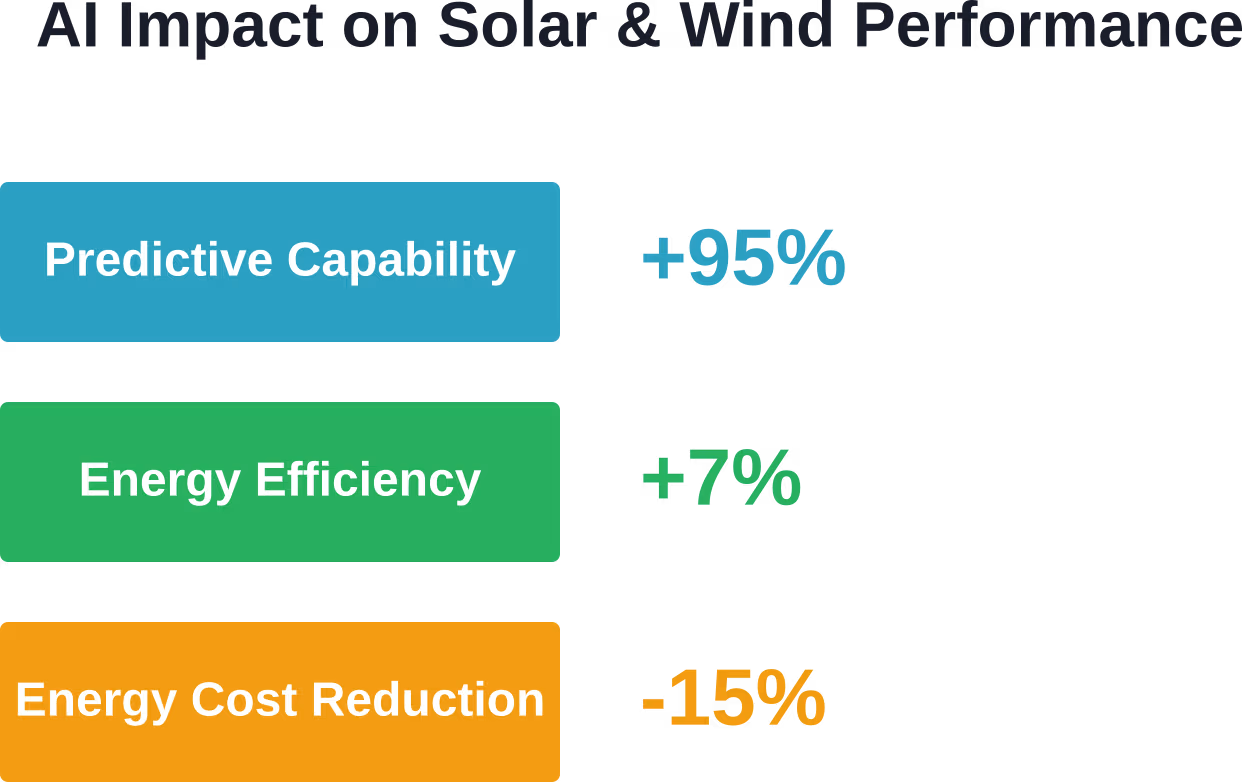
Predictive Maintenance for Grid Assets
Equipment failures disrupt service, trigger emergency repairs, and cost utilities millions in lost revenue and penalties. Predictive maintenance algorithms monitor sensor data from transformers, turbines, transmission lines, and substations to detect early warning signs of degradation. Predictive maintenance can significantly reduce unwanted downtime through early fault detection, allowing teams to schedule repairs during planned outages rather than responding to catastrophic failures. Arizona State University received a DOE award for Photovoltaic Plant Predictive Maintenance Optimization with an awardee cost share of $380,000. This project aims to enhance grid monitoring and fault detection capabilities.
Energy Storage Optimization
Battery storage systems play a critical role in balancing renewable intermittency, but charging and discharging cycles must be carefully managed to maximize lifespan and economic return. Predictive analytics determines optimal charge/discharge schedules based on forecasted demand, renewable availability, and dynamic electricity pricing. Optimized charging and discharging plans can reduce energy storage costs through better cycle management, making storage deployments financially viable at scale.
The Technology Stack Powering Predictive Energy Analytics
Implementing effective predictive analytics requires integrating multiple technologies across the data pipeline.
Data Acquisition and IoT Infrastructure
Smart meters, grid sensors, and SCADA systems generate the raw data streams that feed prediction models. Advanced Metering Infrastructure captures granular consumption data at 15-minute or hourly intervals, while Phasor Measurement Units provide real-time grid synchronization data.
Machine Learning Algorithms
Energy analytics leverage both supervised and unsupervised learning methods:
- Linear and logistic regression for baseline load forecasting and classification tasks
- Decision trees and random forests for handling non-linear relationships and feature importance analysis
- Clustering algorithms for customer segmentation and anomaly detection
- Time-series models (ARIMA, LSTM networks) for temporal pattern recognition
The choice of algorithm depends on data characteristics, prediction horizon, and accuracy requirements.
Cloud Computing and Big Data Platforms
Processing terabytes of historical and real-time data demands scalable infrastructure. Cloud platforms provide the computational horsepower for training complex models, while distributed processing frameworks handle data ingestion and transformation at scale.
Economic and Operational Impact
The financial case for predictive analytics extends beyond operational efficiency. Industry analyses indicate that suboptimal AC Optimal Power Flow solutions cost the United States between $6-19B annually in sub-optimality costs. Better algorithms and predictive models directly reduce this waste. For individual utilities, the benefits compound across multiple dimensions:
| Impact Area | Improvement Range | Primary Mechanism |
|---|---|---|
| Forecasting Accuracy | 65% MAPE reduction | Automated time-series models |
| System Efficiency | 14-24% improvement | ML-optimized grid operations |
| Renewable Efficiency | 7% gain | AI-enhanced output prediction |
These aren’t marginal gains—they represent fundamental improvements in how energy infrastructure operates.
Implementation Challenges and Regulatory Considerations
Despite proven benefits, adoption faces hurdles. Legacy systems dominate many utilities, and integrating modern analytics platforms with decades-old SCADA infrastructure requires careful planning and significant investment. Data quality issues complicate model training. Missing values, sensor drift, and inconsistent formatting require extensive preprocessing before algorithms can extract meaningful patterns. Regulatory frameworks often lag technological capability. Energy markets operate under strict compliance requirements, and proving that predictive models meet reliability standards demands rigorous validation and documentation. Real talk: conservative power sectors move slowly. Building stakeholder confidence in AI-driven decisions requires demonstrating consistent results over extended periods, not just promising pilot projects.
Future Directions and Emerging Trends
The next wave of predictive analytics in energy will likely focus on several key areas:
- Distributed energy resource management: As rooftop solar, electric vehicles, and home batteries proliferate, forecasting and controlling millions of distributed assets becomes exponentially more complex. Advanced analytics will coordinate these resources to provide grid services without compromising customer comfort.
- Edge computing for real-time decisions: Moving computation closer to data sources reduces latency and enables faster response to grid events. Edge devices running lightweight ML models can trigger protective actions in milliseconds rather than seconds.
- Explainable AI for regulatory acceptance: Black-box models face skepticism from regulators and grid operators. Developing interpretable algorithms that explain their predictions in human-understandable terms will accelerate adoption in risk-averse environments.
- Integration with carbon markets: Predictive models will increasingly optimize not just for cost and reliability, but for carbon intensity—forecasting the cleanest hours to shift flexible loads and maximizing renewable utilization.
Frequently Asked Questions
How accurate are predictive analytics models for energy forecasting?
Accuracy varies by application and data quality, but recent implementations show significant improvements. Automated causal and time-series models have reduced forecasting error rates by 65% in energy-exploration demand prediction. For renewable output forecasting, AI augmentation increased predictive capability by 95%, though absolute accuracy depends on weather variability and local conditions.
What data sources do energy predictive analytics systems require?
Effective predictive models integrate multiple data streams: smart meter readings capturing consumption patterns, weather data (temperature, wind speed, solar irradiance), grid sensor outputs (voltage, frequency, line loading), equipment telemetry (vibration, temperature, operating hours), market prices, and historical maintenance records. The U.S. Department of Energy’s Open Energy Data Initiative provides benchmark datasets for model development.
Can small utilities benefit from predictive analytics, or is it only for large operators?
While large utilities pioneered adoption, cloud-based analytics platforms and software-as-a-service models now make predictive tools accessible to smaller operators. The key is starting with high-impact use cases—demand forecasting or transformer health monitoring—rather than attempting comprehensive implementations. Many vendors offer scalable solutions that grow with organizational needs.
How long does it take to implement predictive analytics in an energy operation?
Implementation timelines vary widely based on scope and existing infrastructure. Pilot projects focused on specific assets or processes can demonstrate value in 3-6 months. Enterprise-wide deployments integrating legacy systems typically require 12-24 months, including data infrastructure upgrades, model development, validation, and staff training. Modern tools significantly accelerate deployment timelines compared to earlier approaches.
What skills do energy companies need to deploy predictive analytics successfully?
Successful implementations require a blend of domain expertise and technical capability. Teams typically include data scientists familiar with machine learning algorithms, data engineers who build and maintain data pipelines, domain experts who understand grid operations and energy markets, and IT professionals who integrate analytics platforms with existing systems. Many organizations partner with specialized vendors initially while building internal capabilities.
How do predictive analytics help integrate renewable energy sources?
Renewables introduce variability that traditional grid management struggles to accommodate. Predictive models forecast solar and wind output hours or days ahead, allowing operators to schedule conventional generation, adjust energy storage, and activate demand response programs. This increases renewable penetration without compromising reliability. Research shows AI augmentation of solar and wind systems improved overall energy efficiency by 7% while increasing predictive capability by 95%.
What security concerns arise with predictive analytics in energy systems?
Energy infrastructure represents critical national assets, making cybersecurity paramount. Predictive systems create new attack surfaces through data connections, cloud platforms, and automated control pathways. Best practices include network segmentation (isolating operational technology from IT systems), encryption of data in transit and at rest, rigorous access controls, continuous monitoring for anomalous activity, and regular security audits. Regulatory frameworks increasingly mandate specific cybersecurity standards for grid-connected analytics systems.
Conclusion
Predictive analytics has moved from experimental to essential in the energy sector. The combination of IoT infrastructure, machine learning algorithms, and cloud computing delivers measurable improvements in efficiency, reliability, and cost—reductions in forecasting error by 65%, system efficiency gains of 14-24%, and operational cost cuts of 15%. But technology alone doesn’t guarantee success. Effective implementation requires quality data, skilled teams, stakeholder buy-in, and realistic expectations about timelines and challenges. For energy companies evaluating predictive analytics initiatives, the question isn’t whether to adopt these tools—it’s how quickly they can implement them before competitors gain insurmountable advantages. The organizations building predictive capabilities today will define industry standards tomorrow. Start with high-impact use cases, demonstrate measurable results, and scale systematically. The data is already flowing through energy systems—the opportunity lies in extracting its full value.