Quick Summary: Predictive analytics in healthcare uses machine learning, AI, and statistical modeling to analyze historical and real-time patient data to forecast future health outcomes, identify at-risk populations, and optimize clinical decisions. This technology enables earlier disease detection, reduces hospital readmissions, prevents costly complications, and personalizes treatment plans at scale. By 2026, healthcare organizations are leveraging predictive models to transform reactive care into proactive, data-driven interventions that save lives and reduce the industry’s annual expense burden. Healthcare has always been reactive. A patient shows symptoms, visits a doctor, receives a diagnosis, then starts treatment. But what if providers could predict complications before symptoms even appear? That’s exactly what predictive analytics delivers. By mining massive datasets—electronic health records, lab results, imaging studies, genomic profiles, even social determinants—sophisticated algorithms now forecast which patients will develop sepsis, who’s likely to be readmitted within 30 days, and which chronic disease patients need immediate intervention. The stakes couldn’t be higher. According to research cited in authoritative sources, approximately 60% of persons have to manage at least one chronic disease, while 40% have multiple chronic conditions. Annual U.S. healthcare expenses hit $5.3 trillion, much of it spent treating preventable complications. Predictive analytics shifts the paradigm from reactive firefighting to proactive prevention. And the results speak for themselves.
What Is Predictive Analytics in Healthcare?
Predictive analytics applies statistical algorithms, machine learning models, and artificial intelligence to historical and real-time data to generate forecasts about future events. In healthcare, this means analyzing patient records, clinical variables, population health trends, and operational metrics to anticipate outcomes. Here’s the thing though—predictive analytics isn’t fortune-telling. It’s pattern recognition at industrial scale. Machine learning models train on thousands or millions of patient cases. They identify which combinations of lab values, vital signs, medications, and demographic factors correlate with adverse outcomes. Once trained, these models score new patients in real time, flagging those at highest risk. The technology draws on several data sources:
- Electronic health records (EHRs): Demographics, diagnoses, medications, lab results, vital signs, clinical notes
- Claims data: Utilization patterns, prior hospitalizations, procedures, costs
- Medical imaging: Radiology scans, pathology slides analyzed via computer vision
- Genomic data: Genetic markers that influence disease risk and treatment response
- Wearable devices: Continuous monitoring of heart rate, activity, glucose, sleep
- Social determinants: Housing stability, food security, transportation access
Algorithms process these inputs, identify risk signatures, and produce actionable predictions—often 12 hours or more before traditional clinical detection methods catch the problem.
Real-World Use Cases Driving Results
Predictive analytics isn’t theoretical. Healthcare organizations worldwide are deploying these models to solve urgent clinical and operational challenges.
Sepsis Prediction and Early Intervention
Sepsis kills more hospital patients than heart attacks. Early detection is critical—every hour of delayed treatment increases mortality risk. Machine learning models now predict sepsis onset 12 hours before traditional clinical detection, according to research analyzing the PhysioNet 2019 Challenge dataset of over 40,000 ICU patients. These algorithms monitor vital signs, lab trends, and medication changes in real time, alerting care teams the moment risk scores cross critical thresholds. One hospital deployed a sepsis prediction model and cut mortality by identifying at-risk patients during the narrow window when antibiotics and fluids remain maximally effective.
Hospital Readmission Prevention
Nearly one in five adult patients experiences hospital readmission within 30 days of discharge. Each readmission costs thousands of dollars and signals care coordination failures. Predictive models analyze discharge data—diagnoses, social factors, medication adherence patterns, follow-up appointment scheduling—to calculate readmission probability. High-risk patients receive intensive transitional care: home visits, telemonitoring, medication reconciliation, rapid follow-up appointments. According to industry reports, one major health system prevented 200 readmissions through predictive modeling, saving $5 million while improving patient outcomes.
Chronic Disease Management at Scale
A recent study analyzed 4,845 electronic medical records from 5,000 patients with chronic conditions. The population had a median age of 71.83 years; 63.8% were women, and 29.7% received home care. Prevalence rates were striking: 67.2% had hypertension, 57.3% had dyslipidemia, 52.9% had diabetes, and 19.4% had COPD. Machine learning models predicted mortality and hospitalization risk with remarkable accuracy. Elastic Net models demonstrated 0.883 AUCROC for mortality prediction and 0.952 for hospitalization risk in chronic disease patient studies. XGBoost achieved 0.896 AUCROC for mortality prediction and 0.963 for hospitalization risk, exceeding traditional clinical scoring systems. These models enable care managers to prioritize the highest-risk patients for intensive case management, medication optimization, and proactive specialist referrals.
Precision Oncology and Treatment Response
Cancer treatment is moving from one-size-fits-all protocols toward precision medicine guided by genomic profiles and predictive biomarkers. Research from the National Institutes of Health demonstrates this starkly: colorectal cancers with mismatch repair (MMR) proficiency show 0% immune-related objective response rates to certain immunotherapies, while MMR-deficient tumors respond 40% of the time. Predictive models integrating genomic data, tumor imaging, and clinical variables now forecast which patients will benefit from specific chemotherapy regimens, immunotherapies, or targeted agents—sparing others from ineffective treatments and toxic side effects.
Operational Efficiency and Resource Allocation
Predictive analytics extends beyond clinical care into operational optimization. Hospitals use forecasting models to predict emergency department volume, surgical case duration, ICU bed demand, and staffing requirements. During the COVID-19 pandemic, predictive models helped hospitals anticipate surge capacity needs, allocate ventilators, and manage PPE inventory based on infection rate trajectories. 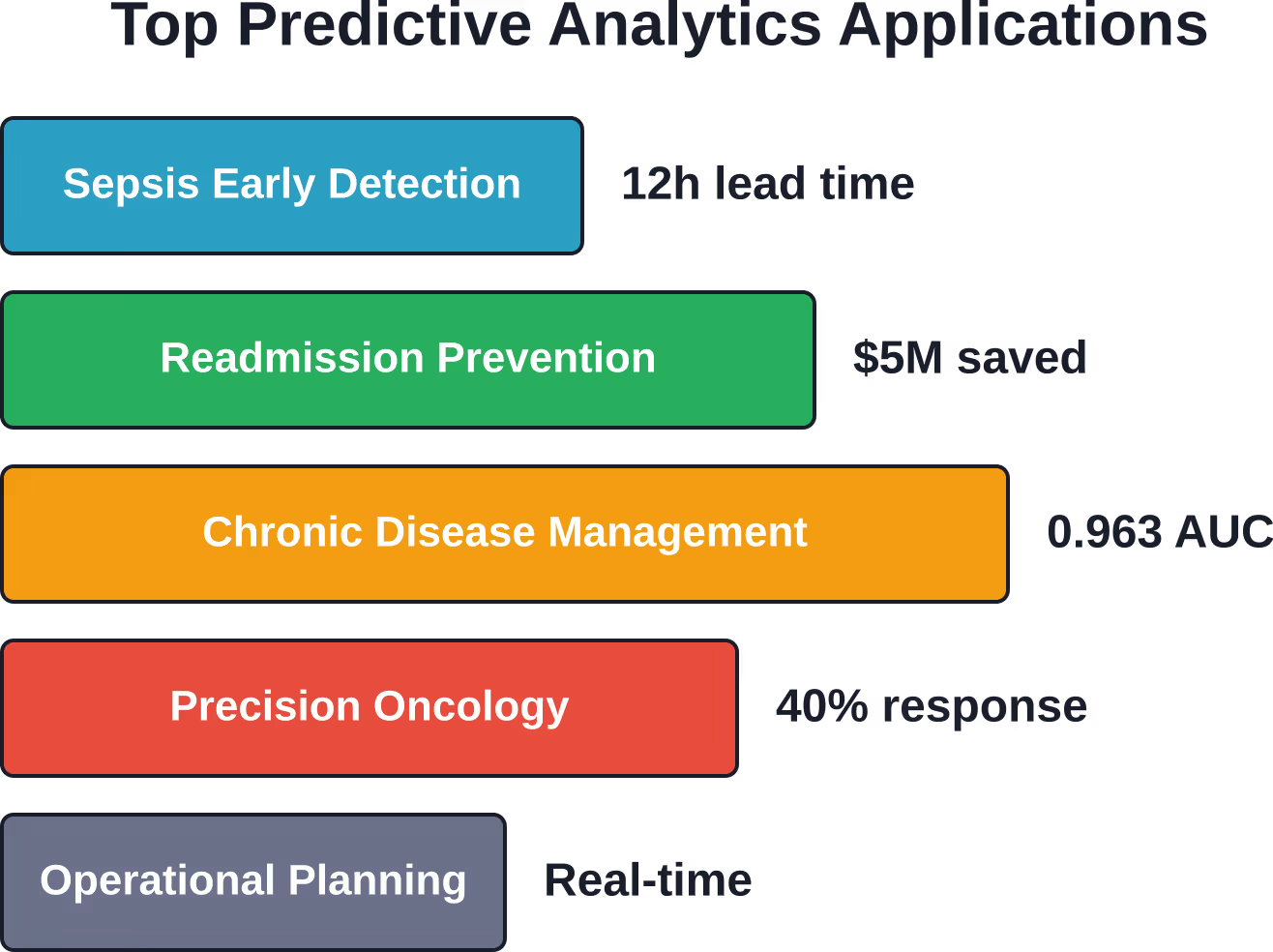
Key Benefits for Healthcare Organizations
Organizations implementing predictive analytics report benefits across multiple dimensions.
Earlier Disease Detection and Intervention
Traditional diagnostic workflows rely on symptom presentation. Predictive models identify disease signatures in asymptomatic patients—catching conditions when they’re most treatable. Research shows machine learning models successfully detect sepsis, acute kidney injury, heart failure decompensation, and diabetic complications before clinical signs appear. That early warning creates intervention windows that can prevent ICU admissions, organ damage, and death.
Reduced Healthcare Costs
Preventing complications costs far less than treating them. A single prevented sepsis case saves tens of thousands in ICU expenses. Avoided readmissions eliminate duplicate diagnostic workups, procedures, and hospital days. The $5 million saved by preventing 200 readmissions represents just one hospital’s results. At scale across health systems, predictive analytics can bend the cost curve on the industry’s annual spend.
Personalized Treatment Plans
Precision medicine moves beyond population averages to individualized risk profiles. Predictive models incorporate patient-specific factors—genetics, biomarkers, comorbidities, social context—to recommend tailored interventions. A diabetic patient with predicted high hospitalization risk (based on the 0.963 AUCROC model) might receive intensive case management, while a lower-risk patient continues routine follow-up. That stratification optimizes resource allocation and outcomes simultaneously.
Enhanced Operational Efficiency
Predicting patient volumes, procedure durations, and discharge timing allows hospitals to right-size staffing, reduce wait times, and maximize asset utilization. Better forecasting means fewer cancelled surgeries due to bed shortages, reduced emergency department crowding, and improved staff satisfaction through predictable scheduling.
Improved Care Coordination
Predictive models surface patients who need extra support—those at risk for medication non-adherence, transportation barriers, or care plan confusion. Care coordinators intervene proactively rather than reacting to missed appointments and deteriorating conditions.
| Benefit Category | Impact | Example Metric |
|---|---|---|
| Clinical Outcomes | Earlier detection, reduced mortality | 12-hour sepsis prediction lead time |
| Financial | Lower readmission costs | $5 million saved (200 readmissions prevented) |
| Operational | Optimized resource allocation | Real-time bed capacity forecasting |
| Quality | Personalized care delivery | 0.963 AUCROC hospitalization prediction |
| Population Health | Targeted chronic disease management | 67.2% hypertension prevalence identified |
Challenges and Ethical Considerations
Predictive analytics delivers powerful capabilities, but implementation raises important challenges.
Data Quality and Integration
Machine learning models require clean, comprehensive, interoperable data. Healthcare data remains fragmented across EHR systems, claims databases, labs, imaging centers, and wearable devices. The Office of the National Coordinator for Health Information Technology advanced standards like USCDI v7 (released January 29, 2026) through the 2026 Interoperability Standards Advisory. But gaps persist. Incomplete records, coding errors, and missing variables degrade model performance. Organizations must invest in data governance, quality monitoring, and integration infrastructure before deploying predictive analytics at scale.
Algorithm Bias and Health Equity
Models trained on biased data perpetuate and amplify existing disparities. If training datasets underrepresent minority populations, the resulting algorithms may perform poorly for those groups—recommending suboptimal care or missing disease signatures. Healthcare organizations must audit algorithms for bias, ensure diverse training data, and monitor performance across demographic subgroups. Transparency about model limitations is essential.
Clinical Workflow Integration
Even accurate predictions fail if clinicians ignore them. Alert fatigue plagues electronic health records—providers dismiss too many warnings as false positives. Successful predictive analytics implementations embed risk scores seamlessly into clinical workflows, provide actionable recommendations (not just numbers), and demonstrate value through feedback loops showing prevented complications.
Privacy and Data Security
Predictive models require access to sensitive health information. Organizations must comply with HIPAA regulations, implement robust cybersecurity controls, and maintain patient trust through transparent data governance policies. Patients deserve to know when algorithms influence their care and should have opportunities to review predictions for accuracy.
Regulatory and Liability Questions
Who’s liable when a predictive model misses a diagnosis or recommends inappropriate treatment? Regulatory frameworks haven’t fully caught up to AI-driven clinical decision support. Healthcare organizations need clear policies defining human oversight requirements, model validation standards, and accountability structures.
Implementation Strategies for Healthcare Organizations
Successful predictive analytics programs follow structured implementation roadmaps.
Start with High-Value Use Cases
Don’t boil the ocean. Identify specific clinical or operational problems where predictive analytics can deliver measurable impact—sepsis prediction, readmission prevention, chronic disease stratification. Prove value with pilot projects before scaling enterprise-wide.
Build Data Infrastructure First
Invest in data warehouses, integration engines, and quality monitoring tools. Leverage interoperability standards like FHIR (Fast Healthcare Interoperability Resources) to connect disparate systems. Clean, normalized, real-time data feeds are prerequisites for accurate models.
Partner with Clinical Champions
Predictive analytics succeeds when clinicians trust and act on model outputs. Involve physicians, nurses, and care managers early in model development. Clinical champions translate technical capabilities into workflow-integrated solutions that frontline providers actually use.
Validate Models Rigorously
Retrospective model performance on historical data doesn’t guarantee real-world success. Conduct prospective validation studies comparing model predictions against actual outcomes in live clinical environments. Continuously monitor for performance drift as patient populations and practice patterns evolve.
Prioritize Transparency and Explainability
Black-box algorithms that provide risk scores without explanations face clinician skepticism. Implement explainable AI techniques that show which factors drive individual predictions. When a model flags a patient for readmission risk, clinicians need to see contributing factors—recent hospitalization, medication non-adherence, lack of follow-up appointment—to craft appropriate interventions.
Establish Governance and Oversight
Create multidisciplinary committees (clinical, IT, legal, ethics) to oversee model development, deployment, monitoring, and retirement. Regular audits for bias, performance degradation, and unintended consequences maintain model integrity and patient safety. 
Make Predictive Healthcare Models Work in Clinical Settings
Predictive analytics in healthcare often fails not because of algorithms, but because models never make it into real clinical use. AI Superior works with organizations that need to move from isolated experiments to systems that actually support care decisions. They focus on building AI solutions around real datasets and embedding them into existing environments where predictions can be used in practice, not just analyzed.
Turn Healthcare Data Into Usable Clinical Signals
AI Superior helps bridge the gap between model output and real-world use:
- Design AI solutions around specific clinical or operational problems
- Work with complex and fragmented healthcare data sources
- Develop and test models before scaling them into production
- Connect predictions to workflows where decisions are made
- Monitor model performance as conditions and data change
If predictive analytics matters for your organization, (/contact/) and see how it can be applied in real healthcare settings.
The Technology Stack Behind Predictive Analytics
Healthcare predictive analytics relies on several core technologies working in concert.
Machine Learning Algorithms
Different model types suit different prediction tasks:
- Logistic regression and Elastic Net: Interpretable models for binary outcomes (mortality, readmission). Elastic Net models demonstrated 0.883 AUCROC for mortality prediction and 0.952 for hospitalization risk in chronic disease patient studies.
- Random Forest and XGBoost: Ensemble methods that handle non-linear relationships and complex interactions. XGBoost achieved 0.896 AUCROC for mortality prediction and 0.963 for hospitalization risk, exceeding traditional clinical scoring systems.
- Neural networks: Deep learning models for image analysis, natural language processing of clinical notes, and complex time-series predictions. Neural network models achieved 0.886 AUCROC for mortality prediction.
- Recurrent neural networks (RNNs): Specialized for sequential data like vital sign trends over time.
Big Data Infrastructure
Predictive analytics processes massive datasets. The MIMIC-III database contains records from over 40,000 patients at Beth Israel Deaconess Medical Center (2001-2012). MIMIC-IV extends coverage to ICU records from 2008-2019. Organizations leverage cloud platforms, distributed computing frameworks (Hadoop, Spark), and specialized databases to store, process, and analyze petabyte-scale health data.
Clinical Data Standards
Interoperability standards enable data exchange across systems. Key standards include:
- FHIR (Fast Healthcare Interoperability Resources): Modern API-based standard for health data exchange
- USCDI (United States Core Data for Interoperability): Defines essential data elements for nationwide exchange. On March 21, 2025, ONC exercised enforcement discretion guidance and subsequently released USCDI version 3.1 (USCDI v3.1).
- HL7: Messaging standards for clinical and administrative data
- LOINC and SNOMED CT: Standardized terminologies for lab tests and clinical concepts
Clinical Decision Support Systems
Predictive models deliver value through decision support interfaces embedded in EHRs and care management platforms. These systems surface risk scores, recommend interventions, and track outcomes.
Looking Ahead: The Future of Predictive Analytics
The trajectory is clear. Predictive analytics will become the standard of care across healthcare delivery. Several trends will accelerate adoption:
- Real-time continuous monitoring: Wearables, remote patient monitoring devices, and hospital sensor networks will feed algorithms with continuous physiologic data streams. Models will detect subtle deterioration patterns invisible to intermittent clinical assessments.
- Multimodal AI: Next-generation models will integrate structured data (lab values, vital signs), unstructured text (clinical notes, radiology reports), medical images, genomic sequences, and patient-reported outcomes into unified predictions.
- Federated learning: Privacy-preserving techniques will allow institutions to collaboratively train models on pooled data without sharing patient records—improving accuracy while maintaining confidentiality.
- Causal inference: Moving beyond correlation to causation, new methods will identify which interventions actually improve outcomes rather than merely predicting risk.
- Democratization through standards: As interoperability standards mature and data quality improves, predictive analytics tools will become accessible to smaller practices and community hospitals—not just academic medical centers.
But technology alone won’t suffice. Success requires cultural transformation—shifting mindsets from reactive problem-solving to proactive risk management, from clinician intuition to human-AI collaboration, from siloed departments to integrated care teams.
Frequently Asked Questions
What is predictive analytics in healthcare?
Predictive analytics in healthcare uses machine learning algorithms, statistical models, and artificial intelligence to analyze historical patient data and forecast future health outcomes, complications, or resource needs. These models process electronic health records, lab results, imaging studies, and other data sources to identify patients at risk for adverse events before they occur.
How accurate are predictive healthcare models?
Accuracy varies by use case and model type. High-performing models achieve AUCROC scores above 0.90—for example, XGBoost reached 0.963 for hospitalization prediction and 0.896 for mortality forecasting in chronic disease patients. Sepsis prediction models identify at-risk patients 12 hours before traditional clinical detection. However, models require continuous validation and monitoring to maintain performance as patient populations and care patterns evolve.
What data sources do predictive analytics models use?
Predictive models draw on electronic health records (demographics, diagnoses, medications, vital signs, lab results), claims data (utilization patterns, costs), medical imaging (radiology, pathology), genomic profiles, wearable device data (continuous monitoring), and social determinants of health (housing, transportation, food security). The MIMIC-III and MIMIC-IV databases, containing records from over 40,000 ICU patients, have been instrumental in model development and validation.
What are the main challenges in implementing predictive analytics?
Key challenges include data quality and integration issues (fragmented systems, missing values, coding errors), algorithm bias that can perpetuate health disparities, clinical workflow integration barriers, alert fatigue from too many false positives, privacy and security concerns, and unclear regulatory frameworks around AI-driven clinical decisions. Organizations must invest in data infrastructure, governance structures, and clinical champion engagement to succeed.
How does predictive analytics reduce healthcare costs?
Predictive analytics reduces costs by preventing expensive complications before they occur. Early sepsis detection avoids ICU admissions and organ damage. Readmission prevention eliminates duplicate hospitalizations—one health system saved $5 million by preventing 200 readmissions through predictive modeling. Optimized resource allocation reduces waste from overstaffing, underutilized equipment, and inefficient scheduling. At scale, these efficiencies can meaningfully impact the healthcare industry’s annual expense burden.
Can predictive models replace clinical judgment?
No. Predictive analytics augments rather than replaces clinical expertise. Models provide risk scores and flag patients who need attention, but clinicians make final treatment decisions based on their assessment of the whole patient, including factors algorithms might miss. The most effective implementations combine machine pattern recognition with human judgment, contextual understanding, and relationship-based care. Explainable AI techniques help clinicians understand model reasoning and integrate predictions into their decision-making process.
How do healthcare organizations get started with predictive analytics?
Start by identifying high-value use cases with measurable outcomes (sepsis prediction, readmission prevention). Build data infrastructure to integrate and clean information from multiple sources. Partner with clinical champions who will advocate for adoption and provide workflow insights. Validate models prospectively in real clinical environments, not just retrospectively on historical data. Implement explainable AI so clinicians understand predictions. Establish governance committees to oversee model deployment, monitor for bias, and ensure patient safety. Prove value with focused pilots before scaling enterprise-wide.
Conclusion: From Reactive to Proactive Healthcare
Predictive analytics represents healthcare’s transformation from reactive crisis management to proactive prevention. By forecasting which patients will develop sepsis, who’s heading toward readmission, and whose chronic diseases are spiraling out of control, these technologies enable interventions during narrow windows when they’re most effective. The evidence is compelling. Models predict sepsis 12 hours early. XGBoost achieves 0.963 AUCROC for hospitalization risk. Preventing 200 readmissions saves $5 million. Precision oncology targets therapies to the 40% of MMR-deficient colorectal cancer patients who’ll actually respond. But realizing this potential demands more than deploying algorithms. Healthcare organizations must invest in data infrastructure that meets evolving interoperability standards like USCDI v7. They must audit models for bias to ensure equity across populations. They must integrate predictions seamlessly into clinical workflows so providers act on insights rather than dismiss alerts. Real talk: implementation is hard. Data is messy. Clinicians are skeptical. Regulations lag behind innovation. But the healthcare system’s challenges—rising costs, aging populations, chronic disease burden affecting 60% of Americans—demand transformation. Predictive analytics offers a path forward. Not a silver bullet, but a powerful tool that, when implemented thoughtfully, saves lives, reduces suffering, and bends the cost curve. The future of healthcare is proactive, personalized, and data-driven. Organizations that master predictive analytics today will define care delivery tomorrow. Those that wait risk falling behind as competitors leverage AI to deliver better outcomes at lower costs. Ready to explore predictive analytics for your organization? Start with one high-impact use case, build the data foundation, engage clinical champions, and prove value. The journey from reactive to proactive healthcare begins with a single prediction.