Quick Summary: Predictive analytics software uses historical data, statistical modeling, machine learning, and AI to forecast future outcomes and identify trends before they happen. Modern platforms range from code-free business tools to enterprise data science ecosystems, with capabilities spanning revenue forecasting, churn prediction, demand planning, and risk assessment. Choosing the right solution depends on your data maturity, team skills, minimum viable dataset size, and whether you need industry-specific models or general-purpose forecasting. Marketing analysts spend approximately 40% of their time preparing data for analysis, leaving minimal room for the predictions that drive revenue. The right predictive analytics tool changes that equation—but only if it matches your data infrastructure, team capabilities, and specific use cases. This guide evaluates predictive analytics platforms on criteria that matter: minimum data requirements, deployment complexity, model transparency, and the difference between marketing-specific versus general business intelligence tools.
What Is Predictive Analytics Software?
Predictive analytics software analyzes current and historical business data to forecast future events, trends, and behaviors. These platforms use statistical modeling, data mining techniques, artificial intelligence, and machine learning to determine the likelihood of future outcomes. Put simply, predictive analytics interprets an organization’s historical data to make predictions about what comes next. Today’s predictive analytics techniques can discover patterns in data to identify upcoming risks and opportunities. When implemented effectively, these tools deliver measurable business outcomes that directly impact bottom-line results. Revenue forecasting becomes more reliable when platforms analyze historical sales patterns alongside market signals, seasonal trends, and customer behavior data. Finance teams using predictive models can anticipate cash flow needs weeks or months ahead rather than reacting to shortfalls.
How Predictive Analytics Works
The process starts with data collection. Platforms pull information from databases, spreadsheets, cloud services, CRM systems, marketing automation tools, and other sources. Next comes data preparation—cleaning inconsistencies, handling missing values, and transforming raw inputs into model-ready formats. This stage typically consumes the bulk of analyst time. Then statistical modeling and machine learning algorithms identify patterns in historical data. The software trains on past examples to learn which variables correlate with specific outcomes. Finally, the trained models generate predictions on new data, scoring leads, forecasting demand, estimating churn probability, or whatever the target variable happens to be. But here’s the thing: accuracy depends entirely on data quality and volume. If the model sees only 50 conversions, it won’t generalize well. If lead sources change but the training data doesn’t reflect that shift, predictions drift.
Common Predictive Analytics Techniques
Different techniques suit different prediction tasks. Most platforms support multiple methods, automatically selecting the best fit or letting data scientists choose manually.
Regression Analysis
Regression models predict continuous numeric outcomes—revenue, deal size, customer lifetime value, inventory levels. Linear regression finds straight-line relationships between variables. More complex regression techniques handle nonlinear patterns and interactions between features.
Classification Models
Classification predicts categorical outcomes: will this lead convert (yes/no), which customer segment does this prospect belong to (A/B/C/D), is this transaction fraudulent (true/false). Logistic regression, decision trees, and random forests are common classification techniques.
Time Series Forecasting
Time series methods analyze data points collected at consistent intervals—daily sales, monthly churn, quarterly revenue. These models account for seasonality, trends, and cyclical patterns to project future values. ARIMA, exponential smoothing, and Prophet are popular time series algorithms.
Machine Learning and Neural Networks
Machine learning algorithms learn patterns without explicit programming. Neural networks, particularly deep learning models, excel at finding complex nonlinear relationships in large datasets. These techniques power advanced use cases like image recognition for quality control or natural language processing for sentiment analysis.
Clustering and Segmentation
Clustering groups similar records together without predefined categories. Marketing teams use clustering to discover customer segments based on behavior patterns. Operations teams apply it to identify equipment failure modes or supply chain bottlenecks.
Types of Predictive Analytics Platforms
Not all predictive analytics software serves the same audience or solves the same problems. Platforms fall into several categories, each with distinct strengths.
Unified BI Platforms with Predictive Features
Tools like Domo combine business intelligence dashboards, data integration, and predictive capabilities in one environment. These platforms work for business analysts who need forecasting without writing code. Moderate learning curves, 1,000+ data connectors, and SOC 2/HIPAA compliance make them suitable for regulated industries. Strengths: all-in-one functionality, faster deployment, accessible to non-technical users. Limitations: less customization than data science platforms, may hit ceiling with highly specialized models.
Marketing-Specific Predictive Tools
Purpose-built for marketing use cases—lead scoring, churn prediction, conversion probability, campaign ROI forecasting. These tools understand marketing data structures and come pre-configured for common marketing predictions. Strengths: fast time to value, domain-specific features, optimized for marketing workflows. Limitations: limited applicability outside marketing, may require separate tools for finance or operations forecasting.
Enterprise Data Science Platforms
Heavyweight ecosystems built for data science teams: model development environments, experiment tracking, MLOps pipelines, deployment infrastructure. Examples include Databricks, SageMaker, and Azure Machine Learning. Strengths: maximum flexibility, supports custom algorithms, scales to massive datasets, full lifecycle management. Limitations: steep learning curve, requires data science expertise, longer implementation timelines.
AutoML and No-Code Platforms
Automated machine learning tools let business users build predictive models through point-and-click interfaces. The software handles feature engineering, algorithm selection, hyperparameter tuning, and model evaluation automatically. Strengths: democratizes predictive analytics, fast prototyping, minimal technical skills required. Limitations: less control over modeling decisions, may not handle edge cases well, harder to troubleshoot when predictions seem off. 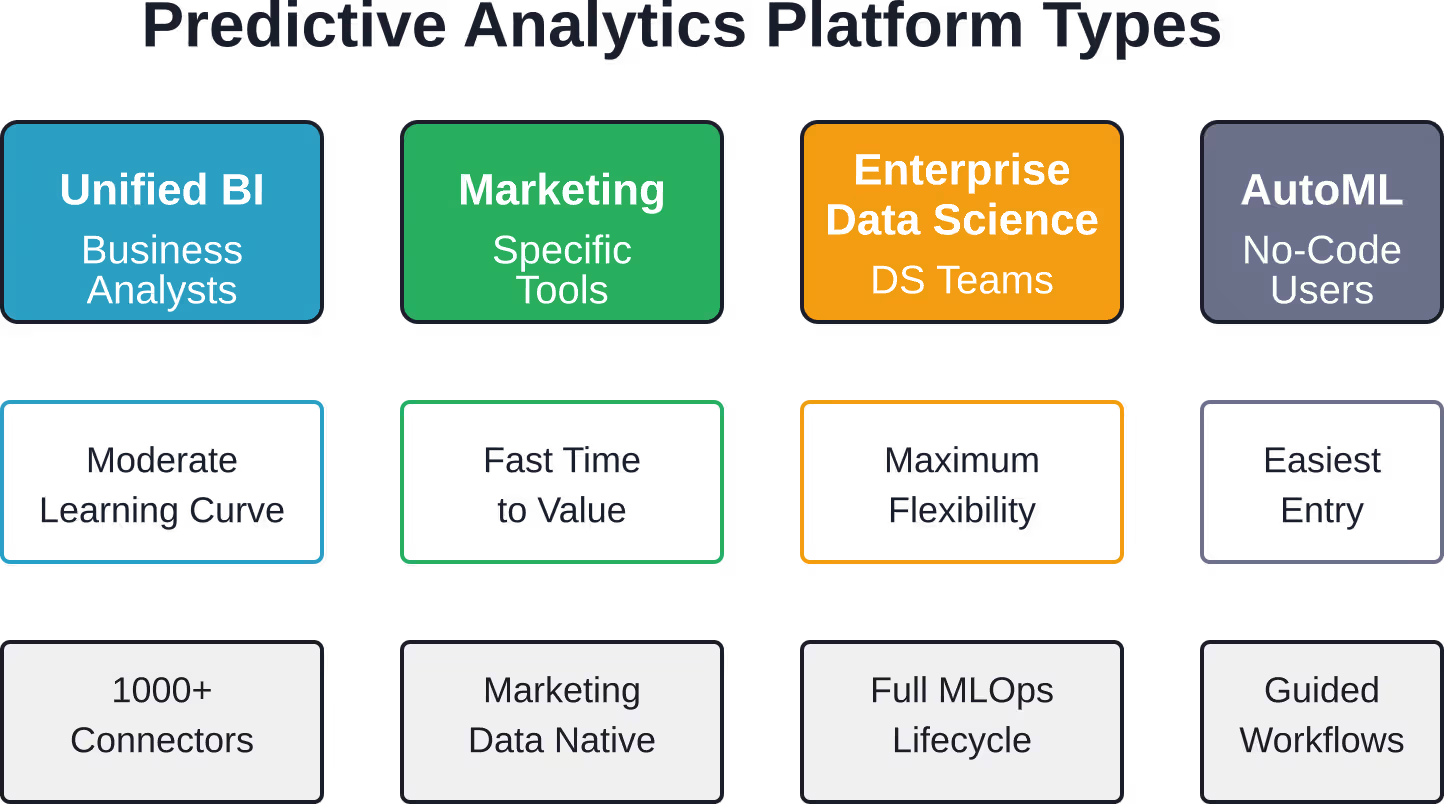
Key Features to Look for in Predictive Analytics Software
Evaluating predictive analytics platforms requires looking beyond marketing claims to capabilities that impact real-world outcomes.
Data Integration and Preparation
The platform needs connectors to your existing data sources. Has 100+ data source connectors to databases, spreadsheets, and cloud services? Can it be deployed in the cloud and on-premises? Look for built-in data cleaning, transformation, and feature engineering. If every prediction project requires custom ETL work, the tool becomes a bottleneck rather than an accelerator.
Model Transparency and Explainability
Black-box predictions erode trust. When a model scores a lead as low-priority, sales teams need to understand why. Explainable AI features show which variables drove each prediction. This matters for regulatory compliance too. Financial services, healthcare, and other regulated industries must document model decisions. Standards on validating machine learning, including those from IEEE, emphasize verification frameworks for production AI systems.
Deployment and Integration
Predictions sitting in a data science notebook don’t drive business value. The platform must push predictions into operational systems—CRM, marketing automation, ERP, wherever decisions get made. Data, visualizations, and dashboards should be embeddable into third-party tools. Real-time scoring APIs let applications request predictions on demand.
Scalability and Performance
Can the platform handle your data volume today and three years from now? Some tools perform well on 100,000 records but choke on 10 million. Training time matters too. If retraining a model takes eight hours, incorporating fresh data becomes impractical for fast-moving use cases.
Collaboration and Governance
Multiple team members need to access models, review predictions, and understand methodology. Version control, audit logs, and role-based permissions prevent chaos as the team grows. Model monitoring alerts teams when prediction accuracy degrades, signaling the need for retraining or investigation.
When Predictive Analytics Fails: Minimum Viable Data Requirements
Here’s what most vendors won’t tell you upfront: predictive models need substantial historical data to produce reliable forecasts. Deploy on insufficient data and accuracy collapses. If the prediction target is conversion probability, the model needs to see hundreds—ideally thousands—of past conversions across different contexts. Minimum thresholds vary by prediction type. Lead scoring typically requires at least 6 months of lead history and 500+ conversions. Fewer conversions mean the model can’t distinguish signal from noise. Churn prediction typically requires 12+ months of customer lifecycle data and at least 200 churn events, along with consistent tracking of engagement metrics. If churn definitions changed halfway through (cancellations vs non-renewals), the model learns inconsistent patterns. Demand forecasting needs 24+ months of sales history to capture seasonal cycles. One year isn’t enough—the model can’t tell whether December’s spike is an annual pattern or a one-time anomaly. Real talk: if your dataset falls below these thresholds, predictive models will overfit, producing great results on historical data but failing on new predictions. Better to wait and collect more data than deploy a model that misleads decision-makers.
Best Predictive Analytics Tools for 2026
Choosing the right platform depends on team skills, budget, data infrastructure, and specific use cases. This comparison highlights strengths and ideal scenarios for top tools.
| Tool | Best For | Key Strength | Learning Curve | Typical Users |
|---|---|---|---|---|
| Domo | Unified BI + predictive | All-in-one platform with 1,000+ connectors | Moderate | Business analysts, BI teams |
| Improvado | Marketing analytics | Marketing data unification + AI Agent for natural language predictions | Low | Marketing analysts, CMOs |
| Tableau | Visual analytics | Exploration + embedded forecasting | Moderate | Analysts, data viz specialists |
| Databricks | Enterprise ML | Unified data + AI platform for massive scale | High | Data engineers, ML engineers |
| AWS SageMaker | Cloud-native ML | Full model lifecycle on AWS infrastructure | High | Data scientists, developers |
| H2O.ai | AutoML | Automated model building for non-experts | Low to moderate | Analysts, citizen data scientists |
Unified BI Platforms
Domo combines data integration, dashboards, and predictive capabilities in one subscription. Teams can connect 1,000+ data sources, build visualizations, and layer on statistical forecasting or machine learning models without switching tools. The platform supports complex calculations and rich time-series analysis to explore seasonality and trends. Business users train models through guided workflows rather than code. Well-designed models with clean, relevant data can achieve accuracy in the 80 to 95 percent range for many business applications. SOC 2 and HIPAA compliance make Domo suitable for healthcare, financial services, and other regulated sectors.
Marketing-Specific Tools
Improvado focuses exclusively on marketing data—unifying metrics from advertising platforms, CRM, web analytics, and marketing automation. The platform’s AI Agent lets marketers ask questions in natural language and get predictive insights without SQL or Python. Setup takes roughly two weeks, dramatically faster than general-purpose data science platforms. Pre-built connectors understand marketing data structures, eliminating most data preparation work. Ideal for marketing teams that need lead scoring, campaign ROI forecasting, and customer lifetime value predictions but lack dedicated data science resources.
Enterprise Data Science Ecosystems
Databricks provides a unified environment for data engineering, data science, and machine learning. Teams build pipelines that ingest raw data, transform it, train models, and deploy predictions to production—all within one platform. The lakehouse architecture handles structured and unstructured data at petabyte scale. Collaborative notebooks let data scientists and engineers work together, version models, and track experiments. Best for organizations with mature data teams tackling complex use cases: recommendation engines, fraud detection, supply chain optimization, predictive maintenance.
Cloud-Native ML Services
AWS SageMaker offers the full machine learning lifecycle as managed services. Data scientists prepare data with built-in notebooks, train models using pre-configured algorithms or custom code, and deploy to auto-scaling endpoints. Integration with the broader AWS ecosystem—S3, Redshift, Lambda, Step Functions—makes SageMaker a natural choice for AWS-heavy tech stacks. Pricing follows AWS’s consumption model: pay for compute during training and inference, storage for models and data. Costs scale with usage but can get complex to forecast.
AutoML Platforms
H2O.ai automates feature engineering, algorithm selection, hyperparameter tuning, and model evaluation. Business analysts upload data, specify the target variable, and let the platform test dozens of modeling approaches to find the best performer. The software explains predictions with SHAP values and partial dependence plots, showing which features drive outcomes. Models export to production as Java, Python, or REST API endpoints. Works well for teams that need predictive capabilities without hiring data scientists, though customization options remain more limited than code-first platforms.
Predictive Analytics Use Cases by Industry
Different industries apply predictive analytics to distinct challenges, though techniques often overlap.
Retail and E-Commerce
Demand forecasting prevents stockouts and overstock situations. Models analyze purchase history, seasonality, promotions, and external factors like weather or economic indicators to predict future demand by SKU and location. Customer lifetime value predictions help marketing teams allocate acquisition budgets. If a segment shows high predicted CLV, spending more to acquire those customers makes financial sense. Churn prediction identifies at-risk customers before they leave, enabling retention campaigns targeted at the right moment.
Financial Services
Credit risk models assess the probability that a borrower will default. These predictions inform lending decisions, interest rates, and credit limits. Fraud detection systems score transactions in real-time, flagging suspicious patterns for review. Machine learning models adapt as fraud tactics evolve. Algorithmic trading uses predictive models to identify market opportunities and execute trades faster than human discretion allows.
Healthcare
Readmission risk models identify patients likely to return to the hospital after discharge. Care coordinators can intervene with additional support to prevent costly readmissions. Disease progression forecasting helps clinicians anticipate patient trajectories and adjust treatment plans proactively. ISO/TS 9491-1:2023 and related ISO standards on predictive computational models in personalized medicine research provide guidelines for constructing, verifying, and validating computational models used in clinical decision support systems.
Manufacturing
Predictive maintenance forecasts equipment failures before they occur. Sensors collect operational data—temperature, vibration, pressure—and models detect patterns that precede breakdowns. Planned maintenance during scheduled downtime costs far less than emergency repairs on a failed production line. Quality prediction models analyze process parameters to anticipate defect rates, letting operators adjust settings before producing scrap.
Supply Chain and Logistics
Organizations including Estée Lauder and Kellogg’s have adopted specialized supply chain AI platforms. These systems forecast demand across thousands of SKUs, optimize inventory positions, and route shipments efficiently. The COVID-19 pandemic pressured many organizations to rethink supply chain strategies, accelerating adoption of predictive analytics for scenario planning and risk assessment.
How to Choose the Right Predictive Analytics Tool
Selecting a platform requires aligning technical capabilities with organizational needs. Start by answering these questions.
What’s Your Team’s Technical Skill Level?
Do team members write Python or R code daily, or are they Excel-native business analysts? Data science platforms assume programming fluency. AutoML and BI tools accommodate less technical users. Mismatches between tool complexity and team skills lead to failed implementations. An overly technical platform sits unused because analysts can’t operate it. An overly simple tool frustrates data scientists who need customization.
What’s Your Data Maturity?
Is data centralized in a warehouse or scattered across systems? Are definitions consistent—does “customer” mean the same thing in CRM, billing, and support databases? Low data maturity means spending months on integration before any predictive work begins. Look for platforms with extensive connectors and data preparation features to accelerate this phase.
What Predictions Do You Actually Need?
Generic “we want to use AI” goals rarely succeed. Define specific predictions: revenue forecast by product line, lead conversion probability, churn risk by customer segment, next month’s demand by warehouse. Some platforms excel at specific use cases. If 80% of your needs center on marketing predictions, a marketing-specific tool likely delivers faster results than a general-purpose data science platform.
What’s Your Minimum Viable Dataset?
Review the data requirements outlined earlier. Do you have enough history and enough examples of the target outcome to train reliable models? If not, consider starting with descriptive analytics—dashboards showing what happened—while collecting more data for future predictive work.
Cloud, On-Premises, or Hybrid?
Regulatory, security, or architecture constraints might dictate deployment options. Some industries require on-premises deployment. Others embrace cloud for scalability and reduced operational overhead. Check whether the platform supports your required deployment model before investing in evaluation.
What’s the Total Cost of Ownership?
Subscription fees represent one component of cost. Also factor in implementation services, training, ongoing maintenance, and infrastructure (compute, storage). Some platforms charge per user, others per data volume, still others based on compute consumption. Model the pricing structure against your expected usage to avoid surprises.
Getting Started with Predictive Analytics
Even the best platform won’t deliver value without a sound implementation approach.
Start Small and Prove Value
Don’t launch with an enterprise-wide transformation. Pick one high-impact, well-defined use case—lead scoring for the sales team, demand forecasting for one product category, churn prediction for a single customer segment. Achieve small-scale transformation first, demonstrate ROI, then expand. Early wins build organizational momentum and secure budgets for broader initiatives.
Establish Data Governance
Predictions are only as good as input data. Define data quality standards, ownership responsibilities, and processes for handling issues. Who fixes incorrect customer records? How quickly are CRM updates reflected in the predictive model’s data source? Unclear answers lead to degraded model performance over time.
Build Cross-Functional Teams
Predictive analytics projects require domain expertise, data skills, and operational integration. A data scientist alone can’t deliver—they need partnership with business owners who understand the context and end users who act on predictions. Regular collaboration ensures models solve real problems rather than interesting-but-irrelevant technical challenges.
Monitor and Retrain Models
Model accuracy decays as conditions change. Customer behavior shifts, market dynamics evolve, competitors enter or exit, pandemics happen. Automated monitoring tracks prediction accuracy and alerts teams when performance drops below thresholds. Retraining on fresh data restores performance—but only if the team has processes in place to respond to alerts.
Invest in Change Management
Predictions drive value only when people change decisions based on them. If sales reps ignore lead scores or planners override demand forecasts, the model creates no impact. Communicate how predictions improve outcomes, involve end users early, and demonstrate quick wins to build trust in the system. 
Build Predictive Analytics That Works in Your Real Operations
Choosing predictive analytics software doesn’t solve the main problem – most tools still depend on how well they fit your data and processes. AI Superior focuses on the part most platforms don’t cover: designing and developing custom AI software, including predictive models, based on specific business problems and available data. Instead of forcing your operations into a tool, the solution is built around how your business actually runs.
Turn Predictive Models Into Decisions You Can Act On
AI Superior works on making predictive analytics usable in real environments:
- Define and develop models based on specific operational or business needs
- Prepare and structure data before applying machine learning
- Build solutions that fit into existing systems rather than replace them
- Link predictions to the points where decisions are made
- Monitor results and adjust models as data and conditions change
Before you commit to another platform, (/contact/) and understand what it takes to make predictive analytics work beyond the tool itself.
Predictive vs. Descriptive vs. Prescriptive Analytics
These three analytics types complement each other, serving different decision-making needs. Descriptive analytics answers “what happened?” Dashboards, reports, and visualizations summarize historical performance. Sales last quarter, conversion rates by channel, average order value—all descriptive. Predictive analytics answers “what will happen?” Models forecast future outcomes based on patterns in historical data. Revenue next quarter, which leads will convert, when equipment will fail. Prescriptive analytics answers “what should we do?” These systems recommend specific actions to optimize outcomes. Which price maximizes profit, how we should route shipments to minimize cost, which customers should receive which offer. Most organizations start with descriptive, progress to predictive, and eventually layer on prescriptive capabilities as maturity increases.
Common Pitfalls and How to Avoid Them
Even well-funded initiatives fail when teams overlook critical success factors.
Deploying Without Sufficient Data
The most common failure mode: building models on datasets too small to support generalization. Review minimum data requirements before starting, not after investing months in a doomed project.
Ignoring Model Drift
A model trained in 2024 won’t perform as well in 2026 if conditions changed. Customer preferences shift, economic factors fluctuate, competitors adjust strategies. Continuous monitoring catches drift early. Automated retraining keeps models current.
Prioritizing Accuracy Over Explainability
A neural network might achieve 2% better accuracy than logistic regression, but if nobody understands why it makes specific predictions, adoption suffers. In regulated industries, explainability isn’t optional—it’s required. Even where not mandated, interpretable models build trust faster.
Forgetting the Last Mile
Predictions don’t deliver value sitting in a database. Integration with operational systems—CRM, ERP, marketing automation—ensures the right people see predictions at decision time.
Underestimating Change Management
Technical implementation represents half the challenge. Convincing people to trust and act on predictions requires communication, training, and patience. Involve end users early, demonstrate wins quickly, and address skepticism with evidence rather than dismissal.
Frequently Asked Questions
What’s the difference between predictive analytics software and business intelligence tools?
Business intelligence tools focus on descriptive analytics—dashboards and reports that show what happened in the past. Predictive analytics software goes further, using statistical models and machine learning to forecast what will happen in the future. Some modern BI platforms now include predictive features, blurring the line between categories.
How much data do I need before predictive analytics becomes useful?
Minimum requirements depend on the prediction type. Lead scoring needs 6+ months of history and 500+ conversions. Churn prediction requires 12+ months of customer data and 200+ churn events. Demand forecasting benefits from 24+ months to capture seasonal patterns. Below these thresholds, models overfit and produce unreliable predictions.
Can small businesses benefit from predictive analytics, or is it only for enterprises?
Small businesses can benefit if they have sufficient data and clear use cases. AutoML platforms and marketing-specific tools lower barriers to entry compared to enterprise data science ecosystems. Start with one focused prediction—lead scoring, inventory forecasting, customer segmentation—rather than attempting comprehensive transformation.
Do I need a data science team to use predictive analytics software?
Not necessarily. AutoML platforms and unified BI tools with predictive features let business analysts build models through guided workflows. However, data science expertise helps with complex use cases, custom algorithms, and troubleshooting when models underperform. The required skill level depends on platform choice and use case complexity.
How long does it take to implement predictive analytics?
Implementation timelines range from two weeks to six months depending on platform complexity, data infrastructure, and organizational readiness. Marketing-specific tools with pre-built connectors can deploy in two weeks. Enterprise data science platforms on fragmented data may require 3-6 months for the first production model. Most time goes to data preparation, not model training.
What industries use predictive analytics most?
Retail, financial services, healthcare, manufacturing, and logistics lead adoption. Retail uses predictive analytics for demand forecasting and customer lifetime value. Financial services apply it to credit risk and fraud detection. Healthcare predicts patient readmissions and disease progression. Manufacturing forecasts equipment failures. Logistics optimizes routing and inventory.
How do I measure ROI from predictive analytics investments?
Define metrics before implementation. For demand forecasting, measure inventory carrying cost reduction and stockout prevention. For lead scoring, track conversion rate improvement and sales cycle acceleration. For churn prediction, calculate retention rate increase and customer lifetime value impact. Compare outcomes before and after deployment, controlling for other variables where possible.
Conclusion
Predictive analytics software transforms historical data into forward-looking intelligence, enabling organizations to anticipate outcomes rather than react to them. The market offers platforms ranging from code-free AutoML tools to enterprise machine learning ecosystems, each suited to different team skills and use cases. Successful implementations start small, focus on well-defined predictions with sufficient historical data, and prioritize integration with operational systems where decisions happen. Model monitoring and retraining maintain accuracy as conditions evolve. The right platform depends on your data maturity, team capabilities, specific use cases, and deployment requirements. Marketing-specific tools deliver faster results for marketing predictions. Unified BI platforms suit business analyst teams. Enterprise data science platforms provide maximum flexibility for complex, large-scale applications. Start by identifying one high-impact prediction, verifying you have adequate data, and selecting a platform aligned with team skills. Prove value on a focused use case before expanding scope. Ready to move from reactive reporting to proactive forecasting? Assess your minimum viable dataset, evaluate platforms against your specific requirements, and begin with a pilot that demonstrates measurable business impact.