Quick Summary: Predictive analytics in marketing uses AI, machine learning, and statistical modeling to analyze historical data and forecast future customer behavior, campaign outcomes, and market trends. By leveraging these insights, marketers can personalize campaigns, reduce churn, optimize spending, and improve ROI—with AI-driven forecasting improving accuracy by 20–50% compared to traditional statistical methods. Leading retailers have increased conversion rates by 2% while cutting targeting costs by 80% through uplift modeling. Marketing used to rely on gut instinct and broad demographic guesses. Not anymore. Today’s marketers have access to mountains of customer data—purchase history, browsing patterns, social media engagement, email interactions. The challenge isn’t getting data. It’s making sense of it fast enough to act. That’s where predictive analytics steps in. Instead of looking backward at what customers did last quarter, predictive marketing looks forward—forecasting who will buy, who will leave, and which campaigns will drive the highest return before spending a single dollar. The technology combines machine learning, artificial intelligence, and statistical modeling to turn historical patterns into actionable predictions. And the results speak for themselves: AI-driven forecasting models can improve accuracy by 20–50% and reduce forecast errors by 20–50% compared to traditional statistical methods. Here’s the thing though—predictive analytics isn’t one-size-fits-all magic. It’s a collection of models and techniques tailored to specific marketing challenges, from lead scoring to churn prevention to dynamic pricing. This guide breaks down exactly how predictive analytics works in marketing, the concrete use cases driving ROI today, and the real numbers behind adoption and impact.
What Is Predictive Analytics in Marketing?
Predictive analytics in marketing—often called predictive marketing—uses data mining, AI, and statistical models to analyze past customer behavior and predict future outcomes. Think of it as pattern recognition at scale. The technology examines thousands or millions of data points—what products customers viewed, when they opened emails, how much they spent, whether they called support—and identifies patterns that signal intent. Once patterns are identified, machine learning models assign probabilities. Which leads are most likely to convert? Which customers are at risk of churning? What price point maximizes both conversion and margin? These aren’t guesses. They’re data-backed forecasts that help marketers allocate budgets, personalize messaging, and time campaigns for maximum impact.
How Predictive Analytics Differs From Descriptive Analytics
Most marketing teams already use descriptive analytics—dashboards showing last month’s traffic, conversion rates, revenue. Descriptive analytics answers “what happened?” Predictive analytics answers “what will happen?” and “why?” Descriptive tells you 15% of users abandoned their cart last week. Predictive tells you which current cart-abandoners are likely to complete checkout if sent a 10% discount within the next two hours—and which won’t respond even with an offer. That distinction changes how marketers act. Instead of broad, reactive campaigns, predictive analytics enables precise, proactive targeting.
Key Use Cases of Predictive Analytics in Marketing
Predictive analytics isn’t theoretical. Marketers across industries use it daily to solve specific, measurable problems. Here are the most impactful applications.
1. Lead Scoring and Prioritization
Sales teams can’t pursue every lead with equal intensity. Predictive lead scoring ranks prospects based on their likelihood to convert, using behavioral signals like website visits, content downloads, email engagement, and firmographic data. Instead of manually qualifying hundreds of leads, reps focus on the top 20% flagged by the model—the ones statistically most likely to close. According to a 2021 report cited across multiple sources, companies that grow faster drive 40% more of their revenue from personalization and targeted efforts enabled by predictive insights.
2. Customer Churn Prediction
Losing customers costs more than acquiring new ones. Predictive churn models identify at-risk customers before they leave by analyzing usage drops, support ticket frequency, payment delays, and engagement declines. Once identified, marketers trigger retention campaigns—personalized offers, loyalty incentives, check-in emails—targeted at those most likely to churn. The result? Lower attrition and higher lifetime value.
3. Personalized Product Recommendations
AI-driven recommendation engines are a form of predictive analytics. They analyze past purchases, browsing behavior, and similar-user patterns to suggest products a customer is likely to buy next. Research indicates that AI-driven recommendation systems contribute significantly to customer interactions, with direct search and other sources also playing important roles. Real-time personalization increases conversions. Studies indicate that sessions influenced by predictive intelligence can see measurable conversion lifts.
4. Campaign Optimization and Budget Allocation
Which channels drive the highest ROI? Which audience segments respond best to which messages? Predictive models analyze historical campaign performance to forecast outcomes before launch. Marketers can simulate scenarios—testing different budget splits, creative variants, and targeting criteria—and choose the strategy with the highest predicted return. This approach also identifies diminishing returns, showing when additional spend stops driving proportional results.
5. Dynamic Pricing and Promotion Timing
Predictive analytics helps determine the optimal price point and discount timing for individual customers or segments. For example, models can predict which customers will purchase at full price versus those who need a 10% or 20% discount to convert. They also forecast the best day and time to send promotional emails based on past engagement patterns. This level of precision lowers marketing spend while improving sales—getting the right offer to the right person at the right moment.
6. Uplift Modeling for Targeted Campaigns
Uplift modeling goes beyond predicting who will respond to a campaign. It predicts the incremental effect of the campaign—separating customers who would have bought anyway from those who need the nudge. Research highlights retail cases where uplift modeling improved conversion rates while substantially reducing targeted customer count and associated costs. Real talk: this is one of the most underutilized techniques in predictive marketing, despite its proven impact.
7. Customer Lifetime Value (CLV) Forecasting
Not all customers are equally valuable. Predictive CLV models estimate the total revenue a customer will generate over their relationship with the brand. Marketers use CLV predictions to segment audiences, allocate acquisition budgets, and decide how much to invest in retention for different customer tiers. High-CLV customers get premium support and exclusive offers. Low-CLV segments receive cost-efficient, automated campaigns. 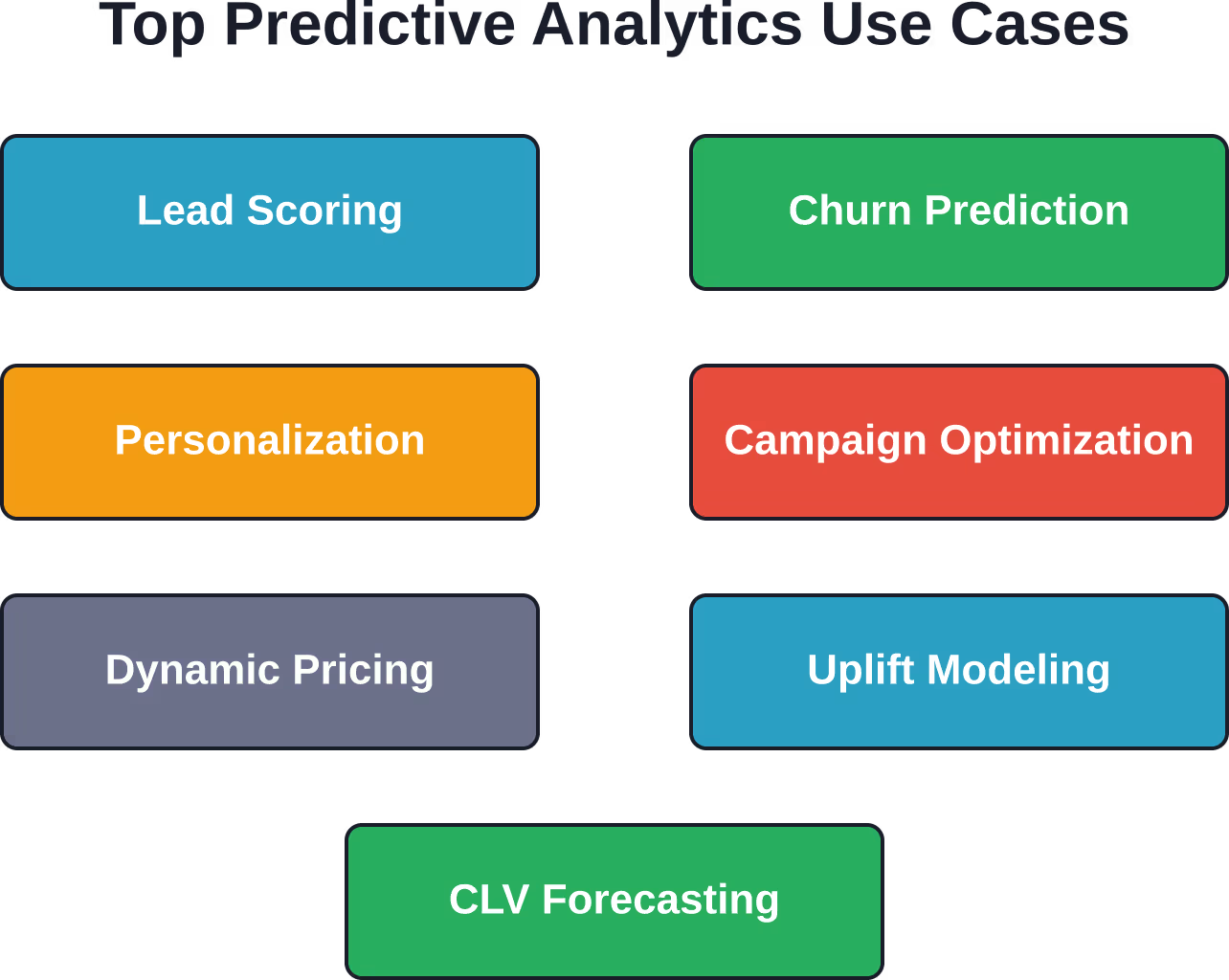
Benefits of Predictive Analytics for Marketing
Why are marketers adopting predictive analytics at such a rapid pace? The benefits go far beyond buzzword appeal.
Improved Personalization at Scale
Customers expect relevant experiences. Generic mass emails don’t cut it anymore. Predictive analytics enables hyper-personalization—tailoring product recommendations, content, offers, and timing to individual preferences and predicted behaviors. According to research, companies that grow faster drive 40% more revenue from personalization strategies. And this scales. Whether targeting 10,000 or 10 million customers, predictive models deliver individualized insights automatically.
Higher ROI and Lower Acquisition Costs
Targeting everyone is expensive and wasteful. Predictive models focus budgets on high-probability prospects and high-value customers. The UC Berkeley research on uplift modeling showed an 80% reduction in targeted customer count while maintaining—and even improving—conversion rates. That translated to a drop from $400,000 to $80,000 in targeting costs for the retailer studied. Better targeting means less wasted spend and higher return on every marketing dollar.
Proactive Decision-Making Instead of Reactive
Most marketing teams react to trends after they happen. Predictive analytics flips that dynamic. Marketers can forecast demand spikes, identify emerging customer segments, and anticipate competitive moves before they fully materialize. This proactive stance creates a competitive edge—acting while competitors are still analyzing last quarter’s reports.
Reduced Customer Churn
Acquiring a new customer costs five to seven times more than retaining an existing one. Predictive churn models spot at-risk customers early, giving marketers time to intervene with retention offers. Even a modest reduction in churn—say, from 15% to 12% annually—compounds significantly over time, boosting lifetime value and profitability.
Faster, Data-Driven Decisions
Manual analysis is slow. Predictive models process massive datasets in seconds, surfacing insights that would take analysts weeks to uncover. Speed matters. Markets shift, competitors launch campaigns, customer preferences evolve. Predictive analytics shortens the decision cycle, enabling marketers to act on opportunities before they pass.
Predictive Analytics Market Trends and Adoption
Predictive analytics isn’t emerging—it’s here. Adoption rates and market valuations confirm its shift from experimental to essential.
Rapid Growth in AI Adoption
Research indicates significant growth in AI adoption across financial commerce enterprises in recent years. That’s more than a doubling in six years, signaling mainstream acceptance across industries. Marketing is following a similar trajectory. According to Salesforce, 91% of top marketers are either fully committed to or already implementing predictive marketing.
Market Size and Projections
The global predictive analytics market reached $18.89 billion in 2024 and is expected to grow to $82.35 billion by 2030, according to market research data. That growth reflects surging demand across sectors—retail, finance, healthcare, SaaS—as organizations recognize the competitive advantage of data-driven forecasting.
Technology Infrastructure Maturation
Cloud platforms, accessible machine learning tools, and integrated marketing automation systems have made predictive analytics more feasible for mid-sized businesses, not just enterprises. Platforms now offer pre-built models for common use cases like churn prediction and lead scoring, lowering the technical barrier to entry. But here’s the catch: ease of access doesn’t guarantee success. Models require clean data, ongoing tuning, and strategic alignment. Technology alone won’t deliver ROI without thoughtful implementation.
Common Challenges of Predictive Analytics in Marketing
Predictive analytics delivers real benefits, but it’s not plug-and-play. Marketers face several recurring obstacles.
Data Quality and Integration Issues
Predictive models are only as good as the data feeding them. Incomplete customer records, siloed databases, and inconsistent formatting sabotage accuracy. Marketers often struggle to unify data from CRM systems, email platforms, web analytics, and offline channels. Without integration, models miss critical signals. Solution: invest in data cleaning, governance, and integration before launching predictive initiatives. Garbage in, garbage out applies doubly to machine learning.
Model Drift and Maintenance
Customer behavior changes. Market conditions shift. Economic cycles alter spending patterns. A predictive model trained on 2023 data may lose accuracy in 2026 if not retrained regularly. This phenomenon—called data drift or model drift—requires ongoing monitoring and updates. IEEE research on MLOps highlights the need for continuous model evaluation and retraining to avoid performance degradation over time.
Privacy and Ethical Concerns
Predictive analytics relies on personal data—purchase history, browsing behavior, demographic details. Regulations like GDPR and CCPA impose strict limits on data collection and use. The Federal Trade Commission has hosted seminars on alternative scoring products and the ethical implications of predictive consumer analytics, emphasizing transparency and fairness. Marketers must balance personalization with privacy, ensuring compliance and maintaining customer trust.
Skill Gaps and Organizational Buy-In
Building and deploying predictive models requires expertise in statistics, machine learning, and data engineering. Many marketing teams lack these skills in-house. Additionally, gaining organizational buy-in can be tough. Stakeholders accustomed to traditional reporting may distrust probabilistic forecasts or resist changing established workflows. Solution: start with small, high-impact pilots that demonstrate clear ROI. Success builds credibility and eases broader adoption.
| Challenge | Impact | Solution |
|---|---|---|
| Data Quality | Inaccurate predictions, wasted budget | Data cleaning, integration, governance |
| Model Drift | Declining accuracy over time | Regular retraining, monitoring |
| Privacy Concerns | Regulatory risk, customer distrust | Compliance, transparency, consent |
| Skill Gaps | Implementation delays, poor model performance | Training, hiring, vendor partnerships |
| Organizational Buy-In | Slow adoption, siloed efforts | Pilot projects, ROI demonstrations |
How to Implement Predictive Analytics in Marketing
Launching predictive analytics doesn’t require a complete digital overhaul. The most successful implementations follow a phased, strategic approach.
Step 1: Define Clear Business Objectives
Start with the problem, not the technology. What specific outcome are you trying to improve?
- Increase lead conversion rates?
- Reduce churn by 10%?
- Boost email click-through rates?
- Optimize ad spend allocation?
Clear objectives guide model selection, data requirements, and success metrics.
Step 2: Audit and Prepare Data
Assess available data sources: CRM, email platforms, web analytics, transaction databases, social media. Identify gaps, inconsistencies, and integration needs. Clean the data—removing duplicates, filling missing values, standardizing formats. This step is unglamorous but critical.
Step 3: Choose the Right Model for the Use Case
Different problems require different models:
- Logistic regression for binary outcomes (will convert / won’t convert)
- Decision trees for segmentation and rule-based insights
- Neural networks for complex, high-dimensional patterns
- Time-series models for forecasting trends
Many platforms offer pre-built models tailored to marketing use cases, reducing the need for custom development.
Step 4: Test, Validate, and Iterate
Launch predictive models in controlled tests—A/B tests, holdout groups, limited campaigns. Measure accuracy against actual outcomes. Expect iteration. Initial models rarely achieve peak performance. Refine based on real-world feedback, retrain with new data, and adjust thresholds.
Step 5: Scale and Monitor
Once validated, expand predictive models across broader campaigns and segments. Automate where possible—triggered emails, dynamic ad targeting, real-time recommendations. But scaling isn’t fire-and-forget. Continuous monitoring catches model drift, data anomalies, and shifting customer behavior before they degrade performance. 
Turn Predictive Marketing Into Real Campaign Results
High model accuracy doesn’t mean much if campaigns still rely on guesses. AI Superior works on the part most marketing tools miss – building AI systems where predictive models are applied to real data and integrated into existing processes. Their approach focuses on making predictions usable within day-to-day operations rather than leaving them at the reporting level.
Make Predictive Marketing Work Beyond Dashboards
AI Superior focuses on practical implementation:
- Build predictive models based on specific business needs
- Work with customer and behavioral data from multiple sources
- Validate models before scaling
- Monitor and update models as data changes
Talk to AI Superior and see how predictive analytics can be applied in your marketing operations.
Future Trends in Predictive Analytics for Marketing
Predictive analytics is evolving fast. Several emerging trends will shape the next few years.
Real-Time Predictive Decisioning
Batch processing is giving way to real-time predictions. Imagine a customer browsing a product page—within milliseconds, a model predicts purchase likelihood, suggests complementary items, and adjusts the offer displayed. Streaming data platforms and edge computing are making real-time decisioning feasible at scale, enabling hyper-responsive marketing.
Integration with Generative AI
Predictive analytics tells you what will happen. Generative AI can create the content to act on that prediction—personalized email copy, ad creatives, landing page variations—automatically tailored to each segment or individual. Combining predictive and generative AI creates a closed loop: predict, create, deliver, measure, refine.
Privacy-Preserving Techniques
As privacy regulations tighten, marketers are exploring federated learning, differential privacy, and synthetic data to train predictive models without exposing individual customer data. These techniques allow insight generation while maintaining compliance and trust—a critical balance for sustainable growth.
Democratization of Predictive Tools
No-code and low-code platforms are bringing predictive analytics to non-technical marketers. Drag-and-drop model builders, automated feature engineering, and pre-trained templates lower the barrier to entry. This democratization accelerates adoption but also raises the risk of poorly implemented models. Education and best practices remain essential.
Frequently Asked Questions
What is predictive analytics in marketing?
Predictive analytics in marketing uses AI, machine learning, and statistical modeling to analyze historical customer data and forecast future behaviors, such as purchase likelihood, churn risk, and campaign response rates. It helps marketers make proactive, data-driven decisions.
How accurate is predictive analytics for marketing forecasts?
Accuracy varies by use case, data quality, and model sophistication. AI-driven forecasting models can improve accuracy by 20–50% and reduce forecast errors by 20–50% compared to traditional statistical methods. Continuous model tuning and clean data are critical for maintaining high accuracy.
What are the most common use cases for predictive analytics in marketing?
The most common applications include lead scoring, customer churn prediction, personalized product recommendations, campaign optimization, dynamic pricing, uplift modeling, and customer lifetime value forecasting. Each addresses specific marketing challenges with measurable ROI.
Do I need a data science team to use predictive analytics?
Not necessarily. Many modern marketing platforms offer pre-built predictive models and no-code interfaces that marketers can use without deep technical skills. However, complex or custom models benefit from data science expertise, and ongoing model maintenance requires analytical capabilities.
What challenges should I expect when implementing predictive analytics?
Common challenges include poor data quality, siloed data sources, model drift over time, privacy and compliance concerns, skill gaps, and organizational resistance. Successful implementations prioritize data governance, continuous monitoring, and phased rollouts with clear ROI demonstration.
How does predictive analytics improve marketing ROI?
Predictive analytics improves ROI by targeting high-probability prospects, reducing wasted ad spend, personalizing offers to increase conversion rates, preventing costly churn, and optimizing budget allocation across channels. Research shows retailers have cut targeting costs by 80% while improving conversions through uplift modeling.
Is predictive analytics compliant with privacy regulations like GDPR?
Predictive analytics can be compliant, but it requires careful implementation. Marketers must ensure transparent data collection, obtain proper consent, allow opt-outs, and use anonymization or privacy-preserving techniques where applicable. The Federal Trade Commission and other regulators emphasize fairness and transparency in predictive consumer analytics.
Conclusion: Why Predictive Analytics Matters Now
Marketing without prediction is marketing with a blindfold. Customer expectations are higher, competition is fiercer, and budgets are tighter than ever. Predictive analytics removes the guesswork. It tells you who to target, when to engage, what to offer, and how much to spend—backed by data, not hunches. The technology is mature. Adoption is accelerating. The question isn’t whether predictive analytics works—it’s whether your competitors are using it while you’re still flying blind. Start small. Pick one high-impact use case—lead scoring, churn prediction, campaign optimization. Prove ROI. Then scale. The brands winning in 2026 are the ones that stopped reacting to the past and started predicting the future.