
Quick Summary: Predictive analytics in life sciences uses AI and machine learning to forecast patient outcomes, optimize clinical trials, and accelerate drug development. From reducing adverse drug reactions to predicting sepsis 12 hours before clinical symptoms appear, these tools transform massive datasets into actionable insights that save lives and reduce U.S. healthcare expenses of over $5 trillion annually. The life sciences industry stands at the intersection of massive datasets and life-or-death decisions. Predictive analytics has emerged as the critical tool bridging that gap, turning genomic sequences, electronic health records, and real-world evidence into forecasts that guide everything from clinical trial design to personalized treatment protocols. Here’s the thing though—predictive analytics isn’t just another tech buzzword in this space. It’s fundamentally changing how drugs reach patients. Consider this: pharmaceutical companies invest more than $300 billion in research and development annually, but just 12% of drugs entering clinical trials ultimately gain FDA approval. The failure rate is staggering. Predictive analytics attacks this problem directly by identifying which compounds will succeed, which patient populations will respond, and which adverse events might derail a program before millions vanish into failed trials.
What Predictive Analytics Actually Means in Life Sciences
Predictive analytics refers to the use of statistical algorithms, machine learning models, and big data techniques to identify the likelihood of future outcomes based on historical data. In life sciences, this translates to forecasting disease progression, treatment response, patient risk stratification, and clinical trial success rates. The approach differs from traditional descriptive analytics—which tells you what happened—and diagnostic analytics—which explains why it happened. Predictive analytics answers: what’s going to happen next? According to the National Institutes of Health, healthcare analytics uses quantitative and qualitative methods to systematically collect and analyze data from electronic health records, medical imaging, insurance claims, patient surveys, wearable devices, genomics, and pharmaceutical data. This supports evidence-based and outcome-driven decision-making in clinical practice.
Clinical Applications Saving Lives Right Now
Machine learning models have been successfully developed and deployed to predict sepsis in hospitalized patients before clinical signs appeared—advancing detection by 12 hours compared to traditional methods. Early sepsis detection is crucial because timely treatment can prevent organ failure and death. But wait. That’s just one application. Research published in medical journals shows AI predictive analytics influences patient outcomes across multiple domains: disease progression forecasting, treatment response prediction, and recovery trajectory modeling. The technology analyzes patterns in electronic health records, lab results, imaging data, and genomic profiles to generate individual patient risk scores.
Chronic Disease Management
In the United States, 60% of adults manage at least one chronic disease, while 40% manage two or more chronic conditions. These chronic diseases drive annual U.S. healthcare expenses of over $5 trillion annually. Predictive models help identify which patients will experience disease progression, enabling early intervention. Predictive models for chronic disease management can achieve improved accuracy through additional clinical variables. Small improvements in accuracy translate to thousands of prevented hospitalizations.
Predictive Biomarkers in Oncology
Predictive biomarkers identify patient populations who will optimally benefit from specific therapies. They reduce the size and cost of clinical development programs while increasing the probability of regulatory approval. Real talk: the difference is dramatic. For colorectal cancer, immune-related objective response rates vary from 0% in MMR-proficient malignancies to 40% in MMR-deficient cancers. Predictive biomarkers ensure the right patients receive the right treatments.
| Biomarker Type | Purpose | Clinical Impact |
|---|---|---|
| Predictive | Identify treatment responders | Optimize therapy selection |
| Prognostic | Forecast disease progression | Risk stratification |
| Diagnostic | Confirm disease presence | Enable early detection |
| Pharmacodynamic | Measure drug activity | Dose optimization |
Revolutionizing Clinical Trials
Clinical trials consume enormous resources and time. Predictive analytics optimizes every phase, from patient recruitment to endpoint selection. Data-driven decision-making in clinical trials enables researchers to identify optimal patient cohorts, predict enrollment rates, forecast adverse events, and model treatment outcomes before trials begin. This reduces the risk of expensive late-stage failures.
Patient Stratification and Enrollment
Machine learning algorithms analyze real-world data to identify patients who match trial eligibility criteria and predict their likelihood of enrollment, adherence, and completion. This accelerates recruitment timelines and reduces screen failure rates. Validation studies of biomarker-based diagnostic algorithms require substantial sample sizes and resources. Predictive enrollment models help sponsors accurately budget and timeline these efforts.
Adverse Event Prediction
Adverse drug reactions impose significant costs on U.S. healthcare systems. Predictive models trained on electronic health records, genomic data, and prior trial results can flag patients at elevated risk for specific adverse events before treatment begins. The FDA now provides guidance on using AI to support regulatory decisions about drug safety, effectiveness, and quality. Models must demonstrate credibility, validation, and transparent methodology. 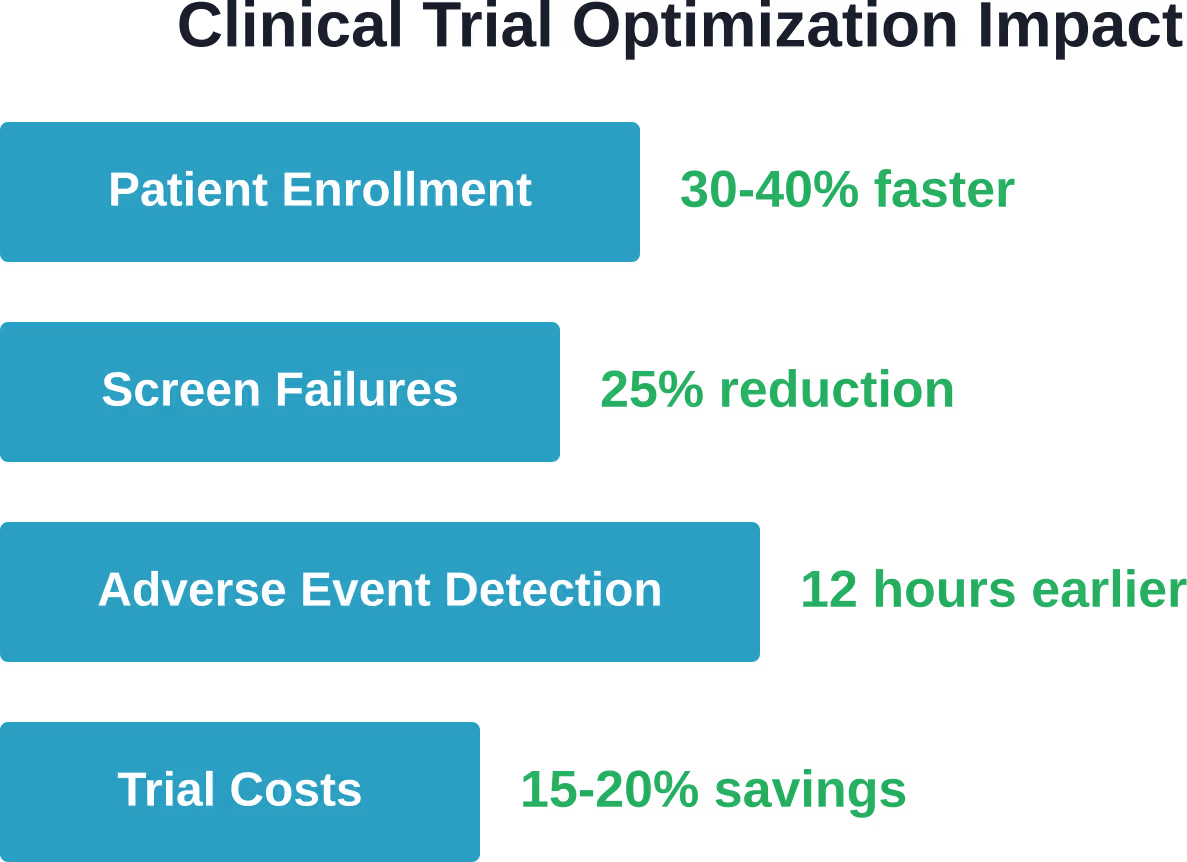
Drug Development and Precision Medicine
Predictive analytics accelerates the journey from molecule to market. Computational models forecast drug-target interactions, predict pharmacokinetic properties, and identify optimal lead compounds before expensive wet-lab validation. The FDA recognizes the increased use of AI throughout the drug development process and across therapeutic areas. Modeling and simulation are now powerful tools that complement traditional bench-top testing and animal studies for products regulated by the agency.
Genomics and Personalized Treatment
Researchers funded by the National Institutes of Health’s Big Data to Knowledge (BD2K) initiative developed computational genomics tools to systematically incorporate genomics knowledge into precision medicine. The tools help researchers identify which genetic variants predict treatment response for individual patients. Whole exome sequencing (WES) targets approximately 3% of the whole genome, which is the basis for protein-coding genes, and generates massive datasets requiring predictive analytics to extract clinically actionable insights. Artificial intelligence for personalized and predictive genomics enables researchers to move from raw sequences to treatment recommendations.
Real-World Evidence Integration
Predictive models increasingly incorporate real-world data from electronic health records, insurance claims, patient registries, and wearable devices. This complements controlled trial data with evidence from everyday clinical practice. The telemedicine market has experienced significant expansion, with projections for continued growth through 2030. This explosion in remote monitoring generates continuous patient data streams that feed predictive algorithms, enabling early intervention before conditions deteriorate.
Marketing and Commercial Applications
Life science companies operate in highly regulated environments where product success significantly affects patient outcomes. Predictive analytics optimizes marketing strategies, resource allocation, and revenue growth. Granular planning aligned with enterprise strategy can deliver incremental ROI of 8-10%. Robust Marketing Mix Modeling solutions enable effective budget allocation and performance monitoring across channels.
Demand Forecasting
Pharmaceutical companies use predictive models to forecast prescription volume, market share evolution, and competitive dynamics. These forecasts inform manufacturing capacity decisions, distribution strategies, and commercial team sizing. Algorithmic forecasting analyzes historical sales data, prescription trends, formulary changes, and competitive launches to generate forward-looking demand scenarios. This reduces inventory costs and prevents stockouts of critical therapies.
Patient Journey Optimization
Predictive analytics maps patient journeys from diagnosis through treatment selection, adherence, and outcomes. Identifying where patients drop off enables targeted interventions to improve adherence and persistence. For digital therapeutics initiatives, predictive models analyze real-world healthcare data to identify key cohorts with unmet medical needs and optimize lines of therapy at an individual level.
Challenges and Implementation Barriers
Now, this is where it gets interesting. Predictive analytics offers transformative potential, but implementation faces real obstacles.
Model Validation and Credibility
Machine learning algorithms carry a higher risk of overfitting and unstable performance compared to traditional statistical methods. Software implementations are imperative for validation purposes, and algorithms must be transferable to other systems for independent verification. There’s increasing awareness that research methodology and findings should be transparent. Studies using artificial intelligence to develop predictive algorithms must disclose data sources, feature engineering steps, validation approaches, and performance metrics across diverse populations.
Ethical Considerations and Patient Perspective
Patients can play a valuable role in supporting the safe and practicable embedding of predictive tools. Ethical implications include consent for data use, algorithm transparency, bias mitigation, and accountability when predictions prove incorrect. Patient perspective on predictive models highlights translation into practice as a critical gap. Models validated in research settings often fail when deployed in real clinical workflows due to data quality issues, integration challenges, or clinician mistrust.
| Challenge | Impact | Mitigation Strategy |
|---|---|---|
| Data Quality | Garbage in, garbage out | Standardized collection protocols |
| Model Overfitting | Poor generalization | External validation cohorts |
| Regulatory Uncertainty | Delayed deployment | Early FDA engagement |
| Algorithmic Bias | Health disparities | Diverse training datasets |
| Clinician Adoption | Tools sit unused | Workflow integration design |
Big Data Infrastructure Requirements
Predictive analytics in the era of big data requires robust infrastructure for data storage, processing, and analysis. Healthcare organizations must invest in cloud computing resources, data governance frameworks, and cybersecurity measures to protect patient information. The FDA’s draft guidance on alternatives to animal testing emphasizes new approach methodologies, including in silico modeling. Validating these computational approaches requires extensive datasets and computing power previously unavailable to most organizations. 
Use Reliable Predictive Analytics for Treatment Decisions
In life sciences, decisions are rarely based on complete certainty. Clinical trials, treatment responses, and development strategies all depend on patterns that are not immediately visible in large and fragmented datasets. AI Superior develops custom AI software that incorporates predictive analytics, working with clinical, research, and real-world data to identify relationships between variables and forecast possible outcomes. This makes it possible to approach trial design, patient selection, and treatment evaluation with a clearer view of how different factors interact over time.
Bring Predictive Models Into Clinical Workflows
AI Superior’s approach focuses on how predictive analytics fits into real environments:
- Integrating predictive models into existing clinical and research data systems
- Connecting historical datasets with continuously generated data sources
- Designing AI solutions that support analysis without replacing established workflows
If you’re assessing how predictive analytics could be applied in your clinical or research processes, (/contact/) and review how your data is currently being used.
Future Directions
The trajectory is clear: predictive analytics will become standard practice across life sciences. Several trends will accelerate adoption. Federated learning enables model training across distributed datasets without centralizing sensitive patient information. This addresses privacy concerns while leveraging larger, more diverse training populations. Continuous learning systems update predictions as new data arrives, rather than remaining static after initial deployment. This keeps models current as treatment landscapes evolve and new evidence emerges. Multi-modal integration combines genomic sequences, medical images, electronic health records, and patient-reported outcomes into unified predictive frameworks. These holistic models capture complexity that single-data-type approaches miss. The fundamental shift is this: life sciences decision-making is moving from intuition-driven to data-driven. Predictive analytics provides the engine for that transformation.
Frequently Asked Questions
What is predictive analytics in life sciences?
Predictive analytics in life sciences uses statistical algorithms, machine learning, and big data to forecast future outcomes based on historical data. Applications include predicting disease progression, treatment response, clinical trial success rates, adverse events, and patient risk stratification. The goal is evidence-based decision-making that improves patient outcomes and reduces costs.
How does predictive analytics improve clinical trials?
Predictive analytics optimizes clinical trials by accelerating patient enrollment through better cohort identification, reducing screen failures via eligibility prediction, forecasting adverse events before they occur, and modeling treatment outcomes to inform go/no-go decisions. This reduces trial duration, cost, and failure rates while improving safety monitoring.
What are predictive biomarkers and why do they matter?
Predictive biomarkers identify which patients will respond to specific therapies. They enable personalized treatment selection, reduce exposure to ineffective drugs with serious side effects, and improve clinical trial efficiency by enriching study populations with likely responders. For example, MMR status predicts immunotherapy response in colorectal cancer, with response rates ranging from 0% to 40% depending on biomarker status.
What challenges do organizations face implementing predictive analytics?
Major challenges include ensuring data quality across fragmented sources, validating models in diverse populations to prevent overfitting, navigating evolving regulatory requirements, mitigating algorithmic bias that could worsen health disparities, and integrating predictions into clinical workflows so they’re actually used. Infrastructure requirements for big data storage and processing also present barriers.
How accurate are predictive models in healthcare?
Accuracy varies widely depending on the application, data quality, and validation approach. Well-validated models for specific tasks—such as sepsis prediction 12 hours before symptom onset—demonstrate clinically meaningful performance. However, many published models suffer from methodological flaws, inadequate validation, or performance degradation when deployed outside their development environment. Independent validation and transparent reporting are essential.
What role does the FDA play in predictive analytics?
The FDA issued draft guidance on using AI to support regulatory decisions about drug safety, effectiveness, and quality. The agency evaluates computational models submitted as evidence in device and drug applications, requiring demonstration of credibility, validation, and appropriate uncertainty quantification. FDA’s modeling and simulation program conducts research to ensure credibility of computational tools in regulatory contexts.
Can predictive analytics reduce healthcare costs?
Yes, through multiple mechanisms: preventing expensive complications via early intervention, reducing adverse drug reaction costs through better prediction, optimizing clinical trial efficiency to lower development costs, improving treatment selection to avoid ineffective therapies, and enabling better resource allocation. However, implementation costs and infrastructure investments must be considered against these savings.
Conclusion
Predictive analytics has moved from experimental novelty to operational necessity in life sciences. The evidence is compelling: earlier disease detection, personalized treatment selection, optimized clinical trials, and reduced healthcare costs. The organizations that master predictive analytics will bring therapies to market faster, at lower cost, with better patient outcomes. Those that don’t will watch competitors pull ahead. So what’s the next step? Start small. Identify one high-impact use case—adverse event prediction, enrollment forecasting, biomarker validation—and build a proof of concept. Validate rigorously. Integrate carefully. Scale deliberately. The data is already there. The tools exist. The question is whether organizations will deploy them before the competition does.