
Quick Summary: Predictive analytics in retail and e-commerce uses machine learning and statistical models to forecast customer behavior, optimize inventory, personalize experiences, and improve pricing strategies. According to data presented at NRF 2026: Retail’s Big Show Asia Pacific, retailers implementing AI-powered solutions achieved margin increases of 15%, inventory reductions of 30%, and time-to-market reductions of 60% in Q1 2026. It transforms reactive decision-making into proactive strategy by turning historical data into actionable forecasts.
Retail has crossed a threshold. The old playbook—react to what happened last week, last month, last quarter—doesn’t cut it anymore.
Modern retailers don’t just track what customers bought. They anticipate what those customers will want next week, what price they’ll accept, and when they’re about to switch to a competitor.
That shift from reactive to proactive? That’s predictive analytics at work.
What Is Predictive Analytics in Retail & E-commerce?
Predictive analytics applies statistical models, machine learning algorithms, and data mining techniques to historical data—transaction records, browsing behavior, seasonality patterns, external market signals—to forecast future outcomes.
In retail and e-commerce, those outcomes include demand forecasts, customer churn probability, optimal price points, inventory requirements, and personalized product recommendations.
Here’s the thing though—predictive analytics isn’t fortune-telling. It’s pattern recognition at scale. The models identify correlations and trends buried in millions of data points that humans can’t spot manually.
Core Components of Retail Predictive Analytics
Every predictive analytics system rests on three pillars:
- Data collection: Transaction histories, clickstreams, CRM records, loyalty program data, inventory logs, external factors like weather and economic indicators.
- Statistical modeling: Regression analysis, time series forecasting, clustering algorithms, classification models, and neural networks trained on historical patterns.
- Actionable outputs: Dashboards, automated triggers, API feeds that push recommendations directly into pricing engines, merchandising systems, and marketing platforms.
The U.S. Census Bureau reported that e-commerce sales in the first quarter of 2026 accounted for 16.8% of total sales, increasing 9.7% from the first quarter of 2025. That growth intensifies competition—and makes predictive precision a survival skill.
Why Predictive Analytics Matters for Modern Retail
Retail margins are thin. Inventory missteps cost money. Customer acquisition is expensive, so retention matters.
Predictive analytics addresses all three pressure points.
According to data presented at NRF 2026: Retail’s Big Show Asia Pacific, retailers implementing AI-powered solutions achieved margin increases of 15%, inventory reductions of 30%, and time-to-market reductions of 60% in Q1 2026.
Those aren’t marginal improvements. They’re step-function gains that separate market leaders from laggards.
The Shift from Reactive to Anticipatory
Traditional retail analytics tells you what happened. Descriptive dashboards show last month’s sales, conversion rates, and basket sizes.
Predictive analytics tells you what’s coming. It flags customers likely to churn before they leave, forecasts demand spikes two weeks out, and identifies which products to discount and which to hold at full price.
That anticipatory posture protects customer lifetime value and ROI in ways reactive analytics never could.

Create Predictive Analytics Software With AI Superior
AI Superior builds predictive analytics tools that use current and historical data to support forecasting and better decision-making. Their work also covers machine learning, BI solutions, big data analytics, and custom software development.
For retail and e-commerce teams, this can support demand forecasting, customer behavior analysis, stock planning, product recommendations, and sales prediction.
Need Predictive Models for Business Data?
AI Superior can help with:
- building predictive analytics systems
- creating machine learning forecasting models
- analyzing customer and product data
- connecting AI tools with existing platforms
👉 Contact AI Superior to discuss your project.
Core Use Cases Transforming Retail & E-commerce
Predictive analytics isn’t a single application. It’s a toolkit.
Demand Forecasting & Inventory Optimization
Stockouts lose sales. Overstock ties up capital and leads to markdowns.
Predictive models ingest sales velocity, current stock levels, promotional calendars, seasonality indicators, and external factors—weather, holidays, economic trends—to forecast demand at SKU, store, and regional levels.
Forecasting horizons vary by use case. Short-term forecasts (0–30 days) leverage sales velocity and promo calendars, achieving accuracy ranges of 85–95% based on internal benchmarks from retail analytics firms. Medium-term forecasts (31–90 days) incorporate seasonal indicators and typically hit 75–88% accuracy.
| Forecasting Horizon | Primary Data Inputs | Typical Accuracy Range |
|---|---|---|
| 0–30 days | Sales velocity, current stock, promo calendar | 85–95% |
| 31–90 days | Seasonal indicators, market trends, historical patterns | 75–88% |
| 91+ days | Macro trends, new product launches, competitive intelligence | 60–75% |
Retailers using machine learning for demand forecasting report significant reductions in both stockouts and excess inventory, directly improving cash flow and margin.
Personalized Product Recommendations
Amazon generates up to 35% of sales through recommendation engines that analyze browsing history, purchase patterns, and collaborative filtering signals.
Machine-learning recommendation engines tailor product suggestions in real time. They don’t just show “customers also bought”—they predict what this specific customer wants next based on behavior patterns, session context, and lookalike modeling.
Personalization has become table stakes. Many customers now expect companies to treat them as unique individuals, reflecting a significant shift in personalization expectations.
Dynamic Pricing & Promotion Optimization
Static pricing leaves money on the table. Dynamic pricing models adjust in response to demand elasticity, competitor moves, inventory levels, and customer willingness-to-pay.
Predictive models identify the highest price a customer segment will accept without abandoning cart, and they flag when to hold pricing versus when to discount.
One example from the used truck market: a client using predictive analytics to process daily market signals from 18 aggregators increased average selling prices by 6% and reduced purchase expenses by 14%.
Promotion optimization models forecast the incremental lift from different discount levels, channels, and timing—so retailers stop over-discounting and start targeting offers precisely.
Customer Churn Prediction & Retention
Acquiring new customers costs five to seven times more than retaining existing ones.
Churn prediction models score customers by their likelihood to defect based on engagement drop-offs, declining purchase frequency, negative sentiment signals, and comparison to historical churn patterns.
Once a high-risk customer is flagged, automated workflows trigger retention offers—personalized discounts, loyalty point bonuses, or concierge outreach—before the customer leaves.
Retailers report churn reduction rates of 10–25% when predictive intervention replaces generic retention campaigns.
Fraud Detection & Risk Management
E-commerce fraud—chargebacks, account takeovers, payment fraud—costs retailers billions annually.
Predictive fraud models analyze transaction velocity, device fingerprints, geolocation anomalies, and behavioral patterns to flag suspicious orders in real time.
These models balance fraud prevention with customer experience. Aggressive fraud rules block legitimate customers; predictive scoring applies friction (additional verification) only to high-risk transactions.
Implementation Strategy: How to Deploy Predictive Analytics
Predictive analytics isn’t plug-and-play. Success requires deliberate planning.
Start With Clean, Integrated Data
Garbage in, garbage out. Predictive models need high-quality, integrated data feeds.
That means consolidating siloed data sources—CRM, ERP, web analytics, POS systems, loyalty programs—into a unified data warehouse or data lake.
Data quality checks matter: deduplication, missing-value imputation, outlier detection, and schema normalization all improve model accuracy.
Define Business Outcomes First, Models Second
Don’t start with the algorithm. Start with the business problem.
What outcome are you trying to move? Reduce churn by 15%? Cut inventory holding costs by 20%? Increase recommendation click-through rates by 10%?
Once the outcome is clear, choose the modeling approach—regression, classification, time series, clustering—that fits the problem.
Pilot, Measure, Scale
Launch pilots in controlled environments. Test demand forecasts for a single category or region. Run personalized recommendations on a segment of traffic.
Measure results against a control group using A/B tests or holdout validation. Document lift, confidence intervals, and edge cases where the model failed.
Only after pilots prove ROI should organizations scale to full deployment.
Build Feedback Loops & Continuous Retraining
Predictive models decay. Customer behavior shifts, market conditions change, and yesterday’s patterns stop predicting tomorrow’s outcomes.
Establish feedback loops that capture prediction accuracy, retrain models on fresh data, and deprecate stale models.
Leading retailers retrain demand forecasting models weekly or daily. Churn models often retrain monthly.
Challenges & How to Overcome Them
Predictive analytics delivers results—but not without obstacles.
Data Silos & Integration Complexity
Retail data lives everywhere: e-commerce platforms, brick-and-mortar POS systems, loyalty apps, third-party ad networks.
Integrating those sources requires ETL pipelines, API connectors, and data governance policies. Cloud data platforms and pre-built integration tools reduce the lift, but expect months of work for complex environments.
Talent & Expertise Gaps
Building and maintaining predictive models demands skills in statistics, machine learning, data engineering, and domain expertise in retail.
Many retailers lack in-house teams. Options include hiring data scientists, partnering with analytics consultancies, or leveraging managed platforms with pre-built retail models.
Model Interpretability & Trust
Black-box models—deep neural networks, ensemble methods—deliver high accuracy but offer little transparency.
Business stakeholders resist acting on predictions they don’t understand. Explainable AI techniques—SHAP values, LIME, feature importance scores—help bridge that trust gap by showing which factors drove each prediction.
Privacy, Compliance & Ethical Considerations
Predictive analytics relies on customer data. Regulations like GDPR, CCPA, and emerging global privacy laws impose strict requirements on data collection, storage, and use.
Retailers must implement consent management, data anonymization, and audit trails. Ethical considerations also matter—models that inadvertently discriminate by demographic factors can trigger legal and reputational risk.
The Future of Predictive Analytics in Retail
Predictive analytics is evolving fast. Several trends will shape the next wave.
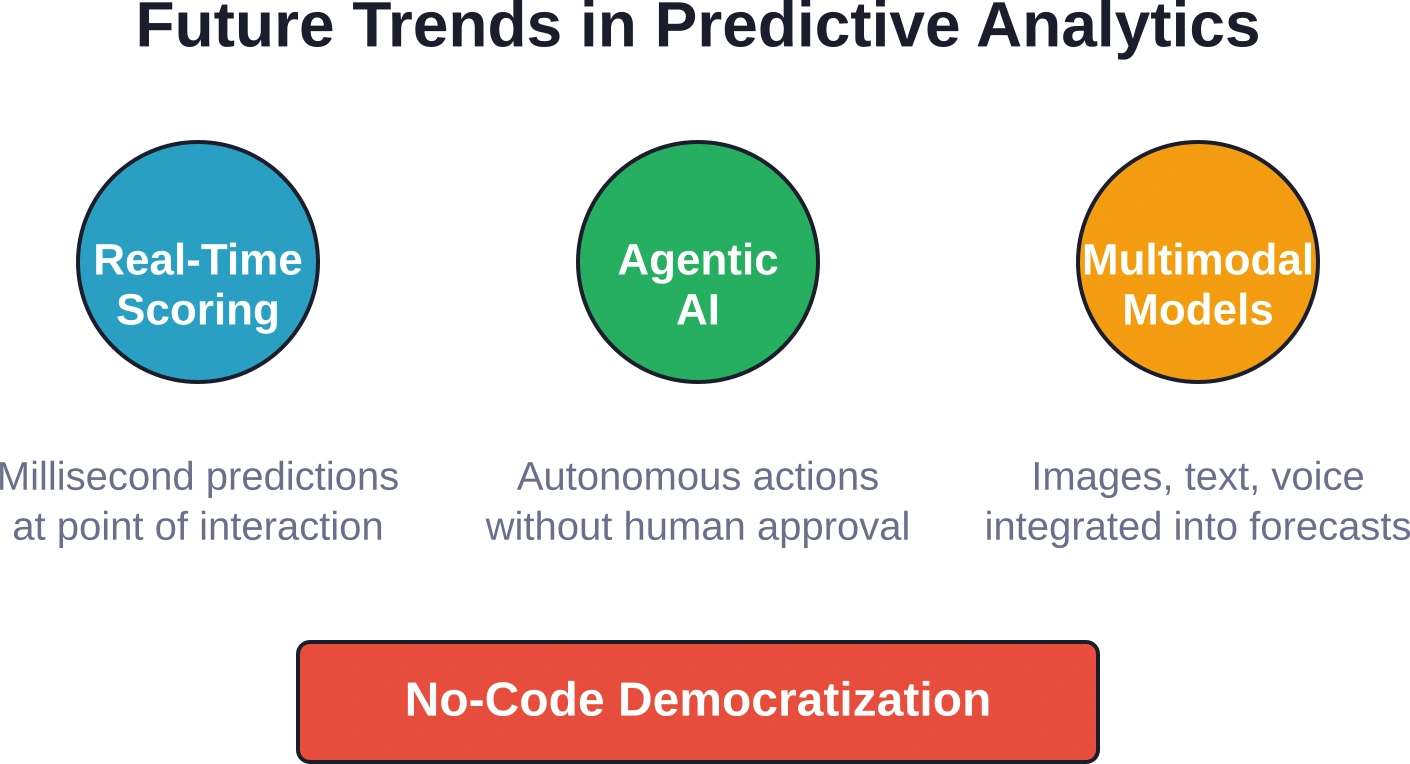
Real-Time Prediction at the Edge
Batch predictions—running models overnight, generating daily forecasts—give way to real-time scoring.
Edge computing and streaming data pipelines let retailers score transactions, sessions, and customer interactions in milliseconds, enabling instant personalization and fraud detection.
Agentic AI & Autonomous Decision-Making
Current systems generate predictions; humans decide actions. The next generation will close the loop.
Agentic AI systems take autonomous actions based on predictive signals—adjusting prices, reordering inventory, triggering retention campaigns—without human approval for routine decisions.
Stanford research on YouTube’s recommendation engine showed that incorporating user intent prediction boosted daily active users by 0.05%. That may sound small, but it represents one of the most significant improvements ever measured for the platform.
That same principle—deeper behavioral modeling—will drive the next leap in retail predictive analytics.
Multimodal Models & Richer Data Sources
Today’s models mostly ingest structured data: transactions, clicks, demographics.
Future models will incorporate unstructured data—product images, customer reviews, social media sentiment, voice interactions—using computer vision, natural language processing, and multimodal learning.
That richer context will improve prediction accuracy and unlock new use cases like visual search recommendations and sentiment-driven inventory planning.
Democratization Through No-Code Platforms
Historically, predictive analytics required data science teams and custom code.
No-code and low-code platforms now package pre-trained models, drag-and-drop workflows, and automated feature engineering—making predictive analytics accessible to business analysts and merchandisers.
That democratization accelerates adoption, especially among mid-market retailers without large data teams.
Key Metrics to Track for Predictive Analytics Success
Implementation without measurement is guesswork. Track these KPIs to validate impact.
| Metric | What It Measures | Target Benchmark |
|---|---|---|
| Forecast Accuracy (MAPE) | Mean Absolute Percentage Error between prediction and actual | <15% for short-term demand |
| Churn Reduction Rate | Percentage decrease in customer defection after intervention | 10–25% improvement |
| Recommendation CTR | Click-through rate on personalized product suggestions | 15–25% baseline, 30%+ with ML |
| Inventory Turnover | How quickly stock sells and replenishes | 10–20% improvement post-deployment |
| Gross Margin Impact | Change in margin due to optimized pricing and promotions | 5–15% lift documented in case studies |
Regular reporting against these benchmarks keeps stakeholders aligned and surfaces areas for model refinement.
Real-World Results: What Leading Retailers Achieve
Theory matters less than results. Here’s what’s happening in production environments.
Alfamart, a leading Indonesian convenience chain, enrolled 60% of customers in its Alfagift loyalty program, creating a rich data foundation for predictive models that drive personalized promotions and inventory planning.
A winery leveraged data analytics to optimize marketing and saw an 88% sales increase by targeting high-propensity customers with tailored messaging and pricing.
E-commerce sales in the U.S. totaled $302.3 billion in Q1 2026, representing a 9.7% increase from Q1 2025—evidence of the ongoing digital shift that makes predictive analytics essential for competitive positioning.
These aren’t edge cases. They’re the new normal for retailers that treat data as a strategic asset.
Frequently Asked Questions
What is predictive analytics in retail?
Predictive analytics in retail uses machine learning, statistical models, and historical data to forecast future customer behavior, demand patterns, optimal pricing, and inventory needs. It shifts decision-making from reactive to proactive by anticipating outcomes before they occur.
How accurate are retail demand forecasts using predictive analytics?
Accuracy varies by forecasting horizon and data quality. Short-term forecasts (0–30 days) typically achieve 85–95% accuracy, while medium-term forecasts (31–90 days) range from 75–88%. Longer horizons have lower accuracy but still outperform manual methods significantly.
What ROI can retailers expect from predictive analytics?
Documented outcomes include margin increases of 15%, inventory reductions of 30%, time-to-market improvements of 60%, and churn reductions of 10–25%. ROI depends on use case, implementation quality, and organizational readiness, but payback periods of 6–18 months are common.
Do small retailers benefit from predictive analytics or is it only for large enterprises?
Predictive analytics scales to businesses of all sizes. No-code platforms, managed services, and pre-built retail models reduce the barrier to entry. Even small e-commerce operations can deploy recommendation engines, churn scoring, and demand forecasts without large data science teams.
What data sources do predictive models need?
Core data includes transaction histories, customer profiles, web analytics (clickstreams, session data), inventory logs, and CRM records. Enhanced models incorporate external factors like weather, economic indicators, social media sentiment, and competitive pricing intelligence.
How often do predictive models need retraining?
Frequency depends on the use case and rate of change in the underlying patterns. Demand forecasting models often retrain weekly or daily. Churn models typically retrain monthly. Real-time fraud models may retrain hourly using streaming data pipelines.
What are the biggest implementation challenges?
Common obstacles include data silos and integration complexity, talent shortages in data science and machine learning, model interpretability and stakeholder trust issues, and compliance with privacy regulations like GDPR and CCPA. Success requires addressing all four dimensions systematically.
Conclusion: Predictive Analytics as a Competitive Requirement
Predictive analytics isn’t a nice-to-have anymore. It’s table stakes.
Retailers that forecast demand accurately avoid costly stockouts and overstock. Those that personalize experiences retain customers longer and drive higher lifetime value. Dynamic pricing captures margin that static pricing leaves on the table.
The data is clear: according to data presented at NRF 2026: Retail’s Big Show Asia Pacific, retailers implementing AI-powered solutions achieve margin increases of 15%, inventory reductions of 30%, and time-to-market reductions of 60%.
And as e-commerce continues its climb—now representing 16.8% of total U.S. retail sales with 9.7% year-over-year growth—the competitive pressure intensifies.
Organizations that embed predictive analytics into core operations don’t just react faster. They see around corners. They know what customers want before customers do.
That’s the difference between surviving and leading.
Start with a focused pilot—demand forecasting for a single category, churn prediction for high-value segments, or personalized recommendations on a traffic slice. Measure rigorously. Scale what works.
The future of retail belongs to those who predict it.