Quick Summary: Predictive analytics is a data analytics approach that uses historical data, statistical modeling, machine learning, and AI to forecast future outcomes and trends. In business, it helps organizations anticipate customer behavior, optimize operations, reduce risk, and make proactive decisions rather than reactive ones. The Bureau of Labor Statistics projects the field will grow by 34-36% through 2034, with more than 20,000 new jobs added. Businesses can’t see the future. But they can make educated guesses about what’s likely to happen next. That’s where predictive analytics comes in. Instead of just looking at what already happened or why it happened, organizations now use historical data combined with statistical techniques to forecast future trends, customer behavior, and business outcomes. And it’s not just for tech giants anymore. Companies of every size and industry are tapping into predictive analytics to gain competitive advantages, reduce risks, and make smarter strategic decisions.
What Is Predictive Analytics?
Predictive analytics is a branch of advanced analytics that uses historical data to predict future events and outcomes. It combines techniques like data mining, statistical modeling, machine learning, and artificial intelligence to identify patterns and forecast what’s likely to happen next. Here’s the thing though—predictive analytics doesn’t tell organizations exactly what will happen. It calculates probabilities and likelihoods based on past patterns. According to Harvard Business School Online, data analytics can be broken into four distinct types, each answering a different question:
- Descriptive analytics: What happened?
- Diagnostic analytics: Why did this happen?
- Predictive analytics: What might happen in the future?
- Prescriptive analytics: What should be done about it?
Predictive analytics sits right in the middle of this progression. It takes the “what” and “why” from descriptive and diagnostic analytics, then projects forward to answer “what’s next.”
How Predictive Analytics Works in Practice
The process starts with data collection. Organizations gather historical information from multiple sources—customer transactions, website interactions, supply chain records, market trends, and more. Next comes data processing. Raw data is cleaned, organized, and prepared for analysis. This step matters because algorithms only deliver actionable insights when fed high-quality, reliable data. Then statistical models and machine learning algorithms get to work. These techniques identify patterns, correlations, and trends within the historical data. The algorithms learn from past events to calculate probabilities about future outcomes. Finally, the system generates predictions. These forecasts help decision-makers understand what’s likely to happen under various scenarios—which customers might leave, which products will see increased demand, where operational bottlenecks might emerge. 
Apply Predictive Analytics with AI Superior
AI Superior works with companies that need predictive models tied to real data and workflows. They focus on defining the use case, building a working model, and integrating it into business processes where it can be used in practice.
Looking to Use Predictive Analytics in Your Business?
AI Superior can help with:
- evaluating your data and use case
- building predictive models
- integrating models into existing systems
- refining performance over time
👉 Contact AI Superior to discuss your project, data, and implementation approach.
Core Predictive Analytics Model Types
Different business questions require different analytical approaches. Syracuse University’s iSchool identifies four main model types used in predictive analytics:
Classification Models
Classification models sort data into predefined categories. A bank might use classification to predict whether a loan applicant will default or repay. An email provider might classify messages as spam or legitimate. These models answer yes/no questions or sort observations into distinct groups based on their characteristics.
Regression Models
Regression models predict numerical values. Sales forecasting is a common application—predicting next quarter’s revenue based on historical performance, marketing spend, and market conditions. These models work well when the outcome is a continuous number rather than a category.
Time-Series Models
Time-series models analyze data points collected over time to forecast future values. Retailers use these to predict seasonal demand fluctuations. Financial analysts apply them to stock price forecasting. The key is recognizing patterns that repeat at regular intervals.
Clustering Models
Clustering models group similar data points together without predefined categories. Marketing teams use clustering for customer segmentation—identifying groups of customers with similar behaviors or characteristics. This helps organizations tailor strategies to specific segments rather than treating all customers the same. 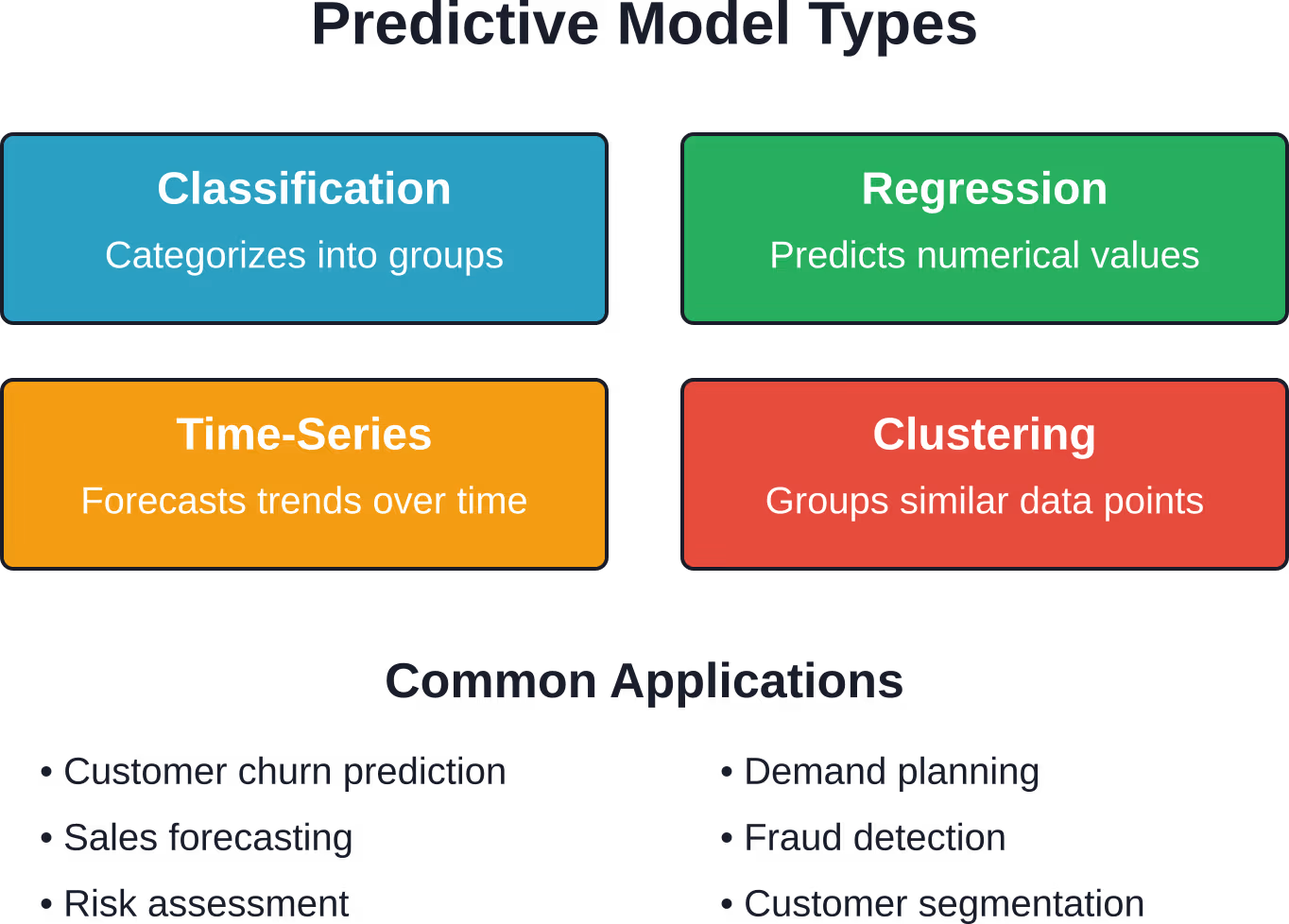
Real Business Applications of Predictive Analytics
Predictive analytics isn’t theoretical. Organizations across industries are using it to solve concrete business problems right now.
Customer Retention and Churn Prevention
Businesses can identify customers who are likely to cancel services or stop purchasing. By analyzing behavior patterns—declining engagement, reduced purchase frequency, customer service complaints—models flag at-risk accounts. This allows companies to intervene proactively with targeted retention offers rather than waiting until customers have already left.
Sales Forecasting and Demand Planning
Retailers use predictive models to anticipate product demand, optimize inventory levels, and prevent stockouts or overstock situations. Manufacturers forecast component needs to streamline supply chains. Accurate demand predictions reduce waste, lower carrying costs, and improve customer satisfaction by ensuring product availability.
Risk Management and Fraud Detection
Financial institutions apply predictive analytics to assess credit risk, detect fraudulent transactions, and prevent money laundering. Insurance companies evaluate claim risk and set premiums accordingly. According to Wake Forest University School of Business, insurance professionals rely on predictive analytics to maximize ROI, improve customer service, and work more efficiently.
Marketing Personalization
Marketing teams use predictive models to determine which offers will resonate with specific customer segments, optimize email send times, and identify cross-selling opportunities. Instead of generic campaigns, businesses deliver personalized messages based on predicted customer preferences and likelihood to convert.
Operational Efficiency
Predictive maintenance systems forecast equipment failures before they happen, reducing downtime in manufacturing and logistics. Airlines predict flight delays. Utilities anticipate power grid demands. These applications save costs while improving reliability and service quality.
| Industry | Predictive Analytics Application | Primary Benefit |
|---|---|---|
| Retail | Demand forecasting and inventory optimization | Reduced waste, improved stock availability |
| Finance | Credit risk assessment and fraud detection | Lower default rates, reduced fraud losses |
| Insurance | Claims prediction and premium pricing | Better underwriting, increased profitability |
| Healthcare | Patient readmission prediction | Improved outcomes, lower costs |
| Manufacturing | Predictive maintenance | Reduced downtime, extended equipment life |
| Marketing | Customer segmentation and churn prediction | Higher retention, better ROI |
The Growing Demand for Predictive Analytics Skills
The field is expanding rapidly. According to updated labor market statistics for 2026, employment for data scientists and analysts is projected to grow by 36% through 2033, significantly exceeding previous estimates of 10,000 total jobs. Organizations across sectors need professionals who can collect data, build models, interpret results, and translate predictions into actionable business strategies. And it’s not just data scientists. Business analysts, marketing professionals, operations managers, and finance teams increasingly need to understand predictive analytics concepts to remain competitive.
Key Technologies Powering Predictive Analytics
Several technologies have made predictive analytics more accessible and powerful in recent years.
Machine Learning and AI
Machine learning algorithms automatically improve their predictions as they process more data. Unlike traditional statistical models that require manual adjustment, machine learning systems adapt and refine themselves over time. Artificial intelligence takes this further by recognizing complex patterns that humans might miss.
Big Data Infrastructure
Cloud computing and distributed data systems allow organizations to process massive datasets quickly. This scalability means businesses can analyze years of historical data across millions of customers or transactions.
Advanced Statistical Software
Modern analytics platforms provide user-friendly interfaces for building predictive models. Tools have evolved from requiring deep programming knowledge to offering visual, drag-and-drop model building. This democratization means more business users can leverage predictive techniques without advanced technical training.
Challenges and Limitations
Predictive analytics isn’t foolproof. Several challenges can limit effectiveness.
Data Quality Issues
Models are only as good as the data fed into them. Incomplete, inaccurate, or biased historical data produces unreliable predictions. Organizations must invest in data governance, cleaning, and validation processes before expecting accurate forecasts.
Over-Reliance on Past Patterns
Predictive models assume future conditions will resemble historical patterns. When markets shift dramatically or unprecedented events occur, models trained on past data may fail. Human judgment remains essential for interpreting predictions in context.
Implementation Complexity
Building effective predictive analytics capabilities requires investment in technology, talent, and organizational change. Data silos, resistance to data-driven decision-making, and lack of technical expertise can derail initiatives.
Privacy and Ethical Concerns
Using customer data for predictions raises privacy questions. Regulations like GDPR, the EU AI Act (fully effective as of 2026), and various state-level US laws (like CCPA/CPRA) impose restrictions on how organizations collect, store, and use personal information. Bias in training data can also lead to discriminatory predictions, particularly in sensitive areas like credit scoring or hiring.
| Challenge | Impact | Mitigation Strategy |
|---|---|---|
| Poor data quality | Inaccurate predictions | Implement data governance and validation processes |
| Changing conditions | Models become outdated | Regularly retrain models with recent data |
| Lack of expertise | Failed implementations | Invest in training or hire specialized talent |
| Data privacy concerns | Regulatory penalties, trust loss | Follow compliance requirements, anonymize data |
Getting Started with Predictive Analytics
Organizations don’t need to transform everything overnight. A phased approach works better. Start by identifying high-value business questions where predictions would improve decisions. Focus on problems with clear metrics and available historical data. Assess current data infrastructure. Can systems capture, store, and process the necessary information? Address gaps in data collection and quality before building models. Begin with simpler models and use cases. Classification and regression models typically deliver quicker wins than complex deep learning systems. Build cross-functional teams. Predictive analytics succeeds when data scientists collaborate with business domain experts who understand context and can validate whether predictions make sense. Test, measure, and iterate. Monitor prediction accuracy, adjust models as needed, and expand to additional use cases once initial projects prove valuable.
Frequently Asked Questions
What’s the difference between predictive and prescriptive analytics?
Predictive analytics forecasts what is likely to happen based on historical data patterns. Prescriptive analytics goes further by recommending specific actions to take based on those predictions. Predictive answers “what will happen,” while prescriptive answers “what should we do about it.”
Do small businesses benefit from predictive analytics?
Absolutely. While large enterprises have more data and resources, small businesses can still apply predictive techniques to improve customer retention, optimize inventory, and target marketing efforts more effectively. Many affordable analytics platforms now cater to smaller organizations with limited technical staff.
How accurate are predictive analytics forecasts?
Accuracy varies based on data quality, model sophistication, and the specific business problem being addressed. Some predictions achieve 90%+ accuracy, while others may only be directionally useful. The key is understanding confidence levels and using predictions as one input for decision-making rather than treating them as certainties.
What data sources do predictive models use?
Models can incorporate internal data like sales records, customer interactions, and operational metrics, plus external sources such as market trends, weather data, economic indicators, and social media sentiment. The more relevant data available, the more accurate predictions typically become.
Can predictive analytics prevent all business risks?
No. Predictive analytics identifies probabilities and likelihoods, not certainties. Unexpected events, market disruptions, and unprecedented situations can still occur. Models reduce risk by improving foresight, but they cannot eliminate uncertainty entirely.
What skills are needed to work with predictive analytics?
Technical roles require knowledge of statistics, programming languages like Python or R, and machine learning algorithms. Business-focused roles need analytical thinking, domain expertise, and the ability to translate data insights into strategic recommendations. Many successful implementations involve collaboration between technical and business professionals.
How long does it take to implement predictive analytics?
Timelines vary widely based on organizational readiness, data infrastructure, and project scope. A focused pilot project might take 2-3 months, while enterprise-wide implementations can span a year or more. Starting with smaller, well-defined use cases typically accelerates time to value.
The Strategic Value of Predictive Analytics
Predictive analytics transforms how organizations make decisions. Instead of reacting to events after they happen, businesses can anticipate changes and respond proactively. The shift from reactive to predictive decision-making represents a competitive advantage. Organizations that effectively leverage historical data to forecast trends can optimize operations, reduce costs, improve customer experiences, and identify growth opportunities before competitors do. But success requires more than just technology. It demands cultural change—embracing data-driven decision-making, investing in data quality, and building teams that combine technical expertise with business acumen. As analytics technologies continue advancing and becoming more accessible, the question for most organizations isn’t whether to adopt predictive analytics, but how quickly they can build these capabilities to remain competitive in their markets. The businesses that master predictive analytics now will be the ones shaping their industries in the years ahead—making smarter decisions faster, serving customers better, and staying ahead of change rather than scrambling to catch up. Ready to turn historical data into future insights? Start by identifying one high-impact business question where predictions could improve outcomes, assess current data readiness, and build a pilot project that delivers measurable value. The predictive analytics journey begins with a single forecast.