
Agents treated as identities
An agent that can call your systems needs its own credentials, a defined owner and permissions that can be reviewed and revoked, in the same way as any other system account.
Enterprise AI agents · Governance and integration
In a large organisation, the agent itself is rarely what holds a project up. Identity, data access, audit requirements, the works council and integration with old systems do. We build enterprise AI agents with those constraints in the design from the start, from our base in Germany.

















An agent that can call your systems needs its own credentials, a defined owner and permissions that can be reviewed and revoked, in the same way as any other system account.
Logged runs, documented tool scopes and recorded approvals give your risk, legal and data protection teams something concrete to assess under GDPR and the EU AI Act.
Shared integrations, evaluation and monitoring mean the second and third use case do not repeat the groundwork, and teams do not each run their own unmanaged agents.
The work that a pilot can skip and a production rollout in a large organisation cannot.
A ranked list of agent use cases by value, feasibility and consequence of error, including the ones we would advise you to run as plain workflows.
Service identities for agents, least-privilege tool scopes and enforcement of the end user's own rights, so an agent cannot retrieve a document its user may not open.
Connections to the systems the work actually runs on, including those without a modern API, with write access added step by step after read-only operation has proved itself.
Which decisions an agent may take alone, which need sign-off and who gives it, written down and enforced in code.
Input for your data protection impact assessment and an early check of whether a use case falls into a high-risk category, together with your legal team.
Technical documentation for employee-facing agents, covering what is logged and what is not, so co-determination discussions in Germany start from facts.
Run traces, quality and cost per task, and regression tests against your own cases, connected to the monitoring your IT operations team already uses where possible.
Models and agents hosted in your private cloud or on-premises when policy or regulation rules out a public API.
Not sure which of these you need? Describe the problem and we will recommend the approach.
Discuss your project
In-house LLMno reliance on third-party LLM services
A private, hosted chatbot built on a custom large language model, giving a consulting firm answers with source references while keeping full control over its data.
Read the case study
Outperformed statistical baseline models
A neural network model, trained on five consecutive years of historical medical data, that estimates the risk of economic loss so a niche health insurer can optimise its pricing policies.
25x faster invoice processing
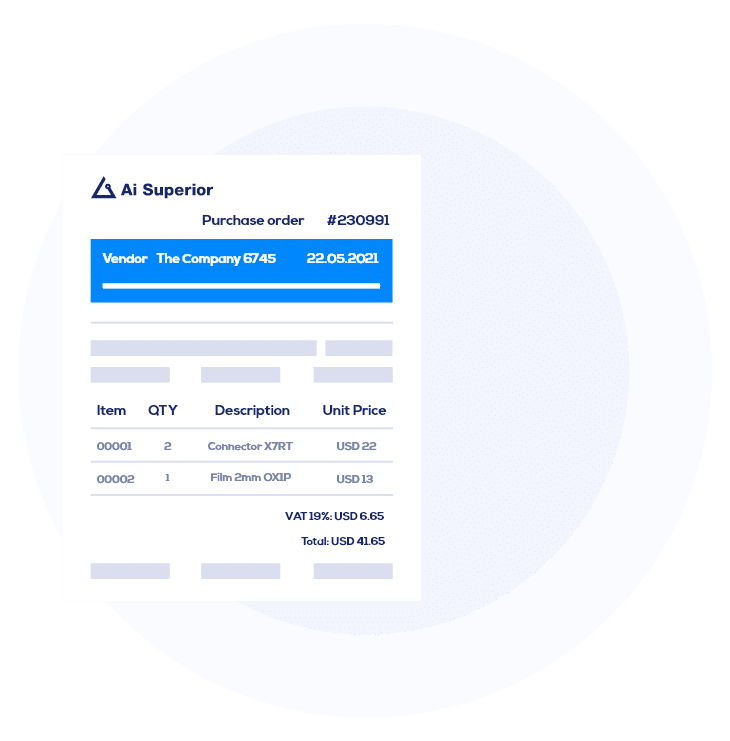
A web service that extracts data from different types of invoices, automating data entry for a multinational equipment distributor and saving 850 man-hours per month.
800+ features from 14 data sources
A machine learning model that predicts borrower default and fully automates underwriting, improving loan portfolio quality and cutting decision time from hours to a fraction of a minute.
Many vendors can build a demo. Making AI work reliably on real data, inside real business processes, is the hard part, and it needs a different kind of team.
AI Superior was founded in 2019 by AI researchers with published papers and patents, and the whole team works to that research standard.
Every project is de-risked in stages, with a go/no-go decision at each milestone, so budget only goes into approaches that have worked on your data.
Strategy, models and software are designed by one team, so nothing gets lost in hand-overs between vendors.
When data must not leave your organisation, we build on private, self-hosted models instead of third-party AI services.
Your project is led by senior data scientists and engineers with research backgrounds, supported by our product and development teams.
 Dr. Ivan Tankoyeu CEO
PhD in Computer Science. Recognised by the IEEE GRSS Society, winner of the Global AI Hackathon 2017, Kaggle TOP500 data scientist (2014).
 Dr. Sergey Sukhanov Advisor
PhD in Machine Learning, data scientist since 2013. Publications, patents and 30+ implemented AI use cases; several IEEE awards.
“I appreciate their approach, expertise, and the quality of information they provide.”
AI and machine learning consulting to identify the right use cases for a web design and graphics company.
“AI Superior showed a strong commitment to delivering high-quality solutions to us.”
Improves and maintains the data infrastructure of a credit solutions company: data pipelines, ML models and custom reports.
“Overall, our experience with AI Superior has been extremely positive, and we have been highly satisfied.”
Delivered a highly specialized AI chatbot with custom AI logic for a foundation supporting children and young adults.
Every stage ends with a result you can check, and you decide on the next one only after seeing the previous one work. You keep control of scope and budget.
We work through the business problem with your team and define the direction of the solution.
You get: Scope, approach and a high-level estimate of effort and expected results
We get to know your team and data and check whether AI is the right tool for this problem.
You get: A data assessment and a clear feasibility verdict before any build starts
We start small, using the data already available, to test the solution in practice.
You get: Measured results on your own data and a basis for the investment decision
We integrate the solution into your existing systems, fine-tune the models and adjust them where needed.
You get: A solution running inside your processes, compatible with your data and systems
We review the results with you and make sure they are read correctly.
You get: What the solution delivered and where to improve next
Recognised by international business awards and by independent B2B platforms that rank companies on verified client reviews.
 Top Artificial Intelligence Company Germany 2026 · Clutch
 Top Machine Learning Company Germany 2026 · Clutch
 Top Computer Vision Company Germany 2026 · Clutch
 Top Generative AI Company Germany 2026 · Clutch
 Go Global Awards Winner 2021 · International Trade Council
 Best Data Science & AI Service Provider, Europe 2021 · German Business Awards
 Top Artificial Intelligence Company 2023 · Clutch
 Top Machine Learning Company 2023 · Clutch
 Clutch Champion Fall 2023 · Clutch
 Clutch Global Fall 2023 · Clutch
 Top BI & Big Data Company Germany 2023 · Clutch
 Top IT Services Company Germany 2023 · Clutch
 Top Artificial Intelligence Companies 2023 · TrueFirms
 Top Machine Learning Companies 2021 · Techreviewer
 Most Reviewed IT Services Companies Germany · The Manifest
The model and the planning loop can be the same. The difference lies around them: agents run under managed identities, reach systems of record, leave an audit trail and have to pass security, legal and procurement reviews. That surrounding work is usually the larger part of the project.
It depends on the use case. Agents inside a suite you already run can be enough for tasks that stay within that suite. Custom development pays off when a task spans several systems, depends on your own data and logic, or has to run in your own environment. We assess this case by case and will say so when a bought product is the better choice.
Yes. Models, retrieval and the agent runtime can run in a private cloud or on-premises. Open models need more evaluation for each task, and the hardware has to be planned, so we test on your cases first and make the trade-off visible.
That depends on what the agent does, not on the fact that it is an agent. An agent that takes part in credit scoring or recruiting decisions can be high-risk, while one that prepares internal reports usually is not. We help assess this at the start of a project. The legal assessment itself stays with your counsel.
Prohibition rarely works. A shared set of approved tools, identities, logging and evaluation makes the managed route the easier one. Your teams then build on a common base, and IT can see which agents exist and what they may access.
In stages, starting read-only in shadow mode, where the agent proposes and people decide. Write access and wider groups of users follow once the measured results justify them. Each stage has criteria agreed in advance, including what would make us stop.
Share a few details and our AI team will take it from there. Here is what happens next: