
Quick Summary: AI will not replace architects, but it will fundamentally transform how they work. According to research cited in competitor materials, 84% of architects see AI as augmenting their work, not replacing it. The profession’s core value lies in creative problem-solving, client relationships, ethical judgment, and contextual understanding—elements AI cannot replicate. The question hits every architecture firm: will artificial intelligence make architects obsolete? It’s a rational fear. AI already drafts floor plans, generates photorealistic renderings in seconds, and analyzes building codes faster than any human. But the answer isn’t simple. According to research published by the American Institute of Architects in March 2025, architects are evenly split between enthusiasm and wariness about AI. The technology sits at a unique intersection—offering genuine opportunities while raising legitimate concerns about the profession’s future. Here’s what’s actually happening in 2026.
What AI Actually Does in Architecture Right Now
The gap between AI hype and reality remains substantial. According to AIA research, 6% of individual practitioners report using AI regularly, while 53% are experimenting with it. This activity concentrates heavily in larger firms with dedicated technology budgets and training resources. The most common applications aren’t revolutionary—they’re practical:
- Chatbots for client communication and research
- Image generators for concept visualization
- Grammar and text analytics for specifications
- Site planning and zoning compliance checks
- Material selection and lighting studies
That last category matters. Tasks previously assigned to junior associates now get automated. Site planning that consumed days happens in minutes through AI-powered compliance checking. But notice what’s missing from that list: holistic design thinking, client trust-building, and creative problem-solving within complex constraints. 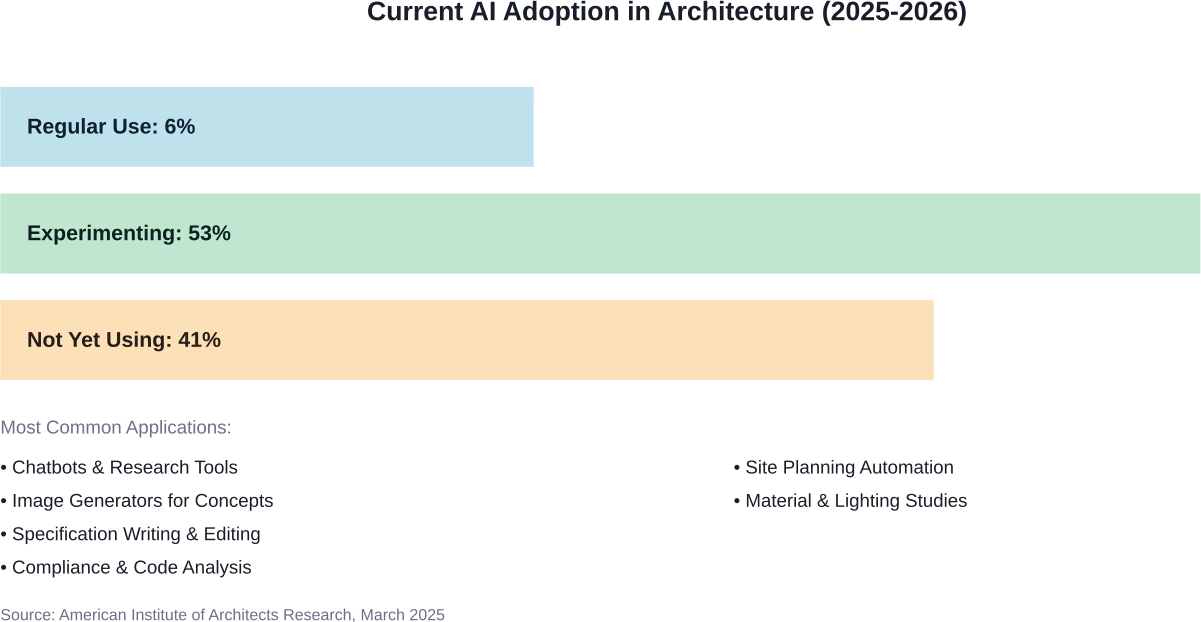 Real talk: AI handles repetitive, rules-based tasks exceptionally well. It struggles with ambiguity, context, and judgment.
Custom AI Solutions With AI Superior
AI Superior provides end-to-end support for companies looking to apply AI in a structured way. This includes evaluating whether AI fits the problem, building models based on available data, and integrating them into everyday processes.
Looking to Build or Integrate AI Systems?
AI Superior can help with:
- tailored AI solution development
- defining use cases and project scope
- integrating AI models into business systems
👉Contact AI Superior to discuss your project, data, and implementation approach
The Tasks AI Won’t Handle
Architecture isn’t just drafting. It’s navigating human complexity. Phil Bernstein, FAIA, addressed this directly at NCARB’s inaugural Futures Symposium. His answer to whether AI will replace architects? Not yet. And possibly not ever for the core aspects of the profession. Why? Because designing a building completely requires capabilities AI doesn’t possess:
- Understanding unstated client needs. Clients rarely articulate what they truly want. Architects interpret desires, fears, budgets, and cultural context through conversation and observation. AI processes explicit inputs—it doesn’t read between the lines.
- Navigating stakeholder conflict. Projects involve competing interests: owners want low costs, users want comfort, municipalities want compliance, communities want context. Architects mediate these tensions through relationships and diplomacy.
- Applying ethical judgment. The AIA’s position statement emphasizes architects’ responsibility for public health, safety, and welfare. When code requirements conflict with accessibility needs, or when budget pressures threaten safety, architects make judgment calls AI cannot.
- Responding to site context. Every location carries history, culture, climate, and community character. AI generates designs from pattern databases. Architects synthesize place-specific meaning.
The Bureau of Labor Statistics analyzed AI’s impact across occupations. Their findings? AI primarily affects tasks that generative AI can easily replicate. But many professional roles involve tasks resistant to automation—particularly those requiring complex human interaction and contextual judgment. Architecture sits squarely in that category.
How Firms Are Actually Transforming
Smart firms aren’t asking whether to adopt AI. They’re asking how to integrate it strategically.
| Application Area | Traditional Timeline | AI-Assisted Timeline | Impact |
|---|---|---|---|
| Site Planning & Compliance | Days to weeks | Minutes to hours | Faster iterations, earlier design refinement |
| Specification Writing | Hours per section | Minutes with AI baseline | 20% cost reduction through accuracy |
| Material & Lighting Studies | Junior associate tasks | Automated exploration | More options evaluated, faster decisions |
| Rendering & Visualization | Hours to days | Seconds to minutes | Real-time client feedback loops |
These aren’t hypothetical gains. Firms report tangible efficiency improvements. But here’s what changed in the workflow: architects shifted from executing repetitive tasks to making higher-level decisions. Instead of manually drafting compliance variations, architects evaluate AI-generated options against design intent. The work became more cognitive, less mechanical. According to Deltek research published in collaboration with AIA, AI can establish a “brilliant baseline” for specifications—automating the table of contents and generating standard sections. Architects then customize, refine, and verify against project-specific requirements. That’s augmentation, not replacement.
The Age Factor Nobody Talks About
AI adoption isn’t uniform across the profession. AIA research found that experimentation and usage are driven significantly more by architects aged 50 or younger. Architects aged 35-50 use chatbots at notably higher rates. Younger cohorts embrace image generators more readily. This creates an interesting dynamic. Senior architects bring irreplaceable experience in client relationships, project delivery, and design judgment. Younger architects drive technological integration and workflow innovation. Firms that leverage both—pairing technological fluency with professional wisdom—gain competitive advantages. Those that resist adaptation? They’ll struggle. Not because AI will replace architects, but because other architects using AI will outcompete them on speed, cost, and iteration capacity.
What the Employment Data Actually Shows
The Bureau of Labor Statistics tracks employment projections through 2034 for architecture and engineering occupations. Their analysis incorporates AI impacts. The conclusion? Overall employment in architecture and engineering is projected to grow faster than average for all occupations, with about 186,500 openings expected from 2024 to 2034. That doesn’t sound like an industry facing AI-driven decimation. The BLS notes that while AI may affect specific tasks within occupations, wholesale replacement remains limited. Software developers are still needed to develop AI-based business solutions. Database administrators and architects are expected to set up and maintain more complex data infrastructure. Research from MIT Sloan, tracking AI adoption from 2010 to 2023, found that AI’s impact targets specific tasks within jobs rather than whole occupations. Firms using AI extensively tend to be larger, more productive, and pay higher wages. They also grow faster—firms that use AI extensively are linked to about 6% higher employment growth and 9.5% more sales growth over five years. Translation: AI adoption correlates with firm growth, not workforce reduction.
The Skills That Matter Now
If AI handles technical execution, what should architects focus on? The answer reshapes architectural education and practice development.
- Relationship intelligence. The architects who thrive aren’t just technically proficient—they’re trusted advisors. They listen to client fears, navigate uncertainty, and guide complex decisions. That’s fundamentally human work.
- Systems thinking. AI optimizes defined parameters. Architects must understand how buildings function as integrated systems within larger urban, environmental, and social contexts. That holistic perspective remains distinctly human.
- Creative problem-solving. When standard solutions don’t fit, architects invent new approaches. AI generates variations on learned patterns. Genuine innovation requires breaking patterns, not optimizing within them.
- Ethical reasoning. Every project involves tradeoffs between competing values. AI lacks values. Architects must balance competing interests while maintaining professional responsibility.
- Technology fluency. Here’s the twist: architects need to understand AI well enough to direct it effectively. That means knowing what to ask for, how to evaluate outputs, and when to override algorithmic suggestions.
According to Brookings Institution research, more than 30% of workers could have their tasks significantly disrupted by generative AI. But worker retraining programs historically show mixed effectiveness—just under half of training program participants across the U.S. participate in classroom training, and this ranges from 14% to 96% across states. The implication? Architects can’t wait for formal retraining. Self-directed learning and experimentation matter more.
What’s Coming in the Next Five Years
AI capabilities accelerate rapidly. Architecture’s transformation will too. The AIA AI Task Force develops resources and guidance to help architects adopt AI responsibly and ethically. Their work addresses both opportunities and challenges—from intellectual property concerns to liability questions when AI generates design elements. Expect these developments:
- Tighter feedback loops. Real-time rendering and structural analysis will enable instant design iteration during client meetings. The conversation shifts from “here’s what we prepared” to “let’s explore options together.”
- Expanded early-stage exploration. AI will test hundreds of massing configurations, site layouts, and material combinations in the time architects previously evaluated three options. This expands the solution space before committing to detailed design.
- Automated documentation. Construction documents, specifications, and compliance reports will largely auto-generate from design models, with architects reviewing and refining rather than creating from scratch.
- Integrated performance prediction. Energy modeling, daylighting analysis, structural performance, and cost estimation will happen automatically as design evolves, not as separate consultant deliverables.
- Personalized design tools. AI trained on a firm’s previous projects will suggest solutions consistent with that firm’s design philosophy and technical approach.
But notice what doesn’t appear on that list: AI independently designing buildings, managing client relationships, or making value judgments about design quality.
The Uncomfortable Middle Ground
Here’s what keeps firm principals up at night: AI won’t replace architects, but architects using AI will replace architects who don’t. That’s already happening. Research suggests that AI-assisted specification writing can contribute to cost reductions and improved accuracy. Firms that use AI for early-stage exploration present clients with more thoroughly vetted options. Firms that integrate AI into workflow free senior architects from technical tasks to focus on strategic design thinking. The competitive advantage isn’t AI itself—it’s the organizational capability to integrate AI effectively while maintaining the human elements that define architectural excellence. According to World Economic Forum research, AI is expected to displace 92 million jobs but create 170 million new roles. The net effect? Growth, but with significant transition pain for those unable to adapt. Architecture follows a similar pattern. The profession will likely grow. But individual architects who view technology as someone else’s problem face career challenges.
The Professional Identity Question
This transformation forces a deeper question: what actually defines an architect? If AI handles drafting, rendering, and compliance checking—tasks that consumed much of an architect’s time—what remains? The answer reveals architecture’s true value proposition: Architects translate human needs into built form. They balance competing interests. They apply judgment where rules provide insufficient guidance. They create spaces that support human flourishing while respecting environmental and cultural context. Those capabilities matter more than ever as projects grow more complex, stakeholder groups multiply, and environmental pressures intensify. AI makes architects more effective at their core mission. It doesn’t eliminate that mission.
Frequently Asked Questions
Will AI completely replace architects in the future?
No. According to research cited in competitor materials, 84% of architects see AI as augmenting their work, not replacing it. AI handles repetitive, rules-based tasks but cannot replicate the client relationships, ethical judgment, contextual understanding, and creative problem-solving that define architectural practice. The Bureau of Labor Statistics projects architecture and engineering employment will grow faster than average through 2034, even accounting for AI impacts.
What percentage of architects currently use AI?
As of March 2025, AIA research shows that 6% of individual practitioners report using AI regularly, while 53% are experimenting with it. Adoption is significantly higher in large firms with dedicated technology resources. Usage is driven more by architects aged 50 or younger, with those aged 35-50 showing particularly high chatbot adoption rates.
Which architecture tasks will AI automate first?
AI currently automates code compliance checking, specification writing, rendering generation, and site planning analysis most effectively. These tasks involve clear rules and defined parameters. Tasks requiring judgment, client interaction, contextual interpretation, and ethical reasoning remain firmly in human control and show little evidence of near-term automation potential.
Do architects need to learn AI programming to stay competitive?
Architects don’t need programming skills, but they do need technology fluency—understanding what AI can do, how to evaluate its outputs, and when to override its suggestions. The competitive advantage comes from integrating AI into workflow effectively while maintaining the human elements that define design excellence. Self-directed experimentation matters more than formal programming education.
How will AI change architecture salaries and job opportunities?
MIT Sloan research tracking AI adoption from 2010 to 2023 found that firms using AI extensively pay higher wages and experience faster employment growth—about 6% higher employment growth and 9.5% more sales growth over five years. AI adoption correlates with firm growth, not workforce reduction. However, individual architects who resist technology adoption may face competitive disadvantages.
What should architecture students focus on to prepare for an AI-augmented profession?
Students should develop strong relationship intelligence, systems thinking, creative problem-solving, and ethical reasoning—capabilities AI cannot replicate. Technical skills remain important but shift toward evaluating and directing AI tools rather than manual execution. Understanding both design fundamentals and technology integration creates the most valuable skill combination.
Are smaller architecture firms at a disadvantage with AI adoption?
Currently, yes—AIA research shows AI usage concentrates in larger firms with technology budgets and training resources. However, as AI tools become more accessible and user-friendly, this gap may narrow. Smaller firms that embrace early experimentation and self-directed learning can capture efficiency gains without massive technology investments. The barrier is often mindset more than budget.
The Bottom Line
Will AI replace architects? No. Will AI transform architecture? Absolutely, and that transformation is already underway. The architects who thrive won’t be those with the best AI tools. They’ll be those who combine technological fluency with the irreplaceable human capabilities that define the profession—creative vision, relationship intelligence, ethical judgment, and contextual sensitivity. AI handles the mechanical. Architects provide the meaning. The AIA AI Task Force offers resources and guidance for responsible AI adoption. Their position statement emphasizes that architects must lead this transformation rather than react to it. That means experimenting now, learning continuously, and integrating AI strategically while preserving the profession’s core values. The future of architecture isn’t human or AI. It’s human and AI, working together. Start experimenting with AI tools in low-risk contexts. Join professional discussions about ethical AI use. Most importantly, double down on the distinctly human skills that make architects irreplaceable. Because the question isn’t whether AI will change your practice. It’s whether you’ll lead that change or let it happen to you.