Quick Summary: AI will not replace paralegals entirely, but it will fundamentally transform how they work. According to the 2024 Legal Trends Report, while 69% of hourly billable paralegal work could be automated by AI, the technology lacks critical human skills like client communication, ethical judgment, and strategic thinking. Paralegals who embrace AI tools and upskill will become more valuable, shifting from routine document processing to higher-level strategic support roles. The legal profession is watching artificial intelligence reshape traditional workflows at an unprecedented pace. For paralegals and legal assistants, this technological shift raises an urgent question: will automation eliminate these essential support roles? Here’s what’s actually happening. AI tools are already handling document review, legal research, and contract analysis—tasks that once consumed hours of paralegal time. According to Harvard Law School research, in high-volume litigation matters, AI-powered complaint response systems reduced associate time from 16 hours down to 3-4 minutes for certain tasks. But the complete picture tells a different story than simple job replacement. The U.S. Bureau of Labor Statistics projects total employment to grow from 170.0 million in 2024 to 175.2 million in 2034. While AI will impact occupations whose core tasks can be replicated by generative AI, the effects on paralegals specifically are more complex than many headlines suggest.
What Paralegals Actually Do (And What AI Can’t)
Understanding the paralegal role helps clarify which functions AI can automate and which remain firmly human. Paralegals handle diverse responsibilities across law firms and corporate legal departments. They conduct legal research, draft documents, manage case files, coordinate with clients, prepare trial materials, and maintain compliance records. About 70% of law firms today are small or medium-sized operations, according to recent industry data, that rely heavily on paralegal efficiency. The work breaks down into two categories: routine administrative tasks and complex judgment-based work.
Tasks AI Handles Well
Artificial intelligence excels at repetitive, high-volume activities. Document review systems can scan thousands of pages for relevant information. AI research tools pull case law and statutes faster than manual searches. Contract analysis software identifies standard clauses and flags inconsistencies. According to the 2024 Legal Trends Report, 69% of hourly billable work performed by paralegals could technically be automated by AI. That’s a significant percentage that initially sounds alarming. But automation potential doesn’t equal job elimination.
What Requires Human Judgment
Real talk: AI can’t replicate the human elements that make paralegals indispensable. Client communication requires empathy, discretion, and the ability to read emotional cues. Ethical decision-making involves nuanced judgment that AI systems don’t possess. Strategic case planning demands understanding context, predicting opposing counsel’s moves, and adapting to unexpected developments. Paralegals also serve as the bridge between attorneys and clients, translating complex legal concepts into understandable language. They manage relationships, coordinate multiple parties, and handle sensitive situations that require human touch. These skills can’t be programmed into an algorithm. 
AI Implementation Support With AI Superior
AI Superior focuses on turning AI ideas into working systems. Instead of jumping straight into development, the process begins with use case assessment and data analysis, followed by building models and connecting them to real workflows.
Need Support Moving From Idea to Implementation?
AI Superior can help with:
- development of AI-powered applications
- defining architecture and technical direction
- embedding AI into existing tools and operations
👉 Contact AI Superior to discuss your project, data, and implementation approach
How AI Is Currently Transforming Legal Work
Let’s separate fact from fiction about what’s happening right now in law firms. Artificial intelligence isn’t arriving in some distant future—it’s already embedded in legal practice management software, research platforms, and document automation tools. The transformation is underway, but it looks different than mass unemployment.
AI Tools Paralegals Use Today
Modern legal departments deploy AI across multiple functions. Document automation systems generate first drafts of standard agreements using templates and client data. E-discovery platforms use machine learning to identify relevant documents in litigation, sorting through massive datasets that would take humans weeks to review manually. Legal research platforms now incorporate AI to suggest relevant cases and predict judicial outcomes based on historical patterns. Contract review software flags risky clauses and ensures consistency across agreements. These tools don’t work autonomously. They require paralegal oversight, interpretation, and quality control.
Real-World Productivity Gains
The efficiency improvements are substantial. According to Harvard Law School research, in high-volume litigation matters, AI-powered complaint response systems reduced associate time from 16 hours down to 3-4 minutes for certain tasks. But here’s what that actually means for paralegals. Instead of spending hours manually reviewing documents, paralegals now spend time verifying AI output, handling exceptions the system can’t process, and focusing on substantive analysis. The role shifts from data processor to quality controller and strategic thinker. Law firms using AI effectively report that paralegals become more productive, not redundant. They handle higher caseloads with the same staff or reallocate paralegal time to client-facing work that generates more value.
Employment Projections and What They Really Mean
Government data provides context that sensational headlines often miss. The Bureau of Labor Statistics incorporates AI impacts into employment projections. According to BLS data, over the 2023–33 employment projections period, AI is expected to primarily affect occupations whose core tasks can be most easily replicated by generative AI in its current form. However, the BLS also notes that AI may support demand for certain occupations. Software developers are needed to develop AI-based business solutions and maintain AI systems. Database administrators are expected to be needed to set up and maintain more complex data infrastructure. The pattern repeats across industries: AI eliminates some tasks but creates demand for workers who can implement, manage, and work alongside these systems.
The Brookings Institution Analysis
Research from the Brookings Institution found that more than 30% of all workers could see at least 50% of their occupation’s tasks disrupted by generative AI. The analysis examined both AI exposure and workers’ adaptive capacity—their ability to transition to new roles if displacement occurs. Among workers in the top quartile of occupational AI exposure, 26.5 million also have above-median adaptive capacity, meaning they’re among those best positioned to make a job transition if displacement occurs. However, the analysis also documented that some 6.1 million workers (4.2% of the workforce) face potential vulnerability. For paralegals specifically, the adaptive capacity is relatively high. The skills developed in legal work—attention to detail, analytical thinking, written communication, and process management—transfer to many other professional roles. That said, adaptation requires intentional upskilling. 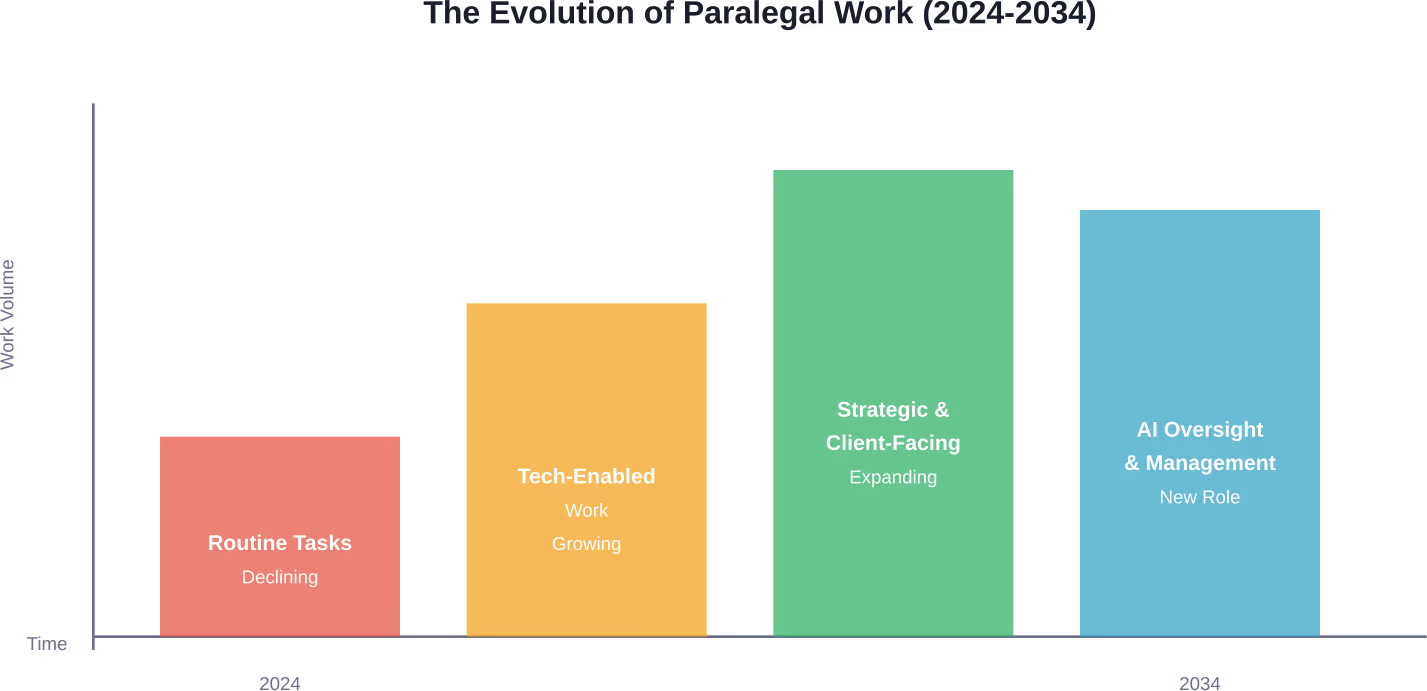
Why Experts Say Paralegals Won’t Become Obsolete
Legal professionals and industry researchers consistently reach the same conclusion: AI augments paralegal work rather than replacing it. Guidance on leveraging AI-powered legal technology emphasizes that AI presents opportunities and challenges for paralegals. The transformation requires adaptation, not career abandonment.
The Augmentation Model
AI functions best as a tool that enhances human capability, not as a replacement for human workers. This pattern appears across industries implementing automation. When law firms deploy AI document review systems, they still need paralegals to frame the search parameters, validate results, and handle documents that don’t fit standard patterns. When AI generates contract drafts, paralegals review them for accuracy, customize them to specific client needs, and ensure they comply with current regulations. The technology handles the heavy lifting. Humans provide the judgment, creativity, and client relationship management that AI lacks.
What Stanford Research Shows
Research from Stanford University examining AI’s impact at work found a nuanced dynamic. According to organizational behavior experts, AI adoption is about more than improving productivity—it’s about job enrichment. Workers who successfully integrate AI into their workflows often report higher job satisfaction. They spend less time on tedious tasks and more time on engaging, intellectually challenging work that requires human expertise. For paralegals, this means shifting from document processing drudgery to strategic support that directly impacts case outcomes.
Essential Skills for Paralegals in the AI Era
The paralegals who thrive won’t be those who resist AI—they’ll be those who master it. Upskilling becomes critical. But what specific capabilities matter most?
Technical Competencies
Understanding how AI tools work helps paralegals use them effectively. This doesn’t require programming expertise, but it does mean learning how to configure AI research platforms, train document review systems, and interpret AI-generated insights. Data literacy grows increasingly important. Paralegals need to understand what data AI systems require, how to prepare datasets, and how to spot when AI output seems questionable. Legal technology management emerges as a specialized skill. Someone needs to evaluate new AI tools, implement them across teams, and train other staff. Paralegals with technology aptitude can carve out valuable niches as the bridge between legal expertise and technical systems.
Distinctly Human Skills
The skills AI can’t replicate become more valuable, not less. Complex communication stands out. Explaining legal concepts to anxious clients, negotiating with opposing counsel, and coordinating between multiple stakeholders require emotional intelligence and adaptability that AI systems don’t possess. Ethical reasoning and professional judgment grow more critical as AI handles routine decisions. Paralegals serve as the ethical guardrails, ensuring AI recommendations align with professional standards and client interests. Strategic thinking separates commodity legal services from high-value counsel. Understanding the bigger picture, anticipating problems before they arise, and crafting creative solutions to novel situations—these capabilities remain firmly human.
| Skill Category | Specific Competencies | Why It Matters |
|---|---|---|
| AI & Technology | AI tool configuration, data preparation, legal tech evaluation, system training | Maximizes efficiency of AI tools and positions paralegals as technology leaders |
| Communication | Client relations, stakeholder coordination, complex explanations, active listening | Provides human touch that clients value and AI cannot replicate |
| Analysis & Strategy | Case strategy, risk assessment, creative problem-solving, pattern recognition | Delivers high-value insights that go beyond what AI can generate |
| Ethics & Judgment | Ethical decision-making, confidentiality management, professional standards | Ensures AI recommendations align with legal and ethical requirements |
| Project Management | Workflow optimization, deadline management, resource coordination, quality control | Orchestrates combined human-AI workflows for optimal outcomes |
How Law Firms Are Actually Using AI
The real-world implementation of AI in legal practice looks different than Hollywood portrayals. Small and medium-sized firms—which represent about 70% of the legal market—adopt AI more cautiously than large firms. They focus on affordable, user-friendly tools that solve immediate pain points rather than comprehensive AI transformation.
Practical Applications Today
Document automation ranks among the most common uses. Firms use AI to generate standard agreements, court filings, and client correspondence from templates. Paralegals customize the AI-generated drafts and ensure accuracy. Legal research platforms incorporate AI to surface relevant cases more quickly. Instead of manually sifting through hundreds of search results, paralegals review AI-curated lists of the most pertinent precedents. E-discovery remains a major AI application in litigation. Machine learning algorithms identify potentially relevant documents in large datasets, drastically reducing the time paralegals spend on document review. Client intake and case management systems use AI to route inquiries, schedule appointments, and flag urgent matters. Paralegals handle the substantive client interactions while AI manages the administrative logistics.
The Implementation Reality
Here’s what most articles won’t tell you: AI implementation is messy. Systems require training on firm-specific data. They make mistakes that humans must catch. They struggle with edge cases and unusual situations. Early adopters often report that AI tools require more oversight than vendors promised. Successful implementation depends on paralegals who understand both the technology’s capabilities and its limitations. Firms need staff who can spot when AI output seems wrong, troubleshoot technical issues, and continuously refine how the tools are deployed. This creates new paralegal specializations rather than eliminating positions.
The Entry-Level Problem and Potential Solutions
One legitimate concern deserves serious attention: what happens to entry-level paralegal positions? Industry observers note that AI may disrupt traditional career pathways. Entry-level paralegals historically spent significant time on routine tasks—document review, basic research, file organization—that AI now handles more efficiently. If firms eliminate these entry-level roles, how do aspiring paralegals gain experience?
The Medical Residency Model
Some experts propose applying the medical residency model to legal careers. Instead of expecting entry-level workers to immediately generate billable value, firms would structure formal training programs that combine AI-assisted work with mentorship and skill development. Brookings Institution researchers suggest this approach could preserve career pathways while acknowledging that AI changes the nature of entry-level work. Firms would invest in training, knowing that the skills developed—working alongside AI, exercising judgment, understanding legal process—create value over time. Whether law firms will broadly adopt this model remains uncertain. Economic pressures push firms toward immediate productivity rather than long-term talent development.
Alternative Pathways
Paralegal programs increasingly incorporate AI training into curricula. National University and other institutions teaching paralegal studies now include modules on working with legal technology, understanding AI capabilities, and developing skills that complement automation. Some paralegals enter the field through legal operations roles that focus on process improvement and technology implementation from the start. Others specialize in areas where human judgment remains paramount—family law, immigration, criminal defense—where routine automation provides less advantage. The career path is evolving, not disappearing.
Preparing for the Future: Actionable Steps
So what should paralegals actually do? First, embrace AI tools rather than resisting them. Experiment with legal research platforms that incorporate AI. Volunteer to help your firm evaluate new technology. Build familiarity with how these systems work and where they excel or struggle. Second, invest in skills that AI can’t replicate. Take courses in client relations, negotiation, or legal project management. Develop expertise in complex practice areas that require nuanced judgment. Strengthen your writing and communication abilities. Third, position yourself as a technology bridge. Offer to train colleagues on new systems. Document best practices for using AI tools effectively. Become the person your firm relies on to make technology decisions. Fourth, stay informed about AI developments in legal technology. Follow industry publications, attend webinars, and join professional associations that provide AI-related training. Understanding where the technology is headed helps you prepare rather than react. Fifth, develop specialized expertise. Generalist paralegals face more automation pressure than specialists. Build deep knowledge in a specific practice area, industry vertical, or legal technology domain that creates unique value.
Frequently Asked Questions
Will AI completely replace paralegal jobs by 2030?
No. While AI will automate specific paralegal tasks—particularly routine document processing and basic research—it cannot replicate the human judgment, client communication, ethical reasoning, and strategic thinking that define effective paralegal work. The 2024 Legal Trends Report found that 69% of billable paralegal work could theoretically be automated, but automation potential differs significantly from actual job elimination. Paralegals who embrace AI tools and develop complementary human skills will remain essential to legal practice.
What paralegal tasks are most at risk from AI automation?
Routine, repetitive tasks face the highest automation risk. These include basic document review, standard legal research, citation checking, routine filing, contract clause extraction, and data entry. High-volume litigation document review has already been substantially automated through e-discovery AI systems. However, these tasks typically represent only a portion of paralegal responsibilities, and automation often shifts paralegals to quality control and exception handling rather than eliminating their involvement entirely.
Which paralegal skills are becoming more valuable because of AI?
Skills that AI cannot replicate grow more valuable. Client communication and relationship management top the list, as these require empathy, discretion, and emotional intelligence. Ethical judgment and professional responsibility remain exclusively human domains. Strategic thinking, creative problem-solving, and complex analysis that requires understanding context and predicting consequences all increase in importance. Technical skills around managing AI tools and evaluating their output create new specialization opportunities for paralegals.
Should new paralegals still enter the field given AI developments?
Yes, but with clear awareness that the career path is evolving. Entry-level positions may look different as routine tasks get automated, requiring new paralegals to develop AI-related skills earlier in their careers. Paralegal programs increasingly incorporate legal technology training to prepare graduates for this reality. The field continues to need skilled professionals who can work alongside AI systems, provide human oversight, and deliver the client service and strategic support that technology cannot. Total employment is projected to continue growing according to Bureau of Labor Statistics data, though the nature of many jobs will transform.
How can experienced paralegals stay relevant as AI advances?
Experienced paralegals should focus on three areas: mastering AI tools used in their practice area, strengthening distinctly human skills like communication and strategic thinking, and positioning themselves as technology bridges who can train others and evaluate new systems. Building specialized expertise in complex practice areas reduces automation vulnerability. Volunteering for technology implementation projects demonstrates value beyond routine task completion. Staying informed about AI developments through professional associations and continuing education helps experienced paralegals anticipate changes rather than react to them.
Are some legal practice areas less affected by AI than others?
Yes. Practice areas requiring significant human judgment, client sensitivity, and case-by-case customization face less automation pressure. Family law, immigration, criminal defense, and complex litigation all involve substantial human elements that AI struggles to replicate. In contrast, high-volume transactional work, due diligence reviews, and standardized contract processing see greater AI adoption. However, even in heavily automated areas, paralegals remain necessary for oversight, quality control, and handling exceptions that AI systems cannot process independently.
What’s the realistic timeline for major AI disruption in paralegal work?
Major disruption is already underway, but it’s happening gradually rather than as a sudden replacement event. Over the next 5-10 years, expect continued expansion of AI tools that handle specific tasks while human paralegals manage overall workflows and provide judgment. The Bureau of Labor Statistics employment projections through 2034 incorporate AI impacts and still show employment growth overall, though with shifts in the types of work performed. The transformation will accelerate in large law firms with resources to invest in AI systems, while small and medium-sized firms adopt technology more slowly due to cost and complexity constraints.
The Bottom Line: Transformation, Not Elimination
Will AI replace paralegals? The evidence points to a clear answer: no, but the paralegal profession will transform significantly. AI excels at routine tasks. It processes documents faster than humans, searches legal databases more comprehensively, and identifies patterns in massive datasets with impressive accuracy. Law firms adopting these tools see substantial productivity gains. But AI lacks critical capabilities. It can’t build client relationships, exercise ethical judgment, think strategically about case outcomes, or adapt to the unpredictable situations that characterize legal practice. These human elements remain indispensable. The paralegals who thrive will be those who embrace AI as a tool that amplifies their capabilities rather than a threat to their careers. They’ll spend less time on tedious document processing and more time on substantive analysis, client communication, and strategic support that delivers real value to law firms and clients. The transformation creates challenges, particularly around entry-level career pathways and the need for continuous upskilling. But it also creates opportunities for paralegals who position themselves as technology-savvy professionals who bridge the gap between legal expertise and AI systems. Ready to future-proof your paralegal career? Start by exploring the AI tools available in your practice area. Take a course on legal technology. Volunteer to help your firm evaluate new systems. Build the skills that complement automation rather than compete with it. The legal professionals who succeed won’t be those who resist technological change—they’ll be those who harness it while delivering the irreplaceable human judgment that defines excellent legal work.