Quick Summary: AI is more likely to augment human work than fully replace it. According to the International Labour Organization, globally one in four workers are in occupations with some AI exposure, but only 3.3% of global employment falls into the highest exposure category. Research shows AI typically transforms jobs by automating specific tasks while creating demand for new human skills, particularly in areas requiring creativity, complex decision-making, and interpersonal communication. The fear keeps people up at night. Will artificial intelligence render human workers obsolete? Headlines scream about mass layoffs and robot takeovers, while tech executives make bold predictions about AI capabilities. But here’s the thing—the data tells a more nuanced story than the panic suggests. Research from authoritative organizations like the International Labour Organization and institutions including the Brookings Institution reveals that AI’s impact on employment looks dramatically different from the wholesale job apocalypse many fear. The technology is reshaping work, absolutely. But replacement? That’s happening far less than transformation. A Pew Research Center survey found that 64% of Americans believe AI will lead to fewer jobs over the next 20 years. That anxiety is real and understandable. Yet the emerging evidence from 2023 through early 2026 shows a labor market adapting rather than collapsing.
What the Data Actually Shows About AI and Jobs
The International Labour Organization published refined research in 2025 examining occupational exposure to generative AI across global markets. The findings challenge the replacement narrative. Globally, one in four workers are in occupations with some level of generative AI exposure. That sounds significant until the breakdown reveals the nuance. Only 3.3% of global employment falls into the highest exposure category—jobs where AI could potentially automate a substantial portion of tasks. The overwhelming majority of AI-exposed occupations sit in the augmentation zone. The technology handles specific tasks within a job while humans continue managing the role’s complexity, judgment calls, and interpersonal dimensions. Research from Brookings Institution analyzing the American workforce found that more than 30% of workers could be significantly affected by generative AI technology. But “affected” doesn’t equal “replaced.” The impact varies dramatically by occupation type and task composition. Middle to higher-paid occupations show greater exposure, particularly clerical roles. Women face disproportionate exposure since clerical positions represent an important source of female employment. High and upper-middle income countries see stronger effects due to higher shares of employment in exposed occupations.
Tasks Versus Jobs: The Critical Distinction
Back in 2016, several luminaries in the AI space authored a report predicting AI would replace more tasks than jobs. Nearly a decade later, that prediction largely holds true. The distinction matters enormously. A job consists of multiple tasks—some routine and structured, others requiring creativity, judgment, or human interaction. AI excels at specific, definable tasks but struggles with the messy complexity of entire job roles. Take customer service representatives. AI chatbots now handle routine inquiries efficiently. Does that eliminate customer service jobs? Not quite. The role evolves. Representatives focus on complex issues, emotional situations, and problems requiring nuanced judgment. The job changes, but humans remain essential for the parts AI can’t handle. Historical precedent supports this pattern. In the 1920s, the US telephone industry employed over 300,000 people, ranking as the fifth most important occupation for young women. Mechanization during the 1920s and 1930s led to an 80% drop in employment in operator positions. Yet the telecommunications industry didn’t disappear—it transformed, creating new roles while eliminating entry-level positions. 
AI Development and Consulting Support With AI Superior
AI Superior focuses on building and implementing AI systems for real business use. The work usually starts with assessing a problem, reviewing available data, and defining whether AI is a practical solution. From there, they develop custom AI applications, test ideas through MVPs, and integrate models into existing software and workflows.
Need AI Development or Implementation Support?
AI Superior can help with:
- custom AI software development and model implementation
- AI consulting to define scope, feasibility, and architecture
- integration of AI into existing systems and workflows
👉 Contact AI Superior to discuss your project, data, and implementation approach
Where AI Actually Creates Employment Growth
Here’s what often gets lost in replacement fears: AI adoption correlates with firm growth and increased employment in multiple studies. Research tracking job postings and individual employees covering up to 64% of the US workforce examined companies’ AI investments and accompanying operational changes. Firms investing in artificial intelligence showed measurable employment growth, not the layoffs many predicted. Why? AI enables companies to scale operations, improve productivity, and enter new markets. That expansion creates demand for workers, though the skills required shift. The Trump Administration announced on September 9, 2025 commitments from major organizations to provide free AI training and resources to students and workers. Google committed $1 billion to support education and job training programs in the U.S., as announced in the September 2025 White House initiative. Companies recognize that AI transformation requires workers who understand how to work alongside these systems. Micron, the only US-based memory manufacturer, announced $200 billion in manufacturing and R&D investment expected to create 90,000 American jobs. Memory is foundational to AI infrastructure across data centers, automotive, telecommunications, defense, and consumer electronics. AI advancement drives job creation in supporting industries.
The Occupations Facing Real Pressure
Not all jobs experience AI impact equally. Some occupations face genuine pressure worth acknowledging honestly. Clerical work shows the highest exposure to generative AI. Tasks involving structured data processing, basic scheduling, document preparation, and routine communication fall squarely in AI’s wheelhouse. The technology handles these functions efficiently and at scale. Professional and technical roles with strongly digitized workflows also show increased exposure. Legal research, basic coding, financial analysis of standard datasets, and medical diagnostics based on image recognition all face AI augmentation or partial automation. But here’s where adaptive capacity enters the equation. Research from the Centre for the Governance of AI and Brookings Institution examined workers’ ability to transition between occupations if displacement occurs. Among workers in the top quartile of occupational AI exposure, 26.5 million Americans have above-median adaptive capacity. They possess transferable skills, educational backgrounds, and geographic flexibility positioning them to transition if needed. However, 6.1 million workers (4.2% of the workforce) combine high AI exposure with low adaptive capacity—concentrated vulnerability worth policy attention.
| Occupation Category | AI Exposure Level | Primary Impact Type | Adaptive Capacity |
|---|---|---|---|
| Clerical and Administrative | High | Task automation | Medium to Low |
| Professional and Technical | Medium to High | Augmentation | High |
| Creative Industries | Medium | Tool enhancement | High |
| Manual Labor | Low | Minimal current impact | Variable |
| Healthcare Providers | Low to Medium | Diagnostic support | High |
| Education | Low to Medium | Personalization tools | High |
What Makes Humans Irreplaceable
AI systems process information at superhuman speed. They identify patterns across datasets humans couldn’t manually analyze in lifetimes. So why aren’t they replacing us wholesale? Real talk: AI lacks genuine understanding. The systems excel at pattern matching and statistical prediction but don’t comprehend meaning, context, or nuance the way human intelligence does. Machine learning pioneers emphasize that today’s AI systems aren’t actually intelligent in the human sense. Consider healthcare. AI can analyze medical images with impressive accuracy, sometimes catching details human eyes miss. Does that eliminate radiologists? Physicians surveyed about AI pointed to a serious rift between AI expert expectations and medical professional perspectives. Doctors recognize AI as a powerful diagnostic aid but understand medicine involves far more than image analysis. Patient communication, treatment plan discussion, ethical decision-making, handling uncertainty, and adapting to unique individual circumstances—these dimensions of medical care remain firmly in human territory. AI augments physician capabilities but can’t replace the role’s complexity. The same pattern repeats across occupations. Teaching isn’t just content delivery—it’s relationship building, motivation, adapting to individual learning styles, and managing classroom dynamics. Legal work isn’t just document review—it’s strategy, negotiation, client counseling, and argumentation. Business leadership isn’t just data analysis—it’s vision, culture building, stakeholder management, and navigating ambiguity. 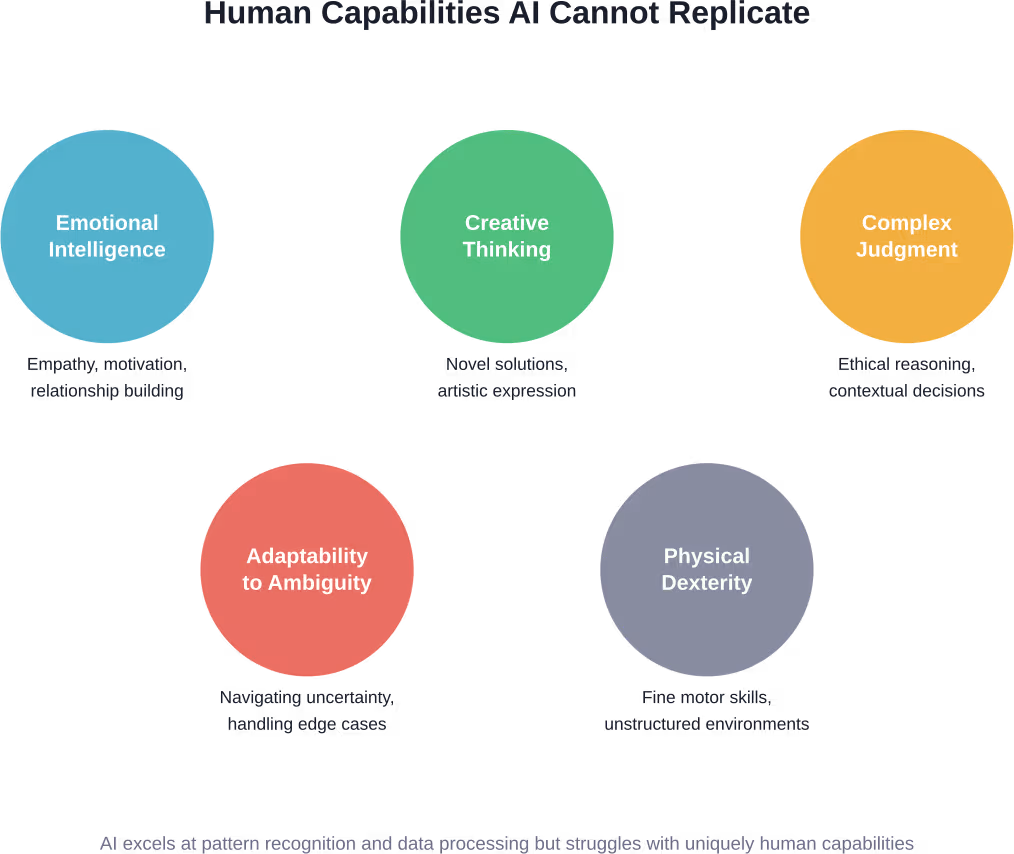
The Real Threat: Humans Without AI Skills
Harvard Business School research makes a crucial point: AI won’t replace humans, but humans with AI will replace humans without AI. Just as the internet drastically lowered the cost of information transmission, AI lowers the cost of cognition. Organizations can accomplish cognitive tasks—analysis, writing, coding, design—faster and cheaper with AI augmentation. Workers who learn to harness these tools become dramatically more productive than those who don’t. This creates a skills divide more concerning than wholesale replacement. Workers who develop AI literacy and learn to collaborate with AI systems will command premium value. Those who resist or lack access to AI training face declining competitiveness. The Trump Administration announced on September 9, 2025 commitments from major organizations to provide free AI training and resources to students and workers. Google committed $1 billion to support education and job training programs in the U.S., as announced in the September 2025 White House initiative. These initiatives recognize that AI transformation requires workforce preparation, not just technological development.
Geographic and Demographic Disparities
AI impact doesn’t distribute evenly across populations. Significant disparities emerge based on gender, income level, and geography. Women face disproportionate exposure because clerical occupations—showing highest AI exposure—represent an important source of female employment globally. The effects are highly gendered, requiring policy attention to ensure fair transitions. High and upper-middle income countries show stronger AI effects due to higher employment shares in exposed occupations. Lower-income countries with less digitized economies face lower immediate exposure but may experience different challenges as AI capabilities expand. Within the United States, adaptive capacity varies significantly by region. Workers in technology hubs with strong educational infrastructure and diverse industry presence show higher adaptive capacity than those in regions with concentrated employment in declining sectors.
What Happens to Entry-Level Positions
One emerging concern deserves attention: the potential disappearance of entry-level roles that traditionally served as career pathways. Many professional careers begin with junior positions involving routine tasks—document review for lawyers, basic data analysis for consultants, simple code implementation for developers. These roles allow newcomers to learn industry norms, build professional networks, and develop judgment while contributing to organizational work. If AI automates these entry-level tasks, how do professionals develop expertise? The telephone industry example from the 1920s shows mechanization eliminated entry-level operator positions. While the industry adapted, the loss of these pathways created barriers for those who previously used them for economic mobility. Research on career pathways examines how AI might reshape progression to better jobs. Gateway occupations play a pivotal role in mobility, offering immediate wage gains from lower-wage work while enabling skill development for transitions into higher-wage positions. STARs—workers Skilled Through Alternative Routes without four-year degrees—account for 62% of the US workforce. AI’s impact on gateway occupations will significantly affect economic mobility for this population.
Policy Responses and Support Systems
The ILO emphasizes the need for proactive policies to minimize negative effects of AI-induced technological unemployment. Market forces alone won’t ensure fair transitions. Recommendations include:
- Expanded access to AI education and reskilling programs, particularly for workers in high-exposure occupations with lower adaptive capacity
- Strengthened social safety nets to support workers during transitions between roles or industries
- Dialogue-based approaches involving workers, employers, and policymakers in shaping AI deployment
- Attention to job quality, ensuring AI augmentation improves rather than degrades working conditions
- Regulation addressing algorithmic management and protecting workers from exploitative AI applications
- Recognition and protection for data laborers—workers who label, categorize, and refine the datasets underlying AI systems
Some companies experiment with novel work arrangements as AI changes productivity dynamics. One software company implementing AI-enhanced workflows saw 130% revenue increase alongside improved employee outcomes including fewer sick days. Forward-looking employers experiment with approaches that share productivity gains with workers rather than simply cutting headcount.
The Current State in 2026
Where do things actually stand as of April 2026? Research on AI and the labor market remains in early stages—the first inning, as one analysis describes it. Nascent research shows three clear patterns emerging: First, AI adoption is accelerating but remains far from universal. Many organizations still experiment with use cases and implementation approaches. The technology’s deployment is heterogeneous across sectors and company sizes. Second, employment effects vary dramatically by context. Some sectors show AI-driven employment growth as companies scale operations. Others see task automation reducing headcount in specific functions. The aggregate picture shows transformation rather than wholesale replacement. Third, job quality implications require ongoing attention. Algorithmic management—AI systems directing human workers—raises concerns about autonomy, surveillance, and working conditions. The technology’s impact extends beyond whether jobs exist to how remaining jobs feel for workers. The labor market of 2026 shows both broad resilience and concentrated pockets of vulnerability. Most workers aren’t facing immediate replacement, but many experience changing job content and skill requirements. The transition is uneven and challenging for those in its path.
Frequently Asked Questions
Will AI take all our jobs in the future?
No evidence supports wholesale job elimination. According to the ILO, only 3.3% of global employment falls into the highest AI exposure category. The overwhelming effect is augmentation—AI handling specific tasks within jobs while humans manage roles’ complexity, creativity, and interpersonal dimensions. Historical technological transitions show jobs transform rather than disappear, though specific occupations and tasks do get automated.
Which jobs are most at risk from AI?
Clerical and administrative occupations face the highest exposure because they involve structured, routine tasks AI handles effectively. Professional roles with strongly digitized workflows also show increased exposure, including aspects of legal research, financial analysis, and medical diagnostics. However, even in high-exposure occupations, AI typically automates tasks rather than entire jobs.
Can AI completely replace human intelligence?
Current AI systems cannot replicate human intelligence’s full range. AI excels at pattern recognition and data processing but lacks genuine understanding, emotional intelligence, creative thinking, complex ethical reasoning, and adaptability to novel situations. Machine learning experts emphasize that today’s AI isn’t actually intelligent in the human sense—it’s sophisticated pattern matching without comprehension.
How can workers prepare for AI changes?
Developing AI literacy is crucial. Workers who learn to collaborate with AI tools become more productive than those who don’t. This doesn’t require becoming a technical expert—it means understanding AI capabilities, limitations, and how to apply tools in specific work contexts. Major organizations have committed to providing free AI training programs to help workers build these skills.
Are companies using AI actually hiring more people?
Research tracking up to 64% of the US workforce found that firms investing in AI showed employment growth, not the layoffs many predicted. AI enables companies to scale operations, improve productivity, and enter new markets, creating demand for workers with evolving skill sets. Micron’s $200 billion AI infrastructure investment expects to create 90,000 American jobs in supporting industries.
What about workers who can’t easily switch careers?
This represents a genuine policy challenge. Among workers in high AI exposure occupations, approximately 6.1 million Americans (4.2% of the workforce) have both high exposure and low adaptive capacity—limited transferable skills, educational backgrounds, or geographic flexibility. The ILO emphasizes need for strengthened social safety nets, reskilling programs, and proactive policies supporting these concentrated vulnerability pockets.
Will entry-level jobs disappear because of AI?
This concern has merit. Many professional careers begin with junior positions involving routine tasks AI can automate. Historical precedent shows technology can eliminate entry pathways—telephone operator positions dropped 80% during 1920s-1930s mechanization. However, industries adapted by creating new entry routes. The key challenge is ensuring AI transformation maintains career pathways for workers without existing credentials or networks.
Looking Forward
So will AI replace humans? The evidence through early 2026 says: in most cases, no. AI will replace specific tasks. It will transform job content across numerous occupations. It will create demand for new skills while reducing demand for others. Some roles will disappear while new ones emerge. Workers without AI literacy will face growing disadvantage. But wholesale replacement of human workers? That’s not what the data shows happening. The transition presents real challenges requiring serious policy attention. Workers in high-exposure occupations with limited adaptive capacity need support. Entry-level pathways require preservation or reinvention. Job quality protections matter as algorithmic management spreads. Fair distribution of productivity gains needs addressing. Organizations and workers should engage actively with AI rather than resist it. The technology offers genuine productivity improvements and problem-solving capabilities. The question isn’t whether to adopt AI but how to deploy it in ways that augment human capabilities and improve outcomes for workers, not just shareholders. Research on AI’s labor market effects remains in early stages. The technology continues evolving rapidly. Monitoring ongoing impacts and adapting policies accordingly will require sustained attention from researchers, policymakers, employers, and workers themselves. The future isn’t humans versus machines. It’s humans and machines, collaborating in ways we’re still figuring out. That future offers both opportunity and risk depending on how intentionally we shape it. Start building AI literacy now. Explore tools relevant to your field. Experiment with augmentation approaches. Advocate for policies supporting fair transitions. The workers who thrive won’t be those who avoid AI—they’ll be those who learn to work alongside it effectively.