
Quick Summary: AI will not replace HR professionals but will fundamentally transform how HR functions operate. According to Bureau of Labor Statistics data and SHRM research from 2026, AI is augmenting rather than eliminating HR roles, automating transactional tasks while elevating HR to more strategic, human-centered work. The future belongs to HR professionals who combine AI tools with uniquely human capabilities like empathy, ethical judgment, and strategic thinking.
The panic around AI replacing HR isn’t new. But here’s what’s different in 2026: we now have actual data instead of speculation.
According to SHRM research released in early 2026, 62% of organizations are currently using AI somewhere in their business (either within HR or elsewhere in the organization), indicating a rapid acceleration of adoption. Yet the conversation has shifted from “if” to “how” AI will reshape human resources.
The Bureau of Labor Statistics has been tracking AI’s employment impacts across occupations since 2023. Their findings? AI primarily affects occupations whose core tasks can be easily replicated by Generative AI in its current form. But the picture for HR is more nuanced than simple replacement.
Here’s the thing though—framing this as replacement misses the point entirely.
What AI Is Actually Doing to HR Right Now
Let’s cut through the hype with real data from 2026.
SHRM research reveals that AI adoption in HR is accelerating, with the majority of adopting organizations beginning adoption over the past year. Organizations aren’t replacing HR teams wholesale. They’re automating specific tasks while redirecting human talent toward higher-value work.
The gap isn’t technology—it’s skills, governance, and leadership. According to SHRM’s findings, organizations struggle with readiness and training gaps more than the technology itself.
According to recent analyses referencing EY US AI Pulse Survey data, only 17% of employers are reducing headcount due to AI. The smarter organizations are using efficiency gains to pivot their HR teams toward strategic work.
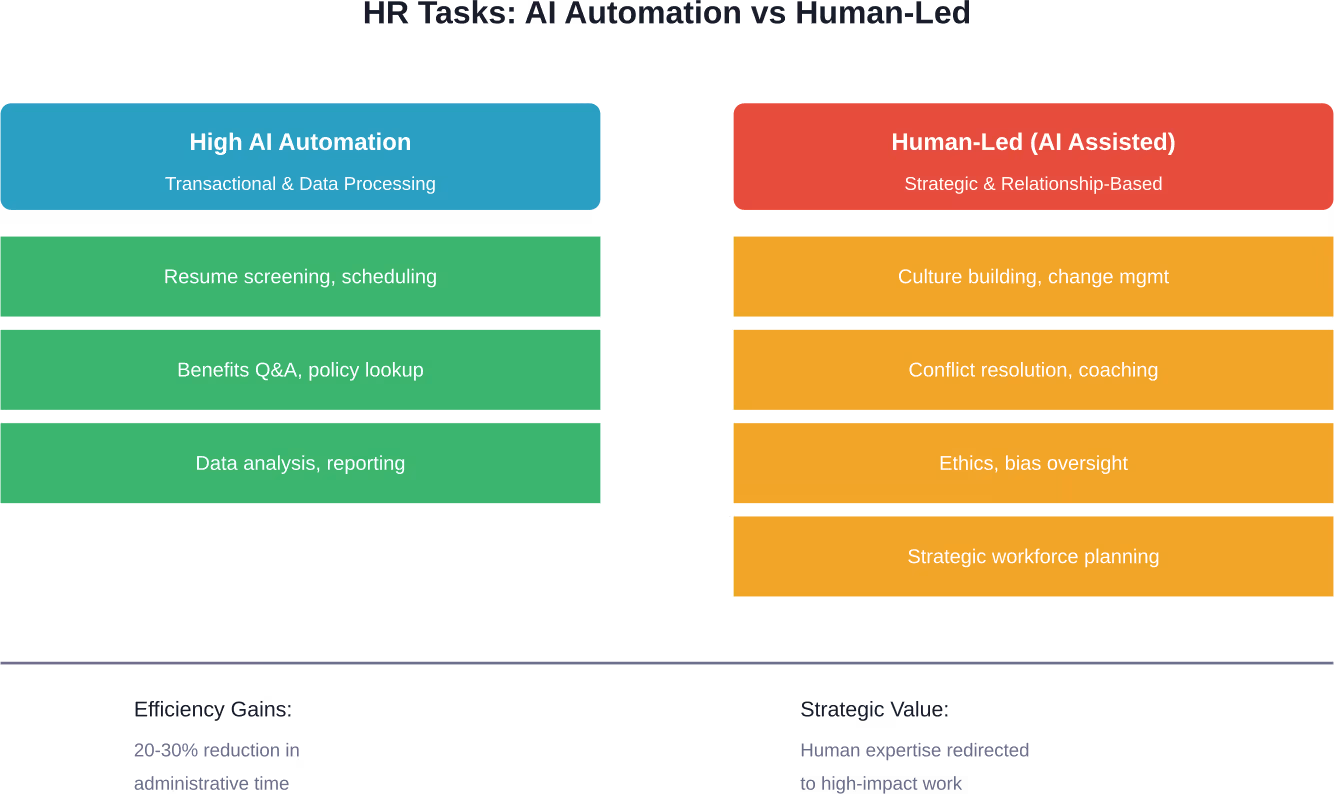
Tasks Being Automated First
AI excels at repetitive, data-intensive tasks that follow predictable patterns:
- Resume screening and initial candidate filtering
- Writing job descriptions and interview questions
- Answering common benefits and policy questions through chatbots
- Scheduling interviews and coordinating logistics
- Generating performance review summaries
- Creating onboarding documentation tailored to specific roles
- Analyzing employee sentiment from survey data
- Summarizing exit interviews to identify turnover patterns
These aren’t HR’s core value drivers. They’re administrative necessities that consumed disproportionate time.

AI Project Support With AI Superior
AI Superior focuses on supporting companies through the full lifecycle of AI projects. This includes early-stage evaluation, model development, and connecting AI solutions to real workflows.
Need Support Across an AI Project?
AI Superior can help with:
- building AI-driven applications and tools
- defining technical scope and system design
- integrating AI into business operations
👉 Contact AI Superior to discuss your project, data, and implementation approach
The Bureau of Labor Statistics Perspective
The BLS has published multiple analyses on AI’s employment impacts through 2025 and into their 2023-2033 projections period.
Their key finding: AI is expected to primarily affect occupations whose core tasks can be most easily replicated by Generative AI in its current form. But there’s a critical detail often overlooked.
The BLS projects total employment to grow from 170.0 million in 2024 to 175.2 million in 2034, representing an increase of 3.1 percent. While this is slower than the 13.0-percent growth recorded over 2014-24, it’s still growth, not contraction.
For computer occupations (which includes roles supporting AI implementation), the BLS notes that AI may actually support demand. Software developers are needed to develop AI-based business solutions and maintain AI systems. Database administrators and architects are expected to be needed to set up and maintain more complex data infrastructure.
The pattern? Technology shifts employment composition, but historically hasn’t eliminated broad occupational categories. The BLS references their own historical analyses from the 1950s and 1960s, when concerns about computers and industrial automation leading to massive job losses proved unfounded.
What History Teaches About Technology and Jobs
The BLS cited their projections for photographic process workers as instructive. Digital cameras were already replacing film cameras, and employment impacts were directly implied by the speed and maturation of technological change. Despite the absence of historical data showing employment declines, BLS projected impacts based on the technology trajectory.
They were right. But the photography industry didn’t disappear—it transformed.
HR is following a similar pattern. The function isn’t vanishing. It’s evolving.
What Remains Irreplaceably Human in HR
Here’s where the replacement narrative falls apart.
According to research from Villanova University’s analysis, 87% of recruiters and hiring managers consider HR certifications an important factor in hiring. Organizations aren’t looking for AI operators—they’re looking for well-educated HR professionals who can use AI responsibly.
The International Labour Organization’s research from 2025 suggests AI is more likely to augment human capabilities and enhance productivity in many roles rather than leading to widespread automation. Certain occupations show higher exposure to transformative effects, but exposure doesn’t equal elimination.
The Uniquely Human Skills
Some HR capabilities resist automation because they require qualities AI fundamentally lacks:
- Empathy and emotional intelligence. Coaching a struggling employee, mediating interpersonal conflicts, or supporting someone through a difficult transition requires reading nuanced emotional cues and responding with genuine human understanding.
- Ethical judgment in complex situations. When bias appears in AI-driven hiring tools, humans must recognize it, assess its implications, and make corrective decisions. AI can flag patterns, but ethical accountability sits with people.
- Change management and culture building. Transforming organizational culture, gaining buy-in for major changes, or building trust across teams requires relationship-building that algorithms can’t replicate.
- Strategic thinking in ambiguous contexts. Workforce planning amid market uncertainty, designing compensation strategies that balance multiple stakeholder interests, or anticipating future talent needs involves judgment calls that extend beyond data analysis.
SHRM research on blending AI with human-centered strategy published January 27, 2026 emphasizes that CHROs can strengthen trust, retention, and culture specifically by combining AI adoption with human-centered HR strategies—not choosing between them.
| HR Function | AI Contribution | Human Contribution | Combined Outcome |
|---|---|---|---|
| Talent Acquisition | Screen resumes, identify skill matches, schedule interviews | Assess cultural fit, conduct nuanced interviews, make final decisions | Faster hiring with better quality matches |
| Learning & Development | Personalize learning paths, track progress, recommend content | Design strategy, coach leaders, facilitate complex discussions | Scalable development with strategic alignment |
| Employee Relations | Analyze sentiment data, flag potential issues, answer FAQs | Mediate conflicts, build relationships, address complex cases | Proactive intervention with human resolution |
| Performance Management | Compile data, generate summaries, identify patterns | Provide coaching, deliver feedback, develop growth plans | Data-informed development conversations |
| Compliance | Monitor policy adherence, flag violations, track training | Interpret regulations, make judgment calls, handle exceptions | Consistent compliance with contextual flexibility |
The Real Threat: Irrelevance, Not Replacement
Cornell University’s ILR School research from September 2025 frames the challenge correctly. As companies increasingly turn to AI for functions like talent acquisition, onboarding, employee engagement, and performance management, HR teams face pressure to demonstrate their value.
But the pressure isn’t “will AI take my job?” It’s “am I evolving my skills fast enough?”
Community discussions reflect this anxiety. HR professionals recognize that resistance is futile, but uncertainty about the path forward creates stress.
The answer? HR professionals who use AI will replace HR professionals who don’t.
Just like calculators didn’t destroy mathematics but made mathematicians more productive, AI won’t destroy HR—it’ll destroy outdated models of HR that refuse to adapt.
The Skills Gap Is the Real Challenge
SHRM’s 2026 research identifies skills, governance, and leadership gaps as the primary factors slowing AI progress in HR—not the technology itself.
Organizations need HR teams that can:
- Prompt, analyze, and partner with AI tools effectively
- Build governance models ensuring fairness and transparency in AI-driven decisions
- Reimagine roles and workflows rather than automating the status quo
- Identify when human judgment should override AI recommendations
- Train others on responsible AI use and limitations
These aren’t technical programming skills. They’re critical thinking, ethical reasoning, and change leadership—areas where HR professionals should already excel.
How HR Roles Are Transforming, Not Disappearing
Research from Mercer and other analysts identifies key HR roles undergoing transformation, including talent acquisition specialists, learning and development professionals, and HR business partners.
But transformation doesn’t mean elimination. It means evolution.
From Transactional to Strategic
According to recent industry analysis, some suggest potential reductions of 20-30% or more in HR headcount per employee as AI handles transactional work. That sounds alarming until you read the next sentence.
Those individuals may end up managing AI platforms, moving into roles as change consultants (which AI still can’t do), or focusing on the strategic work that was always more valuable but never had sufficient time allocated to it.
The International Labour Organization’s 2025 research emphasizes AI’s influence on job quality, including the rise of algorithmic management. This creates new HR responsibilities: ensuring algorithmic fairness, protecting worker dignity in AI-managed environments, and addressing the often-overlooked role of data laborers who underpin AI systems.
These aren’t roles AI can fill. They’re roles AI creates the need for.
New Competencies for HR Professionals
By 2026, optimism among HR professionals regarding artificial intelligence (AI) integration has reached high levels, with approximately 83% to 88% expressing excitement, hope, or optimism about its potential to transform their work.
That concern aligns with broader employment trends. The BLS projects much slower employment growth overall (3.1% over 2024-2034 versus 13.0% the previous decade).
What HR professionals need now:
- Data literacy to interpret AI outputs and identify flawed assumptions
- Ethical frameworks to evaluate AI recommendations against human values
- Change management expertise to guide organizations through AI adoption
- Strategic thinking to identify where AI adds value versus where it introduces risk
- Communication skills to translate between technical teams and business stakeholders
Notice something? These are all distinctly human capabilities that become more valuable as AI handles routine tasks.
The Co-Pilot Model: How AI and HR Work Together
Real talk: the future isn’t human or machine. It’s human with machine.
AI serves as co-pilot, not autopilot. The distinction matters enormously.
An autopilot makes decisions independently within predefined parameters. A co-pilot provides support, handles routine operations, and alerts to potential issues—but humans remain in command and make final decisions.
Practical Examples of AI Augmentation
Modern HR teams using AI effectively aren’t replacing judgment with algorithms. They’re enhancing judgment with better information.
- Predictive turnover analysis: AI identifies employees exhibiting patterns associated with departure risk. HR professionals conduct stay interviews, address underlying issues, and make retention investments where they matter most.
- Personalized learning at scale: AI recommends development content based on role, skills gaps, and career goals. HR professionals design the overall learning strategy, ensure alignment with business objectives, and coach managers on supporting employee growth.
- Real-time sentiment monitoring: AI analyzes survey responses, message sentiment, and engagement data to flag potential morale issues. HR professionals investigate root causes, facilitate difficult conversations, and implement culturally appropriate solutions.
- Bias detection in hiring: AI flags potential bias patterns in job descriptions, interview questions, or candidate evaluations. HR professionals investigate, redesign processes to mitigate bias, and make final hiring decisions accounting for factors AI can’t evaluate.
In each case, AI handles data processing at scale while humans provide context, judgment, and relationship management.
| Scenario | Without AI | With AI (Co-Pilot Model) |
|---|---|---|
| Resume Review (100 applicants) | 8-10 hours of manual screening; inconsistent criteria; possible qualified candidates missed | AI screens in minutes using consistent criteria; HR reviews top 20 matches in 2 hours; better outcomes, 75% time savings |
| Performance Review Cycle | Managers spend 40+ hours writing reviews from memory; recency bias; minimal data support | AI compiles year-round feedback, goal progress, peer input; managers spend 15 hours on coaching conversations with data support |
| Benefits Questions | HR staff answer 200+ repetitive questions monthly; strategic work delayed; slow response times | Chatbot handles 85% of routine questions instantly; HR focuses on complex cases; faster employee support |
| Diversity Analysis | Quarterly manual reports; delayed insights; difficulty identifying patterns across multiple dimensions | Real-time dashboards with intersectional analysis; HR identifies issues early and tests interventions |
Practical Steps for HR Professionals
So what should someone in HR actually do about all this?
Start by acknowledging that AI competency is becoming as fundamental as Excel skills were two decades ago. Resistance isn’t a viable strategy.
Build AI Literacy
Learn how AI tools work at a conceptual level. Understanding the difference between rule-based automation, machine learning, and generative AI helps evaluate vendor claims and identify appropriate use cases.
Experiment with accessible AI tools—ChatGPT for drafting communications, AI-powered scheduling assistants, or sentiment analysis tools for survey data. Hands-on experience builds intuition for what AI does well and where it struggles.
Develop Governance Frameworks
Organizations need someone ensuring AI is used responsibly. HR professionals are ideally positioned for this role.
Create clear policies around:
- When AI recommendations require human review before implementation
- How to audit AI tools for bias and fairness
- What employee data can be used for AI training and analysis
- How decisions made with AI assistance are documented and explained
- Who is accountable when AI produces problematic outputs
This isn’t technical work—it’s ethical and strategic work that leverages HR’s existing expertise in compliance and people advocacy.
Shift Focus to Strategic Value
As AI handles transactional tasks, redirect energy toward the work that drives business outcomes:
- Culture and engagement: Build workplace environments where people thrive. AI can measure engagement, but creating it requires human leadership.
- Workforce planning: Anticipate future talent needs based on business strategy. AI provides data, but strategic interpretation requires business acumen and market understanding.
- Leadership development: Develop the next generation of leaders. AI can personalize content delivery, but developing leadership presence requires human coaching and feedback.
- Change management: Guide organizations through transformation. AI creates change, but managing human responses to change remains deeply human work.
Advocate for Human-Centered AI Implementation
Push back against purely cost-cutting approaches to AI adoption. The goal isn’t fewer people—it’s better outcomes.
When vendors pitch AI solutions, ask:
- How does this improve employee experience, not just operational efficiency?
- What human oversight mechanisms are built in?
- How is the algorithm trained, and what data is it using?
- What happens when the AI produces an incorrect or biased output?
- How do we explain AI-assisted decisions to affected employees?
HR’s unique value lies in keeping people at the center of business decisions. That responsibility intensifies as AI adoption accelerates.
What the Next Five Years Look Like
Based on current adoption patterns and research from SHRM, BLS, and ILO, several trends appear likely through 2030.
AI adoption in HR will accelerate from the current 25% of organizations to potentially 60-70% by 2028. But adoption will remain uneven, with larger organizations and specific industries leading.
The composition of HR teams will shift. Administrative and coordinator roles will decline as AI handles transactional work. Strategic roles—business partners, organizational development specialists, culture advisors—will grow in proportion and influence.
New hybrid roles will emerge: AI governance specialists, people analytics translators, algorithmic fairness auditors. These combine HR domain knowledge with AI literacy.
Regulation will increase. As AI impacts more employment decisions, governments will impose transparency, fairness, and accountability requirements. HR professionals who understand both the technology and compliance landscape will become invaluable.
The skills premium will grow. HR professionals who combine AI fluency with strategic thinking, emotional intelligence, and ethical reasoning will command significantly higher compensation than those focused purely on transactional work.
Generally speaking, HR won’t shrink—it’ll specialize and elevate.
Frequently Asked Questions
Will AI completely replace HR professionals?
No. According to 2026 data from SHRM and the Bureau of Labor Statistics, AI is augmenting HR roles rather than eliminating them entirely. While AI automates transactional tasks like resume screening and benefits inquiries, it cannot replace human capabilities like empathy, ethical judgment, culture building, and strategic thinking. The EY AI Pulse Survey found only 17% of employers reducing headcount due to AI, with most organizations redirecting HR talent toward higher-value strategic work.
Which HR jobs are most at risk from AI automation?
Roles focused primarily on transactional, repetitive tasks face the highest automation risk. This includes positions heavily concentrated on data entry, basic payroll processing, routine benefits administration, and initial resume screening. However, even these roles are more likely to transform than disappear—professionals in these positions can evolve into AI platform managers, governance specialists, or strategic roles as automation handles routine tasks.
What skills do HR professionals need to stay relevant as AI advances?
Critical skills include AI literacy (understanding how AI tools work and their limitations), data analysis and interpretation, ethical reasoning for AI governance, change management expertise, strategic thinking, and enhanced emotional intelligence. According to Villanova University research, 87% of recruiters consider HR certifications important, indicating that formal education in these evolving competencies matters. The ability to work effectively with AI as a co-pilot while providing uniquely human judgment is becoming essential.
How is AI currently being used in HR departments?
As of April 2026, SHRM research shows about 25% of organizations use AI for HR activities. Common applications include resume screening, chatbots for employee questions, interview scheduling, job description writing, sentiment analysis from surveys, performance review summaries, personalized learning recommendations, and predictive analytics for turnover risk. The focus is on automating time-consuming administrative tasks to free HR professionals for strategic work.
Should HR professionals be concerned about job security with AI adoption?
Concern should focus on skill relevance rather than job elimination. HR professionals who resist learning AI tools and continue focusing exclusively on transactional work face irrelevance risk. However, those who develop AI literacy, build governance expertise, and shift toward strategic value creation are positioned to thrive. The International Labour Organization’s 2025 research indicates AI is more likely to augment human capabilities than cause widespread automation, but adaptation is essential.
What’s the difference between AI replacing HR versus transforming it?
Replacement suggests AI doing everything HR currently does, making HR professionals obsolete. Transformation means AI handles specific tasks while fundamentally changing how HR professionals spend their time and deliver value. The evidence points strongly toward transformation. AI excels at data processing, pattern recognition, and handling repetitive inquiries at scale. Humans excel at empathy, complex judgment, relationship building, and ethical reasoning. The future HR professional combines both—using AI for efficiency while focusing their expertise on irreplaceable human capabilities.
How can small organizations without big AI budgets compete for HR talent?
Small organizations can leverage increasingly accessible AI tools that don’t require massive investment. Many HR platforms now include AI features in standard packages. Cloud-based solutions democratize access to capabilities previously available only to large enterprises. The competitive advantage comes not from budget size but from smart implementation—using AI to punch above your weight in candidate experience, employee engagement, and strategic workforce planning. HR professionals often value the opportunity to shape AI strategy from the ground up more than having expensive tools they don’t control.
The Bottom Line: Augmentation, Not Replacement
Will AI replace HR? The data from government agencies, academic research, and industry studies through 2026 tells a consistent story: no, but it will fundamentally transform how HR operates.
The Bureau of Labor Statistics’ employment projections show technology shifting job composition, not eliminating occupational categories wholesale. SHRM’s research demonstrates that organizations struggle more with skills and governance gaps than with technology limitations. The International Labour Organization emphasizes AI’s role in augmenting human capabilities rather than replacing them.
HR professionals face a choice, but it’s not “adapt or be replaced by AI.” It’s “evolve into a strategic, AI-augmented role or become irrelevant while others do.”
The transactional work that consumed 60-70% of HR’s time is automating. That’s not a threat—it’s an opportunity to finally focus on the strategic, human-centered work that drives real business value.
Culture doesn’t build itself. Change management requires human leadership. Ethical oversight of AI systems needs human judgment. Strategic workforce planning demands business acumen that extends beyond data analysis.
These capabilities become more valuable, not less, as AI handles routine tasks. Organizations still need HR—they just need HR professionals who’ve evolved beyond administrative coordination into strategic leadership.
The HR professionals thriving in 2026 aren’t those with the most AI tools. They’re those who’ve combined AI fluency with deepened human capabilities—empathy, ethics, strategic thinking, and change leadership.
That combination is irreplaceable. And it’s entirely within reach for HR professionals willing to learn, adapt, and lead through this transformation.
Sound like a challenge worth taking on? Start today. Experiment with one AI tool. Develop one governance policy. Shift one hour per week from transactional to strategic work. Small steps compound into career transformation.
The future of HR isn’t human versus machine. It’s humans empowered by machines doing work that matters more than ever.
 English
  German
  Arabic
  French
  Dutch
Dutch  Spanish