
Quick Summary: AI will not fully replace human interpreters, especially in complex, high-stakes scenarios requiring cultural nuance, emotional intelligence, and real-time adaptability. While machine interpreting tools are improving for routine, low-risk conversations, the profession faces significant disruption with declining rates and job availability. The future likely involves collaboration between AI and human interpreters rather than complete replacement.
The interpretation industry is experiencing unprecedented upheaval. Translation rates are plummeting, seasoned professionals are considering bankruptcy, and AI-powered tools promise instant, cheap alternatives to human linguists.
But here’s the thing—the question isn’t really whether AI can replace interpreters. It’s already replacing some of them. The real question is: where does the technology actually work, and where does it fall dangerously short?
According to the Bureau of Labor Statistics, interpreters and translators earned a median annual wage of $59,440 in May 2024. That figure tells only part of the story. Behind those numbers, individual professionals report dramatic income declines as AI tools reshape the competitive landscape.
How AI Is Already Disrupting Interpretation Work
Real talk: few industries have been hit by AI as hard as translation and interpretation. The disruption isn’t theoretical—it’s happening right now.
Translators across multiple specializations report that work has dried up substantially. Some professionals with 14+ years of experience are now considering abandoning the field entirely or facing bankruptcy. The changes aren’t gradual—they’re swift and brutal.
Machine translation systems powered by large language models have made significant strides. These systems can now handle routine, low-risk conversations with reasonable accuracy. Organizations use automated interpreting to scale language access for simple interactions like appointment reminders or basic check-ins.
And that’s genuinely useful. Automated interpreting improves speed and efficiency for organizations serving diverse populations.
But here’s where the narrative gets complicated.
Where AI Interpreting Actually Works
Machine interpreting isn’t universally bad. There are legitimate use cases where the technology delivers value without compromising safety or accuracy.
Automated interpreting helps organizations serve more people by handling high-volume, routine communications. Think basic informational queries, automated phone systems, or straightforward transactional conversations.
The Bureau of Labor Statistics data shows that industries with the highest employment levels for interpreters include professional, scientific, and technical services, where mean annual wages reached $63,470. Some of these roles involve repetitive, standardized communications—exactly the kind AI handles reasonably well.
For written translation of technical documents with controlled vocabulary, AI tools have become genuinely useful assistants. They accelerate initial drafts that human translators then refine and verify.
So yes, AI interpreting has a place. Just not everywhere.
The Critical Gaps AI Can’t Bridge
Communication includes emotion, tone, and culture. In high-stakes scenarios—medical consultations, legal proceedings, diplomatic negotiations—these elements aren’t optional extras. They’re essential.
Human interpreters do far more than convert words from one language to another. They navigate cultural context, recognize when a speaker is confused or distressed, and adapt their approach in real-time based on non-verbal cues.
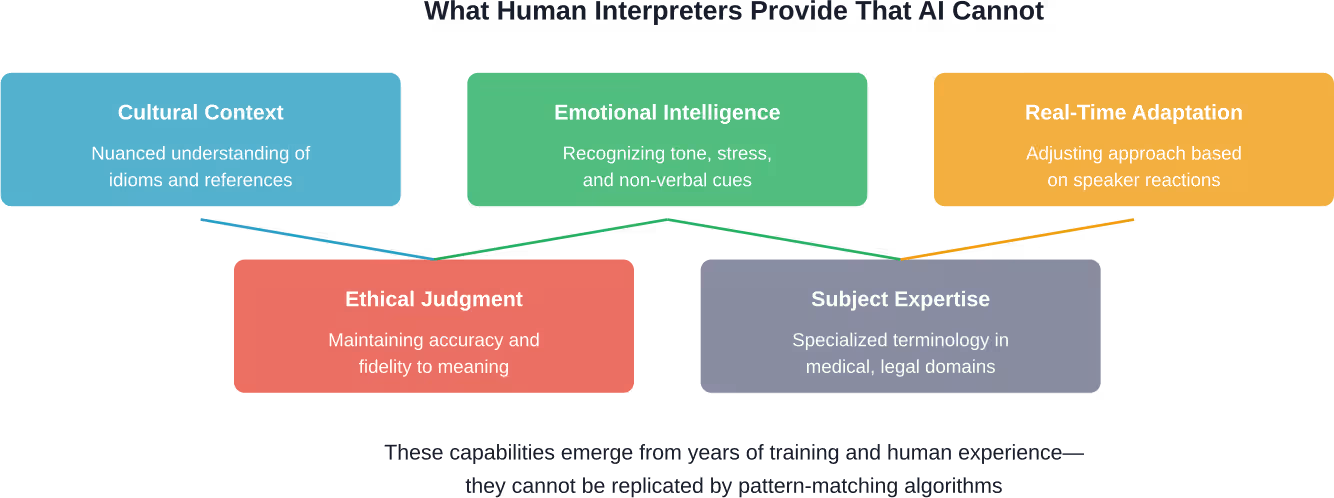
Consider judiciary interpreting. According to insights from the Bureau of Labor Statistics, judiciary interpreters facilitate communication in legal settings where accuracy isn’t just important—it’s a matter of justice. Misinterpretation can lead to wrongful convictions or denied rights.
AI systems lack the ability to recognize when they’ve misunderstood context. They don’t know what they don’t know. A human interpreter working a trial will report to the courtroom early, check equipment, and review case-related documents to ensure accurate interpretation of specialized legal terminology.
Machine interpreting systems don’t prepare. They don’t understand the stakes. They just process input and generate output.
The Simultaneous Interpreting Challenge
Simultaneous interpreting—the work of rendering speech from one language to another in real-time while the speaker continues talking—represents one of the most cognitively demanding professional tasks humans perform.
Professional simultaneous interpreters work in small booths at international conferences, speaking in hushed voices as they convert complex presentations on technical subjects. They manage multiple mental processes simultaneously: listening, comprehending, converting meaning, and speaking—all while the original speaker continues.
Research on machine interpreting shows that AI systems attempt to deliver speech that is shorter and more concise than the source. Professional interpreters generally aim for approximately 75% of the source speech duration as a rule of thumb, though the ideal ratio depends on many factors such as the speed and verbosity of the source speech.
But wait. There’s a fundamental difference between compression and comprehension.
AI systems shorten output because they’re optimizing for efficiency. Human interpreters adjust pacing based on audience comprehension, speaker emphasis, and communicative intent. These aren’t the same thing, even if the duration metrics look similar.
What’s Actually Happening to Interpreter Jobs
The job market data presents a complicated picture. The World Economic Forum predicts that 44% of workers’ skills will be disrupted in the next five years, according to the Future of Jobs Report 2023. A Brookings Institution analysis found that more than 30% of all workers could have half or more of their tasks exposed to generative AI.
For interpreters specifically, the impacts vary dramatically by specialization and work type.
Written translation has been hit hardest. Professionals report that corporate communications work has come to a complete stop in some cases. One translator with 14 years of experience in Rome reported considering abandoning translation to clean houses instead.
The economics have shifted dramatically. Many translators report being paid half as much to do lower-skilled work—post-editing machine translations rather than translating from scratch.
A U.K. survey of 787 members of a trade organization for translators found that 36% of them reported job losses from the use of AI. Those aren’t projections—that’s current reality.
| Interpreter Specialization | AI Impact Level | Reason |
|---|---|---|
| Written technical translation | High disruption | Controlled vocabulary, standardized formats work well with AI |
| Routine phone interpreting | Moderate disruption | AI handles simple transactional conversations adequately |
| Simultaneous conference interpreting | Low disruption | Requires real-time cultural adaptation and subject expertise |
| Medical interpreting | Low disruption | High-stakes scenarios require emotional intelligence and accuracy |
| Legal/judiciary interpreting | Very low disruption | Consequences of errors too severe; ethical and legal requirements |
| Sign language interpreting (ASL) | Very low disruption | Visual-spatial language complexity exceeds current AI capabilities |
ASL and Sign Language Interpretation
American Sign Language interpretation presents unique challenges that expose AI’s fundamental limitations. ASL isn’t just English converted to hand gestures—it’s a complete visual-spatial language with its own grammar, syntax, and cultural context.
AI technologies continue to evolve in sign language recognition, but a pressing question remains: can AI replace human ASL interpreters?
The short answer? Not remotely close.
ASL interpretation requires understanding three-dimensional space, facial expressions, body positioning, and cultural context within the signing community. Machine learning systems struggle with the nuanced, contextual nature of visual-spatial languages.
For the signing community, access to qualified human interpreters isn’t a convenience—it’s a civil rights issue. Replacing human ASL interpreters with inadequate AI systems would create barriers to communication rather than removing them.
Legislative Risks and Regulatory Concerns
Recent legislative proposals have raised alarm among professional interpreter organizations. The American Translators Association’s Advocacy Committee has warned lawmakers about risks of potentially replacing expert interpreters with artificial intelligence in legal settings.
In 2025, Wisconsin Senate Bill 357 was introduced to allow the use of AI or machine-assisted translation tools in lieu of appointing English language interpreters in certain governmental and legal contexts.
The concern isn’t that AI will never have a role. It’s that premature deployment in high-stakes scenarios could deny people their fundamental rights to understand and be understood in legal proceedings.
Officers of the court and the general public need to understand: there’s a massive difference between AI that helps interpreters work more efficiently and AI that replaces the interpreter entirely.
The Hybrid Future
So where does this leave the profession?
The most realistic future involves collaboration rather than replacement. AI handles routine, low-risk communications while human interpreters focus on complex, high-stakes scenarios requiring cultural expertise and emotional intelligence.
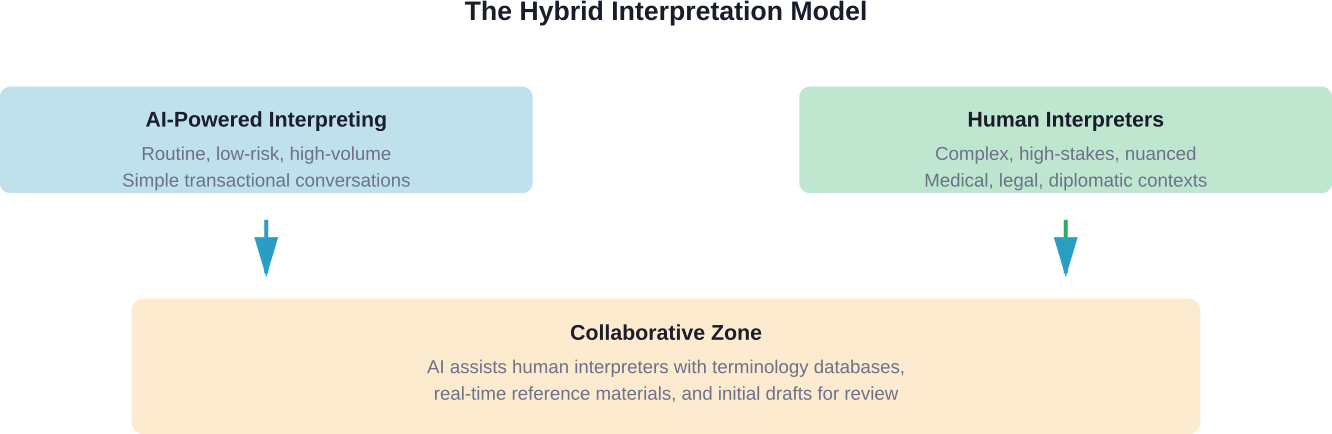
This isn’t settling for less. It’s recognizing what each does best.
AI translation tools can serve as references, providing terminology suggestions and initial drafts that skilled professionals refine. Machine interpreting can triage simple inquiries, escalating complex cases to human interpreters.
But make no mistake—this transition is painful for professionals currently experiencing the disruption. The brain drain from the interpretation field represents a real loss of specialized expertise that takes years to develop.

Use AI In Interpreting Without Risking Miscommunication
AI interpreting works fine for simple exchanges, but once context, tone, or stakes increase, mistakes stop being harmless and start affecting real outcomes. AI Superior approaches this from a system level, not just tools. Instead of relying on raw AI output, they help organizations design how AI is actually used in communication workflows – where it can automate safely and where human interpreters need to stay involved.
What they typically help with:
- Building AI-powered systems for multilingual communication
- Integrating machine translation into existing platforms and workflows
- Structuring data and pipelines so outputs stay consistent
- Defining where automation is safe vs where human validation is required
That setup matters more than the model itself. If you’re planning to use AI in interpreting or multilingual environments, contact AI Superior to discuss how to implement it without breaking communication quality.
What This Means for Language Access
Organizations deploying AI interpreting need clear protocols for when automated systems are appropriate and when human expertise is non-negotiable.
Language access improves when technology expands reach for routine communications. It degrades catastrophically when cost-cutting replaces qualified interpreters in scenarios where accuracy and cultural competence matter.
The National Code of Ethics for interpreters emphasizes maintaining fidelity to the meaning of the original message without adding, omitting, distorting, or substituting ideas. AI systems don’t have ethical codes. They have optimization functions.
There’s a difference.
Frequently Asked Questions
Will AI completely replace human interpreters?
No. AI will not completely replace human interpreters, particularly in complex, high-stakes scenarios like medical consultations, legal proceedings, and diplomatic negotiations. These contexts require cultural nuance, emotional intelligence, and real-time adaptation that current AI systems cannot provide. However, AI is already replacing interpreters in routine, low-risk communications.
What types of interpretation work are most at risk from AI?
Written technical translation with controlled vocabulary and standardized formats faces the highest disruption. Routine phone interpreting for simple transactional conversations also experiences moderate impact. Specialized interpretation requiring cultural expertise—medical, legal, and sign language interpretation—remains largely protected from AI replacement due to complexity and stakes.
Can AI accurately interpret sign languages like ASL?
Not effectively. American Sign Language and other sign languages are complete visual-spatial languages with grammar, syntax, and cultural context that extends far beyond gesture recognition. AI systems currently struggle with the three-dimensional, contextual, and culturally-embedded nature of sign language communication. Human ASL interpreters remain essential for accurate, culturally-appropriate interpretation.
How are interpreter salaries being affected by AI?
Many interpreters report dramatic income declines, with some being paid half previous rates to post-edit machine translations rather than translate from scratch. A U.K. survey found 36% of translators reported job losses from AI use. According to the Bureau of Labor Statistics, the median annual wage for interpreters and translators was $59,440 in May 2024, though individual experiences vary widely by specialization.
Should courts and hospitals use AI interpreters?
Not as replacements for human interpreters in substantive proceedings or consultations. The American Translators Association and other professional organizations strongly warn against replacing expert interpreters with AI in legal settings, where interpretation errors can violate fundamental rights. Healthcare contexts similarly require human expertise due to potential consequences of miscommunication. AI may assist in limited, low-stakes scenarios with appropriate safeguards.
What skills should interpreters develop to remain competitive?
Specialization in high-complexity domains like medical, legal, or technical interpretation offers more protection from AI disruption. Cultural expertise, subject-matter specialization, and skills in simultaneous interpretation for conferences and high-stakes events remain difficult for AI to replicate. Learning to work collaboratively with AI tools—using them as assistants rather than replacements—also provides competitive advantage.
Is the interpretation profession dying?
The profession is transforming rather than dying. Lower-skill translation work has experienced severe disruption, and many professionals face difficult transitions. However, demand continues for skilled human interpreters in complex, high-stakes contexts. The profession will likely become more specialized, with humans focusing on scenarios requiring expertise, cultural competence, and ethical judgment that AI cannot provide.
The Bottom Line
AI will not replace interpreters wholesale, but it’s already fundamentally reshaping the profession. The technology handles routine tasks effectively while failing catastrophically at complex, culturally-nuanced communication.
Professionals experiencing job loss and income decline aren’t being alarmist—they’re reporting real disruption that’s happening right now. At the same time, premature celebration of AI’s capabilities risks dangerous deployment in high-stakes scenarios where errors carry serious consequences.
The future isn’t human versus machine. It’s finding the right roles for each, with clear protocols protecting people in situations where communication barriers can mean the difference between justice and injustice, treatment and misdiagnosis, understanding and confusion.
Sound familiar? That’s because we’ve seen this pattern before with other technologies. The question isn’t whether AI will change interpretation—it already has. The question is whether we’ll deploy it responsibly, preserving human expertise where it matters most while leveraging automation where it genuinely helps.
For organizations considering AI interpreting: establish clear criteria for when automated systems are appropriate and when human interpreters are non-negotiable. For interpreters: specialization in complex, high-stakes domains offers the strongest protection from automation.
And for policymakers: resist the temptation to replace qualified interpreters with cheaper AI alternatives in legal, medical, and other critical contexts. Access to justice and healthcare depends on accurate communication—not just cheap communication.
 English
  German
  Arabic
  French
  Dutch
Dutch  Spanish