
Quick Summary: Image recognition for artwork uses AI-powered deep learning models to identify paintings, verify authenticity, and classify artistic styles by analyzing visual features. Modern systems leverage Vision Transformers and convolutional neural networks trained on extensive art databases to detect forgeries, catalog collections, and provide instant artwork information through smartphone apps.
The art world has entered a new era. Walk into any museum, snap a photo, and within seconds you’ll know the artist, title, and even the price history of that painting. But image recognition for artwork goes far beyond casual identification—it’s now authenticating million-dollar pieces and catching sophisticated forgeries that fool human experts.
This technology merges computer vision with deep learning models trained on massive image datasets. The results? Systems that analyze brushstrokes, color palettes, and compositional patterns with precision that surpasses traditional connoisseurship.
How Artwork Recognition Technology Works
At its core, artwork recognition relies on neural networks that learn visual patterns from thousands of examples. Vision Transformers, a newer architecture introduced in recent research, have proven particularly effective for art authentication tasks.
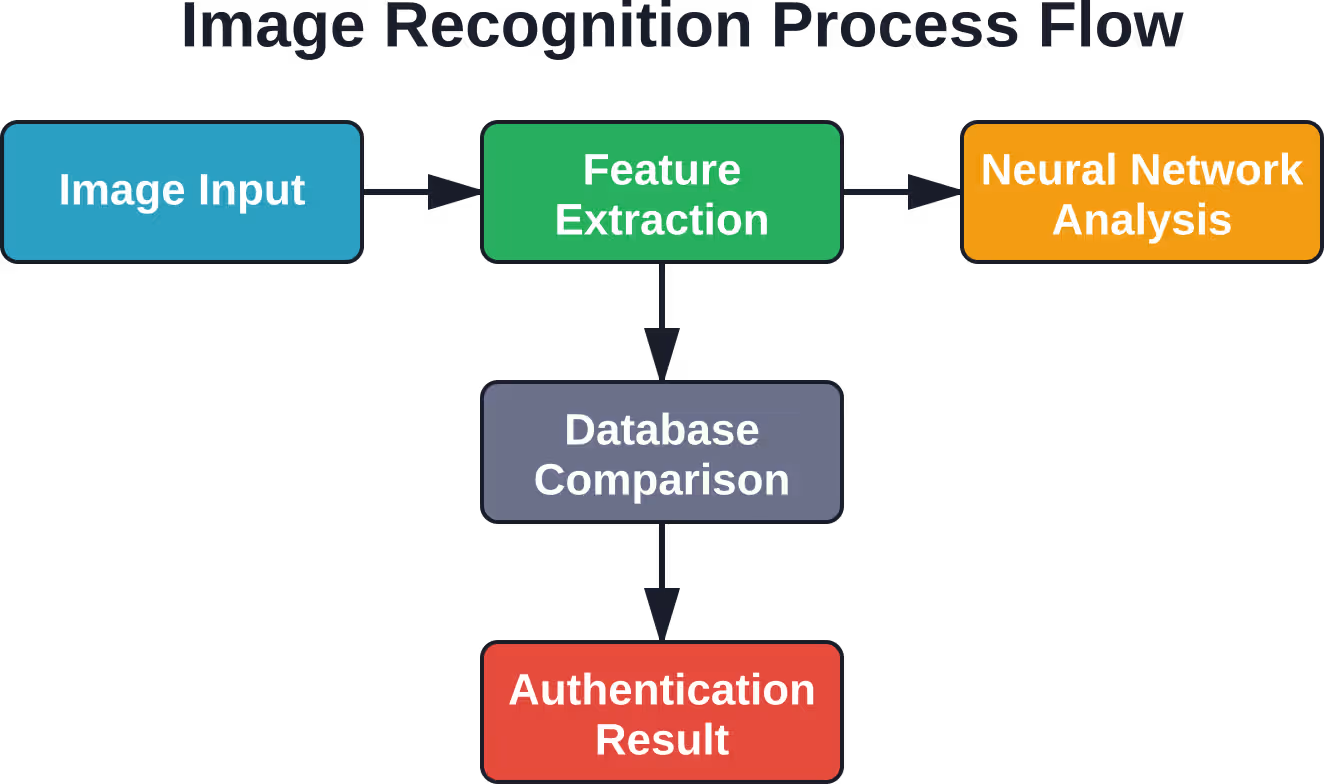
These systems analyze multiple layers of visual information. Color distribution, texture patterns, brushstroke characteristics, compositional structure—all get processed simultaneously. The model compares these features against its training database to generate matches or flag anomalies.
Traditional watermarking methods achieve average detection rates between 27.8-44.0%, according to research published on arxiv.org. Feature-based watermarking methods achieve 90-95% average detection rates against common attacks, demonstrating how specialized approaches outperform generic solutions.

Turn Visual Data Into AI Software With AI Superior
AI Superior helps companies turn image recognition ideas into working software. Their computer vision work can cover image analysis, object detection, segmentation, OCR, and classification, depending on the project needs.
For artwork-related projects, this can support visual classification, artwork cataloging, style or pattern recognition, image comparison, or review workflows built around large image collections.
Need Image Recognition for Visual Collections?
AI Superior can help with:
- building custom image recognition tools
- classifying and comparing visual data
- testing models through PoC or MVP work
- integrating AI into existing platforms
👉 Contact AI Superior to discuss your project.
Authentication Applications
Here’s where things get serious. Art forgery costs collectors billions annually. Image recognition systems now catch fakes by detecting microscopic inconsistencies invisible to the naked eye.
Research on synthetic training data and Vision Transformers explores methods to improve forgery detection. The van Gogh dataset study from 2024 provided benchmark results that advanced the field.
Professional authentication systems analyze high-resolution reproductions to assess artwork authenticity. These aren’t consumer apps—they’re specialized tools used by auction houses, galleries, and insurance companies making high-stakes decisions.
Consumer Apps vs. Professional Systems
The divide is substantial. Consumer apps like Magnus and Smartify prioritize speed and accessibility. Point your phone, get instant artist information and price data. They’re built on general visual search engines.
Professional systems employ proprietary models trained on curated datasets. They process far more data points and apply domain-specific knowledge about artistic techniques, materials, and historical context.
| System Type | Primary Use | Accuracy Level | Cost |
|---|---|---|---|
| Consumer Apps | Quick identification | Good for known works | Free – $10/month |
| Professional AI | Authentication | High for trained artists | Custom pricing |
| Museum Systems | Collection management | Very high | Enterprise |
| Auction House Tools | Provenance verification | Very high | Enterprise |
Vision Transformers for Art Analysis
Traditional convolutional neural networks dominated computer vision for years. They’re still effective—OpenAI’s CLIP model demonstrated zero-shot transfer capabilities on visual classification tasks without directly optimizing for specific benchmarks, expanding beyond traditional 1000-class training set limitations.
But Vision Transformers changed the game. Research published in July 2023 on arxiv.org (arXiv:2307.03039) examined Vision Transformers for art authentication tasks by capturing long-range dependencies in images—crucial for analyzing compositional patterns that define artistic style.
The transformer architecture processes image patches as sequences, similar to how language models handle text. This allows the model to understand relationships between distant parts of a painting, like how a signature’s style relates to brushwork in the upper corner.
Real-World Impact and Growth
The commercial applications extend beyond authentication. Digital inventory management, exhibition guides, and collection cataloging all benefit from automated recognition systems.
Real talk: this technology is scaling fast. In 2019, computer vision company Voxel51 announced $2 million in seed funding from eLab Ventures. The company grew from its initial project staff, demonstrating market demand for specialized visual analysis tools.
Museums deploy these systems to enhance visitor experiences—scan any artwork for instant audio guides and contextual information. Galleries use them for inventory management. Collectors apply them for insurance documentation.
Frequently Asked Questions
How accurate is AI artwork recognition?
Accuracy depends on the system and use case. Consumer apps reliably identify famous paintings in their databases but struggle with lesser-known works. Professional authentication systems employ specialized neural networks, with Vision Transformer models achieving high accuracy for specific authentication tasks.
Can image recognition detect art forgeries?
Yes, but with limitations. Advanced systems analyze brushstroke patterns, color application, and compositional elements to flag inconsistencies. Research shows synthetic training images improve forgery detection rates. However, sophisticated forgeries created with knowledge of detection methods remain challenging.
What’s the difference between consumer apps and professional systems?
Consumer apps prioritize speed and accessibility, matching photos against existing databases of known artworks. Professional systems employ specialized neural networks trained on high-resolution images, analyzing microscopic details and applying domain expertise about artistic techniques and materials.
Do these systems work with all art styles?
Performance varies by style and training data. Systems trained on Western oil paintings may struggle with Eastern ink wash paintings or contemporary digital art. The model’s accuracy directly correlates with how well its training dataset represents the artwork being analyzed.
How much training data is needed?
Substantial amounts. Early visual recognition research used 30 million images for fine-tuning general classification models. Specialized art authentication systems typically train on thousands of high-quality images per artist, requiring extensive digitization efforts and expert curation.
Can blockchain integration prevent art fraud?
Blockchain provides provenance tracking and ownership records but doesn’t verify physical authenticity. Recent research combines fractal analysis and blockchain for AI-generated art, creating intrinsic watermarks that leverage mathematical properties rather than external modifications.
What hardware do professional systems require?
High-resolution imaging equipment captures the detail necessary for authentication analysis. Processing happens on GPU-accelerated servers running deep learning frameworks. Consumer apps work on standard smartphones by compromising detail for portability.
Image recognition for artwork represents a fundamental shift in how the art world verifies, catalogs, and experiences visual culture. Whether you’re a collector seeking authentication or a museum visitor wanting instant information, these AI-powered systems deliver unprecedented access to art knowledge. The technology continues advancing—research on synthetic training data and Vision Transformers explores methods to improve forgery detection while maintaining accessibility. For anyone serious about artwork verification or identification, understanding these systems isn’t optional anymore.
Conclusion
Image recognition for artwork is no longer just a tool for identifying paintings. It now helps with authentication, cataloging, forgery detection, museum guides, and collection management.
Still, AI works best alongside human expertise. Consumer apps are useful for quick matches, while professional systems need strong datasets, high-quality images, and expert review. As Vision Transformers and deep learning models improve, artwork recognition will keep becoming a more practical part of how the art world studies, verifies, and manages visual collections.
 English
  German
  Arabic
  French
  Dutch
Dutch  Spanish