
Quick Summary: Machine learning is revolutionizing the legal industry by automating contract review, legal research, and document analysis. Federal agencies documented 3,600 AI use cases in 2025. While adoption accelerates, challenges around accuracy, ethics, and regulatory compliance remain significant barriers to widespread implementation.
The legal profession has always been document-intensive. Contracts, case law, regulatory filings—lawyers spend countless hours reading, analyzing, and synthesizing information.
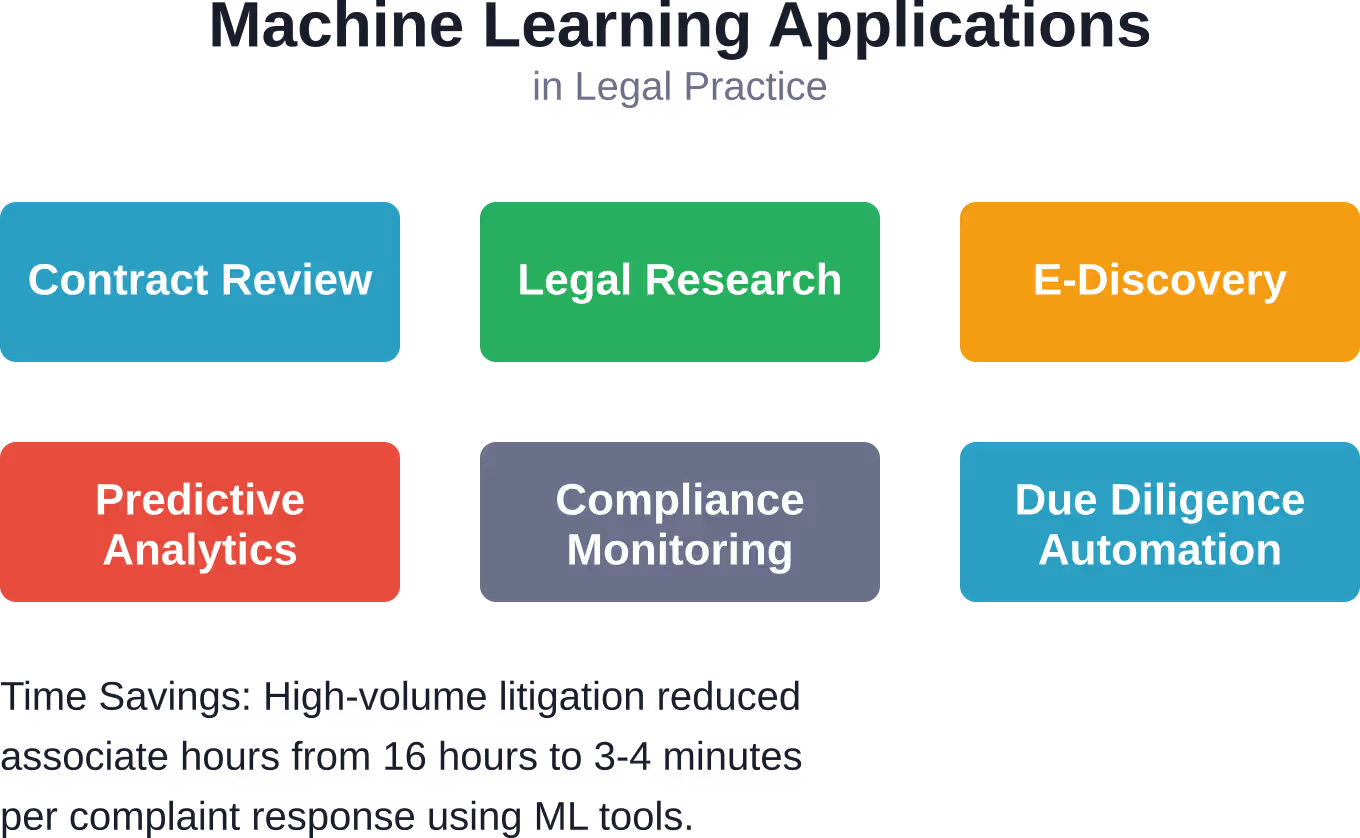
Machine learning changes that equation dramatically. What once took 16 hours of associate time now gets done in 3-4 minutes with AI-powered tools. That’s not hype—that’s actual performance data from high-volume litigation systems deployed at major law firms.
But here’s the thing: adoption isn’t uniform. While federal agencies documented 3,600 individual AI use cases across 41 agencies in 2025—a 69% jump from the previous year—many legal professionals remain cautious. Concerns about accuracy, ethics, and regulatory compliance create friction.
This guide explores how machine learning actually works in legal practice, where it delivers measurable value, and what obstacles still need solving.
How Machine Learning Transforms Core Legal Tasks
Machine learning excels at pattern recognition. Feed it thousands of contracts, and it learns to identify standard clauses, flag unusual terms, and spot potential risks automatically.
Contract Review and Analysis
Contract review represents one of the most mature applications. Machine learning systems trained on legal documents can automatically extract key provisions, identify missing clauses, track expiration dates, and flag non-standard language.
In practice, this means lawyers spend less time on mechanical review and more time on strategic analysis. The technology doesn’t replace legal judgment—it accelerates the groundwork that informs that judgment.
Legal Research and Case Law Analysis
Natural language processing—a subset of machine learning—has become increasingly sophisticated at understanding legal text. Systems can now parse tens of thousands of case records within minutes, identifying relevant precedents and extracting key holdings.
Stanford researchers have explored whether NLP is ready for complex legal hearings. The answer? Partially. The technology handles structured legal documents well but still struggles with nuanced argumentation and context-dependent interpretation.
Document Discovery and E-Discovery
During litigation, legal teams often review millions of documents searching for relevant evidence. Machine learning dramatically reduces this burden through predictive coding—algorithms learn from lawyer-reviewed documents to automatically classify remaining documents by relevance.
This isn’t just faster. It’s demonstrably more consistent than human review alone, reducing the variability that comes from reviewer fatigue and subjective interpretation.

Revolutionize Legal Operations with Trusted ML Partner
Machine learning is reshaping the legal industry, streamlining document review, case predictions, and research efficiency. AI Superior helps legal firms and organizations implement custom AI and ML solutions that address specific data challenges and enhance overall workflow performance.
Unlock AI for Your Legal Projects
Turn to AI Superior to get:
- Automated document analysis and contract review tools
- Predictive models for case outcomes and risk assessments
- Efficient research automation and compliance management
👉Contact AI Superior today to explore how their AI solutions can optimize your legal operations.
Adoption Trends: Where the Legal Industry Stands
Adoption numbers tell two stories simultaneously: rapid acceleration and persistent hesitation.
Federal adoption shows particularly aggressive growth, with agencies documenting expansion of AI use cases over recent years. Similarly, broader business adoption has accelerated significantly in recent years, with larger firms adopting faster than smaller ones.
By 2025, adoption metrics showed significant increases, with many firms indicating likely near-term adoption. That’s momentum, but it’s hardly a universal transformation.
Government Leads the Way
Federal agencies show particularly aggressive adoption. The 3,600 documented AI use cases in 2025 represent a distinct growth path, but the baseline of 720 in 2023 actually referred to a different set of reporting criteria established under Executive Order 13960.
Law Firm Adoption Varies Widely
Large law firms face a complex calculation. AI tools promise efficiency gains, but the billable hour model creates perverse incentives—why adopt technology that reduces the hours billed to clients?
Some firms are experimenting with alternative fee arrangements that better align with AI-driven efficiency. Others focus on using automation to improve margins on fixed-fee work or to handle higher volumes without proportionally increasing headcount.
| Year | Federal AI Use Cases | Year-over-Year Growth |
|---|---|---|
| 2023 | ~720 | baseline |
| 2024 | ~2,130 | ~196% |
| 2025 | 3,600 | 69% |
Practical Benefits: What Actually Improves
The productivity gains are real and measurable. But they cluster around specific task categories rather than transforming all legal work uniformly.
Speed and Volume
Machine learning handles volume that would overwhelm human teams. Reviewing thousands of discovery documents, analyzing hundreds of contracts, or researching decades of case law—tasks that once required weeks now complete in hours or days.
That high-volume litigation example—16 hours reduced to 3-4 minutes—represents a 99.6% time reduction. Even accounting for setup, training, and quality review, the net efficiency gain remains enormous.
Consistency and Error Reduction
Human reviewers get tired. Attention wanders. Interpretation drifts across a long review session. Machine learning doesn’t have those problems. Once properly trained, algorithms apply the same criteria consistently across millions of documents.
This consistency particularly matters in regulatory compliance, where missing a single problematic clause can create significant liability.
Cost Containment
Efficiency translates directly to cost reduction—either fewer billable hours for clients or improved margins for firms operating on fixed fees. In corporate legal departments, automation allows teams to handle growing workloads without proportional headcount increases.
Significant Challenges Still Remain
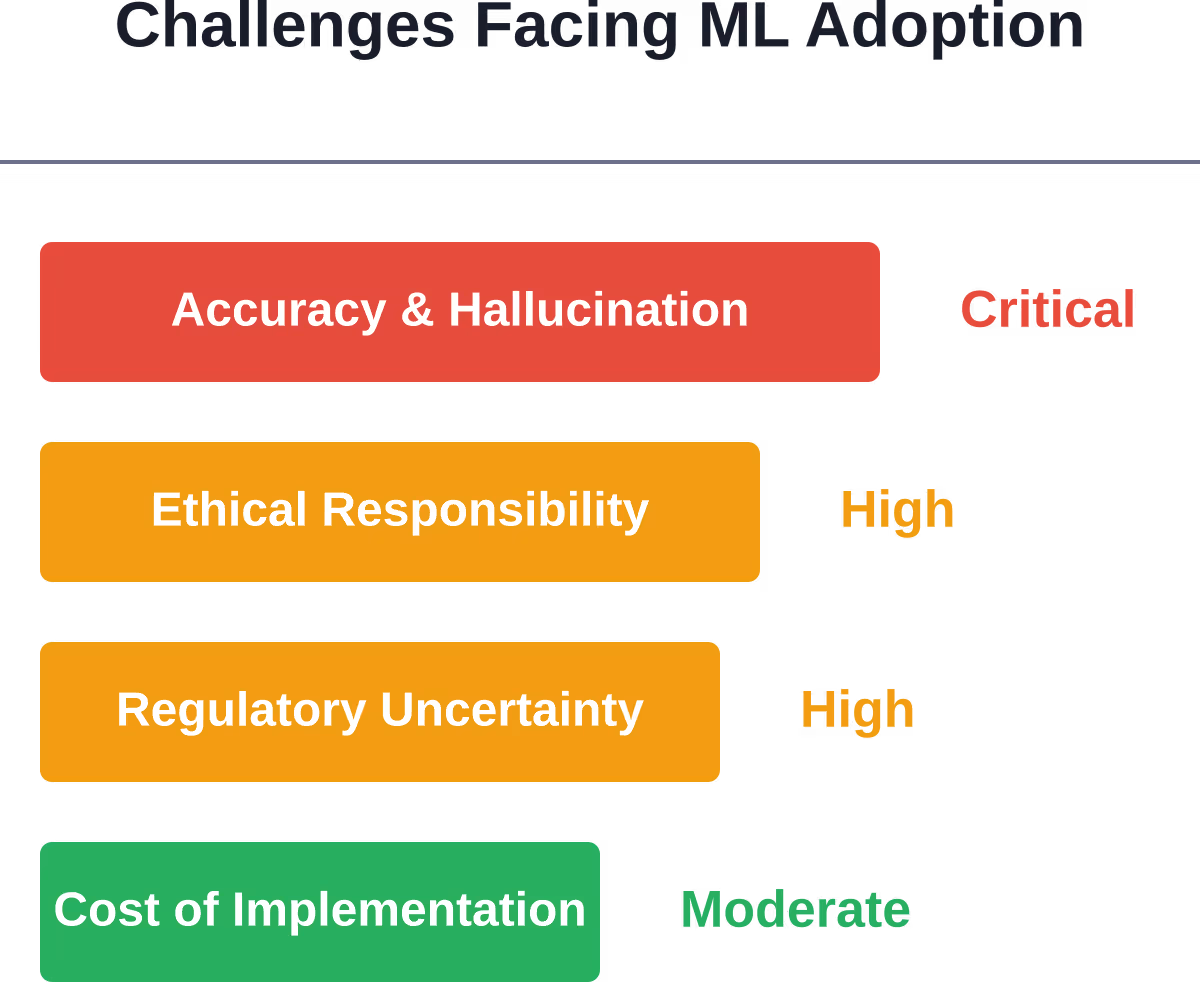
Enthusiasm needs tempering with reality. Machine learning in legal practice faces substantial obstacles.
Accuracy and Hallucination Risks
Large language models can generate impressively fluent text—including confidently stated but entirely fabricated case citations. The Federal Trade Commission has been particularly vocal about AI accuracy issues, filing suit in June 2024 against FBA Machine and its operators for fraudulently guaranteeing income from AI-powered business tools.
Legal work tolerates zero margin for invented precedents or fabricated statutes. The technology isn’t yet 100% reliable, requiring human oversight on every output.
Ethical and Professional Responsibility
Lawyers face professional obligations around competence, confidentiality, and independent judgment. Using AI tools raises questions: Who’s responsible when an algorithm misses relevant precedent? How do confidentiality duties apply to data sent to third-party AI platforms? Does over-reliance on automated analysis compromise independent professional judgment?
State bars are developing guidance, but the ethical framework remains unsettled.
Regulatory Uncertainty
The National Institute of Standards and Technology (NIST) released its AI Risk Management Framework (AI RMF 1.0) in January 2023, and subsequently released the AI RMF Generative AI Profile in July 2024. NIST emphasizes that legal and regulatory requirements involving AI must be understood, managed, and documented.
But specific regulations remain in flux. The FTC has been active—issuing compliance plans, investigating surveillance pricing practices, and pursuing enforcement actions. Legal technology providers face evolving compliance obligations that complicate deployment.
Training and Change Management
Legal professionals trained in traditional research methods face a learning curve. Understanding what AI tools can and can’t do, learning to prompt them effectively, and developing judgment about when to trust automated outputs—all require investment in training.
Resistance isn’t always irrational. Experienced lawyers have seen technology hype cycles come and go. Skepticism serves as a useful filter against adopting immature tools prematurely.
Fairness and Bias Considerations
Machine learning models learn from training data. If that data reflects historical biases—in sentencing patterns, hiring decisions, or credit determinations—the model may perpetuate those biases at scale.
Research into fairness in machine learning identifies multiple mathematical definitions of fairness that can conflict with each other. Calibration, for instance, requires that predicted probabilities match actual outcomes within demographic groups. But achieving calibration across groups can conflict with other fairness metrics like equal false-positive rates.
Legal applications demand particular scrutiny. Predictive policing tools, bail recommendation systems, and risk assessment algorithms all raise concerns about perpetuating systemic bias under the guise of objective analysis.
Looking Ahead: The Future of Law Practice
Machine learning won’t replace lawyers. But it will continue reshaping what legal work looks like day-to-day.
Routine document review, basic research, and compliance monitoring will become increasingly automated. Legal professionals will spend more time on strategic counseling, negotiation, and judgment calls that require human context and creativity.
The economic model will shift too. As efficiency improves, hourly billing becomes harder to justify. Alternative fee arrangements—fixed fees, subscriptions, success fees—will likely grow. That changes how law firms think about profitability and investment in technology.
Regulatory frameworks will mature. NIST’s AI Risk Management Framework provides a foundation. State bars will develop clearer ethical guidance. The FTC and other agencies will establish enforcement patterns that clarify compliance obligations.
And the technology itself will improve. Accuracy will increase. Context understanding will deepen. Integration with legal workflows will become more seamless.
Frequently Asked Questions
How accurate are machine learning tools for legal research?
Accuracy varies significantly by tool and application. Systems trained on structured legal documents achieve high accuracy for tasks like clause extraction and term identification. However, large language models still generate fabricated citations and incorrect legal analysis—requiring human verification of all outputs. No current AI tool is reliable enough to use without lawyer oversight.
Can machine learning replace lawyers?
No. Machine learning automates specific tasks—document review, pattern recognition, information extraction—but cannot replace legal judgment, strategic thinking, client counseling, or courtroom advocacy. The technology augments lawyer capabilities rather than substituting for them. Legal professionals who effectively use AI tools will likely outperform those who don’t.
What are the ethical concerns around AI in law?
Key concerns include maintaining confidentiality when using cloud-based AI platforms, ensuring competent supervision of AI outputs, avoiding over-reliance that compromises independent judgment, and addressing bias in training data that may perpetuate discrimination. State bars are developing guidance, but lawyers remain personally responsible for all work products regardless of what tools assisted in its creation.
How much does legal AI software cost?
Pricing varies widely by vendor, feature set, and firm size. Check vendor websites for current pricing—many legal AI platforms use subscription models with tiered pricing based on users, document volume, or feature access. Some enterprise platforms require custom quotes. Costs have generally decreased as the market matures and competition increases.
What legal tasks benefit most from machine learning?
High-volume, pattern-recognition tasks show the greatest return: e-discovery document review, contract analysis across large portfolios, due diligence document sorting, regulatory compliance monitoring, and legal research across large case law databases. Tasks requiring nuanced judgment, creative strategy, or client relationship management see less direct benefit from current AI capabilities.
How do law firms handle AI training data confidentiality?
Responsible firms use AI vendors that contractually guarantee data isolation, don’t train models on client data, and maintain appropriate security certifications. Some firms deploy on-premises AI solutions to avoid sending client data to external platforms. Others anonymize or redact sensitive information before using it with AI tools. Data handling remains a critical consideration in vendor selection.
What regulations govern AI use in legal practice?
No comprehensive federal AI regulation currently exists for legal practice specifically. However, existing professional responsibility rules apply—duties of competence, confidentiality, and diligence all govern AI use. NIST’s AI Risk Management Framework provides voluntary guidance. The FTC actively polices deceptive AI marketing claims. Individual state bars issue ethics opinions addressing AI use by lawyers in their jurisdictions.
Conclusion
Machine learning has moved from experimental curiosity to practical tools in legal practice. The 3,600 AI use cases documented across federal agencies in 2025 demonstrate real deployment at scale. Productivity gains—turning 16-hour tasks into 4-minute processes—show genuine transformation in specific workflows.
But adoption remains uneven and challenges persist. Accuracy concerns, ethical uncertainties, and regulatory flux all slow broader deployment. The technology works best for high-volume, pattern-recognition tasks while still struggling with nuanced judgment and complex reasoning.
Legal professionals face a choice: engage thoughtfully with AI tools to enhance practice efficiency and effectiveness, or ignore the shift and risk falling behind competitors who master these capabilities. The technology won’t replace lawyers, but lawyers who effectively use the technology will increasingly outperform those who don’t.
The legal industry’s transformation has begun. Understanding where machine learning delivers value—and where it still falls short—positions legal professionals to navigate that transformation successfully.
 English
  German
  Arabic
  French
  Dutch
Dutch  Spanish