
Quick Summary: Machine learning transforms growth marketing by enabling real-time personalization, predictive customer insights, and automated campaign optimization at scale. Rather than relying on intuition, marketers now deploy algorithms that analyze behavioral patterns, forecast churn, and dynamically adjust messaging to maximize conversions—driving measurable improvements in acquisition, retention, and revenue efficiency.
Growth marketing has always demanded experimentation, rapid iteration, and data-driven decision-making. But the sheer volume of customer touchpoints—emails, social ads, website interactions, mobile app sessions—overwhelms even the most analytical teams. Enter machine learning: algorithms that identify patterns humans miss, predict outcomes before they happen, and automate optimization at a pace manual testing can’t match.
The numbers tell the story. The global AI market, which stood at $233.46 billion in 2024, is projected to reach $1,771.62 billion by 2032—a compound annual growth rate of 29.20%. For growth marketers, this isn’t abstract tech hype. It’s a fundamental shift in how campaigns are built, tested, and scaled.
Here’s the thing though—machine learning isn’t magic. It requires clean data, clear objectives, and humans who understand both the business and the algorithms. This guide breaks down how machine learning actually works in growth marketing, where it delivers the most ROI, and what traps to avoid.
Why Machine Learning Matters for Growth Marketing
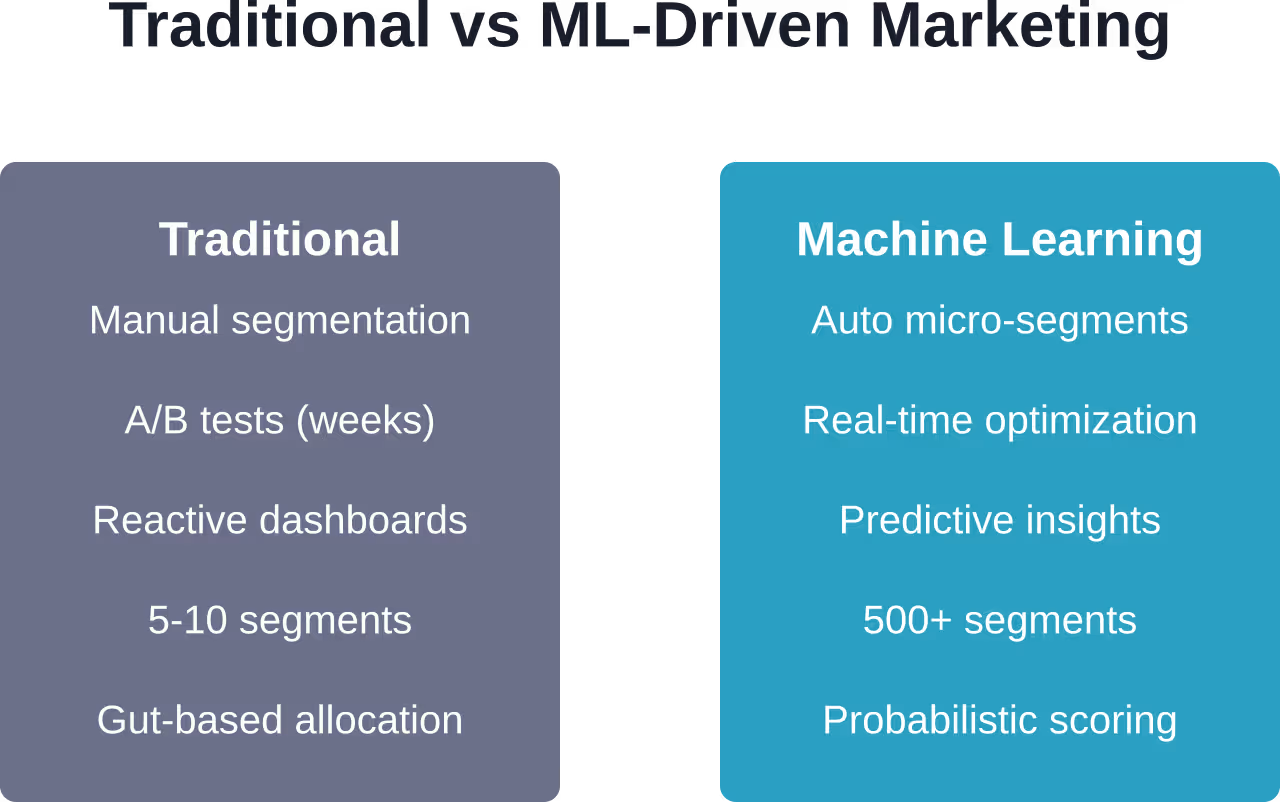
Traditional marketing analytics show what happened. Machine learning predicts what happens next—and automates the response.
Growth teams operate in a world of diminishing marginal returns. The first round of A/B tests yields big wins. The second round finds smaller improvements. After dozens of experiments, intuition-based optimization hits a wall. Machine learning breaks through that ceiling by processing multidimensional data at scale.
Consider personalization. A marketer can manually segment customers into five groups. A machine learning model can identify 500 micro-segments based on behavioral patterns, purchase timing, channel preference, and predicted lifetime value—then dynamically assign each visitor to the optimal experience in milliseconds.
Real talk: this isn’t about replacing marketers. It’s about amplifying their judgment. A skilled growth marketer defines the objective (maximize trial conversions, reduce churn in month two, increase average order value). The algorithm handles the combinatorial complexity of matching thousands of users to the right message at the right time.
From Reactive to Predictive
The shift from descriptive to predictive analytics changes the game. Descriptive dashboards report last week’s conversion rate. Predictive models forecast next month’s churn risk for each customer—allowing proactive intervention.
One study of B2B beverage clients used machine learning to predict which businesses would achieve sales uplift after receiving commercial coolers, analyzing data from 3,119 clients tracked from 2022-01 to 2024-07. This model framed the task as multithreshold binary classification with targets of 10%, 30%, and 50% growth, utilizing 12 months of pretreatment and posttreatment data. This isn’t guesswork. It’s resource allocation based on probability.
Or take customer acquisition. Multi-armed bandit algorithms optimize online ad impressions in real time, testing variations and shifting budget toward winners without waiting for statistical significance. Research showed an 8% improvement in customer acquisition without additional costs achieved through adaptive learning and real-time data optimization—a finding documented in academic research and applied across industry implementations.
Core Machine Learning Applications in Growth Marketing
Machine learning isn’t one technique. It’s a toolkit. Different algorithms solve different problems. Growth marketers need to match the method to the objective.
Behavioral Pattern Recognition and Segmentation
Static segments—demographics, firmographics, basic purchase history—miss the nuance of intent. Machine learning models cluster users based on behavioral sequences: which pages they visit, how long they linger, what they ignore, when they return.
These dynamic segments update in real time. A visitor who browses pricing three times in two days signals higher intent than someone who viewed a blog post once. The algorithm assigns a propensity score and triggers the appropriate nurture sequence.
Real-time segmentation enables adaptive content. Email subject lines, landing page headlines, product recommendations—all customized based on up-to-the-moment interactions. This isn’t batch-and-blast. It’s lifecycle-based messaging that evolves as the customer moves through the funnel.
Churn Prediction and Retention Optimization
Acquisition costs money. Retention multiplies it. Identifying at-risk customers before they churn allows targeted intervention—discounts, outreach, feature education—when it still matters.
Machine learning churn models analyze usage patterns, engagement frequency, support ticket history, and payment behavior.
But accuracy means nothing without action. The model must surface actionable risk scores. A customer with an 80% churn probability in the next 30 days gets immediate attention—a personal email from success, a limited-time offer, a product demo. Someone at 15% stays in the standard nurture track.
Here’s where humans still matter: defining the intervention strategy. The algorithm predicts. The growth team designs the save campaign.
Predictive Customer Lifetime Value
Not all customers are worth the same. Predictive LTV models forecast which leads will become high-value accounts, allowing smarter budget allocation.
A B2C brand might discover that customers who purchase within 48 hours of signup and engage with email content have 3x higher LTV than those who take seven days and ignore emails. The algorithm scores every new lead, and ad spend flows toward sources that deliver high-LTV cohorts.
This flips the traditional funnel. Instead of optimizing for volume at the top, growth teams optimize for quality—targeting prospects who match the behavioral profile of the best existing customers.
Dynamic Pricing and Offer Optimization
Pricing isn’t static. Machine learning models test thousands of price-feature-discount combinations, learning which offers convert which segments.
An e-commerce brand might vary discounts by cart value, time of day, and browsing history. A SaaS company might adjust trial length based on company size and engagement signals. The algorithm runs continuous multivariate tests, adapting faster than manual experimentation ever could.
One caveat: dynamic pricing requires transparency. Customers rebel when they discover arbitrary price discrimination. The best implementations optimize within ethical guardrails—offering contextual discounts (abandoned cart recovery, seasonal promotions) rather than opaque individualized pricing.
Content Personalization and Recommendation Engines
Collaborative filtering—the algorithm behind Netflix and Amazon recommendations—applies directly to content marketing. Visitors who read Article A and downloaded Whitepaper B often convert after viewing Case Study C. The model surfaces C to similar visitors.
Email campaigns benefit even more. Adaptive emails change content blocks based on recipient behavior. Someone who clicked on product features in the last email sees a demo CTA. Someone who ignored three emails gets a re-engagement offer. The message evolves with the relationship.
And optimal send time prediction matters more than most marketers realize. Sending at 10 AM Tuesday might work for one segment, but another converts best at 7 PM Friday. Algorithms learn individual timing preferences and schedule accordingly—boosting open rates without changing the message.

Test Growth Marketing Ideas With AI Superior
Growth marketing often depends on fast testing, but machine learning needs more structure than a regular campaign experiment. AI Superior can help teams decide which growth use cases are suitable for ML, what data is strong enough, and how to test a model before relying on it.
Their work includes AI consulting, data science, machine learning, AI software development, proof of concept development, and model evaluation. That fits growth teams looking at prediction, personalization, customer journeys, or automated decision support.
AI Superior can help with:
- Selecting realistic ML use cases for growth goals
- Reviewing user behavior, funnel, product, and campaign data
- Building proof of concept models
- Developing models for conversion prediction or retention analysis
- Testing model outputs against business metrics
- Planning integration with growth tools or internal dashboards
- Supporting AI development after the concept is validated
For growth marketing, this may apply to conversion optimization, retention modeling, user segmentation, recommendation systems, funnel analysis, and experiment prioritization.
Contact AI Superior to discuss the project.
How Machine Learning Models Learn: A Non-Technical Primer
Most growth marketers don’t need to code neural networks. But understanding how models learn prevents costly mistakes.
Supervised Learning: Teaching With Examples
Supervised models learn from labeled data. Show the algorithm 10,000 customers, half who churned and half who stayed, with their associated behavior. The model identifies patterns that predict the outcome.
This powers most growth applications: churn prediction, LTV forecasting, lead scoring. The algorithm needs historical outcomes to train—ideally at least thousands of examples, though techniques like transfer learning can work with less.
Unsupervised Learning: Finding Hidden Patterns
Unsupervised models cluster data without predefined labels. Feed the algorithm customer behavior, and it groups similar users—revealing segments you didn’t know existed.
This is powerful for discovery. A manual analyst might segment by industry and company size. An unsupervised model might find that engagement cadence and feature adoption matter more—surfacing a high-value micro-segment that was invisible in traditional reporting.
Reinforcement Learning: Learning by Doing
Reinforcement learning algorithms optimize through trial and error. Multi-armed bandit models test variations, measure results, and shift traffic toward winners—continuously balancing exploration (testing new options) and exploitation (capitalizing on known winners).
This suits fast-moving growth environments. Rather than locking in a test design for two weeks, the algorithm adapts daily. That 8% customer acquisition improvement mentioned earlier? That came from a reinforcement learning approach to ad impression allocation.
Real-World Performance Benchmarks
Theory is cheap. ROI matters. What kind of lift can machine learning actually deliver?
Case studies show measurable gains across the funnel. Implementations of machine learning for personalization have shown improvements including 21% increases in average user sessions, 31% increases in conversions, 24% uplifts in revenue per user, and 13% improvements in repeat purchases. That’s not incremental tweaking. That’s compounding growth.
Additional case studies report conversion rate lifts of 250% and increases of 49% in other key metrics, though specific implementations vary. These aren’t isolated outliers—they reflect what happens when you replace batch-and-blast with adaptive, data-driven personalization.
But context matters. A company with messy data, unclear objectives, and no process for acting on model outputs won’t see these results. Machine learning amplifies good marketing. It can’t fix broken fundamentals.
| Application | Typical Improvement | Key Success Factor |
|---|---|---|
| Churn prediction | 15-25% reduction in churn | Fast intervention workflows |
| Lead scoring | 20-40% increase in conversion rate | Sales follow-up alignment |
| Email personalization | 10-30% lift in engagement | Dynamic content blocks |
| Ad optimization | 8-15% improvement in CAC | Real-time budget reallocation |
| Recommendation engines | 20-35% increase in AOV | Sufficient product catalog |
Data Requirements and Quality Standards
Machine learning is data-hungry. Not just volume—quality. Garbage in, garbage out isn’t a cliché. It’s the most common reason ML projects fail.
Minimum Viable Data Sets
Supervised models need labeled examples. For churn prediction, that means historical data on who churned and who didn’t. For LTV forecasting, cohort data showing actual lifetime value. For lead scoring, conversion outcomes.
How much? Generally speaking, thousands of examples per class. Techniques like data augmentation and transfer learning can help with smaller data sets, but there’s no magic workaround for insufficient training data.
Data Hygiene Checklist
Before feeding data into a model, clean it ruthlessly:
- Remove duplicates—merged leads, test accounts, bots
- Handle missing values consistently (impute, flag, or exclude)
- Standardize formats (dates, currencies, categorical values)
- Address class imbalance (churn is usually 5-10%, not 50%)
- Validate outliers (a $10M order from a startup might be a data entry error)
One retailer discovered their churn model was learning to predict data entry mistakes rather than actual churn. The model had 90% accuracy in testing—and failed completely in production. Data quality trumps algorithm sophistication every time.
Feature Engineering: The Underrated Skill
Raw data rarely works as-is. Feature engineering transforms data into variables the model can learn from. Instead of timestamp, derive “days since last login.” Instead of total spend, calculate “spend velocity” (change over time).
Good features encode domain knowledge. A growth marketer who understands that engagement clusters around specific product milestones can engineer features that capture those thresholds—dramatically improving model performance.
Automation at Scale: Moving Beyond Manual Campaigns
Machine learning’s biggest impact isn’t insight—it’s automation. Models that predict and act, not just report.
Closed-Loop Optimization
Traditional campaigns: launch, monitor for a week, manually adjust, repeat. Machine learning campaigns: launch, algorithm adjusts in real time, human reviews weekly summary.
This requires integration. The model must connect to execution systems—email platforms, ad networks, personalization engines. API calls trigger actions based on model scores. A visitor with high purchase intent sees a demo CTA. Someone at risk of churning gets a retention offer. The whole loop runs without human intervention.
At a major sales organization, 90% of the sales force accessed a centralized BI solution weekly, enabling self-service analytics powered by ML-driven insights. The system became a one-stop shop, eliminating the bottleneck of centralized reporting and empowering reps to act on fresh data.
Multi-Touch Attribution and Budget Allocation
Last-click attribution is dead. Machine learning attribution models analyze the full customer journey—every touchpoint, every channel—assigning credit based on actual influence.
This matters for budget allocation. If paid social drives awareness but organic search converts, last-click gives all credit to search. An ML attribution model recognizes the complementary effect and maintains a budget for both.
Implementing this requires unified data. Customer IDs must persist across web, mobile, email, and offline interactions. Many companies struggle here—not because the algorithms are hard, but because their data infrastructure fragments the customer journey.
Challenges, Limitations, and Ethical Considerations
Machine learning isn’t a silver bullet. It introduces complexity, risk, and ethical questions that growth teams must navigate carefully.
The Cold Start Problem
New products, new markets, and new customer segments lack historical data. Models trained on existing customers might not generalize. A B2B SaaS company expanding from startups to enterprise can’t assume the same behavioral signals predict conversion.
Solutions include transfer learning (adapting models from similar domains), hybrid approaches (combining rules-based logic with ML for new segments), and active learning (strategically selecting which new data points to label for fastest model improvement).
Model Drift and Retraining Cadence
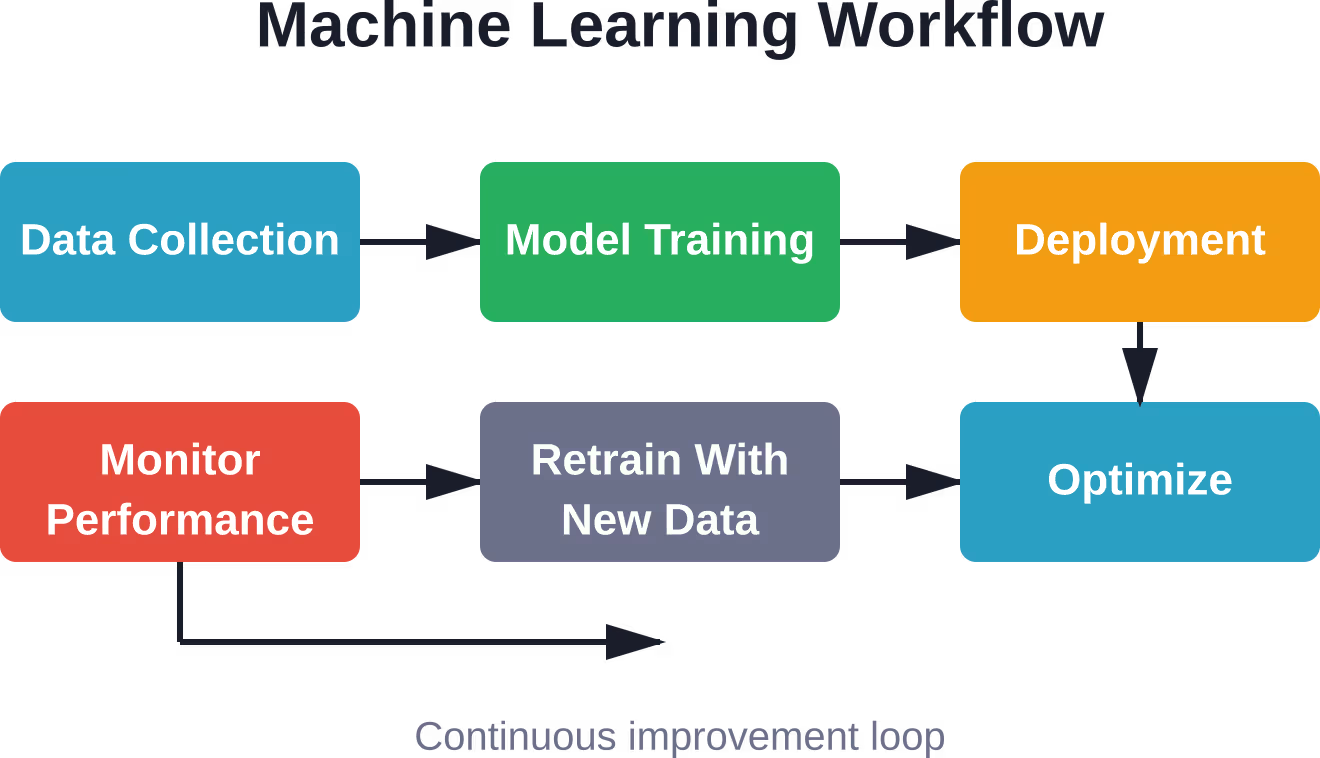
Customer behavior changes. Market conditions shift. A model trained in Q1 might underperform by Q3. Monitoring performance metrics—accuracy, precision, recall—catches drift before it damages outcomes.
Best practice: automated retraining pipelines. When performance dips below a threshold, trigger retraining with recent data. Some teams retrain monthly, others weekly. The right cadence depends on how fast behavior changes and how much new data accumulates.
Explainability and Trust
Black-box models create friction. A sales team won’t trust lead scores they can’t understand. Growth marketers need to know why a segment was flagged, not just that it was.
Techniques like SHAP (SHapley Additive exPlanations) and LIME (Local Interpretable Model-agnostic Explanations) decompose predictions, showing which features contributed most. This builds trust and surfaces counterintuitive insights—sometimes the model discovers patterns humans missed.
Privacy, Bias, and Ethical Guardrails
Machine learning inherits the biases in training data. If historical data reflects discriminatory practices, the model perpetuates them. Growth teams must audit for bias—testing model predictions across demographic segments and intervening when disparities emerge.
Privacy regulations (GDPR, CCPA) add constraints. Models can’t use data customers didn’t consent to. Anonymization and aggregation techniques help, but there’s tension between personalization and privacy. The best implementations default to privacy, using ML to optimize within strict data minimization rules.
And transparency matters. Customers should understand when they’re interacting with automated systems. Hidden manipulation—deceptive pricing, exploitative nudges—damages trust and invites regulation.
Building a Machine Learning Growth Stack
Implementing ML doesn’t require a data science PhD. It does require the right tools, roles, and workflows.
Essential Infrastructure Components
Growth teams need:
- Data warehouse: Centralized storage (Snowflake, BigQuery, Redshift) where customer data from all sources lives
- Activation layer: Reverse ETL tools (Census, Hightouch) that push model scores back into execution systems
- Experimentation platform: A/B testing infrastructure that lets you validate ML-driven changes
- ML platform: Tools like Braze, Salesforce Einstein, or custom-built pipelines that handle model training and deployment
The stack must support iteration. Deploy a churn model, measure impact, retrain, deploy v2. The faster this cycle runs, the faster you improve.
Roles and Team Structure
Who builds and maintains ML systems? Options include:
- Growth analysts: Use no-code/low-code ML tools to build basic models
- Data scientists: Embedded in growth teams, owning model development and iteration
- ML engineers: Focus on infrastructure, deployment, and scaling
- Product managers: Define use cases, success metrics, and prioritization
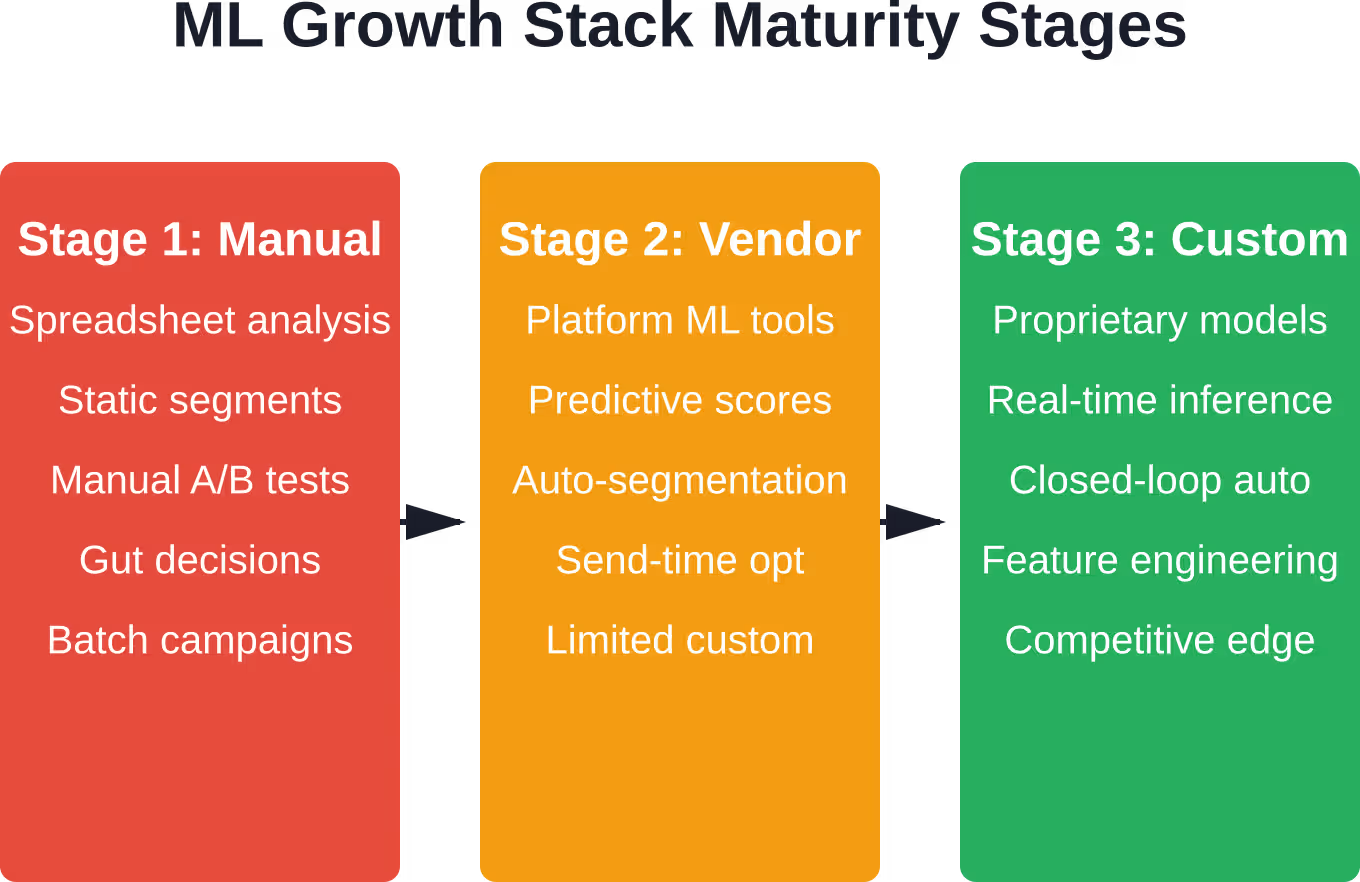
Small teams start with no-code tools and vendor solutions. Larger teams build custom infrastructure. The right choice depends on budget, technical maturity, and competitive requirements.
Vendor Solutions vs. Build-Your-Own
Marketing platforms increasingly embed ML: predictive send time, content recommendations, audience lookalikes. For many teams, vendor solutions offer the fastest path to value.
Custom builds offer flexibility and competitive differentiation but require sustained engineering investment. Most companies adopt a hybrid approach—vendor tools for commodity use cases, custom models for strategic differentiators.
Getting Started: A Practical Roadmap
Machine learning doesn’t require a massive upfront investment. Start small, prove value, scale what works.
Step 1: Identify High-Impact Use Cases
Not all ML applications deliver equal ROI. Prioritize based on:
- Data availability: Do you have enough historical data to train a model?
- Business impact: Does a 20% improvement in this metric move revenue?
- Execution feasibility: Can your team act on model outputs?
Churn prediction often tops the list—data exists (historical churn), impact is clear (retained revenue), and action is straightforward (trigger save campaigns).
Step 2: Establish Baseline Performance
Measure current performance before deploying ML. What’s your baseline conversion rate, churn rate, or CAC? Without this anchor, you can’t prove ROI.
And run controlled experiments. Deploy the ML-driven approach to a subset of customers, compared against a control group. This isolates the model’s impact from other changes (seasonality, new product features, market shifts).
Step 3: Start With Vendor Tools
Most growth teams should begin with platform-embedded ML—Salesforce Einstein, Braze Intelligence Suite, Google Smart Bidding. These tools require minimal setup and deliver quick wins.
Once you’ve exhausted vendor capabilities and proven the value of ML, consider custom builds for strategic differentiators.
Step 4: Build Feedback Loops
Deploy, measure, iterate. Machine learning improves with more data and faster feedback. Set up dashboards that track model performance—not just business metrics (conversion rate) but model metrics (precision, recall, calibration).
When a model underperforms, diagnose: Is the data quality degrading? Has customer behavior shifted? Is the feature set incomplete? Treat models as living systems that need maintenance, not one-time projects.
The Expanding AI Growth Marketing Landscape
Machine learning is one piece of a broader AI transformation. Generative AI, large language models, and advanced decision support systems are reshaping growth marketing workflows.
Research on AI-integrated decision support systems for real-time market growth forecasting and multi-source content diffusion analytics shows how AI handles the rapid proliferation of AI-generated content itself—meta-level optimization where AI manages AI-created campaigns.
And causal predictive optimization frameworks go beyond correlation, attempting to infer causality. Instead of “customers who do X tend to convert,” these systems ask “does doing X cause conversion?”—enabling more confident intervention strategies.
The AI market’s trajectory—from $233.46 billion in 2024 to a projected $1,771.62 billion by 2032—reflects adoption across every industry. For growth marketers, the question isn’t whether to adopt ML, but how fast competitors are adopting it.
Yet despite this momentum, 23% of CEOs surveyed indicated they don’t believe marketers can deliver on the growth agenda. That gap represents both a challenge and an opportunity. Growth marketers who master ML close that credibility gap—demonstrating measurable, scalable impact.
Common Pitfalls and How to Avoid Them
Most ML failures aren’t technical. They’re organizational. Here’s what goes wrong—and how to prevent it.
Pitfall 1: Solution in Search of a Problem
Building ML because it’s trendy, not because it solves a problem. Start with the business objective. Define success metrics. Then ask: would ML help? If manual processes already deliver good results cheaply, ML might be overkill.
Pitfall 2: Ignoring Data Quality
Models amplify data problems. If 30% of your customer records have incorrect industry tags, a model trained on that data learns garbage. Invest in data hygiene before model sophistication.
Pitfall 3: No Plan for Acting on Predictions
A churn model that generates weekly reports no one reads is worthless. Design intervention workflows before deploying the model. Who receives the at-risk list? What actions do they take? How fast?
Pitfall 4: Overlooking Change Management
Humans resist algorithmic recommendations. Sales reps ignore lead scores that contradict their intuition. Customer success teams distrust churn predictions. Socialize the model early, involve stakeholders in design, and prove value with pilots before full rollout.
Pitfall 5: Set-and-Forget Mentality
Models decay. Retrain regularly, monitor performance, and iterate. The best ML teams treat models like products—versioned, tested, and continuously improved.
FAQ
What is machine learning in growth marketing?
Machine learning in growth marketing refers to algorithms that analyze customer data, predict behavior, and automate optimization—enabling personalization, churn prediction, lead scoring, and dynamic campaign adjustments at scale without manual intervention.
How is machine learning different from traditional marketing analytics?
Traditional analytics describe what happened (dashboards, reports). Machine learning predicts what will happen and automates responses. Instead of reporting last month’s churn rate, ML identifies which customers will churn next month and triggers retention campaigns automatically.
Do I need a data science team to use machine learning for growth marketing?
Not necessarily. Many marketing platforms embed ML tools that require no coding—predictive send times, automated segmentation, content recommendations. For advanced custom models, in-house data science expertise helps, but vendor solutions enable most teams to start immediately.
How much data do I need to train a machine learning model?
Generally speaking, thousands of labeled examples per category. For churn prediction, that means historical data on thousands of customers, some who churned and some who stayed. Techniques like transfer learning can work with less, but data scarcity limits model performance.
What’s the typical ROI timeline for machine learning in growth marketing?
Simple use cases (email send-time optimization, basic segmentation) can show ROI within weeks. Complex custom models (LTV prediction, multi-touch attribution) require 3-6 months for data collection, model development, testing, and iteration. Pilot small, scale what works.
Can machine learning models become biased or make unethical decisions?
Yes. Models learn from historical data, which may reflect past biases. If training data underrepresents certain customer segments or encodes discriminatory patterns, the model perpetuates them. Regular audits, diverse training data, and human oversight mitigate this risk.
How often should I retrain my machine learning models?
It depends on how fast customer behavior and market conditions change. Some teams retrain monthly, others weekly. Monitor model performance metrics—when accuracy, precision, or recall degrade, trigger retraining. Automated pipelines make frequent retraining feasible.
Conclusion: The Compounding Advantage of Machine Learning
Growth marketing has always been about systematic experimentation and rapid learning. Machine learning accelerates both—running more experiments, learning faster, and optimizing across dimensions humans can’t manually manage.
The data makes the case. Organizations implementing ML-driven personalization see 21% increases in sessions, 31% gains in conversions, and 24% revenue-per-user uplifts. Ad optimization algorithms improve customer acquisition by 8% without increasing spend.
But the real advantage compounds over time. Every interaction generates data. Every data point improves the model. Every model improvement drives better results. Growth teams that start now build flywheel competitors will struggle to match.
So where do you start? Identify one high-impact use case. Establish a baseline. Deploy a vendor tool or simple model. Measure. Iterate. Then scale what works and tackle the next use case.
Machine learning isn’t magic. It’s math applied systematically to growth problems. The teams that win won’t be those with the fanciest algorithms—they’ll be those who integrate ML into their growth operating system, learning faster and optimizing smarter than everyone else.
Ready to move beyond intuition? Your customer data already holds the patterns. Machine learning just makes them actionable.
 English
  German
  Arabic
  French
  Dutch
Dutch  Spanish