
Quick Summary: AI capabilities transforming business in 2026 span automation, predictive analytics, natural language processing, and autonomous decision-making. According to authoritative data, enterprise spending on GenAI is approaching $40 billion, yet 95% of integrated pilots fail to produce measurable ROI. The most valuable capabilities include workflow automation, customer intelligence, content generation, and data-driven forecasting—but success requires strategic implementation aligned with risk management frameworks from NIST and IEEE standards.
Artificial intelligence has moved beyond experimental projects into core business operations. But here’s the reality: while spending skyrockets, most organizations struggle to extract real value from their AI investments.
According to a recent MIT report, despite enterprise spending on GenAI approaching $40 billion, a staggering 95% of integrated pilots are failing to produce any measurable return. That’s not a technology problem—it’s an implementation problem.
The capabilities exist. The question is which ones actually matter for business outcomes, and how to deploy them without becoming another statistic in the 95% failure bracket.
Understanding AI Capabilities in Business Context
When businesses talk about AI capabilities, the conversation often veers toward shiny features rather than operational value. Real talk: capabilities only matter when they solve specific business problems.
NIST’s AI Risk Management Framework emphasizes cultivating trust in AI technologies while promoting innovation and mitigating risk. That framework matters because it separates legitimate capabilities from vendor hype.
The White House released “Winning the AI Race: America’s AI Action Plan” in July 2025, outlining over 90 Federal policy actions across three pillars. But for business leaders, the strategic question isn’t what AI can do theoretically—it’s what capabilities deliver measurable outcomes in real operational environments.
The Capability vs. Feature Distinction
Features are what vendors sell. Capabilities are what organizations build. A natural language interface is a feature. The ability to extract structured insights from unstructured customer feedback at scale is a capability.
That distinction matters because capabilities require integration, training, and organizational change. Features just require a subscription.

Develop AI Capabilities With AI Superior
AI Superior builds AI-based applications, custom software products, and machine learning systems. Their services include AI software development, AI consulting, R&D, training, computer vision, NLP, predictive analytics, BI, and big data analytics.
For businesses reviewing AI capabilities, this can help move from a general idea to a scoped project, tested MVP, and integrated solution.
Need AI Built for a Real Business Use Case?
AI Superior can help with:
- assessing AI use cases
- building custom AI and ML tools
- testing ideas through PoC or MVP development
- integrating AI into daily workflows
👉 Contact AI Superior to discuss your project.
Workflow Automation and Process Intelligence
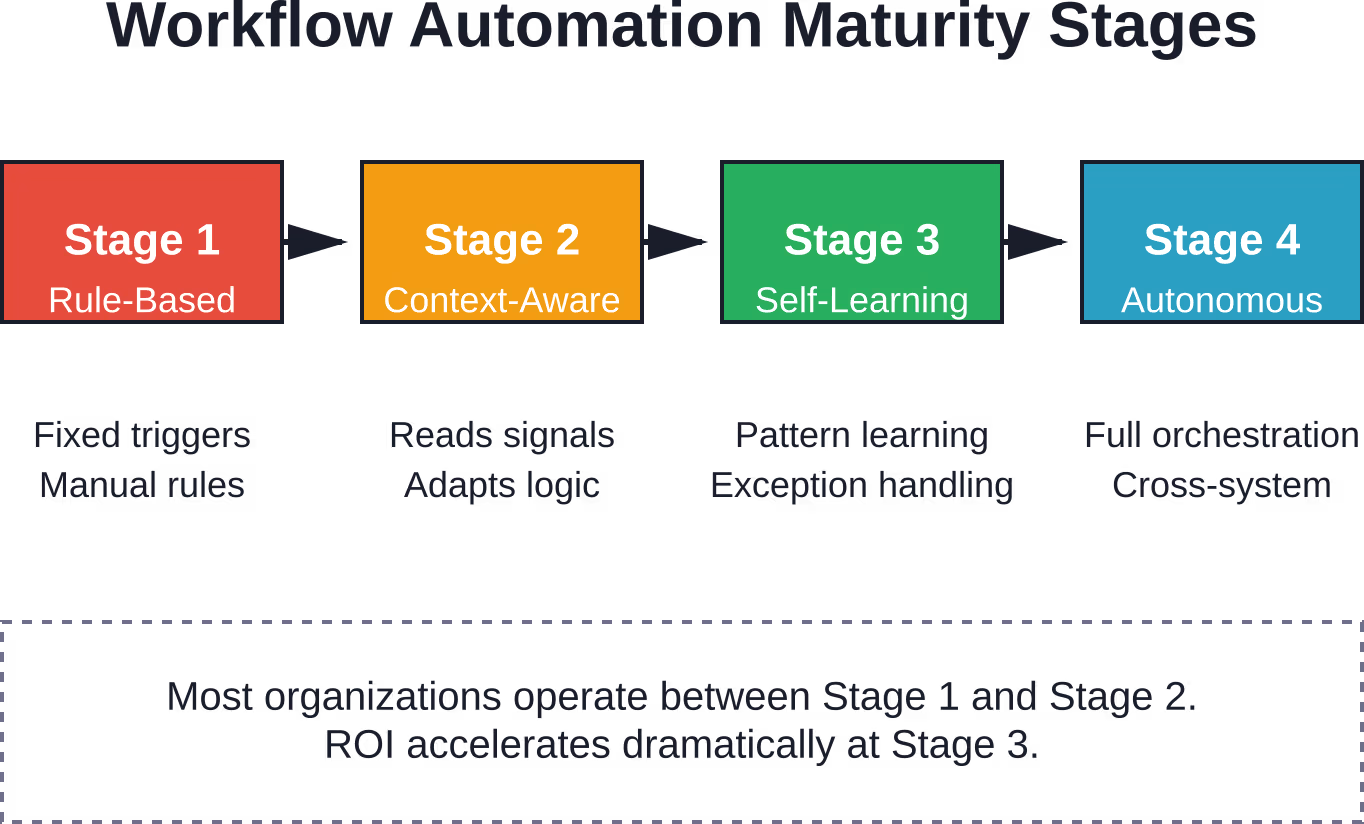
Automation represents the most mature and measurable AI capability for business. Not the simple if-then automation of previous decades—intelligent automation that adapts to context, learns from exceptions, and orchestrates across systems.
Research from Brookings Institution covering detailed data on job postings and individual employees, as much as 64% of the U.S. workforce, shows that AI has spurred firm growth and increased employment, contrary to displacement fears. But the organizations seeing those gains share common patterns: they’re automating repetitive cognitive work, not just mechanical tasks.
Multi-System Orchestration
The real capability isn’t automating a single task—it’s orchestrating workflows across disconnected systems. That’s where traditional automation broke down and why industry reports suggest 78% of enterprises struggle to integrate AI with current tech stacks.
Modern AI platforms connect CRM, ERP, communication tools, and data warehouses into unified workflows. The system pulls customer data from Salesforce, cross-references inventory in NetSuite, checks shipping logistics, and updates the customer via email—all without human intervention.
Sound familiar? It should. That’s what businesses have wanted for two decades. The difference now is natural language processing that handles variations in data formats, and machine learning that optimizes routing decisions based on outcomes.
Exception Handling and Edge Cases
Here’s where intelligent automation separates from its predecessors. Traditional automation fails on exceptions. AI automation learns from them.
When a workflow encounters an unexpected input—a purchase order with non-standard terms, a support ticket combining multiple issues—the system can flag it for human review while learning the resolution pattern. Over time, it handles similar exceptions autonomously.
That learning loop transforms automation from brittle to resilient. Research shows that firms investing in AI capabilities see employment growth as workers shift from repetitive exception-handling to higher-value problem-solving.
Predictive Analytics and Business Intelligence
Predictive capabilities move businesses from reactive to proactive operations. Not fortune-telling—probabilistic forecasting based on historical patterns, external signals, and real-time data streams.
According to Brookings Institution research on the effects of AI on firms and workers, AI deployment correlates with measurable business improvements. But predictive AI only works when organizations have clean data pipelines and clear decision frameworks.
Demand Forecasting
Traditional forecasting relied on historical averages and seasonal patterns. AI-powered forecasting incorporates hundreds of variables: market trends, competitor actions, weather patterns, social sentiment, supply chain signals, and economic indicators.
Retail operations use predictive models to optimize inventory across locations, reducing both stockouts and excess inventory. Manufacturing operations forecast equipment failures before they occur, scheduling maintenance during planned downtime rather than responding to breakdowns.
The capability extends beyond simple prediction to prescriptive recommendations. The system doesn’t just forecast demand spikes—it suggests optimal pricing, staffing levels, and inventory allocations to maximize margin while meeting service levels.
Customer Behavior Modeling
Amazon has reported that cross-selling and upselling driven by predictive recommendations make up as much as 35% of its revenue. That’s not magic—it’s systematic analysis of purchase patterns, browsing behavior, and cohort similarities.
Businesses deploy similar capabilities at smaller scales. The system identifies customers likely to churn based on usage patterns, engagement metrics, and lifecycle stage. It surfaces upsell opportunities when usage patterns indicate readiness for premium features.
Customer lifetime value predictions inform acquisition spending, retention investments, and segment prioritization. The models continuously refine themselves as actual behavior validates or contradicts predictions.
| Prediction Type | Business Impact | Implementation Complexity | Data Requirements |
|---|---|---|---|
| Demand forecasting | 10-20% inventory reduction | Medium | Historical sales, external signals |
| Churn prediction | 15-25% retention improvement | Low-Medium | Usage logs, engagement metrics |
| Lead scoring | 30-40% sales efficiency gain | Low | CRM data, conversion history |
| Equipment failure | 20-30% maintenance cost reduction | High | Sensor data, maintenance records |
Natural Language Processing and Understanding
NLP capabilities have advanced from keyword matching to genuine comprehension of context, intent, and nuance. That shift enables applications that were science fiction five years ago.
The capability isn’t just parsing sentences—it’s extracting structured meaning from unstructured text, understanding sentiment and tone, recognizing entities and relationships, and generating contextually appropriate responses.
Customer Communication at Scale
Businesses handle thousands of customer interactions daily across email, chat, social media, and support tickets. NLP systems triage incoming messages by urgency, sentiment, and complexity. Simple requests get automated responses. Complex issues route to specialists with context summaries.
The system learns company-specific terminology, product names, common issues, and resolution patterns. It doesn’t just match keywords—it understands that “the widget won’t sync” and “synchronization failure on the device” describe the same problem.
Through sentiment analysis and customer feedback evaluation, AI helps businesses understand customer satisfaction patterns across touchpoints. That intelligence flows back into product development, support training, and communication strategies.
Document Intelligence and Data Extraction
Organizations drown in unstructured documents: contracts, invoices, emails, reports, proposals. NLP capabilities extract structured data from these sources at scale.
Legal teams deploy AI to review contracts for standard clauses, flag non-standard terms, and extract key dates and obligations. Finance teams process invoices automatically, matching purchase orders to receipts and flagging discrepancies.
The capability extends to knowledge management. NLP systems index internal documentation, making institutional knowledge searchable and accessible. Employees ask questions in natural language and receive answers synthesized from multiple documents with source citations.
Computer Vision and Visual Intelligence
Computer vision capabilities enable businesses to extract insights from images and video at scales impossible for human review. Manufacturing, retail, security, and healthcare operations deploy these capabilities across quality control, inventory management, and safety monitoring.
Quality Inspection and Defect Detection
Manufacturing operations use computer vision to inspect products at production speed. The system examines every unit for defects that human inspectors might miss or identify inconsistently.
The AI learns what constitutes a defect from training data, then generalizes to detect similar issues. It doesn’t just flag defects—it classifies defect types, tracks patterns across production runs, and identifies upstream process issues causing quality problems.
That feedback loop enables continuous improvement. When defect rates spike for specific components or during certain shifts, the system surfaces those patterns for investigation.
Visual Search and Recognition
Retail operations deploy visual search capabilities that let customers find products by uploading photos. The system identifies items by visual features, suggesting exact matches or similar alternatives.
Warehouse operations use visual recognition for inventory management. Systems identify products without barcodes, verify shipment contents, and detect misplaced items. That reduces manual scanning and improves inventory accuracy.
Conversational AI and Voice Capabilities
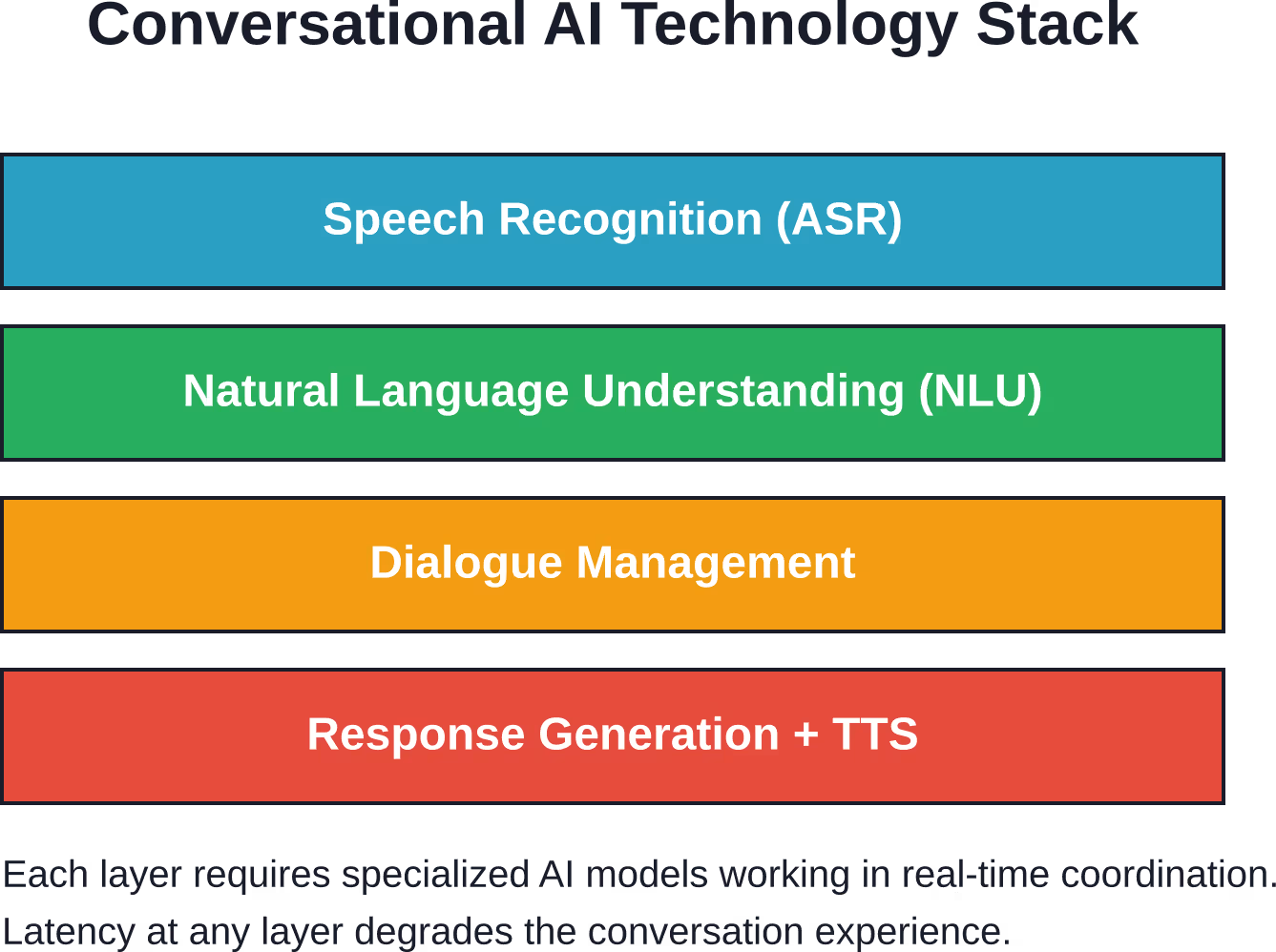
Conversational AI has evolved from frustrating phone trees to systems that conduct natural, contextual dialogues. The capability combines speech recognition, natural language understanding, dialogue management, and speech synthesis into seamless interactions.
Customer Service Automation
Voice agents handle routine customer service calls end-to-end: account inquiries, appointment scheduling, order status checks, and simple troubleshooting. The systems understand diverse accents, handle interruptions, and manage multi-turn conversations.
When conversations exceed the agent’s capabilities, it transfers to human agents with full context. The human doesn’t start from scratch—they see the transcript, extracted information, and the agent’s assessment of the issue.
That hybrid approach optimizes cost and satisfaction. Routine interactions resolve automatically. Complex issues get immediate human attention with better context than traditional IVR systems provide.
Internal Operations and Support
Conversational AI extends beyond customer-facing applications. Employees interact with internal systems via voice or chat: checking PTO balances, submitting expense reports, accessing HR policies, requesting IT support.
The system integrates with enterprise applications, executing transactions and retrieving information across systems. It understands company-specific terminology and organizational context that generic assistants lack.
Content Generation and Creative AI
Generative AI capabilities create text, images, code, and other content based on prompts and training data. These capabilities accelerate content production, enable personalization at scale, and augment creative work.
But here’s the thing: content generation only delivers value when integrated into workflows with proper review, brand alignment, and quality control. Raw generation without governance creates more problems than it solves.
Marketing Content and Copywriting
Marketing teams deploy generative AI to create draft content across channels: email campaigns, social posts, blog articles, ad copy, and product descriptions. The systems learn brand voice, messaging guidelines, and audience preferences.
The capability isn’t replacing copywriters—it’s accelerating first drafts. A marketer outlines key points and positioning; the AI generates draft copy variations. The human refines, adapts, and approves. That workflow cuts production time while maintaining quality and brand consistency.
Personalization scales through generation. Instead of one email blast, the system creates variations tailored to customer segments, purchase history, and engagement patterns. Subject lines, body content, and calls-to-action adapt to recipient characteristics.
Code Generation and Development Assistance
Development teams use AI code generation to accelerate implementation. Developers describe functionality in natural language or provide partial code; the system generates complete implementations, suggests optimizations, and identifies potential bugs.
The capability extends beyond simple code completion. AI systems review pull requests, explain complex codebases, generate documentation, and create test cases. Research shows that workers with AI skills command premium compensation, with TensorFlow skills showing a 0.9 co-occurrence score with core AI capabilities—meaning 90% of job postings requiring TensorFlow also require fundamental AI skills.
Organizations adopting these capabilities report productivity gains in development velocity, code quality, and onboarding speed for new team members.
AI Agents and Autonomous Systems
AI agents represent a capability leap from tools to autonomous collaborators. These systems pursue goals across multiple steps, make decisions within defined parameters, and coordinate across tools and data sources without constant human direction.
According to recent benchmark assessments, AI agent readiness for business focuses on safety and effectiveness in real-world tasks in real-world tasks. The standards emphasize controlled autonomy—agents operate within guardrails, not unconstrained.
Sales and Lead Generation Agents
Sales teams deploy AI agents that research prospects, qualify leads, and initiate outreach. The agent identifies potential customers matching ideal customer profiles, researches their business challenges and initiatives, and crafts personalized outreach messages.
Testing shows these agents can create qualified lead lists in 20 minutes that previously required hours of manual research, as demonstrated in Lindy case studies. The agent searches across databases, scrapes public information, identifies decision-makers, and compiles detailed prospect profiles.
When leads respond, the agent handles initial questions, schedules meetings, and briefs sales reps with context. The human focuses on relationship-building and closing; the agent handles research and logistics.
Customer Success and Retention Agents
Customer success teams deploy agents that monitor customer health signals, identify at-risk accounts, and trigger retention workflows. The agent tracks product usage, support ticket patterns, payment history, and engagement metrics.
When signals indicate churn risk—declining usage, increased support contacts, delayed payments—the agent initiates interventions. It might trigger personalized check-in emails, schedule success manager calls, or offer targeted resources addressing specific usage gaps.
The agent coordinates across systems: updating CRM records, creating tasks for human team members, logging all interactions, and measuring intervention effectiveness. That coordination ensures nothing falls through cracks.
| Agent Type | Autonomy Level | Primary Value | Human Oversight |
|---|---|---|---|
| Research agents | High | Information gathering at scale | Output review |
| Workflow agents | Medium | Multi-step task orchestration | Exception handling |
| Decision agents | Medium-Low | Rule-based decisioning | Parameter setting, monitoring |
| Interaction agents | Variable | Customer/employee engagement | Escalation paths |
Implementation Frameworks and Risk Management
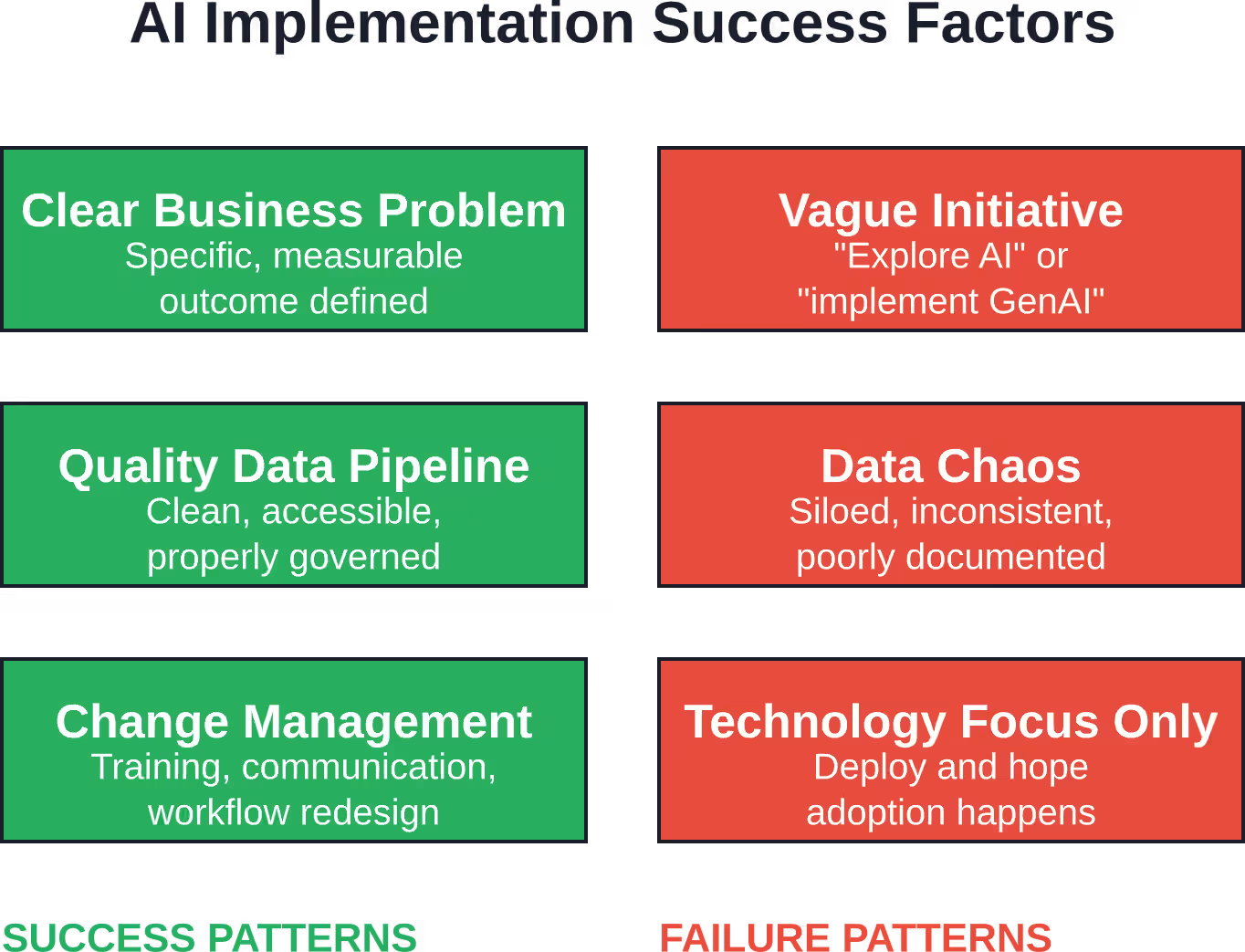
Technical capabilities mean nothing without proper implementation frameworks. That’s where most organizations hit the 95% failure rate documented by MIT research.
NIST’s AI Risk Management Framework provides structure for cultivating trust while promoting innovation. The framework emphasizes risk-based approaches that balance potential benefits against possible harms.
Regulatory Approaches Across Regions
Different jurisdictions take distinct approaches to AI governance:
- The EU employs a risk-based approach emphasizing potential for harm
- The US uses a decentralized approach with sector-specific agency oversight
- Singapore and Canada favor principles-based approaches focusing on ethical guidelines
- China implements government-led regulation with centralized control
- Japan emphasizes industry-led self-regulation
Organizations operating across regions must navigate these different frameworks. That complexity drives demand for standardized approaches like ISO/IEC 42001:2023, the international standard for AI management systems.
Procurement and Vendor Evaluation
IEEE standards offer structured guidance for AI system procurement. The framework includes six steps designed to help teams develop solicitations and identify, mitigate, and monitor harms associated with high-risk AI systems:
- Problem definition: Clearly articulate business needs and success criteria
- Solicitation preparation: Develop requirements addressing functionality and risk
- Vendor evaluation: Assess provider capabilities, track record, and governance
- Solution evaluation: Test performance against requirements and edge cases
- Contract negotiation: Establish performance standards, liability, and monitoring
- Contract monitoring: Continuously assess outcomes and intervene when needed
IEEE 3119 procurement standards map specific clauses addressing AI risks across these phases. Organizations following structured procurement avoid common pitfalls: vague requirements, insufficient testing, and inadequate performance monitoring.
Measuring AI Impact and ROI
Capabilities only matter if they deliver measurable business value. That requires establishing clear metrics before implementation, not retrofitting justification after deployment.
Leading vs. Lagging Indicators
Effective measurement combines leading indicators that predict success and lagging indicators that confirm business impact.
Leading indicators include adoption rates, user engagement, error rates, and intervention frequency. These signal whether the capability is being used properly and performing as designed.
Lagging indicators measure business outcomes: cost reduction, revenue increase, customer satisfaction improvement, or cycle time reduction. These prove ROI but lag behind implementation.
Organizations tracking both types identify problems early. Low adoption rates predict poor business outcomes. High error rates signal training gaps or technical issues. Monitoring leading indicators enables course correction before lagging indicators confirm failure.
Attribution and Incrementality
The challenge with AI measurement isn’t tracking metrics—it’s isolating AI’s contribution from other factors. Did customer satisfaction improve because of the new chatbot, or because of the simultaneously launched service initiative?
Rigorous measurement requires control groups, A/B testing, and incrementality analysis. Organizations deploy AI capabilities to segments while maintaining control groups using previous approaches. That comparison isolates AI’s specific contribution.
Research from Brookings Institution analyzing firm-level data shows that companies investing in AI capabilities see measurable improvements in growth and employment. But those studies control for numerous confounding factors. Anecdotal improvements without proper controls often reflect correlation, not causation.
Emerging Capabilities and Future Directions
AI capabilities continue evolving rapidly. What’s experimental today becomes production-ready tomorrow. But executives must distinguish genuine capability advances from vendor hype.
Multimodal AI Systems
Emerging systems process and generate across multiple modalities: text, images, audio, video, and structured data. These systems understand relationships across modalities—analyzing images while reading accompanying text, or generating videos from text descriptions.
Business applications include richer customer support (analyzing photos customers submit with problem descriptions), enhanced content creation (generating matched visuals and copy), and more comprehensive data analysis (combining numerical trends with document context and visual data).
Reasoning and Planning Capabilities
Current AI excels at pattern recognition but struggles with multi-step reasoning and long-term planning. Emerging capabilities address these limitations through techniques that decompose complex problems, verify intermediate steps, and adapt plans based on feedback.
These advances enable more autonomous agents that handle complex, multi-step business processes: strategic analysis requiring synthesis across many sources, complex negotiations with adaptive strategies, and long-term project planning with risk assessment.
Building AI Capabilities: Build vs. Buy
Organizations face fundamental decisions about developing AI capabilities internally versus purchasing solutions. Neither approach dominates—the right choice depends on specific circumstances.
When to Build
Internal development makes sense when capabilities require deep domain expertise, differentiate competitively, or integrate tightly with proprietary systems and data.
Organizations with unique data assets and specialized processes often build custom models that outperform generic solutions. That’s particularly true in regulated industries where compliance requirements necessitate transparent, auditable systems.
Building requires AI talent that commands premium compensation. Research shows workers with AI skills earn significantly more than those without, with specialized skills like TensorFlow showing premium compensation, and competition for talent remains intense. Organizations committed to building must invest in recruitment, retention, and continuous skill development.
When to Buy
Commercial solutions make sense for common business functions where vendors achieve economies of scale and continuous improvement across many customers. Email classification, document extraction, basic chatbots, and predictive analytics for standard use cases rarely justify custom development.
Purchased solutions accelerate deployment, reduce technical risk, and include ongoing maintenance and updates. The trade-off is less customization and potential vendor lock-in.
Hybrid approaches often work best: purchase platform capabilities while building custom models for unique requirements. That balances speed and flexibility with differentiation and control.
Organizational Readiness and Change Management
Technical capabilities fail without organizational readiness. Research examining workflow processes found significant gaps between documented and actual high-performer practices in various business roles. That gap illustrates how AI reveals organizational knowledge that’s tacit rather than documented.
Skills and Training
AI deployment requires new skills across roles. Business users need prompt engineering, output evaluation, and tool proficiency. Technical staff need model development, deployment, and monitoring capabilities. Leaders need strategic understanding of capabilities, limitations, and risks.
Training can’t be one-time onboarding. Capabilities evolve continuously, requiring ongoing skill development. Organizations establishing AI centers of excellence create shared learning, best practices, and support structures.
Process Redesign
AI enables process transformation, not just automation of existing workflows. Organizations achieving real value redesign processes around AI capabilities rather than layering AI onto inefficient legacy processes.
That redesign requires cross-functional collaboration. IT understands technical possibilities. Business units understand operational requirements. Process experts identify optimization opportunities. Success requires all three perspectives.
Ethical Considerations and Responsible AI
AI capabilities raise ethical questions about bias, privacy, transparency, and accountability. Organizations deploying AI must address these considerations proactively rather than reactively.
Bias Detection and Mitigation
AI systems learn patterns from training data. When that data reflects historical biases—in hiring, lending, or other decisions—models perpetuate and potentially amplify those biases.
Responsible deployment requires bias testing across demographic groups, continuous monitoring for disparate impacts, and mitigation strategies when bias emerges. That’s not just ethical—it’s often legally required under anti-discrimination laws.
Transparency and Explainability
Many AI systems operate as black boxes, making decisions without clear explanations. That opacity creates problems for accountability, debugging, and compliance.
Explainable AI techniques provide insight into model reasoning: which features influenced decisions, how confident the system is, and what changes would alter outcomes. Those explanations enable human oversight and intervention.
Regulatory frameworks increasingly require explainability, particularly for high-stakes decisions affecting individuals. Organizations should prioritize interpretable models and explanation capabilities even when regulations don’t mandate them.
Integration with Existing Technology Stacks
AI capabilities must integrate with existing systems: CRM platforms, ERP systems, data warehouses, communication tools, and productivity suites. Poor integration limits AI utility and creates data silos.
API-First Architectures
Modern AI platforms emphasize API-first design, enabling programmatic integration with other systems. Organizations can trigger AI capabilities from existing workflows, pass data between systems, and embed AI outputs into operational dashboards.
That integration enables AI to augment existing processes rather than requiring separate workflows. Sales reps access AI insights within their CRM. Support agents see AI recommendations in their ticketing system. Developers trigger AI capabilities from CI/CD pipelines.
Data Pipeline Architecture
AI systems require continuous data flows. Batch processes that worked for traditional analytics create staleness and lag. Real-time or near-real-time pipelines keep AI systems current with operational reality.
Organizations building AI capabilities invest in modern data infrastructure: streaming platforms, data lakes, feature stores, and orchestration tools. That infrastructure serves AI today and enables future capabilities tomorrow.
Frequently Asked Questions
What AI capabilities deliver the fastest ROI for businesses?
Workflow automation and predictive analytics typically deliver measurable returns within months rather than years. Organizations starting with clearly defined, repetitive processes see cost reductions of 20-40% while improving consistency. Customer service automation, document processing, and lead qualification represent high-ROI starting points that don’t require extensive data science capabilities or custom model development.
How much does enterprise AI implementation typically cost?
Costs vary dramatically based on scope and approach. Off-the-shelf SaaS solutions for specific functions start around $20-40 per user monthly for platforms like Microsoft Copilot. Custom enterprise implementations requiring data infrastructure, model development, and integration typically range from hundreds of thousands to millions of dollars. According to research from UC Berkeley, enterprise spending on GenAI is approaching $40 billion, yet 95% of pilots fail to produce measurable returns—suggesting that spending without strategic focus wastes resources.
Do businesses need data scientists to implement AI capabilities?
Not always. Many modern AI platforms provide no-code or low-code interfaces for common business applications. Marketing automation, chatbots, document extraction, and basic predictive analytics often require configuration rather than coding. However, custom models, complex integrations, and specialized applications do require data science expertise. Organizations should start with purchased solutions for standard capabilities and hire or contract data scientists only when custom development delivers clear competitive advantages.
What are the biggest risks in AI implementation for business?
The primary risks include poor data quality leading to inaccurate predictions, bias in training data creating discriminatory outcomes, integration failures preventing adoption, and unrealistic expectations causing disillusionment. According to NIST’s AI Risk Management Framework, organizations should prioritize risk-based approaches that balance innovation with harm mitigation. Testing thoroughly before deployment, establishing human oversight for high-stakes decisions, and monitoring continuously for unexpected behaviors reduce operational risks significantly.
How long does AI implementation typically take from decision to deployment?
Timeline depends on complexity and organizational readiness. Simple SaaS solutions deploy in weeks: evaluation, procurement, configuration, and training. Custom implementations requiring data pipeline development, model training, and process redesign typically span 6-12 months for initial deployment plus ongoing refinement. Organizations with poor data quality or unclear requirements experience longer timelines. Starting with pilot projects focusing on specific use cases accelerates learning while containing risk.
What industries benefit most from AI capabilities?
Every industry shows AI adoption, but financial services, healthcare, retail, and manufacturing lead in implementation maturity. Financial services leverage predictive analytics for fraud detection and risk assessment. Healthcare deploys AI for diagnostic support and patient monitoring. Retail uses AI for demand forecasting and personalization. Manufacturing applies AI to quality control and predictive maintenance. That said, AI capabilities like workflow automation, customer service, and document processing deliver value across all sectors.
How do businesses measure AI success beyond technical metrics?
Successful measurement focuses on business outcomes rather than technical performance. Organizations track metrics like cost per transaction reduction, customer satisfaction score improvement, revenue per employee increase, or cycle time reduction. Research analyzing 64% of the U.S. workforce shows that firms investing in AI see employment growth and productivity gains. The key is establishing baseline metrics before implementation, defining clear success criteria aligned with business objectives, and tracking both leading indicators (adoption, usage patterns) and lagging indicators (business outcomes) throughout deployment.
Conclusion: From Capabilities to Competitive Advantage
AI capabilities mean nothing without execution. The technologies exist. The platforms work. The question isn’t whether AI can transform business operations—it’s whether organizations can implement capabilities strategically rather than joining the 95% failure rate.
Start with clear business problems, not technology exploration. Prioritize capabilities where success measures are obvious and data quality is strong. Build organizational readiness alongside technical deployment. Measure rigorously and adjust continuously.
The competitive advantage won’t come from having AI capabilities—every organization will have those soon enough. Advantage comes from integrating capabilities into operations so seamlessly that they amplify human decision-making, accelerate execution, and enable strategies impossible without AI augmentation.
The race isn’t to deploy the most AI. It’s to deploy the right AI, in the right places, with the right governance, and the right change management to actually deliver business value.
Organizations that figure that out don’t just implement AI capabilities. They build AI into competitive moats.
 English
  German
  Arabic
  French
  Dutch
Dutch  Spanish