
Quick Summary: Artificial intelligence project ideas span beginner chatbots and image classifiers to advanced recommendation engines, fraud detection systems, and generative AI applications. The global AI market, valued at $233.46 billion in 2024, is projected to reach $1,771.62 billion by 2032, creating unprecedented demand for hands-on AI skills. Building practical AI projects—from sentiment analyzers to medical diagnosis tools—remains the most effective way to master machine learning, deep learning, and neural networks while creating a portfolio that demonstrates real-world problem-solving ability.
The artificial intelligence landscape has shifted dramatically. Reading tutorials isn’t enough anymore—recruiters and hiring managers want to see what you’ve actually built.
Real talk: the difference between someone who lands an AI role and someone who doesn’t often comes down to portfolio projects. Not theoretical knowledge. Not certifications alone. Actual, working systems that solve real problems.
This guide breaks down 50+ artificial intelligence project ideas across difficulty levels. Whether you’re writing your first Python script or fine-tuning transformer models, you’ll find projects that match your current skill set and push you toward the next level.
Why AI Projects Matter More Than Ever in 2026
The numbers tell a clear story. According to research analyzing the National Institutes of Health portfolio, AI projects receive a measurable 13.4% funding premium compared to non-AI work. That’s not just academic—it reflects how organizations across sectors value demonstrated AI capability.
The global AI market reached $233.46 billion in 2024 and is projected to hit $1,771.62 billion by 2032, representing a compound annual growth rate of 29.20%. Organizations aren’t just experimenting with AI anymore—they’re deploying it at scale.
But here’s what matters for developers and students: 79% of AI projects remain in research and development stages, while only 14.7% reach clinical deployment or implementation. That gap represents opportunity. Companies need people who can take models from notebooks to production.
Building projects forces you to confront the messy reality of AI development. Data never arrives perfectly cleaned. Models don’t converge on the first try. Production environments have constraints that Jupyter notebooks don’t.
That’s exactly why projects work. They expose you to the problems you’ll actually solve in professional roles.

Test AI Project Ideas With AI Superior
AI Superior develops custom AI software, including machine learning models, AI-based applications, web and mobile apps, and custom software products. Their team can support projects from discovery and data review to PoC or MVP development, integration, and result evaluation.
Need Help Building an AI Project?
AI Superior can help with:
- assessing AI project ideas
- building custom AI and ML tools
- testing concepts through PoC or MVP work
- integrating AI into existing systems
👉 Contact AI Superior to discuss your project.
Beginner AI Project Ideas: Build Your Foundation
Starting with the fundamentals matters. These projects introduce core concepts—supervised learning, classification, regression, basic neural networks—without overwhelming complexity.
1. Email Spam Detection System
Build a classifier that separates spam from legitimate emails using natural language processing. This project introduces text preprocessing, feature extraction with TF-IDF or word embeddings, and binary classification with algorithms like Naive Bayes or logistic regression.
The dataset is readily available (SpamAssassin public corpus), and the problem is well-defined. You’ll learn how to handle imbalanced datasets—spam typically represents a minority class—and measure performance with precision, recall, and F1 scores rather than just accuracy.
2. Handwritten Digit Recognition
Train a neural network to recognize digits from the MNIST dataset. This classic project introduces convolutional neural networks, image preprocessing, and the fundamentals of deep learning frameworks like TensorFlow or PyTorch.
Despite being a standard beginner project, it teaches crucial concepts: how convolution layers extract features, how pooling layers reduce dimensionality, and how to prevent overfitting with dropout and data augmentation.
3. House Price Prediction Model
Predict real estate prices based on features like square footage, location, number of bedrooms, and age. This regression project teaches feature engineering, handling categorical variables, and evaluating model performance with metrics like mean absolute error and R-squared.
Use the Kaggle Housing Prices dataset or collect local real estate data. You’ll learn how to identify and handle outliers, normalize features, and compare multiple algorithms—linear regression, decision trees, random forests—on the same problem.
4. Movie Recommendation System
Create a system that suggests movies based on user preferences using collaborative filtering. Start with a simple approach: recommend movies that similar users enjoyed.
The MovieLens dataset provides ratings from thousands of users. This project introduces matrix factorization, similarity metrics (cosine similarity, Pearson correlation), and the cold-start problem—what do you recommend to new users with no history?
5. Sentiment Analysis Tool
Build a classifier that determines whether product reviews, tweets, or comments express positive, negative, or neutral sentiment. Use pre-trained models like VADER for a quick start, then train your own model on domain-specific data.
This project teaches the difference between rule-based and machine learning approaches, how context affects sentiment (“not bad” vs. “not good”), and how to handle sarcasm and negation in text.
6. Weather Prediction System
Forecast temperature, precipitation, or weather conditions using historical data. This time-series project introduces concepts like seasonality, trend analysis, and temporal dependencies.
Start with simple moving averages, then progress to ARIMA models or recurrent neural networks (RNNs). You’ll learn how to handle missing data, create lagged features, and evaluate forecasts with time-series-specific metrics.
| Project | Primary Technique | Key Learning | Typical Duration |
|---|---|---|---|
| Spam Detection | Text Classification | NLP basics, imbalanced data | 1-2 weeks |
| Digit Recognition | CNN | Deep learning fundamentals | 1-2 weeks |
| House Price Prediction | Regression | Feature engineering | 1-2 weeks |
| Movie Recommender | Collaborative Filtering | Similarity metrics | 2-3 weeks |
| Sentiment Analysis | Text Classification | NLP, pre-trained models | 1-2 weeks |
| Weather Forecasting | Time Series | Temporal patterns | 2-3 weeks |
Intermediate Artificial Intelligence Project Ideas
Once the basics click, intermediate projects add complexity—multiple data sources, more sophisticated architectures, deployment considerations.
7. Credit Card Fraud Detection
Identify fraudulent transactions in highly imbalanced datasets where fraud represents less than 1% of cases. This project demands techniques like SMOTE for handling class imbalance, anomaly detection algorithms, and careful threshold tuning to balance false positives against false negatives.
Use the Kaggle Credit Card Fraud dataset. You’ll learn why accuracy is a misleading metric for imbalanced problems and how precision-recall curves guide threshold selection in production systems.
8. Chatbot with Natural Language Understanding
Build a conversational agent that understands user intent and provides relevant responses. Start with rule-based patterns, then add intent classification and entity extraction using libraries like spaCy or Rasa.
This project introduces dialogue management, context tracking across conversation turns, and the challenge of handling ambiguous or out-of-scope queries. Consider integrating with a knowledge base or API to provide dynamic responses.
9. Face Recognition System
Detect and recognize faces in images or video streams. Use pre-trained models like FaceNet or build your own using CNNs with triplet loss for learning face embeddings.
This project teaches transfer learning, one-shot and few-shot learning (recognizing people from limited examples), and real-time processing constraints. You’ll handle variations in lighting, pose, and image quality.
10. Stock Price Forecasting Tool
Predict stock prices or market trends using historical data, technical indicators, and potentially external signals like news sentiment. This project demonstrates AI’s limitations—markets are notoriously difficult to predict—as much as its capabilities.
Use APIs like Alpha Vantage or Yahoo Finance for data. Experiment with LSTM networks for sequence modeling, and learn why backtesting on historical data doesn’t guarantee future performance.
11. Medical Diagnosis Assistant
Create a system that predicts diseases or conditions from symptoms, medical images, or lab results. Use datasets like the Heart Disease dataset or chest X-ray images for pneumonia detection.
This project introduces ethical considerations—medical AI must prioritize minimizing false negatives—and the importance of model interpretability. Healthcare professionals need to understand why a model made a particular prediction.
12. Customer Churn Prediction
Identify customers likely to cancel subscriptions or stop using a service. This classification problem appears across industries—telecom, SaaS, banking—and directly impacts business metrics.
Feature engineering is crucial here: usage patterns, support ticket frequency, payment history, and engagement metrics all provide signals. You’ll learn how to translate model predictions into actionable retention strategies.
13. Content-Based Image Retrieval System
Build a system that finds visually similar images from a database. Users upload an image, and your system returns the most similar matches based on visual features rather than text tags.
Use pre-trained CNNs like ResNet or VGG as feature extractors, then calculate similarity with cosine distance in the embedding space. This project introduces dimensionality reduction techniques like PCA and efficient nearest-neighbor search with libraries like FAISS.
Advanced AI Projects for Experienced Developers
Advanced projects tackle open-ended problems, require architectural decisions, and often combine multiple AI techniques.
14. Autonomous Navigation System
Develop an agent that navigates environments using reinforcement learning. Start with simulated environments like OpenAI Gym, then progress to more complex scenarios with obstacles, multiple agents, or continuous action spaces.
This project introduces Q-learning, policy gradients, and actor-critic methods. You’ll handle the exploration-exploitation tradeoff and design reward functions that encourage desired behaviors without unintended consequences.
15. Neural Machine Translation System
Build a model that translates text between languages using sequence-to-sequence architectures with attention mechanisms. Use parallel corpora from sources like Europarl or the Tatoeba dataset.
This project teaches encoder-decoder architectures, attention mechanisms that let models focus on relevant input tokens, and evaluation metrics like BLEU scores. Consider fine-tuning pre-trained models like mBART or T5 for better results with limited data.
16. Generative AI Art Creator
Create original images using generative adversarial networks (GANs) or diffusion models. Train on specific domains—portraits, landscapes, abstract art—to generate novel outputs in that style.
This project introduces adversarial training where a generator and discriminator compete, mode collapse issues where generators produce limited variety, and techniques like progressive growing for high-resolution outputs.
17. Real-Time Object Detection for Video
Detect and track multiple objects in video streams using models like YOLO or Faster R-CNN. Optimize for real-time performance—25+ frames per second—on consumer hardware.
You’ll balance accuracy against speed, handle overlapping objects with non-maximum suppression, and track objects across frames. Consider deployment on edge devices using model quantization and pruning.
18. Question Answering System
Build a system that answers questions by extracting information from documents or knowledge bases. Use pre-trained transformers like BERT fine-tuned on SQuAD or Natural Questions datasets.
This project teaches reading comprehension models, passage retrieval strategies when working with large document collections, and hybrid approaches that combine information retrieval with deep learning.
19. Voice Assistant with Wake Word Detection
Create a voice-controlled assistant that listens for a wake word, transcribes speech, processes commands, and responds. Combine speech recognition (using models like Wav2Vec or Whisper), intent classification, and text-to-speech synthesis.
This end-to-end project integrates multiple AI components into a single pipeline. You’ll handle real-time audio processing, background noise, and different accents or speaking styles.
20. AI Code Review Assistant
Develop a tool that analyzes code for bugs, style violations, or security issues using machine learning. Train on datasets of code changes paired with reviewer comments, or fine-tune code-specific models like CodeBERT.
This project applies NLP techniques to a structured domain (programming languages), teaches abstract syntax tree (AST) analysis, and demonstrates how AI can augment rather than replace human expertise.
Domain-Specific AI Project Ideas
Specializing in a domain—healthcare, finance, retail—differentiates portfolios and aligns with career goals.
Healthcare AI Projects
Medical imaging classification (detecting tumors in MRI scans), drug interaction prediction, patient readmission forecasting, and electronic health record analysis all address real healthcare challenges.
These projects require attention to regulatory standards, patient privacy (HIPAA compliance), and the consequences of errors. According to NIH analysis, Cancer, aging, and mental health account for 50.1% of all AI funding, while health disparities research is severely underrepresented at just 5.7%—a gap that represents both ethical concern and opportunity.
Financial AI Projects
Algorithmic trading systems, loan default prediction, insurance claim fraud detection, and portfolio optimization demonstrate AI’s business impact. Financial projects often have clear success metrics—return on investment, false positive rates, processing time—that matter to employers.
But they also introduce challenges: markets are adversarial (other algorithms react to your algorithm), regulations constrain what data you can use, and backtesting results don’t guarantee live performance.
Retail and E-Commerce Projects
Product recommendation engines, dynamic pricing systems, demand forecasting, visual search, and customer lifetime value prediction all solve problems retailers face daily.
These projects work with diverse data types—transactional records, product catalogs, customer behavior logs, images—and must scale to millions of users and products.
Content and Media Projects
Automated content tagging, video summarization, deepfake detection, copyright infringement identification, and content moderation systems address challenges in digital media.
Community discussions highlight both the technical challenges (handling adversarial examples, scaling to millions of posts) and ethical ones (bias in moderation decisions, transparency in automated removals).
AI Agent and Automation Project Ideas
Agentic AI—systems that plan, reason, and act autonomously—represents a significant trend in 2026. NIST announced the “AI Agent Standards Initiative” in February 2026 to ensure interoperability and security as these systems proliferate.
21. Research Paper Summarizer
Build an agent that extracts papers from arXiv, summarizes key findings, and organizes them by topic. Combine PDF parsing, extractive and abstractive summarization, and topic modeling.
22. Automated Job Application Assistant
Create a system that scrapes job boards, matches positions to a resume, and generates customized cover letters. This project combines web scraping, NLP for matching skills to job descriptions, and text generation.
23. Financial News Analyzer
Develop an agent that monitors financial news, extracts company mentions and sentiment, and correlates news with stock price movements. Integrate APIs for news sources, perform named entity recognition, and analyze sentiment trends.
24. Social Media Content Scheduler
Build a tool that generates social media posts, optimizes posting times based on engagement data, and automatically publishes content. Combine text generation, time-series analysis of engagement patterns, and API integration.
25. Meeting Notes and Action Item Extractor
Create a system that transcribes meetings, summarizes discussions, and extracts action items with assigned owners and deadlines. Use speech recognition, summarization models, and information extraction techniques.
Cutting-Edge AI Project Ideas for 2026
These projects explore emerging techniques and trends shaping AI development.
26. Multi-Modal AI System
Build a system that understands and generates content across modalities—text, images, audio. For example, a model that takes a product image and description, then generates an advertising video with voiceover.
Multi-modal models like CLIP, Flamingo, and GPT-4V demonstrate how different data types can inform each other. This project teaches cross-modal attention, alignment between modalities, and handling inputs of vastly different dimensions.
27. Federated Learning System
Implement a system where multiple clients train a shared model without sharing their raw data. This privacy-preserving approach matters for healthcare, finance, and any domain with sensitive data.
You’ll learn distributed optimization, how to aggregate model updates, and techniques for handling non-IID data (clients have different data distributions).
28. Few-Shot Learning Classifier
Create a model that learns new categories from just a few examples—critical when labeled data is scarce. Use meta-learning approaches like MAML or prototypical networks.
This project introduces learning-to-learn paradigms where models optimize for rapid adaptation rather than performance on a fixed task.
29. Explainable AI Dashboard
Build a system that not only makes predictions but explains its reasoning using techniques like SHAP values, LIME, or attention visualization. Apply it to a high-stakes domain like loan applications or medical diagnosis.
According to IEEE standards work, transparency and explainability are fundamental to ethical AI. Organizations increasingly demand interpretable models, especially in regulated industries.
30. AI Model Performance Monitor
Develop a system that tracks model performance in production, detects data drift, and alerts when retraining is needed. This MLOps project teaches the difference between development and deployment.
Models degrade over time as data distributions shift. Monitoring systems track prediction confidence, feature distributions, and ground truth labels (when available) to identify when models no longer reflect reality.
Tools and Technologies for AI Projects
Selecting the right stack accelerates development and teaches industry-standard tools.
Programming Languages
Python dominates AI development for good reason—extensive libraries, readable syntax, strong community support. R works for statistical modeling and data analysis. Julia gains traction for numerical computing and performance-critical applications.
Performance on code generation benchmarks reflects rapid progress. According to research analyzing model capabilities, initial version of Codex achieved 28.8% accuracy on HumanEval, while GPT-5 (version unspecified) scored 93.5% as of 2025, with the Kimi-K2 open-weights model surpassing it at 94.5%.
Machine Learning Frameworks
TensorFlow and PyTorch lead for deep learning. Scikit-learn excels at traditional machine learning algorithms. JAX offers high-performance numerical computing with automatic differentiation.
Framework choice matters less than you might think—employers value problem-solving ability and ML fundamentals over specific library expertise. That said, PyTorch has momentum in research, while TensorFlow maintains strong production deployment tools.
Cloud Platforms and Computing
Google Cloud, AWS, and Azure all offer AI/ML services—pre-trained models, managed training infrastructure, deployment platforms. Google Colab provides free GPU access for learning and prototyping.
Local development works for small projects. Larger models and datasets require cloud resources. Understanding cloud platforms becomes essential for production deployment.
Data Tools and Databases
Pandas handles tabular data manipulation. NumPy powers numerical operations. For large-scale data, Spark and Dask enable distributed processing.
Vector databases like Pinecone, Weaviate, and ChromaDB have become essential for similarity search and retrieval-augmented generation systems.
Best Practices for AI Project Development
Successful projects follow patterns that separate working prototypes from abandoned notebooks.
Start with a Clear Problem Statement
Define what success looks like before writing code. What specific problem does this solve? What metrics matter? Who would use this?
Vague goals—”build something with neural networks”—lead to abandoned projects. Specific goals—”classify customer support tickets into five categories with 85% accuracy”—provide direction.
Use Version Control from Day One
Git isn’t just for software engineers. Track your code, experiments, and model versions. Use branches for experiments. Write meaningful commit messages that explain what changed and why.
Tools like DVC (Data Version Control) extend Git to handle large datasets and model files.
Document Your Process
Keep a project journal recording decisions, experiments, and results. Future employers want to understand your thinking process, not just see the final model.
Document dead ends too. Explaining why an approach didn’t work demonstrates understanding just as much as successful implementations.
Focus on Data Quality
Models only learn patterns present in training data. Garbage in, garbage out remains true no matter how sophisticated the architecture.
Spend time on exploratory data analysis. Understand distributions, identify outliers, check for leakage (when test data accidentally informs training). Data work isn’t glamorous, but it determines project success more than model architecture choices.
Start Simple, Then Iterate
Begin with the simplest approach that might work—logistic regression before neural networks, small models before large ones. Establish a baseline, then add complexity only if it improves results.
Simple models train faster, debug easier, and often perform surprisingly well. Complex models make sense only when simpler approaches fail.
Consider Deployment from the Start
How will someone actually use this? A notebook that requires manual cell execution isn’t deployed. A REST API, web interface, or command-line tool makes projects accessible.
Deployment exposes constraints invisible during development: latency requirements, memory limits, dependency conflicts, error handling. These aren’t afterthoughts—they’re core to production AI.
Ethical Considerations in AI Projects
AI governance has become a substantial industry. The AI governance market is worth over $308 million and estimated to grow 35.7% in the next 5 years, according to research published by IEEE Standards Association.
Organizations worldwide recognize that ethical AI isn’t optional—it’s essential for trust, regulatory compliance, and long-term viability.
Bias and Fairness
Models inherit biases present in training data. Facial recognition systems that work better for some demographics than others. Hiring algorithms that favor certain backgrounds. Credit scoring that perpetuates historical inequities.
Test model performance across demographic groups. Use fairness metrics beyond overall accuracy. Consider whether your training data represents the population your model will serve.
Privacy and Data Protection
Personal data requires careful handling. GDPR in Europe, CCPA in California, and emerging regulations worldwide impose strict requirements.
Minimize data collection—use only what’s necessary. Anonymize when possible. Understand retention requirements. For healthcare projects, HIPAA compliance is mandatory.
Transparency and Explainability
High-stakes decisions—loan approvals, medical diagnoses, criminal justice—demand explanation. “The algorithm said so” isn’t sufficient when people’s lives are affected.
IEEE’s work on ethical AI standards emphasizes transparency and explainability as fundamental principles. Projects should include interpretability methods that explain predictions to stakeholders.
Security and Robustness
NIST’s cybersecurity guidelines for AI systems, published in December 2025, address emerging threats—adversarial examples, model inversion attacks, data poisoning.
Consider security throughout development. Validate inputs. Test robustness to adversarial examples. Implement monitoring to detect attacks or model degradation.
| Ethical Concern | Project Impact | Mitigation Strategy |
|---|---|---|
| Bias & Fairness | Unequal performance across groups | Diverse training data, fairness metrics, bias testing |
| Privacy | Unauthorized data exposure | Data minimization, anonymization, compliance checks |
| Transparency | Unexplainable decisions | Interpretability tools, documentation, audit trails |
| Security | Adversarial attacks, data poisoning | Input validation, robustness testing, monitoring |
| Environmental | Energy consumption of training | Efficient architectures, carbon-aware computing |
Building Your AI Portfolio
Projects demonstrate capability, but presentation matters as much as technical implementation.
Select Projects Strategically
Quality beats quantity. Three well-executed, well-documented projects impress more than ten half-finished notebooks. Choose projects that showcase different skills—one classification problem, one generative model, one end-to-end application.
Align projects with career goals. Targeting healthcare AI roles? Prioritize medical imaging or clinical prediction projects. Interested in NLP? Build conversational systems, text generation, or information extraction tools.
Document Thoroughly
Each project needs clear documentation: problem statement, approach, results, lessons learned. Include visualizations—learning curves, confusion matrices, sample outputs.
Write for someone unfamiliar with the problem. Explain why you made architectural choices. Discuss what didn’t work and what you’d try next. This demonstrates critical thinking, not just coding ability.
Make Projects Accessible
Host code on GitHub with comprehensive README files. Include setup instructions, dependencies, usage examples. For models, provide pre-trained weights so others can test without retraining.
Deploy projects when possible. A live demo—even a simple web interface—shows commitment beyond coursework. Services like Streamlit, Gradio, or Hugging Face Spaces make deployment approachable.
Write About Your Work
Blog posts, articles, or technical write-ups extend project impact. Explaining your work to others deepens your own understanding and builds a public presence.
Community discussions consistently mention that candidates who document and share their learning stand out during hiring.
Common Pitfalls to Avoid
Learning from others’ mistakes accelerates progress.
Tutorial Hell
Following tutorials feels productive but builds limited skill. The struggle matters—debugging errors, making design decisions, handling unexpected problems.
Use tutorials for fundamentals, then immediately apply concepts to your own projects. Modify tutorial code. Combine techniques from multiple sources. Break things and fix them.
Overcomplicating Early Projects
Ambition is good. Attempting to build cutting-edge research systems as a first project leads to frustration and abandonment.
Match project complexity to current skill level. Success breeds momentum. Completing three beginner projects builds more confidence than partially finishing one advanced project.
Ignoring Data Quality
Focusing exclusively on model architecture while overlooking data issues guarantees poor results. Bad data can’t be fixed with better models.
Invest time in data cleaning, exploration, and validation. Understand your data’s limitations. Document assumptions and preprocessing decisions.
Not Testing Properly
High accuracy on a test set means nothing if the test set doesn’t represent real-world data. Data leakage—where information from the test set influences training—creates false confidence.
Use proper train-test splits. For time-series data, test on future data, not randomly sampled points. Cross-validate when datasets are small. Always question results that seem too good.
Neglecting Production Concerns
Models that run in notebooks but fail in production have limited value. Consider latency, memory, dependencies, and error handling from the beginning.
Test on representative hardware. Measure inference time. Handle edge cases. Production-ready code is part of the project, not an afterthought.
Resources for AI Project Development
High-quality resources accelerate learning and provide project inspiration.
Datasets
Kaggle hosts thousands of datasets across domains, plus competitions that provide structured problems. UCI Machine Learning Repository offers classic datasets for benchmarking. Hugging Face Datasets provides easy access to NLP and multi-modal data.
Government data portals—data.gov, NIH datasets, NASA datasets—offer real-world data for public benefit projects.
Pre-trained Models
Hugging Face Model Hub provides thousands of pre-trained models for NLP, computer vision, and audio. TensorFlow Hub and PyTorch Hub offer similar resources.
Transfer learning—starting with pre-trained models and fine-tuning on specific tasks—achieves better results with less data and compute than training from scratch.
Learning Platforms
Fast.ai courses emphasize practical implementation. Coursera and edX offer university-level content. YouTube channels like StatQuest explain concepts clearly.
Academic papers on arXiv provide cutting-edge research. Reading papers builds understanding of current techniques and research directions.
Communities
Reddit communities like r/MachineLearning and r/learnmachinelearning provide support and feedback. Stack Overflow helps debug specific issues. Discord servers and Slack communities offer real-time discussion.
Engaging with communities—asking questions, helping others, sharing projects—accelerates learning through collective knowledge.
AI Project Ideas for Different Goals
Tailor project selection to specific objectives.
For Landing Your First AI Job
Focus on end-to-end projects that demonstrate practical skills: data collection, preprocessing, model training, evaluation, and deployment. Prioritize problems with clear business value—customer churn prediction, recommendation systems, fraud detection.
Include at least one project that handles real-world messiness: missing data, class imbalance, noisy labels.
For Academic Research
Choose problems that advance the field: novel architectures, new applications of existing techniques, or thorough empirical comparisons. Document methodology rigorously. Compare against established baselines. Consider submitting to conferences or journals.
For Freelancing or Consulting
Build projects that solve common business problems: automated data processing, predictive analytics, natural language understanding for customer support. Demonstrate ROI—show how your solution saves time or money.
Create polished demos and clear documentation that non-technical clients can understand.
For Starting an AI Product
Validate that the problem is worth solving before building complex solutions. Start with minimal viable products. Focus on one use case, one user segment. Get feedback early and often.
Many successful AI products began as personal projects that solved a real problem the creator faced.
Frequently Asked Questions
What programming languages do I need for AI projects?
Python remains the dominant language for artificial intelligence projects due to extensive libraries like TensorFlow, PyTorch, scikit-learn, and pandas. R works well for statistical analysis and data science projects. For production systems requiring high performance, languages like C++ or Julia offer speed advantages. Most beginners should start with Python—it provides the best balance of capability, learning resources, and job market demand. JavaScript frameworks like TensorFlow.js enable browser-based AI applications when needed.
How long does it take to complete an AI project?
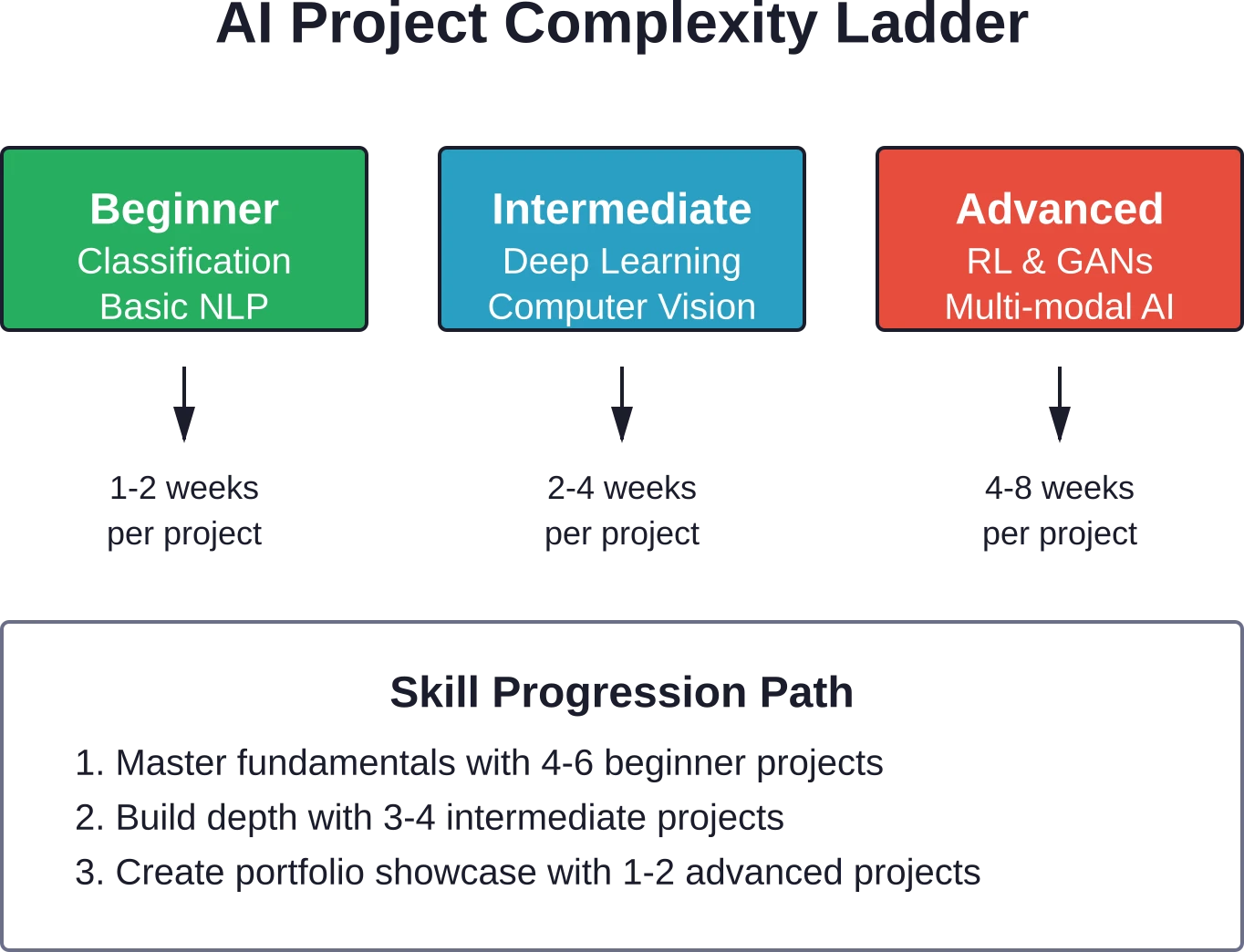
Project duration varies by complexity and experience level. Beginner projects like spam detection or basic image classification typically take 1-2 weeks working part-time. Intermediate projects involving deep learning or multiple data sources require 2-4 weeks. Advanced projects like reinforcement learning agents or multi-modal systems can take 4-8 weeks or more. The key is consistent progress—dedicated work for a few hours daily produces better results than sporadic intensive sessions. Breaking projects into milestones (data collection, baseline model, optimization, deployment) helps track progress and maintain momentum.
Do I need expensive hardware to build AI projects?
Not necessarily. Many beginner and intermediate projects run on standard laptops, especially when using small to medium datasets and pre-trained models. Free resources like Google Colab provide GPU access for training deep learning models without hardware investment. Cloud platforms (AWS, Google Cloud, Azure) offer pay-as-you-go computing for larger experiments. Advanced projects involving massive datasets or training large models from scratch do require significant compute, but starting with transfer learning and smaller-scale problems makes AI accessible without expensive hardware. Most learning happens through problem-solving and experimentation, not raw computing power.
Where can I find datasets for AI projects?
Kaggle hosts thousands of datasets across domains and skill levels, plus structured competitions. UCI Machine Learning Repository provides classic benchmark datasets. Hugging Face Datasets offers easy access to NLP corpora and multi-modal collections. Government portals like data.gov, NASA datasets, and NIH data repositories provide real-world public data. Google Dataset Search helps discover datasets across the web. Academic papers often link to their datasets. For domain-specific projects, industry-specific repositories exist—financial data from Alpha Vantage or FRED, medical imaging from NIH, satellite imagery from NASA. Web scraping can create custom datasets when public sources don’t meet needs, but respect terms of service and robots.txt files.
Should I focus on one AI specialization or learn broadly?
Start broadly to discover what resonates, then specialize based on interest and career goals. Building diverse beginner projects—classification, regression, NLP, computer vision—exposes you to different problem types and techniques. As patterns emerge around what you enjoy and what comes naturally, focus deeper in that area. Specialization (computer vision, NLP, reinforcement learning, generative models) differentiates you in job markets and enables expertise. However, fundamental skills—data preprocessing, model evaluation, debugging, deployment—apply across domains. In practice, projects often combine multiple specializations. A well-rounded foundation plus depth in one area provides the best combination of flexibility and expertise.
How do I know if my AI project is good enough for my portfolio?
Quality portfolio projects demonstrate clear problem-solving ability, not perfection. Look for: a well-defined problem statement, systematic approach to data and modeling, proper evaluation methodology, honest discussion of limitations, and clean documentation. The project should work reliably, even if performance isn’t state-of-the-art. End-to-end completion matters more than achieving top benchmark scores. Good documentation explaining your process, decisions, and learnings often matters more than technical sophistication. If the project taught you something valuable and you can explain what you built and why, it belongs in your portfolio. Polish presentation—clear README, organized code, visualizations—makes projects shine regardless of complexity level.
What’s the difference between AI projects for learning versus job applications?
Learning projects focus on understanding concepts and techniques—completing tutorials, implementing algorithms from scratch, replicating paper results. Job application projects emphasize practical problem-solving and production readiness—handling real messy data, considering deployment constraints, documenting thoroughly, and demonstrating business value. For portfolios, prioritize projects that solve defined problems end-to-end, include clear documentation and visualizations, work reliably (not just in ideal conditions), demonstrate skills relevant to target roles, and show progression in complexity. Transform learning projects into portfolio pieces by adding thorough documentation, deployment (even simple web interfaces), and discussion of real-world considerations like scalability, latency, and error handling.
Taking Your First Step
The gap between reading about AI and building AI systems closes only through action. Theory provides foundation, but projects build capability.
Start simple. Pick one project from the beginner list that interests you. Spend this week getting a basic version working. Don’t aim for perfection—aim for completion.
The artificial intelligence field rewards builders. Models improve through iteration. Skills develop through practice. Portfolios grow one project at a time.
According to government AI strategy initiatives, organizations worldwide are racing to build AI capabilities. The ecosystem that wins will set global standards and reap economic benefits. That creates opportunity for developers who can demonstrate practical AI skills through real projects.
The tools exist. The data is available. The knowledge is accessible. What separates developers who build successful AI projects from those who don’t isn’t talent or resources—it’s simply starting.
Choose a project. Write the first line of code. Debug the first error. The learning happens in the doing, not the planning.
 English
  German
  Arabic
  French
  Dutch
Dutch  Spanish