Quick Summary: Machine learning is revolutionizing chemistry by accelerating drug discovery, predicting molecular properties, and designing novel materials. With algorithms showing promise in protein interaction predictions and materials synthesis forecasting, ML is transforming traditional chemical research from trial-and-error to data-driven precision, drastically reducing development time and costs. The pharmaceutical industry faces a sobering reality: drug development success rates hover around just 9.6-12% from phase I trials to final approval. Traditional methods consume years and billions of dollars, yet fail more often than they succeed. Machine learning is changing that equation. By processing massive chemical datasets and identifying patterns invisible to human researchers, these algorithms are accelerating discovery timelines and improving accuracy across multiple domains.
Drug Discovery Gets a Data-Driven Makeover
Here’s the thing though—machine learning excels precisely where traditional chemistry struggles most. Pattern recognition in vast molecular libraries, property prediction without physical synthesis, and target identification all benefit from algorithmic precision. Deep learning models now predict protein-protein interactions with remarkable accuracy. But drug development remains challenging. The overall success rate from phase I clinical trials to drug approval is approximately 9.6–12%, though it varies significantly by therapeutic area (e.g., ~3% for oncology). The gap between silico promise and clinical reality remains substantial.
Molecular Generation and Property Prediction
Generative models create entirely new molecular structures with desired properties. Various generative approaches show different validity rates for molecular generation. These aren’t trivial accomplishments—generating chemically plausible structures requires understanding bonding rules, stability constraints, and synthetic accessibility. Machine learning models using various approaches such as random forests and recurrent neural networks show promise for predicting drug treatment outcomes and molecular binding, though accuracy varies by specific application and dataset. Generated compounds can be evaluated against force field calculations and drug-like property metrics to assess their viability.
Materials Science Acceleration
Northwestern University researchers and the Toyota Research Institute demonstrated machine learning’s power in materials synthesis. Their model predicted compositions of four, five, and six-element nanomaterials with a specific structural feature. The results? 18 correct predictions out of 19 attempts—approximately 95% accuracy. That’s not statistical modeling; those were actual synthesis experiments validating computational forecasts.
| ML Application | Accuracy Rate | Data Source |
|---|---|---|
| Novel Materials Synthesis Prediction | 95% | 18/19 correct predictions |

Apply ML to Chemistry Research With AI Superior
Chemistry projects often rely on simulations, laboratory measurements, and structured datasets that can benefit from machine learning analysis. AI Superior works with teams exploring predictive modeling, experimental analysis, and AI-assisted research workflows in chemistry-related environments. AI Superior can support chemistry projects with:
- Analysis of experimental and simulation datasets
- Development of ML models for prediction tasks
- Building proof of concept analytical workflows
- Classification and pattern recognition in chemical data
- Validation of model performance and consistency
- Integration support for research software systems
👉Reach out to AI Superior to discuss the planned workflow.
The Data Processing Reality
Real talk: 80% of machine learning practice in chemistry involves data processing and cleaning. Only 20% goes to algorithm application. Chemical datasets arrive messy, inconsistent, and incomplete. That ratio frustrates researchers expecting plug-and-play solutions. But it reflects chemistry’s complexity—experimental conditions vary, measurement techniques differ, and reporting standards remain inconsistent across laboratories and decades.
Quantum Chemistry Meets Deep Learning
Ab initio quantum chemistry predicts molecular properties by solving Schrödinger equations for electron motion. Accurate, yes. Computationally expensive? Absolutely. Deep learning layers now approximate these quantum calculations at a fraction of the computational cost. Models learn from high-fidelity quantum simulations, then predict properties for new molecules without repeating the full quantum mechanical treatment. This hybrid approach preserves accuracy while enabling high-throughput screening. Thousands of molecules can be evaluated in the time traditional quantum chemistry handles dozens. 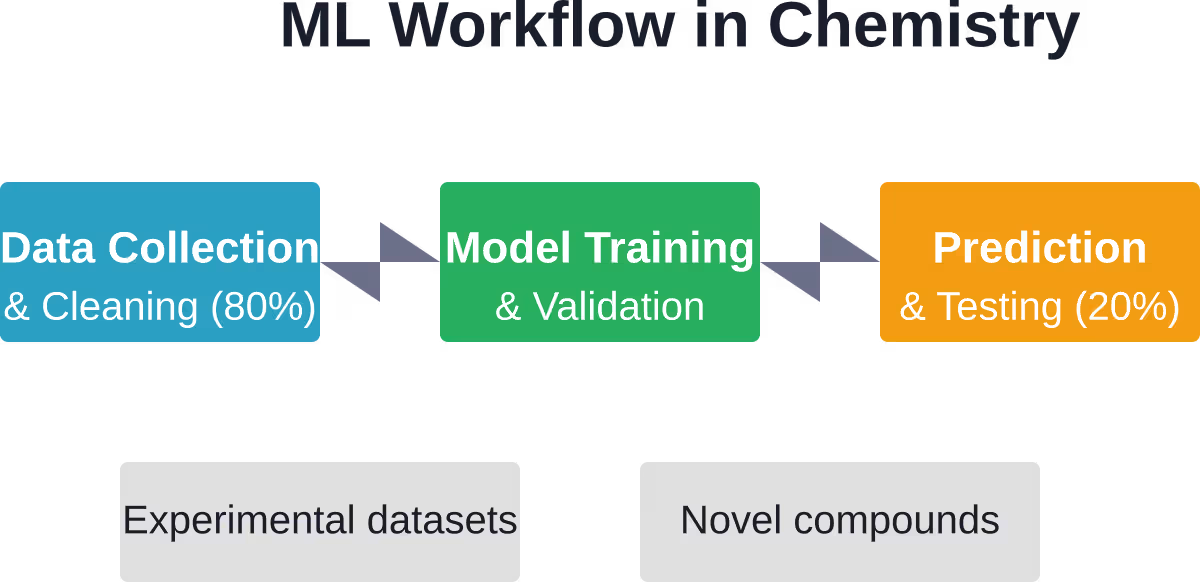
Frequently Asked Questions
What is machine learning in chemistry?
Machine learning in chemistry applies algorithms to predict molecular properties, design new compounds, and accelerate research. Models learn from chemical datasets to identify patterns and make predictions without explicit programming for each scenario.
How accurate are ML predictions for drug discovery?
Accuracy varies by application. Various models show different performance levels for protein-protein interactions and molecular generation. However, clinical trial success rates remain around 9.6-12%, showing computational predictions don’t guarantee clinical outcomes.
Can machine learning replace traditional chemistry experiments?
Not entirely. ML accelerates hypothesis generation and prioritizes candidates for testing, but experimental validation remains essential. The Northwestern materials study achieved 95% prediction accuracy, but those predictions still required laboratory synthesis confirmation.
What data challenges exist in chemistry ML applications?
Data processing and cleaning consume 80% of project time. Chemical datasets often contain inconsistent formats, missing values, experimental variations, and incompatible measurement units. Standardization across decades of research and multiple laboratories poses significant challenges.
Which chemistry domains benefit most from machine learning?
Drug discovery, materials science, and quantum chemistry calculations show strong results. High-throughput screening, molecular property prediction, synthesis route planning, and protein structure prediction all benefit from ML approaches when sufficient quality data exists.
What skills do chemists need to use machine learning?
Basic programming knowledge (Python most commonly), understanding of data formats and preprocessing, familiarity with ML concepts like training/validation splits, and domain expertise to interpret results critically. Data literacy matters more than advanced mathematics for most applications.
How does quantum chemistry integrate with machine learning?
ML models learn from expensive quantum mechanical calculations to approximate results at lower computational cost. This enables high-throughput property prediction while maintaining quantum-level accuracy for molecular systems where full ab initio calculations would be prohibitively slow.
Machine learning hasn’t solved chemistry’s grand challenges yet. But the trajectory is clear—algorithms augment human expertise, accelerate discovery timelines, and reveal patterns buried in decades of experimental data. The 95% materials prediction accuracy represents genuine progress, not hype. For researchers and organizations exploring these tools, the message is pragmatic: invest heavily in data infrastructure, maintain realistic expectations about clinical translation, and remember that 80% of the work happens before any algorithm runs. The computational revolution in chemistry rewards careful preparation more than algorithmic sophistication.