Quick Summary: Machine learning transforms digital marketing by enabling precise customer targeting, personalized content delivery, predictive analytics, and automated campaign optimization. ML algorithms analyze vast behavioral datasets to segment audiences, forecast trends, and deliver relevant experiences across channels. While adoption unlocks competitive advantages, organizations must navigate data quality challenges, regulatory compliance, and integration complexities to realize ML’s full marketing potential. Digital marketing has become unrecognizable from what it was just five years ago. The difference? Machine learning. Marketing teams once relied on gut instinct and basic demographic splits. Now they’re predicting customer behavior before it happens, personalizing content at scale, and automating decisions that used to require days of analysis. But here’s the thing — machine learning isn’t magic. It’s a sophisticated set of algorithms that learn from patterns in data. When applied to marketing operations, these algorithms can process behavioral signals, identify customer segments, optimize ad spend, and deliver the right message at exactly the right moment. The challenge isn’t whether to adopt ML. It’s how to implement it effectively while navigating data privacy regulations, integration hurdles, and the technical complexity that comes with any advanced technology. This guide breaks down how machine learning actually works in digital marketing contexts, where it delivers measurable results, and what obstacles you’ll face during adoption.
Understanding Machine Learning in Marketing Contexts
Machine learning represents a subset of artificial intelligence focused on systems that improve through experience without explicit programming for every scenario. In marketing applications, ML algorithms consume historical data — customer interactions, purchase behavior, content engagement, demographic attributes — and identify patterns humans would miss. Those patterns become predictive models. The transformative element? These models continuously refine themselves as new data arrives. An algorithm predicting email open rates doesn’t just learn once. It adapts as customer behavior shifts, seasonal patterns emerge, or market conditions change. Three core ML categories matter for marketing:
- Supervised learning trains on labeled datasets where outcomes are known. Training data shows which customers converted, which emails got opened, which ads drove clicks. The algorithm learns to predict those outcomes for new, unlabeled data. Customer segmentation and churn prediction rely heavily on supervised learning.
- Unsupervised learning finds hidden structure in data without predefined labels. It discovers customer segments you didn’t know existed, identifies unusual purchasing patterns, or groups content by engagement characteristics. Marketers use it for audience discovery and anomaly detection.
- Reinforcement learning learns optimal actions through trial, error, and reward signals. It’s particularly powerful for dynamic pricing, ad bidding strategies, and real-time content recommendations where the algorithm continuously tests variations and doubles down on what works.
The practical difference between traditional marketing analytics and machine learning? Analytics tells you what happened. Machine learning predicts what will happen next and automatically adjusts your strategy accordingly.
Customer Segmentation and Behavioral Targeting
Demographic segmentation — splitting audiences by age, gender, location — remains common. It’s also increasingly ineffective. Machine learning enables behavioral segmentation at scale. Instead of grouping customers by who they are, ML algorithms group them by what they do: browsing patterns, content consumption, purchase frequency, channel preferences, response timing. The simplest way to define target audiences involves gender and age parameters. But behavioral data often remains incomplete. While precise global averages vary by platform, many industry analyses indicate that direct demographic data collection via forms often reaches 20-30% in high-intent environments, though ML is still used to infer the remaining majority of user profiles. Machine learning fills those gaps by inferring missing parameters based on behavioral similarities with other users. Here’s where it gets interesting. ML-powered segmentation identifies micro-segments — small groups exhibiting specific behavioral signatures that correlate with high conversion probability. These segments shift dynamically as customer behavior evolves. One airline leveraged machine learning algorithms to identify users with behavioral patterns matching existing customers. By analyzing existing customer data, the ML system targeted users with similar online behaviors and interests. The campaign achieved a 35% increase in conversion rates alongside significant improvements in customer acquisition cost efficiency. Behavioral targeting extends beyond initial acquisition. ML algorithms track post-conversion behavior to identify upsell opportunities, churn risk, and optimal retention interventions. 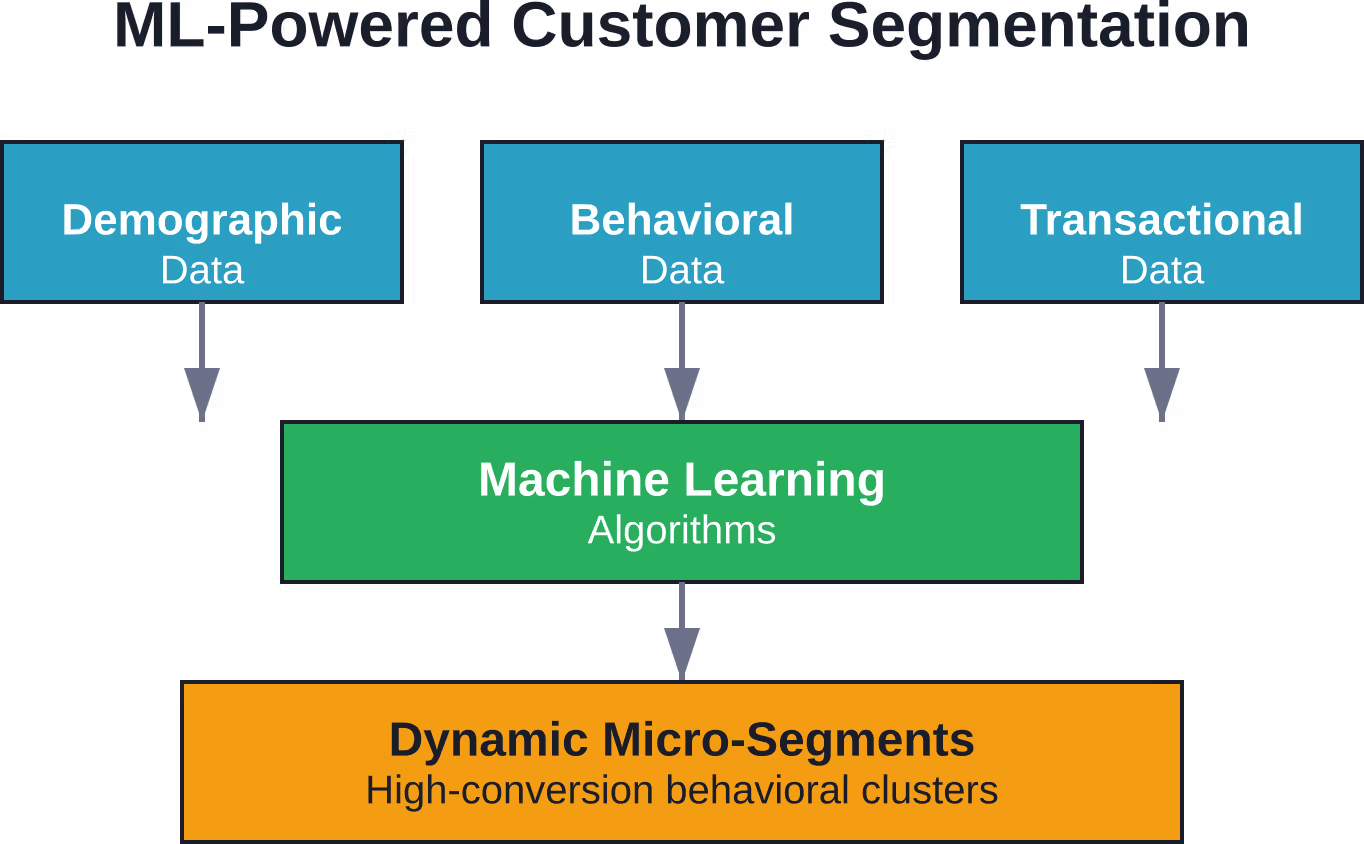 The technical requirement? Clean, integrated data. ML algorithms can’t segment effectively when customer data sits fragmented across platforms, formats, and systems. Data unification precedes effective segmentation.
Predictive Analytics for Campaign Optimization
Predictive analytics applies machine learning to forecast future outcomes based on historical patterns. In marketing contexts, predictive models answer questions like: Which leads will convert? What content will drive engagement? When will customers churn? How much budget should flow to each channel? The operational advantage? Marketers shift from reactive adjustments to proactive optimization. Instead of analyzing why a campaign underperformed after it ends, predictive models flag issues before they materialize and automatically reallocate resources. Lead scoring represents the most mature predictive application. ML algorithms analyze historical conversion data — which prospect characteristics, behaviors, and engagement patterns preceded purchases — then score new leads by conversion probability. Sales teams prioritize high-scoring prospects while automation nurtures lower-scoring contacts until they show buying signals. Budget allocation becomes dynamic rather than fixed. Predictive models continuously estimate ROI across channels, campaigns, and audience segments. When performance shifts, the algorithm redistributes spend toward higher-performing placements without manual intervention. Email optimization leverages predictive analytics extensively. By analyzing user behavior patterns, ML systems recommend optimal send times, tailor content variations, and adapt frequency based on each recipient’s likelihood to open or convert. Newsletters, transactional emails, and triggered flows transform into more relevant, results-driven experiences. Content recommendation engines use predictive models to surface the next article, product, or video most likely to drive engagement for each individual. These systems power personalization at scale — every visitor sees content optimized for their predicted preferences. The challenge lies in model accuracy. Predictive systems trained on insufficient or biased historical data produce unreliable forecasts. Garbage in, garbage out remains the fundamental rule. Organizations need substantial historical datasets before predictive models deliver actionable insights.
Personalization at Scale
Consumers expect personalized experiences. Generic mass marketing feels increasingly obsolete. Machine learning makes individualized personalization feasible at scale. Where manual personalization might segment audiences into 10 or 20 groups, ML algorithms create effectively infinite micro-segments — sometimes treating each customer as a segment of one. The mechanics involve real-time decisioning. When a customer interacts with any touchpoint — website, email, app, ad — ML algorithms instantly process their behavioral history, current context, and similar customer patterns to deliver personalized content, product recommendations, or offers. One resort implemented Salesforce’s ML-powered guest console that tracked visitor preferences and booking patterns. Website visitors who booked certain activities received personalized content promoting complementary experiences — snorkeling sessions or excursions matched to their demonstrated interests. Turtle Bay Resort achieved a 40% increase in customer engagement. Product recommendation accuracy improves dramatically with ML. Traditional rule-based systems use simple logic: “customers who bought X also bought Y.” Machine learning incorporates dozens of signals — browsing patterns, seasonal trends, price sensitivity, category affinity, temporal factors — to predict which products each customer will find relevant. Dynamic content optimization extends personalization beyond products. ML algorithms test headline variations, image selections, layout configurations, and call-to-action phrasing, then automatically serve the combination predicted to resonate with each visitor segment. Email content personalization goes far beyond inserting a name. ML systems determine which content topics, product categories, imagery styles, and message lengths drive engagement for each subscriber, then assemble individualized emails from modular content blocks.
| Personalization Layer | Traditional Approach | ML-Powered Approach |
|---|---|---|
| Audience Segmentation | 5-10 manual segments | Thousands of dynamic micro-segments |
| Content Selection | Rule-based logic | Predictive relevance scoring |
| Timing Optimization | Fixed schedules | Individual send-time prediction |
| Channel Selection | Campaign-level decisions | Individual channel preference prediction |
| Offer Personalization | Segment-level promotions | Individual propensity-based offers |
The limitation? Personalization requires substantial first-party data collection, which must comply with privacy regulations and earn customer trust through transparent value exchange.
Automated Campaign Management
Marketing automation existed before machine learning. But ML transforms automation from executing predefined workflows to making intelligent, adaptive decisions. Traditional automation follows if-then logic: if a customer does X, then send Y. ML-powered automation continuously learns which actions drive outcomes, adjusts workflows based on performance data, and optimizes decisions for each individual. Programmatic advertising represents the most visible automated marketing application. ML algorithms bid on ad inventory in real-time auctions, determining which impressions to purchase and at what price based on predicted conversion probability. The system optimizes across millions of micro-decisions daily — far beyond human capacity. Meta’s advertising platform exemplifies ML-driven automation. Campaigns using machine learning features analyze user behavior across Facebook and Instagram to identify high-intent prospects, optimize ad creative delivery, and adjust bids dynamically. Meta’s latest AI-driven attribution models and Advantage+ features drove a 24% increase in incremental conversions compared to standard models, with specific ad click lifts of 3.5% on Facebook. Chatbots and conversational marketing tools leverage natural language processing — an ML application — to handle customer inquiries, qualify leads, and guide prospects through decision journeys without human intervention. Sophisticated implementations learn from each interaction to improve response accuracy. Social media management platforms use ML to recommend optimal posting times, identify trending topics relevant to brand positioning, and flag content likely to drive engagement before publication. Content creation assistance tools apply ML to generate subject line variations, headline options, and body copy drafts. While humans still direct creative strategy, ML accelerates production and suggests data-informed variations for testing. The risk involves over-automation. Systems making decisions without human oversight can amplify biases present in training data, make decisions misaligned with brand values, or optimize for short-term metrics at the expense of long-term customer relationships.
Recommendation Systems and Content Delivery
Recommendation engines powered by machine learning drive significant portions of engagement for content platforms, e-commerce sites, and streaming services. These systems analyze behavioral patterns to predict which content, products, or services each user will find valuable. The algorithms consider collaborative signals (what similar users engaged with), content attributes (characteristics of items the user previously liked), and contextual factors (time, device, recent behavior). Collaborative filtering identifies patterns across user populations. If users A and B both liked items 1, 2, and 3, and user A also liked item 4, the algorithm predicts user B will likely appreciate item 4. This works at a massive scale across millions of users and items. Content-based filtering analyzes item attributes. If a user engages with articles about specific topics, the algorithm recommends other content with similar characteristics. This approach handles new items better than collaborative filtering but requires rich item metadata. Hybrid systems combine multiple approaches for superior accuracy. Advanced recommendation engines also incorporate reinforcement learning to balance exploration (showing diverse content to learn preferences) with exploitation (serving items predicted to drive engagement). Research shows that fairness considerations in recommender systems remain underdeveloped. Analysis of 120 publications on recommender system fairness reveals approximately 49.1% focus on consumer fairness while 41.8% address producer fairness, but fewer than 10% examine both simultaneously. 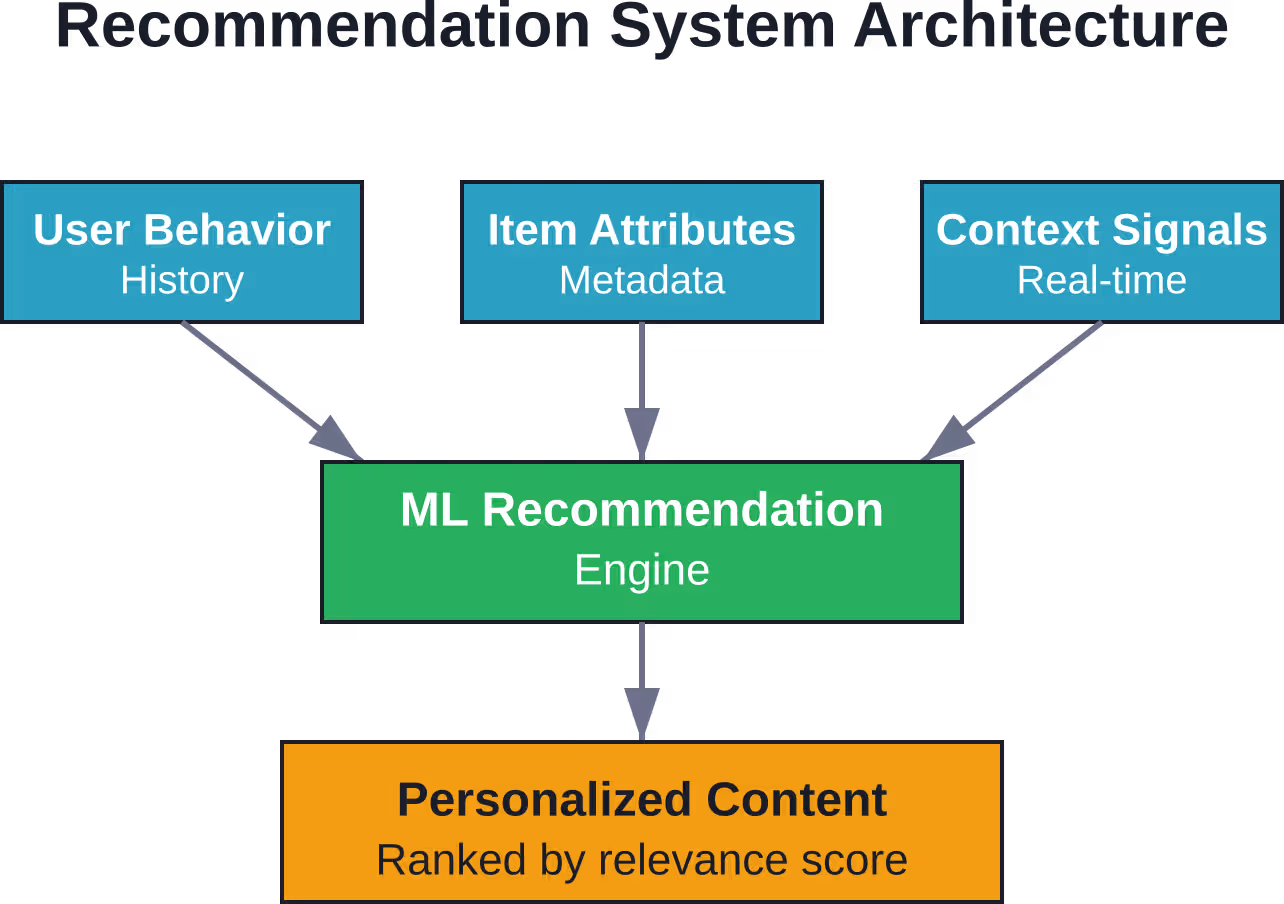 This fairness gap matters because recommendation algorithms significantly influence both consumer experiences and producer (content creator, seller) outcomes. Imbalanced systems can create filter bubbles, amplify existing biases, or disadvantage smaller producers. Organizations implementing recommendation systems need strategies that balance accuracy with diversity, fairness, and long-term user satisfaction rather than solely optimizing short-term engagement.
Sentiment Analysis and Social Listening
Machine learning enables marketers to monitor and analyze consumer sentiment at scale across social media, reviews, support tickets, and other unstructured text sources. Natural language processing (NLP) — an ML application — classifies text sentiment as positive, negative, or neutral. Advanced models detect specific emotions, identify topics being discussed, and flag emerging trends or issues. Brand monitoring tools use sentiment analysis to track reputation, identify PR crises before they escalate, and measure campaign reception in real-time. When sentiment suddenly shifts negative, alerts trigger immediate investigation. Competitive intelligence benefits from ML-powered social listening. Algorithms track competitor mentions, analyze customer complaints about competing products, and identify unmet needs in market conversations. Product development teams leverage sentiment analysis to prioritize feature requests, understand usage pain points, and validate concepts before full development investment. Customer service optimization uses sentiment scoring to route tickets, with negative sentiment messages escalated to experienced agents while neutral inquiries flow to chatbots or junior staff. The accuracy challenge involves context, sarcasm, and cultural nuance. ML models trained primarily on formal English struggle with slang, regional dialects, or languages with different sentiment expression patterns. Organizations need models trained on representative data for their specific markets. 
Plan Your Digital Marketing ML Project With AI Superior
Digital marketing teams often have plenty of data, but not always a clear way to use it. AI Superior can help shape machine learning projects around practical marketing goals, whether the focus is prediction, automation, customer behavior analysis, or internal decision-support tools. Their services cover AI consulting, machine learning, data science, AI software development, proof of concept development, and model evaluation. This fits cases where a company needs to check whether an ML idea is realistic before investing in full development. AI Superior can help with:
- Clarifying the business goal behind the ML use case
- Reviewing campaign, CRM, customer, and analytics data
- Creating proof of concept models for testing
- Building models for lead scoring, segmentation, or churn prediction
- Evaluating model accuracy and reliability
- Connecting AI models with existing software or internal workflows
- Supporting development from early planning to deployment
For digital marketing, this can be relevant when teams want to improve campaign targeting, forecast customer behavior, personalize offers, or make better use of performance data. Contact AI Superior to discuss the project.
Compliance and Privacy Considerations
Machine learning in marketing raises significant data privacy and regulatory compliance challenges. Data sits at the heart of AI development, according to the Federal Trade Commission. ML models require substantial personal information to function effectively — browsing behavior, purchase history, demographic attributes, location data, social connections. Regulatory frameworks increasingly restrict data collection and usage. Organizations must ensure ML implementations comply with regulations like GDPR in Europe, CCPA in California, and evolving privacy laws worldwide. Transparency requirements mandate explaining how algorithms make decisions that affect consumers. But many ML models operate as “black boxes” where even their creators can’t fully articulate why specific predictions emerged. This tension between model complexity and explainability requirements creates legal risk. In September 2024, the FTC announced Operation AI Comply, launching five law enforcement actions against operations using deceptive AI claims. The agency emphasizes that companies must uphold privacy and confidentiality commitments when deploying AI systems. One notable case involved FBA Machine and its operator, charged with falsely guaranteeing that consumers could profit from operating online storefronts using AI-powered software. In another action, Air AI faced a ban from marketing business opportunities after the FTC alleged the company misled entrepreneurs and small businesses about AI capabilities. These enforcement actions signal regulatory scrutiny of exaggerated AI marketing claims. Organizations must ensure their ML implementations deliver advertised capabilities and don’t make deceptive promises about system performance. Bias in ML models creates both ethical and legal concerns. Algorithms trained on historical data perpetuate existing biases — discriminating by race, gender, age, or protected characteristics. When these biased models drive targeting, pricing, or content decisions, organizations face discrimination claims. Data security requirements intensify with ML adoption. Models trained on customer data can inadvertently expose that information through prediction outputs. Proper safeguards prevent models from leaking private information.
| Compliance Area | Key Requirements | ML Implementation Impact |
|---|---|---|
| Data Collection | Consent, purpose limitation | Restricts training data availability |
| Algorithmic Transparency | Explainable decisions | Limits complex model architectures |
| Bias Prevention | Non-discrimination requirements | Requires bias testing and mitigation |
| Data Security | Protection from breaches | Demands model security controls |
| User Rights | Access, deletion, portability | Complicates model retraining |
Organizations deploying ML for marketing need governance frameworks covering data collection practices, model validation procedures, bias testing protocols, and incident response plans for when algorithms produce problematic outputs.
Implementation Challenges and Solutions
Despite proven benefits, machine learning adoption in marketing faces substantial obstacles. Data quality represents the most common barrier. ML algorithms require clean, structured, integrated data. Many organizations have customer information fragmented across disconnected systems — CRM, email platform, web analytics, ad platforms, point-of-sale systems. Models trained on incomplete or inconsistent data produce unreliable predictions. The solution involves data infrastructure investment before algorithm deployment. Organizations need unified customer data platforms that consolidate information from all touchpoints, establish common identifiers, and maintain data quality through validation rules. Technical skills gaps slow adoption. Marketing teams typically lack ML expertise, while data science teams often don’t understand marketing objectives. Successful implementations require cross-functional collaboration and either hiring hybrid-skilled professionals or training existing staff. Some organizations address this through managed ML services that abstract technical complexity. Platforms offering pre-built marketing models — lead scoring, churn prediction, recommendation engines — enable non-technical marketers to leverage ML capabilities without building systems from scratch. Integration complexity creates implementation friction. Adding ML capabilities to existing marketing technology stacks requires connecting multiple systems, managing data flows, and ensuring real-time processing where needed. Legacy systems often lack APIs or data export capabilities that ML tools require. Phased rollouts mitigate integration challenges. Rather than attempting full-stack ML transformation, organizations start with contained use cases — email send-time optimization or basic lead scoring — then expand as integration patterns mature. Cost concerns deter smaller organizations. ML infrastructure, data storage, specialized talent, and ongoing model maintenance require significant investment. However, cloud-based ML services with usage-based pricing make capabilities accessible without major upfront capital. Change management challenges emerge when ML systems alter established workflows. Marketers accustomed to manual campaign optimization may resist automated systems. Sales teams might ignore ML-generated lead scores if they don’t trust the underlying logic. Successful adoption requires demonstrating value through pilot programs, involving end users in implementation, providing training on ML outputs, and maintaining human oversight during transitions. Algorithms should augment human judgment initially rather than replace it entirely. Model maintenance presents an ongoing challenge. ML systems degrade over time as market conditions shift, customer behavior evolves, or data distributions change. Organizations need processes for monitoring model performance, detecting drift, and retraining models with fresh data.
Measuring Machine Learning Marketing Impact
Quantifying ML’s contribution to marketing outcomes requires careful measurement frameworks. Traditional marketing metrics — conversion rates, customer acquisition cost, engagement metrics, revenue attribution — still matter. But ML implementations enable more sophisticated measurement approaches. A/B testing compares ML-optimized campaigns against control groups using traditional methods. Documented implementations show increases of 21% in average user sessions, 31% in conversions, 24% uplift in revenue per user, and 13% improvement in repeat purchases after deploying ML-powered personalization. Incrementality testing isolates ML’s specific impact by measuring outcomes for users exposed to ML-driven experiences versus those receiving standard treatment. This separates correlation from causation — ensuring observed improvements result from ML rather than external factors. Predictive accuracy metrics evaluate model performance. Lead scoring systems measure how accurately the algorithm predicts conversions. Churn prediction models track what percentage of flagged customers actually leave. Recommendation engines monitor click-through and conversion rates for suggested items. Efficiency gains represent another value dimension. ML automation reduces manual effort — fewer hours spent on campaign optimization, audience segmentation, or content selection. Time savings translate to cost reductions or capacity for higher-value strategic work. Customer experience metrics assess whether ML-driven personalization improves satisfaction, Net Promoter Scores, or customer lifetime value. Technology should enhance experiences rather than merely extracting short-term value. 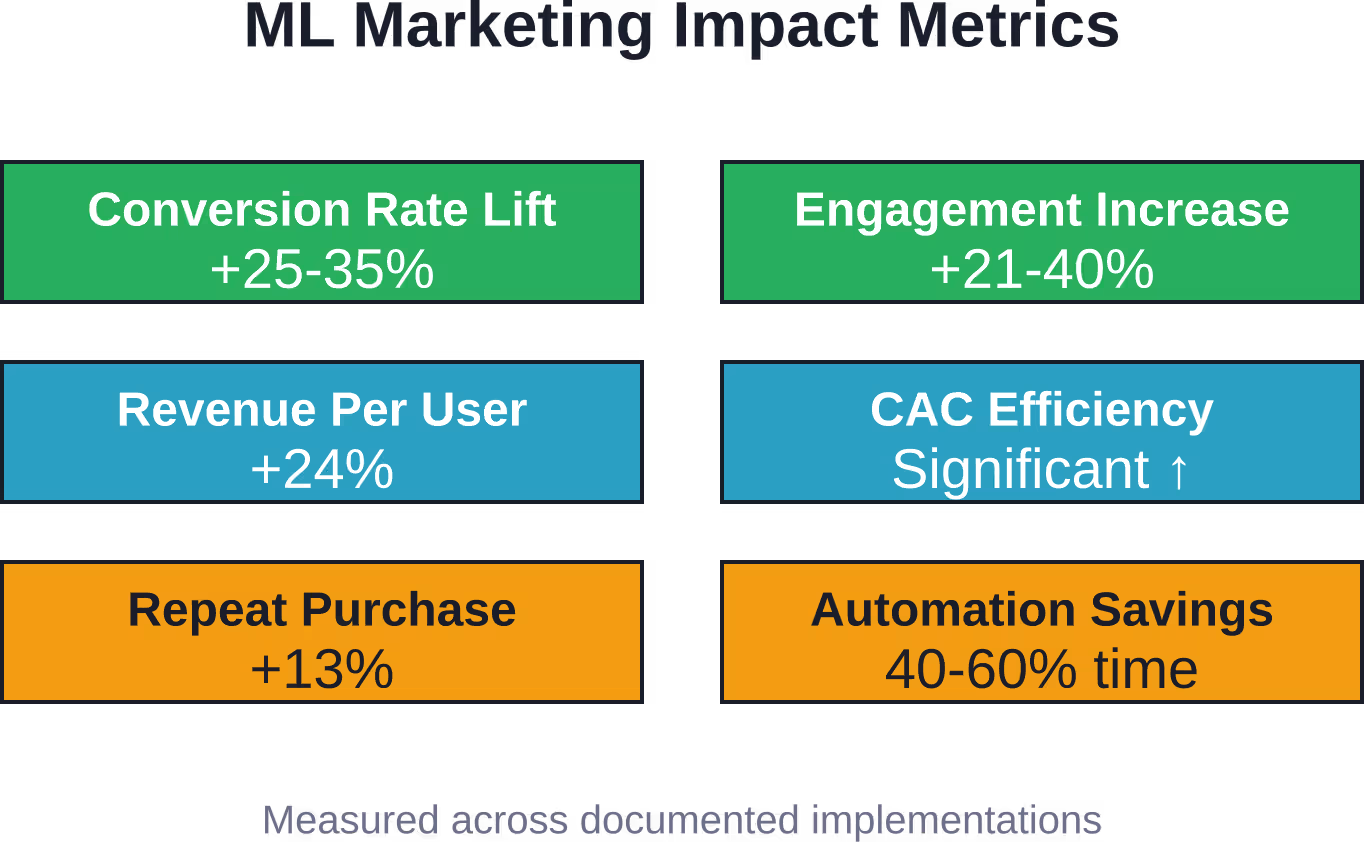 The measurement challenge involves attribution complexity. ML often works behind the scenes across multiple touchpoints. Isolating its contribution from other marketing activities, seasonal factors, or market trends requires rigorous experimental design. Organizations should establish baseline metrics before ML deployment, implement proper control groups, and track both leading indicators (model accuracy, automation rates) and lagging outcomes (revenue, retention, customer value).
Future Developments in ML Marketing
Machine learning capabilities continue advancing rapidly, opening new marketing applications. Generative AI — systems that create text, images, video, and audio — increasingly assists content production. Marketers use these tools to draft copy variations, generate image assets, create personalized video content, and produce synthetic training data for other ML models. Multimodal learning combines different data types — text, images, audio, video — in unified models. Future marketing systems will analyze customer behavior across formats simultaneously, enabling richer personalization and more accurate predictions. Real-time decisioning capabilities improve as computing costs decline and algorithms become more efficient. Marketers will deploy ML systems that optimize experiences in milliseconds across every customer interaction rather than batch-processing decisions hourly or daily. Recent research explores hybrid approaches combining traditional ML with retrieval-augmented generation (RAG) for financial services marketing personalization. These architectures balance predictive accuracy with explainability — addressing compliance requirements while maintaining performance. Knowledge graph applications in recommendation systems enhance content discovery and ad targeting. By representing relationships between entities — products, content, customers, contexts — knowledge graphs help ML models understand semantic connections beyond simple behavioral patterns. Reinforcement learning adoption in marketing remains limited but shows promise for dynamic pricing, bidding strategies, and long-term customer relationship optimization. These systems learn optimal action sequences through interaction rather than relying solely on historical data. Privacy-preserving ML techniques enable training models on sensitive data without exposing individual information. Federated learning, differential privacy, and secure multi-party computation allow organizations to leverage ML while meeting stringent privacy requirements. Edge computing brings ML processing closer to data sources — running models on devices rather than centralized servers. This enables faster personalization, reduces data transmission costs, and addresses some privacy concerns by processing information locally. Automated machine learning (AutoML) tools democratize ML access by automating model selection, hyperparameter tuning, and deployment. These platforms enable non-specialists to build effective ML systems, accelerating marketing adoption.
Frequently Asked Questions
What’s the difference between machine learning and traditional marketing analytics?
Traditional analytics describes historical performance — what happened and why. Machine learning predicts future outcomes and automatically optimizes decisions based on those predictions. Analytics tells you last quarter’s email open rate; ML predicts which subject line will maximize opens for tomorrow’s campaign and personalizes content for each recipient. The fundamental shift is from descriptive insights to predictive action.
How much data does an organization need before machine learning becomes effective?
Requirements vary by use case, but generally organizations need thousands of examples for basic implementations and tens of thousands for sophisticated models. Lead scoring might work with 5,000 historical conversions, while advanced personalization benefits from millions of interactions. Data quality matters more than quantity — clean, accurate, representative data produces better results than massive volumes of noisy information. Start with simpler models requiring less data and expand as datasets grow.
Can small businesses benefit from machine learning marketing, or is it only for large enterprises?
ML marketing tools increasingly serve small businesses through affordable cloud platforms offering pre-built models and usage-based pricing. Email platforms provide ML-powered send-time optimization regardless of list size. Social media ad platforms include ML targeting for any budget. The sophistication level differs — enterprises build custom models while smaller organizations use productized solutions — but meaningful benefits are accessible at any scale. Focus on managed services rather than building custom infrastructure.
What are the most common reasons machine learning marketing projects fail?
Poor data quality causes most failures — fragmented customer information, missing values, inconsistent formats. Other frequent issues include unrealistic expectations about accuracy, insufficient technical expertise, lack of executive support, inadequate change management, and choosing overly complex use cases for initial implementations. Successful projects start with data infrastructure, select contained use cases, involve end users early, and maintain realistic timelines. Pilot small, measure rigorously, then scale what works.
How do organizations ensure their ML marketing systems comply with privacy regulations?
Compliance requires obtaining proper consent for data collection, implementing purpose limitation so data is used only as disclosed, ensuring algorithmic transparency through explainable models, testing for bias regularly, securing data throughout the ML lifecycle, and honoring user rights like deletion requests. Organizations need governance frameworks covering data handling, model validation, bias auditing, and incident response. Legal review of ML implementations before deployment prevents regulatory issues. The Federal Trade Commission emphasizes that AI systems must uphold privacy commitments and avoid deceptive claims.
What skills do marketing teams need to work effectively with machine learning?
Marketers don’t need to build algorithms but should understand ML fundamentals — how models learn, what data they require, their limitations. Key skills include data literacy to assess quality and interpret outputs, analytical thinking to frame problems ML can solve, experimentation methodology for rigorous testing, and technical communication to collaborate with data teams. Organizations benefit from hybrid roles bridging marketing and data science or pairing marketers with technical partners. Training programs help existing staff develop ML fluency without requiring programming expertise.
How frequently do machine learning models need retraining to maintain accuracy?
Retraining frequency depends on how quickly underlying patterns change. Models predicting seasonal behavior need updates quarterly or annually. Systems optimizing rapidly changing environments like programmatic advertising may retrain daily. Most marketing models benefit from monthly or quarterly retraining. The key is monitoring performance metrics — when accuracy degrades beyond acceptable thresholds, retrain with fresh data. Automated retraining pipelines handle this without manual intervention, ensuring models stay current as customer behavior and market conditions evolve.
Conclusion: Strategic Machine Learning Adoption
Machine learning fundamentally transforms how marketing operates. The technology enables precision targeting impossible through manual methods, delivers personalized experiences at scale, predicts customer behavior before it occurs, and automates optimization across countless decisions daily. But ML isn’t magic. It’s sophisticated pattern recognition requires clean data, technical expertise, and strategic implementation. Organizations seeing the strongest results start with clear business problems rather than technology solutions. They invest in data infrastructure before algorithms. They pilot contained use cases, measured rigorously, and scale successes methodically. The competitive pressure intensifies. As ML adoption spreads, organizations leveraging these capabilities gain sustainable advantages in customer acquisition efficiency, lifetime value, and operational productivity. Those relying solely on traditional methods face growing disadvantages. Regulatory landscapes continue evolving. Successful ML marketing balances performance optimization with privacy protection, algorithmic transparency, and bias mitigation. Compliance frameworks aren’t obstacles but foundations for sustainable, trustworthy implementations. The technology will advance. Models will become more accurate, accessible, and explainable. Real-time personalization will improve. Automation will expand. Privacy-preserving techniques will mature. Marketing teams that build ML competencies now — through managed services, partnerships, or internal development — position themselves to capitalize on these advances. Those waiting for perfect clarity may find themselves too far behind to catch up. Start somewhere. Choose a focused use case with available data, measurable outcomes, and manageable complexity. Learn from that implementation. Then expand systematically. Machine learning in digital marketing isn’t the future anymore. It’s the present competitive reality.