
Quick Summary: Machine learning is transforming industrial automation through predictive maintenance, quality control, and intelligent process optimization. Adoption reached 56% in 2021, driven by edge computing, intelligent sensors, and self-learning robotics that reduce downtime and boost manufacturing efficiency. Industrial automation is experiencing its most dramatic shift since the advent of programmable logic controllers. Machine learning has flipped the traditional paradigm: instead of workers learning how machines operate, machines now learn to understand processes, adapt behavior, and interact with their environment. The transformation isn’t just theoretical. According to data from the McKinsey Global Survey on AI, AI adoption in companies reached 56% in 2021, marking a 6% year-over-year increase from 2020. That acceleration shows no signs of slowing. But here’s the thing—implementing machine learning in factory automation differs fundamentally from deploying it in software environments. Industrial settings demand reliability, real-time performance, and integration with decades-old legacy systems. The stakes are higher when a prediction error can halt production lines costing thousands per minute. This guide examines how machine learning is reshaping industrial automation, the specific applications delivering measurable returns, and the best practices manufacturers are using to deploy these systems successfully.
The Shift from Rule-Based to Adaptive Automation
Traditional industrial automation relied on deterministic programming. Engineers wrote explicit rules for every scenario a machine might encounter. If temperature exceeds X, reduce speed by Y. If pressure drops below Z, trigger an alarm. This approach worked reliably for decades, but it had limits. Complex manufacturing processes involve thousands of variables interacting in non-linear ways. Writing rules for every possible combination becomes impractical. More importantly, rule-based systems can’t adapt to conditions their programmers didn’t anticipate. Machine learning flips this model. Instead of encoding explicit rules, ML systems learn patterns from data. A predictive maintenance algorithm doesn’t need programmed thresholds for every failure mode—it learns the signatures of impending failures by analyzing historical sensor data from thousands of machines. The National Institute of Standards and Technology (NIST) has published guidance emphasizing this adaptive approach, recognizing that modern manufacturing demands flexibility traditional automation can’t provide. NIST’s work on Industry 4.0 technologies helps manufacturers determine the best use of advanced systems to improve efficiency and quality while maintaining the high reliability standards American manufacturing demands.
Top Machine Learning Applications in Manufacturing
Not all ML applications deliver equal value in industrial settings. Data from ISA reveals which use cases are gaining the most traction.
Predictive Maintenance: The Leading Application
Predictive maintenance represents 22.2% of AI applications in manufacturing—the single largest category. The value proposition is straightforward: anticipate equipment failures before they happen, schedule maintenance during planned downtime, and avoid catastrophic breakdowns. Adopting a preventative maintenance approach can provide savings from 8% to 12% over reactive maintenance strategies, according to the International Society of Automation. That might sound modest, but for large manufacturing operations, that translates to millions in annual savings. Machine learning excels at this because it can detect subtle patterns in sensor data—vibration signatures, temperature fluctuations, power consumption anomalies—that precede failures. A bearing might show barely perceptible changes in vibration frequency weeks before it seizes. Traditional threshold-based monitoring would miss it. ML algorithms catch it. The technology has matured beyond pilot projects. MTConnect, the open manufacturing connectivity standard, now serves as infrastructure for predictive analytics applications. Factory connectivity coupled with standardized data protocols enables ML systems to learn from equipment across entire production facilities.
Quality Inspection and Assurance
Quality inspection accounts for 19.7% of manufacturing AI applications. Computer vision systems powered by deep learning can inspect products at speeds and accuracy levels human inspectors can’t match. A trained neural network can identify surface defects, dimensional variations, and assembly errors across thousands of units per hour. Unlike human inspectors who fatigue, ML systems maintain consistent performance throughout shifts. American manufacturing has long been associated with high-quality standards meant to ensure reliability and longevity of products. Machine learning helps maintain those standards while reducing inspection costs and catching defects that might slip past manual review.
Manufacturing Process Optimization
Process optimization represents 13% of AI applications. These systems analyze production data to identify efficiency improvements—optimal machine parameters, reduced energy consumption, minimized waste, and increased throughput. ML models can discover non-obvious relationships between process variables. Perhaps a specific combination of temperature, pressure, and material feed rate produces better yields than engineers assumed. The algorithm tests millions of parameter combinations through simulation or controlled experiments, finding optimal human operators that wouldn’t intuitively explore.
Self-Learning Industrial Robots and Cobots
Industrial robots traditionally operated through precise, pre-programmed motion paths. An engineer taught the robot exactly where to move, what to grasp, and how to manipulate parts. Any change to the product or process required manual reprogramming. Machine learning is making robots adaptive. Self-learning robots use reinforcement learning to improve task performance through trial and error. A robotic arm learning to grasp irregularly shaped objects might fail initially, but it adjusts based on feedback from force sensors and vision systems. After thousands of attempts, it develops strategies that work across diverse part geometries. Collaborative robots—cobots—benefit especially from ML. These machines work alongside humans, requiring situational awareness and adaptive behavior that fixed programming can’t provide. Machine learning enables them to anticipate human movements, adjust speeds for safety, and handle the variability inherent in human-robot interaction. The engineering challenges are significant. Robotics research at institutions like NIST focuses on measurement science for autonomous systems, developing standards and test methods that ensure these adaptive machines perform reliably in industrial environments.
Edge Computing and Intelligent Sensors
Running machine learning algorithms on cloud servers introduces latency that many industrial applications can’t tolerate. When a production line moves parts past an inspection camera at high speed, the system needs millisecond-level response times to trigger reject mechanisms. Edge computing solves this by deploying ML inference directly on industrial hardware—sensors, controllers, and edge nodes positioned on the factory floor. IEEE Standard 2805.2-2025 specifies protocols for edge computing nodes to acquire, filter, and pre-process data from industrial controllers including programmable logic controllers, microcontrollers, and industrial robots, with Board Approval dated 2025-09-10 and publication in 2026-02-12. This standardization enables automated data acquisition from field devices with different interfaces, creating the data foundation ML systems require. Intelligent sensors embed ML models directly in sensor hardware. A vibration sensor monitoring a motor might run an anomaly detection model locally, transmitting alerts only when it detects unusual patterns. This reduces network bandwidth requirements and enables real-time response. The architecture looks different from IT-focused ML deployments. Models must be compact enough to run on resource-constrained hardware. Inference must happen deterministically within timing constraints. And the entire system must operate reliably in harsh industrial environments with temperature extremes, electrical noise, and physical vibration.
Condition Monitoring in Factory Automation
Condition monitoring extends beyond predictive maintenance to encompass real-time awareness of equipment health across entire facilities. Machine learning systems continuously analyze sensor streams, building dynamic models of normal operation and flagging deviations. The approach differs fundamentally from traditional threshold-based monitoring. Instead of setting fixed alarm levels, ML models learn what normal looks like for each piece of equipment under various operating conditions. A motor might legitimately run hotter when ambient temperature rises or production speeds increase. Context-aware ML models distinguish between normal variation and genuine anomalies. These systems often employ unsupervised learning techniques. Anomaly detection algorithms don’t need labeled examples of every possible failure mode—they simply learn the manifold of normal operation and identify data points that fall outside it. This approach catches issues that traditional threshold-based monitoring misses. A gradual drift in multiple correlated parameters might not cross any single threshold, but an ML model recognizes the pattern as abnormal based on historical data.
Implementation Best Practices
Deploying machine learning in industrial automation requires different approaches than software-focused ML projects. These best practices emerge from successful implementations across the manufacturing sector.
Start with High-Value, Low-Complexity Applications
Don’t begin with the most technically challenging problem. Identify applications where ML delivers clear ROI with manageable implementation complexity. A single production line with well-instrumented equipment makes a better starting point than enterprise-wide optimization. Predictive maintenance on critical assets often fits this profile. The value case is quantifiable—avoided downtime, reduced maintenance costs. The technical requirements are achievable—collect sensor data, train models on historical failures, deploy alerts.
Prioritize Data Quality Over Data Quantity
Manufacturing generates massive data volumes, but not all of it is useful. Machine learning models need clean, properly labeled, contextually rich data. A million poorly timestamped sensor readings with missing metadata have less value than ten thousand high-quality records with complete context. Invest in data infrastructure first. Standardize data collection protocols. Implement proper timestamping across systems. Capture process context—what product was running, what operating mode, what environmental conditions. This groundwork makes ML implementation feasible.
Address the Integration Challenge
Industrial facilities run diverse automation systems from different vendors, often spanning decades of technology generations. ML systems must integrate with this heterogeneous environment. Standards like MTConnect help by providing consistent data interfaces across equipment types. Edge computing architectures enable ML deployment without replacing existing control systems. The goal is augmenting existing infrastructure with intelligent layers that work alongside proven automation technology.
Plan for Model Lifecycle Management
Machine learning models aren’t static software. They degrade as conditions change. A model trained on equipment in pristine condition might perform poorly after months of wear. Production processes evolve, products change, and operating conditions shift. Successful deployments include monitoring for model drift, retraining pipelines, and version control. Some implementations use online learning approaches where models continuously update based on new data, though this requires careful safeguards in industrial settings. 
Apply ML to Industrial Automation With AI Superior
Industrial automation projects often involve operational data, equipment monitoring, production workflows, and predictive systems. AI Superior can help companies apply machine learning to automation environments where efficiency, monitoring, or process optimization are key goals. Their services include AI consulting, machine learning, data science, AI software development, proof of concept development, and model evaluation. AI Superior can support industrial automation projects with:
- Reviewing production and operational datasets
- Defining automation-related ML use cases
- Building proof of concept models
- Developing prediction, anomaly detection, or optimization systems
- Testing model performance in operational scenarios
- Planning integration with industrial software or infrastructure
- Supporting deployment and workflow automation
For industrial automation, this may apply to predictive maintenance, process optimization, equipment monitoring, anomaly detection, quality inspection, and production forecasting. Contact AI Superior to explore the implementation plan. 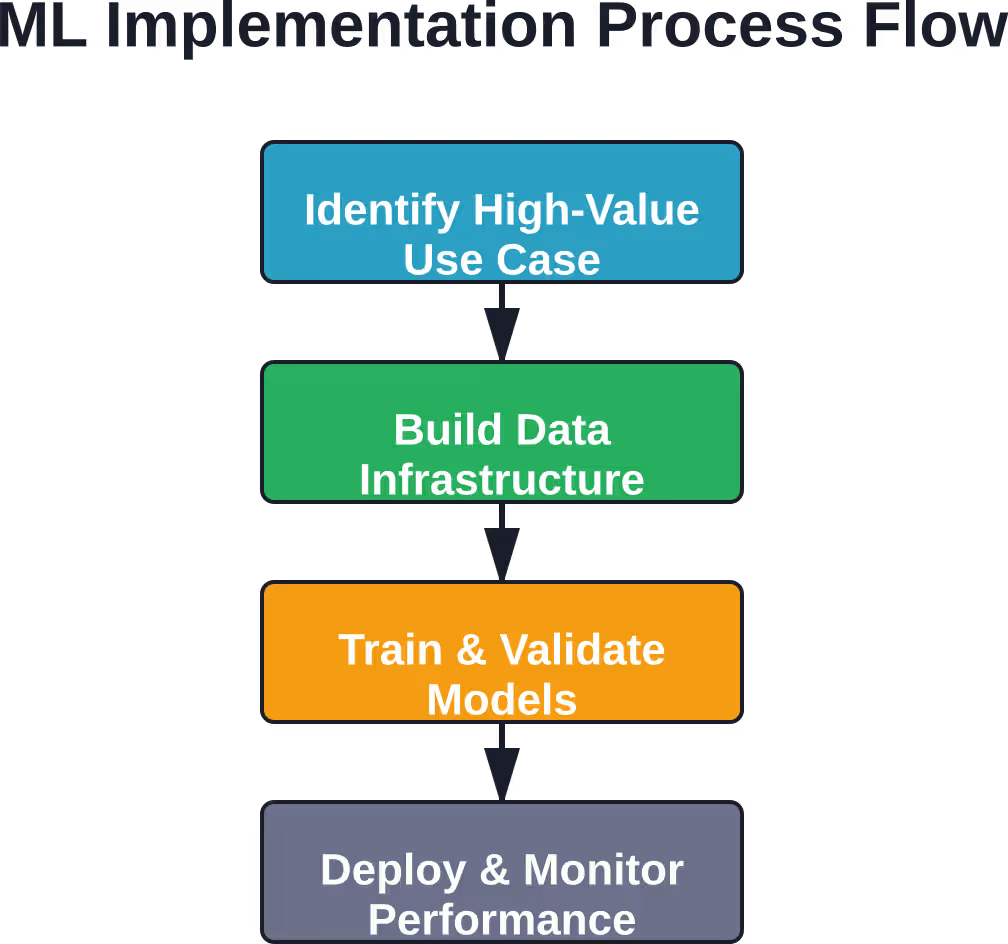
Challenges and Considerations
Machine learning in industrial automation presents several challenges. Understanding these challenges helps set realistic expectations and plan appropriately.
The Explainability Problem
Deep neural networks often function as black boxes. They make accurate predictions, but engineers can’t easily trace why. In industrial settings where safety and compliance matter, unexplainable decisions create problems. When an ML system recommends shutting down a production line, operators need to understand the reasoning. Regulatory environments in certain industries require documented justification for process changes. Research into explainable AI addresses this, developing techniques that provide interpretable insights from complex models. Some implementations use simpler, more transparent algorithms when explainability outweighs marginal accuracy gains from deep learning.
Cybersecurity and Privacy
Cybersecurity and privacy considerations represent a critical but often understated portion of manufacturing AI applications. Connecting industrial systems to networks for ML data collection expands attack surfaces. Edge computing mitigates some risks by processing sensitive data locally rather than transmitting it to cloud servers. But comprehensive security requires defense-in-depth: network segmentation, encrypted communications, authentication mechanisms, and continuous monitoring for anomalous access patterns.
Skills and Expertise Gaps
Effective ML implementation in manufacturing requires hybrid expertise—understanding both machine learning techniques and industrial automation domain knowledge. That combination is scarce. Organizations address this through training existing automation engineers in ML fundamentals, partnering with technology vendors who provide domain-specific solutions, and building cross-functional teams that combine data scientists with manufacturing experts.
Emerging Trends and Future Directions
The machine learning landscape in industrial automation continues evolving rapidly. Several trends are shaping the near-term future.
Natural Language Processing for Industrial Systems
Large language models and natural language processing are beginning to impact industrial automation. Engineers might query production systems in plain English: “Show me all incidents where line 3 experienced unplanned downtime in March.” The system translates natural language into database queries and presents results conversationally. This accessibility could democratize data analysis, enabling plant personnel without data science backgrounds to extract insights from manufacturing systems.
Hybrid AI Strategies
Purely data-driven ML approaches have limitations in industrial settings where safety-critical decisions demand reliability. Hybrid strategies combine machine learning with physics-based models and traditional control logic. A hybrid system might use ML to identify anomalies, physics-based simulation to validate predictions, and rule-based logic to enforce safety constraints. This layered approach provides the adaptability of ML with the predictability industrial environments require.
Reinforcement Learning for Process Control
Reinforcement learning has shown promise in optimizing complex processes with many variables and long-term consequences. The algorithm learns control policies through interaction with the environment, discovering strategies that maximize long-term rewards like product quality, energy efficiency, or throughput. Industrial implementations remain cautious—learning through trial and error on real production equipment risks costly mistakes. Simulations and digital twins enable safer reinforcement learning training before deployment on physical systems.
| Application Area | Primary ML Technique | Typical ROI Timeline | Implementation Complexity |
|---|---|---|---|
| Predictive Maintenance | Supervised learning, time series | 6-12 months | Medium |
| Quality Inspection | Computer vision, CNNs | 3-9 months | Medium-High |
| Process Optimization | Reinforcement learning, regression | 12-24 months | High |
| Anomaly Detection | Unsupervised learning, autoencoders | 6-18 months | Medium |
| Supply Chain | Forecasting, optimization | 12-24 months | High |
Real-World Deployment Considerations
Theory meets reality when deploying ML systems on factory floors. These practical considerations often determine success or failure.
Hardware Selection for Edge Deployment
Edge computing nodes need sufficient processing power for ML inference while meeting industrial environment requirements. That means extended temperature ranges, shock and vibration resistance, and long-term availability. Some implementations use industrial PCs with GPU acceleration for computer vision tasks. Others deploy specialized edge AI accelerators optimized for neural network inference. The hardware choice depends on model complexity, latency requirements, and environmental conditions.
Connectivity and Protocols
Industrial networks weren’t designed for the data volumes ML systems generate. Ethernet/IP, PROFINET, and other industrial protocols prioritize deterministic real-time control over high-throughput data transfer. Successful architectures often layer separate data networks alongside control networks. ML systems collect data over dedicated infrastructure without impacting real-time control communications. Time-sensitive networking standards are emerging to enable both on shared physical infrastructure, but adoption remains at an early stage.
Testing and Validation
Validating ML systems in industrial environments requires different approaches than software testing. Models must perform reliably across the full range of operating conditions, including edge cases and failure modes. Testing combines simulated environments, hardware-in-the-loop setups, and carefully controlled production trials. The goal is building confidence that the system behaves predictably before full deployment on critical production assets.
Measuring Success and ROI
Machine learning projects need clear metrics that tie to business outcomes. Technical metrics like model accuracy matter, but they’re means to ends—reduced costs, improved quality, increased throughput, or enhanced safety. Successful implementations establish baseline measurements before ML deployment, then track improvements in specific KPIs. For predictive maintenance, that might be the mean time between failures, maintenance costs, and unplanned downtime. For quality inspection, it’s defect escape rates and inspection throughput. The measurement discipline serves two purposes. It justifies the ML investment through demonstrated ROI. And it guides ongoing optimization by revealing which models and applications deliver the most value.
FAQ
What’s the difference between AI and machine learning in industrial automation?
Artificial intelligence is the broader concept of machines performing tasks that typically require human intelligence. Machine learning is a subset of AI focused on systems that learn from data without explicit programming. In industrial contexts, most “AI” implementations are actually machine learning—algorithms trained on production data to make predictions or optimize processes.
How long does it take to implement machine learning in a manufacturing facility?
Timelines vary based on application complexity and existing infrastructure. Simple predictive maintenance implementations might show results in 3-6 months. Complex process optimization or enterprise-wide deployments typically require 12-24 months. The data infrastructure buildout often consumes more time than actual model development.
Can machine learning work with older industrial equipment?
Yes, but it requires retrofitting sensors and connectivity. Legacy equipment typically lacks the instrumentation ML systems need. Adding vibration sensors, temperature monitors, or current sensors to older machines enables data collection. Edge computing nodes can then process this data without replacing existing control systems. The investment in sensors and connectivity is often far less than equipment replacement costs.
What skills do manufacturers need to deploy machine learning systems?
Successful implementations need hybrid teams combining data science expertise with manufacturing domain knowledge. Data scientists develop and train models. Manufacturing engineers understand process physics and can validate whether ML insights make operational sense. Automation engineers handle integration with existing control systems. Cross-functional collaboration is essential—pure data scientists often lack manufacturing context, while traditional engineers may lack ML expertise.
How do machine learning systems handle false positives in predictive maintenance?
False positives—predicting failures that don’t occur—undermine confidence in ML systems. Effective implementations tune models to balance false positives against missed detections based on cost trade-offs. Some use two-stage approaches: an ML model flags potential issues, then physics-based analysis or human expert review confirms before action. Over time, models improve as they learn from feedback about false alarms versus genuine failures.
Is cloud computing or edge computing better for industrial machine learning?
Most industrial ML deployments use hybrid architectures. Edge computing handles real-time inference where latency matters—vision inspection, anomaly detection, immediate process adjustments. Cloud computing handles model training on large datasets, long-term data storage, and analytics that don’t require millisecond response times. The edge-cloud split depends on specific applications, latency requirements, and connectivity reliability.
What’s the typical return on investment for machine learning in manufacturing?
ROI varies widely by application. Predictive maintenance implementations often show 8-12% savings over reactive approaches according to ISA data. Quality inspection systems may reduce defect escape rates by 50-90% while increasing throughput. Process optimization can improve yields by 2-10% or reduce energy consumption by 5-15%. Specific returns depend on baseline performance, implementation quality, and how effectively organizations act on ML insights.
Conclusion
Machine learning has moved beyond experimental status in industrial automation. With 56% adoption in 2021 and continuing growth, these technologies are becoming standard tools in modern manufacturing operations. The applications delivering the clearest value—predictive maintenance, quality inspection, and process optimization—share common characteristics. They address well-defined problems with measurable ROI. They leverage abundant sensor data that manufacturing environments naturally generate. And they augment rather than replace existing automation infrastructure. But success requires more than deploying algorithms. It demands clean data infrastructure, hybrid expertise spanning ML and manufacturing domains, integration with heterogeneous industrial systems, and realistic expectations about implementation timelines and challenges. The organizations seeing the strongest results start focused rather than attempting enterprise-wide transformation immediately. They build data foundations before model development. They measure results rigorously and iterate based on what works. As edge computing capabilities grow, standardization efforts mature, and hybrid AI approaches evolve, machine learning will become increasingly embedded in industrial automation. The question isn’t whether to adopt these technologies, but how to implement them strategically to deliver measurable manufacturing improvements. Start identifying high-value use cases in your operations. Assess data readiness. Build the cross-functional expertise needed for successful deployment. The competitive advantages of adaptive, intelligent automation are too significant to ignore.