
Quick Summary: Predictive analytics in accounting uses historical data, machine learning, and statistical models to forecast future financial trends, identify risks, and enable proactive decision-making. It transforms accounting from backward-looking record-keeping into a strategic advisory function that helps organizations anticipate cash flow challenges, optimize working capital, and plan for growth with unprecedented accuracy.
Accounting has always been about numbers. But for decades, those numbers told stories about the past—what happened last quarter, last year, last month.
That’s changing. Predictive analytics is causing a fundamental shift in accounting, from historical record-keeping toward forward-looking financial information. Accountants equipped with these tools can now anticipate risks, forecast trends, and guide strategic decisions before problems emerge.
The implications? Organizations gain the ability to navigate uncertainty with confidence, optimize working capital proactively, and transform their finance function from cost center to strategic partner.
What Is Predictive Analytics in Accounting?
Predictive analytics leverages historical data, statistical algorithms, and machine learning techniques to identify patterns and forecast future outcomes. In an accounting context, this means analyzing past financial performance, operational metrics, and market conditions to predict what’s coming next.
Unlike traditional reporting—which tells you what your revenue was last quarter—predictive analytics forecasts what your revenue will likely be next quarter, highlighting potential shortfalls or opportunities before they materialize.
The distinction matters. Traditional accounting looks backward. Predictive analytics looks forward, enabling proactive intervention rather than reactive scrambling.
According to IFAC, Intelligent Process Automation (IPA) handles predictive analysis, learns through time, adapts to changes, and handles complex data analysis—capabilities that set it apart from basic Robotic Process Automation.
How Predictive Analytics Differs From Other Analytics Types
Data analytics in accounting comes in several flavors. Understanding the differences clarifies where predictive analytics fits.
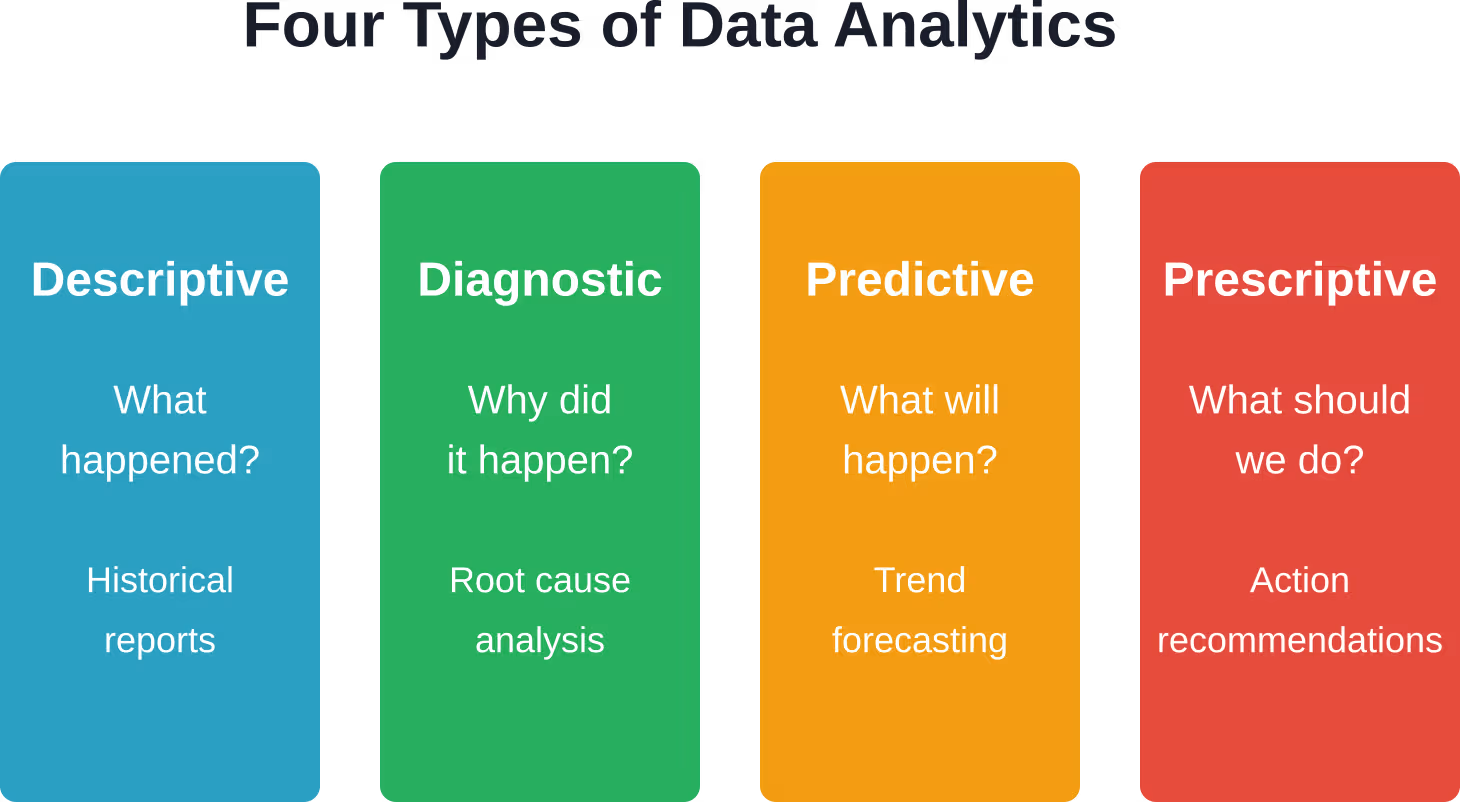
- Descriptive analytics summarizes what happened. Standard financial statements, dashboards showing last month’s expenses, aging reports—all descriptive.
- Diagnostic analytics explains why something happened. Variance analysis, ratio analysis, and drill-down reports that identify root causes fall here.
- Predictive analytics forecasts what will happen. Machine learning models that project next quarter’s cash flow, algorithms flagging invoices likely to go overdue, risk scoring for credit decisions.
- Prescriptive analytics recommends what to do about it. Optimization algorithms that suggest the best payment timing, scenario modeling for strategic decisions.
Most accounting work still sits in the descriptive category. The shift toward predictive and prescriptive analytics represents the profession’s evolution into strategic advisory.

Use Predictive Analytics in Accounting with AI Superior
AI Superior works with finance and accounting teams to build predictive models based on transactional and historical data. The goal is to support forecasting, anomaly detection, and financial planning.
They focus on models that fit into existing accounting systems and workflows.
Looking to Apply Predictive Analytics in Accounting?
AI Superior can help with:
- assessing financial data
- building predictive models
- integrating models into existing tools
- improving accuracy based on usage
👉 Contact AI Superior to discuss your project, data, and implementation approach
Core Use Cases for Predictive Analytics in Accounting
Cash Flow Forecasting
Cash flow problems kill businesses. Predictive analytics helps accountants forecast cash positions weeks or months ahead, identifying potential shortfalls early enough to act.
Models analyze historical payment patterns, seasonal trends, customer payment behavior, and economic indicators to project future cash positions. The result? Finance teams can secure credit lines before they’re desperately needed, optimize payment timing, and avoid liquidity crises.
Accounts Receivable Management
Predictive analytics in accounts receivable provides timely insights into risks and receivables that may constrain working capital. Algorithms score invoices by likelihood of late payment, enabling collections teams to prioritize follow-up.
Some models go further, predicting optimal dunning strategies for different customer segments. The impact on Days Sales Outstanding (DSO) can be significant—reducing the time cash sits in receivables directly improves working capital.
Risk Assessment and Fraud Detection
Anomaly detection algorithms scan transaction data for patterns inconsistent with normal behavior. Unusual vendor payments, atypical expense patterns, duplicate invoices—predictive models flag these for review before they become material losses.
The technology learns over time, adapting to new fraud patterns and reducing false positives as it accumulates more training data.
Budget Accuracy and Planning
Traditional budgeting relies heavily on last year’s numbers plus a growth assumption. Predictive modeling incorporates broader data sets: market conditions, competitive dynamics, operational metrics, even social media sentiment.
The result? Budgets that reflect realistic scenarios rather than wishful thinking, with probability ranges instead of false precision.
Data Sources That Power Predictive Models
Garbage in, garbage out applies doubly to predictive analytics. Models are only as good as the data feeding them.
| Data Source Category | Examples | What It Enables |
|---|---|---|
| Historical financial data | General ledger, trial balances, prior statements | Trend identification, seasonality patterns |
| Operational data | Sales transactions, inventory levels, production volumes | Revenue forecasting, cost predictions |
| Customer data | Payment history, credit scores, interaction records | Receivables forecasting, credit risk scoring |
| Market data | Economic indicators, industry benchmarks, competitor information | Strategic planning, scenario modeling |
| Non-financial data | Website traffic, social sentiment, employee metrics | Leading indicators for financial performance |
Common Predictive Modeling Techniques in Accounting
Several statistical and machine learning approaches power predictive analytics in accounting contexts.
- Regression models remain workhorses for financial forecasting. Linear regression, multiple regression, and polynomial variants project continuous outcomes like revenue or expenses based on predictor variables.
- Classification algorithms—logistic regression, decision trees, support vector machines—sort data into categories. Will this customer pay on time? Is this transaction potentially fraudulent?
- Time series methods like ARIMA (AutoRegressive Integrated Moving Average) excel at forecasting when temporal patterns matter. Monthly revenue, quarterly cash flow, seasonal inventory requirements.
- Machine learning ensembles combine multiple models for improved accuracy. Random forests aggregate hundreds of decision trees; gradient boosting machines iteratively refine predictions.
The choice depends on the question being asked, data characteristics, and interpretability requirements. Regulatory contexts often demand explainable models over black-box neural networks.
Implementing Predictive Analytics: Practical Considerations
Technology alone doesn’t deliver value. Successful implementation requires addressing data quality, organizational readiness, and change management.
Data Quality and Preparation
Models trained on flawed data produce flawed predictions. Data cleansing—removing duplicates, correcting errors, standardizing formats—consumes significant time in analytics projects.
Integration across systems matters too. Financial data lives in the ERP, customer data in CRM, operational data in various departmental systems. Consolidating these sources into an analytics-ready format requires both technical infrastructure and cross-functional coordination.
Skills and Competencies
IFAC notes that a strong finance and accounting background is no longer sufficient to become a value-add business partner over the long term. Building data science and analytics capabilities within finance teams has become critical.
This doesn’t mean every accountant needs a PhD in statistics. But finance teams do need some combination of: analytical thinking, statistical literacy, familiarity with analytics tools, and the ability to translate model outputs into business insights.
Many organizations address this through hybrid teams—pairing accountants who understand the business context with data scientists who build the models.
Technology Infrastructure
Cloud platforms like Google Cloud, Azure, and Amazon SageMaker provide infrastructure for building, training, and deploying predictive models without massive upfront capital investment.
Purpose-built solutions exist for specific accounting use cases. AI-powered tools like Vic.ai, Zeni, Docyt, Blue Dot, and Truewind automate accounting tasks and extract insights from large data sets using advanced machine learning algorithms.
The build-versus-buy decision depends on organizational capabilities, budget, and specific requirements. Off-the-shelf solutions offer faster time-to-value but less customization; custom models offer precision but require ongoing data science resources.
Challenges and Limitations
Predictive analytics isn’t a crystal ball. Models extrapolate from historical patterns—when fundamental conditions change, predictions fail.
The 2020 pandemic illustrated this vividly. Models trained on pre-pandemic data couldn’t anticipate lockdowns, supply chain disruptions, or shifting consumer behavior. Forecasts built in February 2020 were obsolete by March.
Other limitations:
- Data availability: Small organizations with limited historical data struggle to train robust models
- Model complexity: Sophisticated algorithms require technical expertise to implement and maintain
- Interpretability trade-offs: The most accurate models are often the least explainable
- Overfitting risks: Models that perform brilliantly on historical data but fail on new data
- Ethical considerations: Algorithmic bias, fairness concerns, regulatory compliance
Real talk: predictive analytics augments human judgment; it doesn’t replace it. The best outcomes combine model insights with contextual understanding and professional skepticism.
The Strategic Impact on the Accounting Profession
According to IFAC’s 2017 publication ‘Five Reasons Why the Finance Function Is Ready for Disruption,’ finance professionals must sharpen their technical and interpersonal competencies to address technological change in the profession.
But this disruption creates opportunity. As routine tasks automate, accountants shift from data entry and reconciliation toward analysis, strategy, and advisory work.
AICPA emphasizes that CPAs are in the perfect position to aggregate client data to better understand businesses and anticipate needs, delivering strategic insights beyond compliance.
Predictive analytics enables this transformation. Accountants equipped with these tools become strategic partners who help organizations navigate uncertainty, optimize performance, and plan for sustainable growth.
Frequently Asked Questions
What’s the difference between predictive analytics and forecasting?
Forecasting is one application of predictive analytics. Traditional forecasting often relies on simple trend extrapolation or judgmental estimates. Predictive analytics uses statistical models and machine learning to analyze multiple variables simultaneously, identifying complex patterns humans might miss. The result is typically more accurate, probability-weighted predictions.
Do small accounting firms need predictive analytics?
Scale matters less than you’d think. Cloud-based solutions and affordable software have democratized access to predictive tools. Even small firms can use receivables forecasting, cash flow modeling, or client risk scoring. The key is starting with focused use cases that address specific pain points rather than boiling the ocean.
How accurate are predictive models for accounting applications?
Accuracy varies widely based on data quality, model choice, and the specific application. Cash flow forecasts might achieve 85-95% accuracy for near-term predictions but degrade for longer horizons. Fraud detection models balance false positives against missed fraud. The question isn’t whether models are perfect—they’re not—but whether they improve on existing methods.
What skills do accountants need to work with predictive analytics?
Core competencies include statistical thinking, data literacy, critical evaluation of model outputs, and the ability to communicate insights to non-technical stakeholders. Deep programming skills help but aren’t always essential—many modern tools offer visual interfaces. Curiosity and willingness to learn matter more than current technical proficiency.
Can predictive analytics replace human judgment in accounting?
No. Models provide inputs for decisions but don’t make decisions themselves. Accounting requires professional judgment, ethical reasoning, and contextual understanding that algorithms can’t replicate. Predictive analytics is most powerful when it augments human expertise—freeing accountants from routine analysis so they can focus on interpretation, strategy, and client advisory.
How do regulatory requirements affect predictive analytics in accounting?
Regulations increasingly recognize machine-readable data. The SEC’s XBRL requirements created standardized financial data sets that enable analytics at scale. However, certain contexts—audits, regulatory filings, credit decisions—demand transparency and explainability. This sometimes limits the types of models that can be used, favoring interpretable approaches over black-box algorithms.
What’s the ROI timeline for implementing predictive analytics?
Quick wins—like automated cash flow forecasting or receivables risk scoring—can deliver value within weeks. Comprehensive implementations involving data integration, custom model development, and organizational change take months to years. Starting with focused pilots that demonstrate value helps build momentum and justify broader investment.
Moving Forward with Confidence
Predictive analytics represents more than a technological upgrade. It’s a fundamental shift in how accounting adds value—from recording history to shaping the future.
Organizations that embrace these capabilities gain measurable advantages: better cash management, proactive risk mitigation, more accurate planning, and strategic agility. Those that don’t risk falling behind as competitors leverage data for competitive advantage.
The barriers to entry continue falling. Cloud infrastructure, accessible software, and growing talent pools make predictive analytics feasible for organizations of all sizes.
Start small. Identify a specific pain point—late customer payments, cash flow uncertainty, budget inaccuracy. Pilot a focused solution. Learn from the results. Build capability iteratively rather than attempting a big-bang transformation.
The future of accounting isn’t just about what happened. It’s about what’s coming next, and what to do about it. Predictive analytics provides the tools to see around corners and act with confidence in an uncertain world.
 English
  German
  Arabic
  French
  Dutch
Dutch  Spanish